US Securities and Exchange Commission (SEC) Commissioner Hester Peirce has called for the protection of crypto privacy rights and open-source development ahead of the crucial verdict of the Tornado Cash co-founder’s trial.
In Defense Of Crypto Privacy, Developers
On Monday, SEC Commissioner Hester Peirce defended the crypto privacy sector, affirming that US authorities should welcome privacy-protecting technologies and safeguard individuals’ right to self-custody their digital assets.
At the Science of Blockchain Conference, the crypto-friendly commissioner stated that lawmakers and regulators must take concrete steps to protect individuals’ ability to transact privately and develop privacy software without fear of prosecution.
Peirce highlighted that a recent President’s Working Group recommended that American citizens and businesses should be able to own digital assets and use blockchain technologies for lawful purposes.
It also suggested that entrepreneurs and software developers should have the liberty and regulatory certainty to “upgrade all sectors of our economy using these technologies.”
Although a centralized intermediary or even a DAO deploying a DeFi application could build in restrictions on its use, an immutable, open-source protocol is available for anyone’s use in perpetuity, so requiring that it comply with financial surveillance measures is fruitless.
She noted that open-source privacy software developers shouldn’t be responsible for the actions of third parties using their software, citing SEC Chair Paul Atkins’ recent call for a regulatory path for developers to “unleash on-chain software systems that do not require operation by any central intermediary.”
In the Monday speech, Peirce also argued that regulators shouldn’t ask businesses to collect and report information on each other, as “doing so would deputize us to surveil our neighbors—a practice antithetical to a free society. Nor should we require an intermediary to step in the middle of peer-to-peer transactions.”
Notably, the US Department of the Treasury and the Internal Revenue Service (IRS) formally scrapped a controversial crypto rule in July that would have mandated decentralized exchanges to comply with broker reporting obligations.
The rule, originally proposed in November 2021 through the Infrastructure Investment and Jobs Act, aimed to close the “tax gap” by broadening the definition of “brokers” to include crypto exchanges and other intermediaries, while requiring DeFi platforms to report proceeds from digital asset transactions and detail user transaction information, including names and addresses.
Tornado Cash Verdict To Set Key Precedent
Commissioner Peirce’s remarks come ahead of the verdict of the Tornado Cash co-founder’s trial, which could set a negative precedent for open-source developers.
Many industry leaders have argued that trying to hold software developers criminally liable for how third parties use their code will set a terrible precedent and freeze technological innovation in the US.
For context, the US Department of the Treasury’s Office of Foreign Assets Control (OFAC) sanctioned crypto mixer Tornado Cash in August 2022 for “failing to impose effective controls” to prevent malicious actors from laundering funds through the protocol, including $455 million by North Korea’s Lazarus Group.
Following the sanctions, the protocol’s co-founder, Roman Storm, was detained in Washington in 2023 and charged with conspiracy to commit money laundering, conspiracy to commit sanctions violations, and conspiracy to operate an unlicensed money-transmitting business.
Storm pleaded not guilty to all charges and was freed on a $2 million bond to await his three-week trial, which started on July 14. If convicted, he could face up to 45 years in prison.
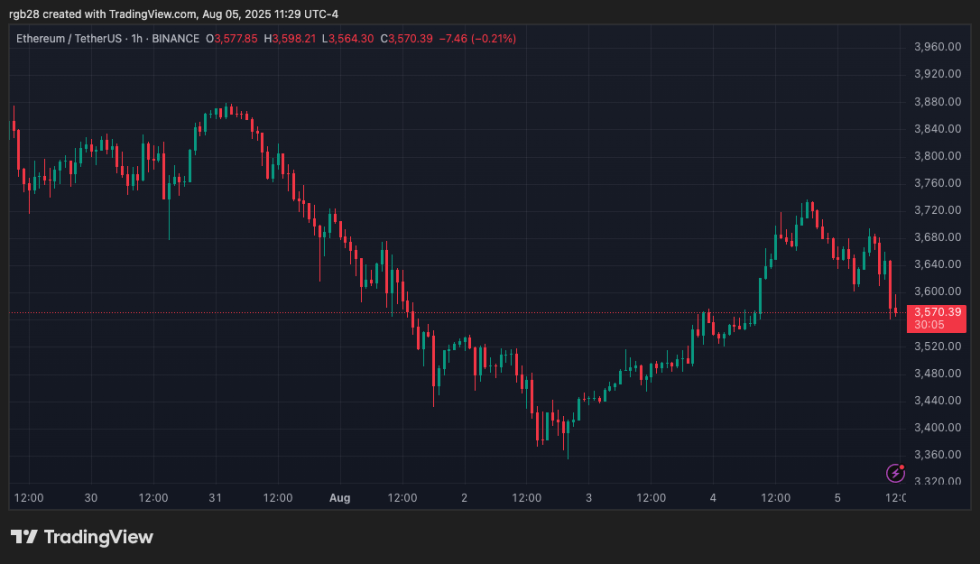
Ethereum (ETH) trades at $3,570 in the one-week chart. Source: ETHUSDT on TradingView

Related Posts