Crypto has come a long way, from niche internet money to a global investment asset. Digital currencies are more popular than ever. But if you look closer, there is still a major gap between what people hold and what people use.
Only very few crypto users spend their assets for everyday purchases. The rest are mostly just trading or keeping them on exchanges. Over 85% of global crypto activity still happens within centralized platforms, not at shops, in apps, or on payment terminals. That makes it hard for crypto to become a real part of daily life.
So, what is holding adoption back? First, many networks have high gas fees that make small payments expensive. Then there is the complex user experience, which makes it tough for beginners. Merchants are also reluctant because they worry about price swings and lack easy tools to accept crypto.
The world is moving quickly when it comes to digital payments, but crypto is falling behind. That is exactly where SpacePay comes in.
What Makes SpacePay Different from Other Crypto Payment Projects
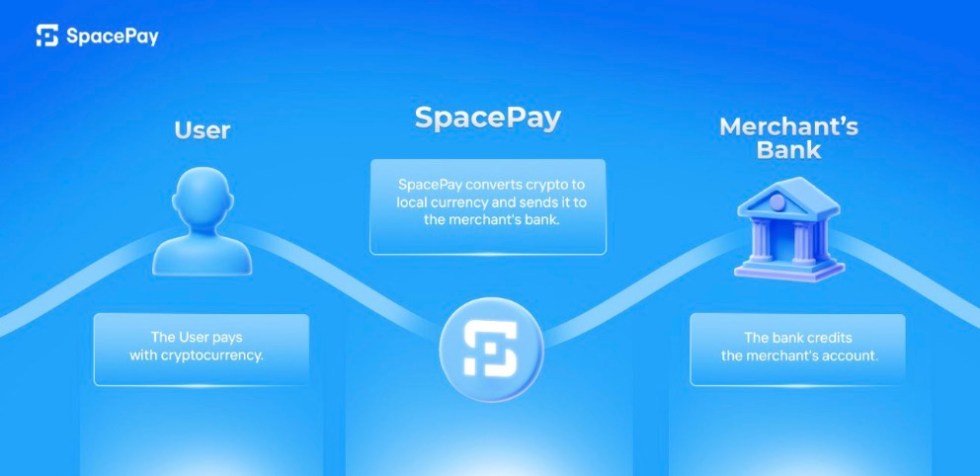
SpacePay is designed to make using crypto as easy as tapping a card. It lets you pay with coins like ETH, BTC, MATIC, and SPY, while the merchant receives the right value in stablecoins or fiat. That solves a huge problem: price volatility.
Merchants do not need to deal with sudden value changes. If someone pays $10 worth of crypto, the seller gets exactly $10 worth of their preferred fiat currency.
The platform is also easy to use. Sellers can install a plugin or use SpacePay’s point-of-sale tools without any coding or technical setup. It works just like a regular card reader, with the difference being that the customer can pay straight from their crypto wallet. SpacePay was built with global reach in mind from the beginning.
How SpacePay Fits Different Regions: Africa, Asia, and Europe
Africa: Solving Mobile Money Fragmentation
Africa is already leading the world in mobile money. In 2024, more than 1 billion mobile money accounts were registered in Sub-Saharan Africa only, which represents the majority of global users. Over 500 million active accounts were recorded across Africa.
For example, many people use apps like M-Pesa, OPay, and PalmPay in Nigeria, Kenya, and Ghana. However, these systems are separate and not suitable for international transactions.
SpacePay can act as a bridge across these tools. It allows people to use their crypto wallets like mobile banking apps, but with more flexibility.
Picture this: a designer in Lagos finishes a project for a UK client. The client sends ETH through SpacePay, and the designer can withdraw in naira without having to stress.
Asia: Enabling Cross-Border Merchant Use
Asia’s market is heavily focused on remittances and digital trade. Countries like the Philippines, Indonesia, and India have many freelancers and small businesses that need to get paid globally.
Some traditional payment methods may not allow international payments and can even be costly or hard to set up. SpacePay could also be the solution here with its instant settlements in local currencies. That means small sellers can avoid delays and cut down on costs.
In 2025, the Philippines ranked third in crypto usage per person worldwide. That shows how quickly crypto is spreading in the region. A Shopify seller in Vietnam could easily accept SOL through SpacePay, and the system automatically converts to local currency, allowing the business to continue as usual.
Europe: Providing an Alternative to Bank-Dominated Checkout
Europe’s challenge is different. It has all the infrastructure but is often tied up by overregulation. Some crypto-friendly businesses are shut out from services like Stripe, PayPal, or SEPA payments.
SpacePay could give them a fresh option. It offers a direct way to accept crypto with full control. Users do not have to wait for any bank approval to make transactions.

Take a café in Lisbon, for example; the owner can install SpacePay’s point-of-sale tool and accept payments in XRP or SPY, right from the customer’s wallet. The funds settle instantly and securely, without a third-party network.
If SpacePay captures just a small slice of the mobile money market in Africa, it would already be handling millions of transactions every month.
The same applies across Asia and Europe. If crypto freelancers, e-commerce stores, and retail merchants start using it, the network effect could grow fast.
It also helps that users do not need to go through long setups or identity checks. Just connect your wallet and you are good to go.
How to Join the SpacePay Presale Before the Next Price Increase
The SPY presale is ongoing, and it is more than a chance to buy a token. It is like getting early access to a future payment network. The earlier you get in, the more tokens you receive for the same amount.
To join the presale, visit the official SpacePay website and connect a compatible wallet. You can pay with ETH, BNB, MATIC, AVAX, USDT, USDC, or BASE. There is also a card payment option for those who prefer using fiat.
Once you confirm your transaction, your SPY tokens will be allocated. You will be able to claim them once the presale ends.
JOIN THE SPACEPAY (SPY) PRESALE NOW
Website | (X) Twitter | Telegram

Related Posts