Bitcoin Growth Rate Indicator Signals Bullish Continuation – Analyst

bitcoinistPublicado a 2025-07-20Actualizado a 2025-07-21

Resumen

Bitcoin has entered a consolidation phase after briefly pushing above the $120,000 level, marking a significant milestone in its ongoing...

Trusted Editorial content, reviewed by leading industry experts and seasoned editors. Ad Disclosure

Bitcoin has entered a consolidation phase after briefly pushing above the $120,000 level, marking a significant milestone in its ongoing bull cycle. Despite the temporary pause in upward momentum, bulls remain firmly in control as the broader landscape continues to improve. Global adoption is steadily accelerating, and in the US, the introduction of legal clarity—particularly through the GENIUS Act—is helping set the foundation for long-term growth in the crypto sector.

Top crypto analyst Darkfost recently shared insights suggesting that Bitcoin’s trend remains intact, with the growth rate indicator maintaining a bullish trajectory. This resilience comes after a period marked by volatility and market uncertainty, where clear direction was often hard to discern. According to Darkfost, the current environment offers a far more constructive setup, driven by improving macroeconomic clarity and institutional interest.

With Bitcoin now consolidating above a major psychological level, market participants are watching closely for the next leg of the move. Whether a breakout occurs in the near term or after a longer consolidation, sentiment remains largely optimistic. The strength of the trend and underlying fundamentals suggest that this is likely just another pause in a much broader uptrend for the digital asset.

Bitcoin Market Outlook: Growth Signal Holds As Macro Clarity Improves

According to Darkfost, the Bitcoin growth rate indicator—measured by comparing Bitcoin’s Market Cap to its Realized Cap—continues to signal that the bull market remains intact. This metric has proven reliable in identifying broad market trends, and its current momentum reflects continued strength. After months of volatility and a highly stressful market environment, the latest data suggest that the worst of that phase has passed, giving the market much-needed room to breathe.

Bitcoin Growth Rate Difference | Source: Darkfost on X

Darkfost notes that we are now transitioning from uncertainty to clarity. While the macroeconomic picture is not yet fully stable, there are growing signs of normalization. Market participants are closely watching the US Federal Reserve, as policymakers weigh further steps to regain control over inflation and restore market confidence. Although the process will take time, the foundation for long-term stability appears to be forming.

Geopolitically, trade tensions remain a variable. The impact of tariffs imposed under the Trump administration has not been fully absorbed, and this week brought new developments from Trump signaling a renewed push on trade policy. Yet, despite these pressures, risk appetite has returned.

BTC Price Analysis: Consolidation Range In Focus

The 12-hour chart shows that Bitcoin is currently consolidating just below the $120,000 mark after reaching a local high at $122,077.61. The price is holding within a defined range between this high and support around $115,724.12. So far, bulls have defended the $115K zone well, signaling continued strength despite a slowdown in upward momentum.
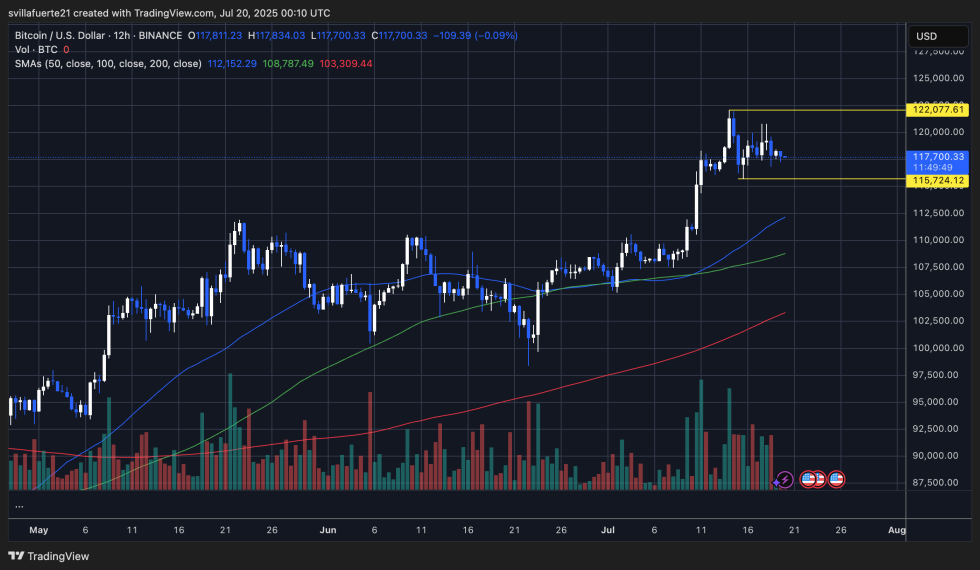
BTC consolidates in a range | Source: BTCUSDT chart on TradingView

The moving averages are in bullish alignment: the 50 SMA is trending above the 100 and 200 SMAs, with the 50 SMA currently at $112,152.29 and climbing. This structure supports the view that the broader uptrend remains intact. However, the lack of volume spikes during this phase suggests the current consolidation may persist before the next breakout attempt.

If Bitcoin holds above $115,700 and breaks above $122,000 with strong confirmation, we could see a renewed push toward uncharted territory. On the other hand, a breakdown below $115,700 could lead to a deeper retracement toward the 50 SMA or even the $110K region.

Featured image from Dall-E, chart from TradingView

Editorial Process for bitcoinist is centered on delivering thoroughly researched, accurate, and unbiased content. We uphold strict sourcing standards, and each page undergoes diligent review by our team of top technology experts and seasoned editors. This process ensures the integrity, relevance, and value of our content for our readers.

Sebastian's journey into the world of crypto began four years ago, driven by a fascination with the potential of blockchain technology to revolutionize financial systems. His initial exploration focused on understanding the intricacies of various crypto projects, particularly those focused on building innovative financial solutions. Through countless hours of research and learning, Sebastian developed a deep understanding of the underlying technologies, market dynamics, and potential applications of cryptocurrencies. As his knowledge grew, Sebastian felt compelled to share his insights with others. He began actively contributing to online discussions on platforms like X and LinkedIn, focusing on fintech and crypto-related content. His goal was to expose valuable trends and insights to a wider audience, fostering a deeper understanding of the rapidly evolving crypto landscape. Sebastian's contributions quickly gained recognition, and he became a trusted voice in the online crypto community. To further enhance his expertise, Sebastian pursued a UC Berkeley Fintech: Frameworks, Applications, and Strategies certification. This rigorous program equipped him with valuable skills and knowledge regarding Financial Technology, bridging the gap between traditional finance (TradFi) and decentralized finance (DeFi). The certification deepened his understanding of the broader financial landscape and its intersection with blockchain technology. Sebastian's passion for finance and writing is evident in his work. He enjoys delving into financial research, analyzing market trends, and exploring the latest developments in the crypto space. In his spare time, Sebastian can often be found immersed in charts, studying 10-K forms, or engaging in thought-provoking discussions about the future of finance. Sebastian's journey as a crypto analyst and investor has been marked by a relentless pursuit of knowledge and a dedication to sharing his insights. His ability to navigate the complex world of crypto, combined with his passion for financial research and communication, makes him a valuable asset to the industry. As the crypto landscape continues to evolve, Sebastian remains at the forefront, providing valuable insights and contributing to the growth of this revolutionary technology.

Lecturas Relacionadas

El último artículo de Fei-Fei Li: Cuando la generación de vídeo, la robótica y NVIDIA se autodenominan modelos del mundo, necesitamos una taxonomía

El artículo de Fei-Fei Li clarifica el término "modelo del mundo", utilizado de manera confusa en IA, proponiendo una taxonomía basada en el ciclo POMDP (Proceso de Decisión de Markov Parcialmente Observable). Identifica tres categorías funcionales: 1) **Renderizador**: genera observaciones (píxeles) visualmente fieles para humanos, como los modelos de video Sora o Genie, pero sin comprensión física precisa. 2) **Simulador**: produce estados del mundo con precisión geométrica, física y dinámica, sirviendo tanto para visualización profesional como para entrenamiento de agentes (robots, vehículos autónomos). 3) **Planificador**: deduce acciones a partir de observaciones y objetivos, cerrando el ciclo percepción-acción, como los modelos de lenguaje-visión-acción (VLA). El artículo argumenta que el simulador es el componente clave y subestimado, pues proporciona la base estructural para la renderización y la planificación. Mientras los renderizadores tienen madurez comercial pero limitaciones físicas, y los planificadores son prometedores pero inmaduros para despliegues reales, los simuladores abarcan aplicaciones cruciales en robótica, diseño y digitalización. La tendencia actual es la fusión de estas categorías, impulsada por la idea de que comparten conocimiento subyacente. Modelos como Marble de World Labs ejemplifican esta convergencia, generando tanto representaciones visuales (splats gaussianos) como mallas para simulación física. La visión final es un **modelo del mundo unificado** capaz de alternar entre renderizar, simular y planificar según la necesidad, avanzando hacia una inteligencia espacial que permita a las máquinas entender e interactuar con el mundo físico.

marsbitHace 6 hora(s)

El último artículo de Fei-Fei Li: Cuando la generación de vídeo, la robótica y NVIDIA se autodenominan modelos del mundo, necesitamos una taxonomía

marsbitHace 6 hora(s)

Trading

Spot
活动图片