Dogecoin Price Retests 100 SMA Again – Here’s What It Means For Price

bitcoinistPublicado a 2025-06-23Actualizado a 2025-06-23

Resumen

After a turbulent price action over the weekend that saw Dogecoin briefly dip below $0.15, the meme-inspired cryptocurrency is now...

Trusted Editorial content, reviewed by leading industry experts and seasoned editors. Ad Disclosure

After a turbulent price action over the weekend that saw Dogecoin briefly dip below $0.15, the meme-inspired cryptocurrency is now back again to testing an important technical level. Particularly, DOGE is now revisiting the 100-week Simple Moving Average (SMA), which has served as a strong support line for more than a year on the weekly candlestick timeframe, raising questions about what might unfold next for its price movement.

Dogecoin Revisits Familiar Support Line

Dogecoin’s recent extended price decline saw it break below $0.15 very briefly in the past 24 hours. Notably, Dogecoin slipped below $0.16 on Saturday for the first time since April, extending a downtrend that’s seen its price fall about 36% in the past 30 days. Over the weekend, DOGE’s price dropped to around $0.143 before rebounding to approximately $0.153 behind heavy trading volume of over five times the recent daily average. 

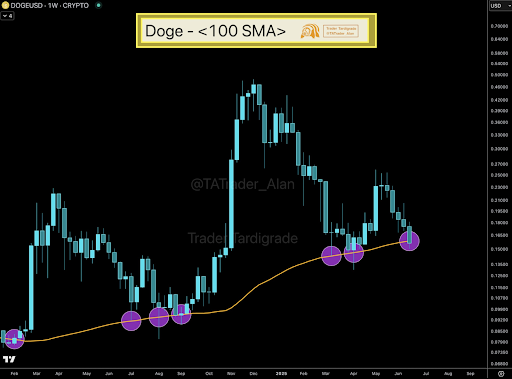
Interestingly, this downward price action has seen DOGE now retesting a technical indicator that has had an important hand in its price action over the past year. This phenomenon was first noted on the social media platform X by crypto analyst Trader Tardigrade.
Dogecoin
Source: Trader Tardigrade on X

The chart shared by the crypto analyst on X captures an important pattern. DOGE’s weekly candles have repeatedly bounced off the 100 SMA over the past year, which has made it a vital technical floor for the meme coin. Each time Dogecoin’s price approached or dipped slightly below this moving average, it quickly recovered and went on uptrends.

Dogecoin’s brief plunge to around $0.143, its lowest point since early April, before rebounding above $0.15, has now placed interest with the 100 SMA, which could serve as a launchpad once again if bullish sentiment seeps in.

DOGE Price Zones To Watch

Right now, the important thing is whether Dogecoin can maintain its footing above the $0.145 to $0.151 support zone. The quick rebound following the weekend’s drop below $0.15 shows that buyers are still stepping in at this level. However, any signs of weakness could invalidate the bullish outlook of a bounce off the 100 SMA.

On the upside, reclaiming the $0.153 to $0.16 resistance range with volume confirmation would lend credibility to the idea that Dogecoin is ready for another rally from the 100 SMA. If that happens, price history shows Dogecoin could mirror previous reactions off this moving average and set up a rebound to a resistance level between $0.19 and $0.21. If the current retest leads to another successful bounce, a projection of the most recent bounce shows a move to at least $0.3 could be next.

At the time of writing, Dogecoin is trading at $0.1547, down by 2% in the past 24 hours.

Dogecoin
DOGE trading at $0.15 on the 1D chart | Source: DOGEUSDT on Tradingview.com
Featured image from Getty Images, chart from Tradingview.com
Editorial Process for bitcoinist is centered on delivering thoroughly researched, accurate, and unbiased content. We uphold strict sourcing standards, and each page undergoes diligent review by our team of top technology experts and seasoned editors. This process ensures the integrity, relevance, and value of our content for our readers.

Scott Matherson is a leading crypto writer at Bitcoinist, who possesses a sharp analytical mind and a deep understanding of the digital currency landscape. Scott has earned a reputation for delivering thought-provoking and well-researched articles that resonate with both newcomers and seasoned crypto enthusiasts. Outside of his writing, Scott is passionate about promoting crypto literacy and often works to educate the public on the potential of blockchain.

Lecturas Relacionadas

El primer gran éxito de Robinhood Chain fue un meme de gato: los inversores minoristas descubren 'CashCat', el nombre antiguo, y el CEO se suma a la broma

**Resumen: El primer fenómeno en Robinhood Chain es un meme de un gato** La red principal de Robinhood Chain, una Layer 2 de Ethereum centrada en la tokenización de acciones, se lanzó el 1 de julio. Contrariamente a la narrativa oficial de activos del mundo real (RWA), el primer activo en ganar popularidad masiva fue el token meme **CASHCAT**. Este token experimentó un aumento de más del 1700% en 24 horas, alcanzando una capitalización de mercado superior a 120 millones de dólares. Su narrativa se basa en una anécdota histórica verificable: el CEO de Robinhood, Vlad Tenev, reveló que el nombre de trabajo inicial de la empresa era "CashCat". El 8 de julio, durante el pico de precios, Tenev publicó un tuit diciendo que la cadena era "también buena para memes", lo que la comunidad interpretó como un guiño tácito, impulsando aún más el frenesí. Sin embargo, el proyecto aclara no tener afiliación oficial con Robinhood. La rápida aparición de tokens homónimos en otras cadenas (como Solana) y cuentas falsas que suplantan a influencers como "Roaring Kitty" para promover direcciones de contratos fraudulentas, subrayan los altos riesgos especulativos y de estafa en este entorno. La liquidez es limitada y la volatilidad extrema. El valor de CASHCAT reside únicamente en la atención y una historia curiosa, sin mecanismos fundamentales de retención de valor.

marsbitHace 8 min(s)

El primer gran éxito de Robinhood Chain fue un meme de gato: los inversores minoristas descubren 'CashCat', el nombre antiguo, y el CEO se suma a la broma

marsbitHace 8 min(s)

La regulación de las criptomonedas podría cambiar este mes a medida que la SEC avanza con la propuesta de Safe Harbor

La Comisión del Mercado de Valores de EE. UU. (SEC) podría proponer su esperada normativa cripto, denominada "Regulation Crypto", ya este mes, marcando un cambio significativo en la política de activos digitales. La propuesta, bajo el liderazgo del presidente Paul Atkins, representa un alejamiento de la dependencia previa en acciones de ejecución hacia un proceso formal de elaboración de normas, buscando mayor claridad regulatoria para la industria. El proyecto establecería puertos seguros y exenciones para ciertas actividades en cadena, como las finanzas descentralizadas (DeFi) y valores tokenizados. Por ejemplo, las startups elegibles podrían ser aquellas valoradas en menos de 5 millones de dólares en sus primeros cuatro años, y los emprendedores podrían recaudar hasta 75 millones mediante contratos de inversión cripto calificados. Un token dejaría de tratarse como valor una vez que los desarrolladores ya no sean la fuerza impulsora del proyecto y hayan completado el trabajo prometido. Mientras tanto, los partidarios de la Ley CLARITY argumentan que la normativa de la agencia por sí sola no puede proporcionar la certeza a largo plazo que requiere la industria. Si esta ley no se aprueba antes de agosto de 2026, es improbable que se convierta en ley ese año, dejando la normativa de la SEC como el marco principal para los mercados cripto estadounidenses.

TheNewsCryptoHace 20 min(s)

La regulación de las criptomonedas podría cambiar este mes a medida que la SEC avanza con la propuesta de Safe Harbor

TheNewsCryptoHace 20 min(s)

Trading

Spot
活动图片