Ripple ‘Making Up For Lost Time’ After SEC Battle, Says Lawyer

bitcoinistPublicado a 2025-04-28Actualizado a 2025-04-29

Resumen

Ripple’s aggressive expansion strategy following its prolonged legal battle with the US Securities and Exchange Commission (SEC) is being interpreted...

Trusted Editorial content, reviewed by leading industry experts and seasoned editors. Ad Disclosure

Ripple’s aggressive expansion strategy following its prolonged legal battle with the US Securities and Exchange Commission (SEC) is being interpreted as a decisive bid to regain lost momentum. Pro-XRP attorney John E Deaton, a prominent figure within the XRP community, commented via X, stating, “I agree with Chamath [Palihapitiya]. I also believe Ripple’s $1.25 billion acquisition of Hidden Road as possibly the best example of the convergence of TradFi and DeFi in all of crypto.”

Ripple Rebounds After SEC Battle

Hidden Road, a prime brokerage firm processing over $3 trillion annually across more than 300 institutional clients, is now incorporating the XRP Ledger (XRPL) for post-trade settlement processes. This integration is expected to result in a radical compression of settlement times, reducing the traditional 24-hour window to a rapid 3–5 seconds. The recently launched RLUSD stablecoin will act as collateral in this system, effectively bridging digital assets with traditional financial (TradFi) infrastructures.

Deaton emphasized the significance of the move, explaining that the acquisition “integrates blockchain infrastructure into institutional trading, merging DeFi’s efficiency with TradFi’s scale and client base, positioning Ripple as a leading pioneer in institutional DeFi.”

The strategic importance of custody services also features heavily in the post-litigation roadmap. Deaton pointed out that Ripple’s expansion into custody solutions — particularly through the acquisitions of Metaco and Standard Custody — is a deliberate maneuver. “There is a very specific reason Ripple now offers ‘Ripple Custody,’” he noted. “By offering custody alongside payments and stablecoin solutions, Ripple becomes a one-stop shop for financial institutions integrating blockchain technology.”

The decision to prioritize custody is underpinned by market projections. According to Boston Consulting Group, the digital asset custody market is expected to exceed $16 trillion in assets by 2030. Deaton implied that this forecast may have motivated the rapid moves in the space.

According to Deaton, the firm’s broader vision appears to be oriented towards establishing the XRP Ledger as a foundational platform for tokenization services. The lawyer outlined that Ripple is positioning itself to offer tokenization-as-a-service, enabling banks to tokenize traditional assets such as stocks, bonds, and real estate. The RLUSD stablecoin is expected to serve a central role in facilitating these tokenized transactions on the XRPL.

“It’s pretty clear that Ripple aims to leverage its custody infrastructure for tokenization-as-a-service, enabling banks to tokenize traditional assets like stocks, bonds, or real estate on the XRPL with RLUSD playing a pivotal role in supporting these transactions, positioning the XRPL as a global hub for tokenized assets,” Deaton wrote.
Summing up the broader implications of Ripple’s recent activity, Deaton concluded, “Looks to me that Brad Garlinghouse is making up for lost time after being slowed down by the SEC lawsuit.”

At press time, XRP traded at $2.31.
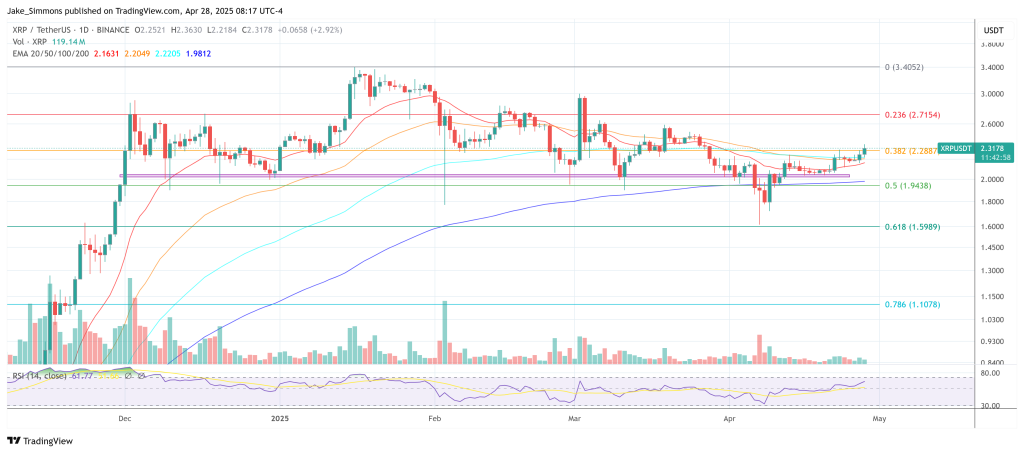
XRP price
XRP breaks above the 0.382 Fib, 1-day chart | Source: XRPUSDT on TradingView.com
Featured image created with DALL.E, chart from TradingView.com
Editorial Process for bitcoinist is centered on delivering thoroughly researched, accurate, and unbiased content. We uphold strict sourcing standards, and each page undergoes diligent review by our team of top technology experts and seasoned editors. This process ensures the integrity, relevance, and value of our content for our readers.

Jake Simmons has been a Bitcoin enthusiast since 2016. Ever since he heard about Bitcoin, he has been studying the topic every day and trying to share his knowledge with others. His goal is to contribute to Bitcoin's financial revolution, which will replace the fiat money system. Besides BTC and crypto, Jake studied Business Informatics at a university. After graduation in 2017, he has been working in the blockchain and crypto sector. You can follow Jake on Twitter at @realJakeSimmons.

Lecturas Relacionadas

Ethereum y Bitcoin enfrentan una compresión de oferta histórica: estas 2 métricas revelan qué sigue

A pesar de meses de volatilidad en el mercado, los tenedores de Ethereum y Bitcoin siguen mostrando poco interés en devolver sus monedas a los exchanges. Las retiradas persistentes continúan reduciendo la oferta líquida disponible. En el momento de publicación, la cantidad de Bitcoin almacenada en exchanges está en su nivel más bajo desde 2017, y la de Ethereum en su mínimo desde 2015. Los flujos netos negativos indican que los inversores institucionales y a largo plazo prefieren custodiar sus monedas en ETFs o tesorerías corporativas, lo que reduce la presión de venta a corto plazo y crea escasez. Si la demanda se recupera, esta oferta limitada podría amplificar el descubrimiento de precios. Detrás de esto, los tenedores a largo plazo de Bitcoin están absorbiendo la oferta circulante, reflejando una creciente convicción. El cambio neto de su posición ha vuelto a ser positivo, confirmando una nueva acumulación. Las "HODL Waves" y el aumento de la oferta ilíquida muestran que las monedas más antiguas permanecen inactivas. La oferta en manos de tenedores a largo plazo se acerca a los 15 millones de BTC, mientras que la de los tenedores a corto plazo ha disminuido, sugiriendo una transferencia hacia manos más fuertes. Sin embargo, el mero ajuste de la oferta puede no sostener la recuperación de Bitcoin. Una tendencia alcista duradera aún requeriría una demanda de compra más fuerte para absorber la liquidez disponible. Sin ese apoyo, Bitcoin podría tener dificultades para mantener el impulso a pesar de los saldos en exchanges cada vez más escasos.

ambcryptoHace 3 hora(s)

Ethereum y Bitcoin enfrentan una compresión de oferta histórica: estas 2 métricas revelan qué sigue

ambcryptoHace 3 hora(s)

AxBlade × AWS Hong Kong Summit Concluye: Definiendo la Responsabilidad para la IA Física

AxBlade, la capa de rendición de cuentas para IA autónoma, coorganizó el evento exclusivo "De la IA Agente a la IA Física: ¿Qué se financia después de la ola de modelos?" junto con el AWS Summit Hong Kong Week. La reunión, dirigida a invitados, reunió a más de 100 fundadores, investigadores, líderes empresariales e inversores para examinar la brecha crítica de infraestructura entre las demostraciones de IA y su implementación en el mundo real. El evento destacó el consenso de que la IA Física no puede pasar del laboratorio a la producción sin identidad verificable, ejecución confiable y registros de comportamiento criptográficamente comprobables. Tres paneles exploraron el cambio del financiamiento de modelos hacia infraestructura, los desafíos de responsabilidad y seguridad cuando los agentes de IA interactúan con sistemas físicos, y la necesidad de middleware para la adopción empresarial, enfatizando la auditabilidad. Como única capa de infraestructura nativa de blockchain representada, AxBlade demostró cómo su blockchain pública Layer 2, que combina Identidad Descentralizada (DID), Entornos de Ejecución Confiables (TEE) y Prueba de Comportamiento de Conocimiento Cero (PoB), aborda directamente esta brecha de responsabilidad. "No estamos construyendo modelos de IA. Estamos construyendo la infraestructura de confianza que los hace auditables", afirmó Nick Hau, fundador de AxBlade. El evento incluyó sesiones de networking y una cena privada, con participación de instituciones como AWS, NVIDIA, Y Combinator, Roche, Pfizer y la City University de Hong Kong.

TheNewsCryptoHace 4 hora(s)

AxBlade × AWS Hong Kong Summit Concluye: Definiendo la Responsabilidad para la IA Física

TheNewsCryptoHace 4 hora(s)

Trading

Spot
活动图片