Bitcoin Price Falters: Why Has The 5th Wave Been Elusive Below $100,000?

bitcoinistPublicado a 2025-04-28Actualizado a 2025-04-28

Resumen

Bitcoin’s recent surge above $94,000 has brought a wave of bullish momentum across the crypto market. However, this rally has...

Trusted Editorial content, reviewed by leading industry experts and seasoned editors. Ad Disclosure

Bitcoin’s recent surge above $94,000 has brought a wave of bullish momentum across the crypto market. However, this rally has yet to gain real traction beyond $95,000. This elusive behavior is part of a wider trend that has seen the anticipated Bitcoin’s 5th wave breakout above $100,000 remain elusive.

Bitcoin’s 5th Wave Appears To Be Stretching

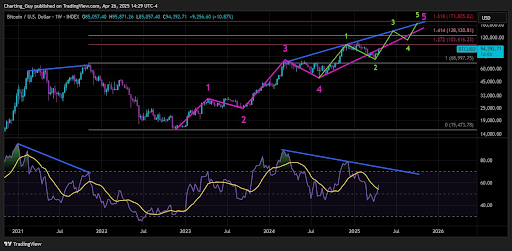
The weekly Bitcoin chart highlights a classic impulsive sequence following Elliott Wave Theory, but it is becoming increasingly clear that the 5th wave has not unfolded in a straight line. As shown in the chart below, Bitcoin entered into a 5th wave formation in the middle of 2024, right when it began its initial rally towards the $100,000 level. This 5th wave formation is the last of a series of Elliott waves that goes back as far as late 2022. 

However, the structure points toward an extended 5th wave, a phenomenon where the final upward leg stretches longer than typical, and is filled with its own sub-impulse waves. This has caused the BTC price to continue trading below $100,000.

Interestingly, Bitcoin is currently playing out its 3rd sub-impulse wave. If this extended wave plays out fully, it could line up with the traditional four-year Bitcoin cycle with a peak above $170,000. According to a crypto analyst that goes by the pseudonymous name Charting Guy on social media platform X, this could lead to major altcoin rallies in its latter stages.
Bitoin
Source: Charting Guy on X

Multiple Price Targets Offer Clues About BTC’s Path Forward

Aside from the extended 5th wave scenario, the analyst laid out other projections for Bitcoin. The $95,000 price level has been met as a target for a relief rally with Bitcoin’s latest breakout. However, surpassing this level is going to be important in maintaining bullish momentum.

The next targets outlined by the analyst include a potential double top forming around $109,000 and a bullish Fibonacci extension move toward $128,000, corresponding to the 1.414 Fibonacci level. Above that, a continued rally could push BTC toward the 1.618 Fibonacci extension near $173,000, although this upper target is more of an optimistic long-term projection at the peak of the extended 5th wave.

Despite the impressive surge in price, momentum indicators are offering a more cautious backdrop. The Relative Strength Index (RSI) on the weekly timeframe exhibits a pattern of lower highs, which may indicate a bearish divergence.

This divergence typically signals weakening internal strength within the uptrend, even though the price is making new highs. It does not invalidate the possibility of higher prices, but it increases the likelihood of corrective phases along the way, which is typical of the extended 5th wave.

At the time of writing, BTC is trading at $94,686. On-chain data shows an impending supply squeeze due to the ongoing wave of Bitcoin outflows from crypto exchanges.

Bitcoin
BTC trading at $94,736 on the 1D chart | Source: BTCUSDT on Tradingview.com
Featured image from Pixabay, chart from Tradingview.com
Editorial Process for bitcoinist is centered on delivering thoroughly researched, accurate, and unbiased content. We uphold strict sourcing standards, and each page undergoes diligent review by our team of top technology experts and seasoned editors. This process ensures the integrity, relevance, and value of our content for our readers.

Scott Matherson is a leading crypto writer at Bitcoinist, who possesses a sharp analytical mind and a deep understanding of the digital currency landscape. Scott has earned a reputation for delivering thought-provoking and well-researched articles that resonate with both newcomers and seasoned crypto enthusiasts. Outside of his writing, Scott is passionate about promoting crypto literacy and often works to educate the public on the potential of blockchain.

Lecturas Relacionadas

Ethereum y Bitcoin enfrentan una compresión de oferta histórica: estas 2 métricas revelan qué sigue

A pesar de meses de volatilidad en el mercado, los tenedores de Ethereum y Bitcoin siguen mostrando poco interés en devolver sus monedas a los exchanges. Las retiradas persistentes continúan reduciendo la oferta líquida disponible. En el momento de publicación, la cantidad de Bitcoin almacenada en exchanges está en su nivel más bajo desde 2017, y la de Ethereum en su mínimo desde 2015. Los flujos netos negativos indican que los inversores institucionales y a largo plazo prefieren custodiar sus monedas en ETFs o tesorerías corporativas, lo que reduce la presión de venta a corto plazo y crea escasez. Si la demanda se recupera, esta oferta limitada podría amplificar el descubrimiento de precios. Detrás de esto, los tenedores a largo plazo de Bitcoin están absorbiendo la oferta circulante, reflejando una creciente convicción. El cambio neto de su posición ha vuelto a ser positivo, confirmando una nueva acumulación. Las "HODL Waves" y el aumento de la oferta ilíquida muestran que las monedas más antiguas permanecen inactivas. La oferta en manos de tenedores a largo plazo se acerca a los 15 millones de BTC, mientras que la de los tenedores a corto plazo ha disminuido, sugiriendo una transferencia hacia manos más fuertes. Sin embargo, el mero ajuste de la oferta puede no sostener la recuperación de Bitcoin. Una tendencia alcista duradera aún requeriría una demanda de compra más fuerte para absorber la liquidez disponible. Sin ese apoyo, Bitcoin podría tener dificultades para mantener el impulso a pesar de los saldos en exchanges cada vez más escasos.

ambcryptoHace 2 hora(s)

Ethereum y Bitcoin enfrentan una compresión de oferta histórica: estas 2 métricas revelan qué sigue

ambcryptoHace 2 hora(s)

AxBlade × AWS Hong Kong Summit Concluye: Definiendo la Responsabilidad para la IA Física

AxBlade, la capa de rendición de cuentas para IA autónoma, coorganizó el evento exclusivo "De la IA Agente a la IA Física: ¿Qué se financia después de la ola de modelos?" junto con el AWS Summit Hong Kong Week. La reunión, dirigida a invitados, reunió a más de 100 fundadores, investigadores, líderes empresariales e inversores para examinar la brecha crítica de infraestructura entre las demostraciones de IA y su implementación en el mundo real. El evento destacó el consenso de que la IA Física no puede pasar del laboratorio a la producción sin identidad verificable, ejecución confiable y registros de comportamiento criptográficamente comprobables. Tres paneles exploraron el cambio del financiamiento de modelos hacia infraestructura, los desafíos de responsabilidad y seguridad cuando los agentes de IA interactúan con sistemas físicos, y la necesidad de middleware para la adopción empresarial, enfatizando la auditabilidad. Como única capa de infraestructura nativa de blockchain representada, AxBlade demostró cómo su blockchain pública Layer 2, que combina Identidad Descentralizada (DID), Entornos de Ejecución Confiables (TEE) y Prueba de Comportamiento de Conocimiento Cero (PoB), aborda directamente esta brecha de responsabilidad. "No estamos construyendo modelos de IA. Estamos construyendo la infraestructura de confianza que los hace auditables", afirmó Nick Hau, fundador de AxBlade. El evento incluyó sesiones de networking y una cena privada, con participación de instituciones como AWS, NVIDIA, Y Combinator, Roche, Pfizer y la City University de Hong Kong.

TheNewsCryptoHace 3 hora(s)

AxBlade × AWS Hong Kong Summit Concluye: Definiendo la Responsabilidad para la IA Física

TheNewsCryptoHace 3 hora(s)

Trading

Spot
活动图片