Anew project joins their ranks today, which is the NFT marketplace Blur with its new governance token, $BLUR.
There’s a ton of activity surging around $BLUR right now, so let’s get you up to speed on all the basics here!
The $BLUR airdrop is finally here
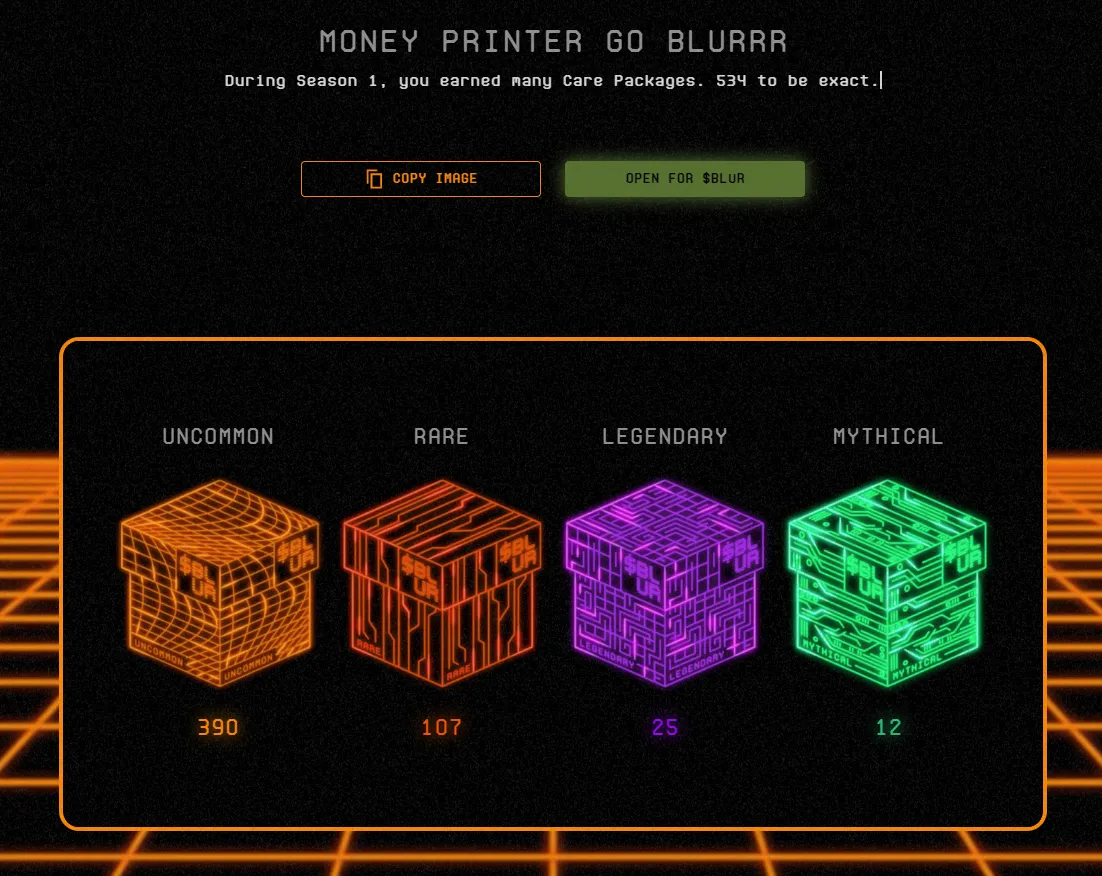
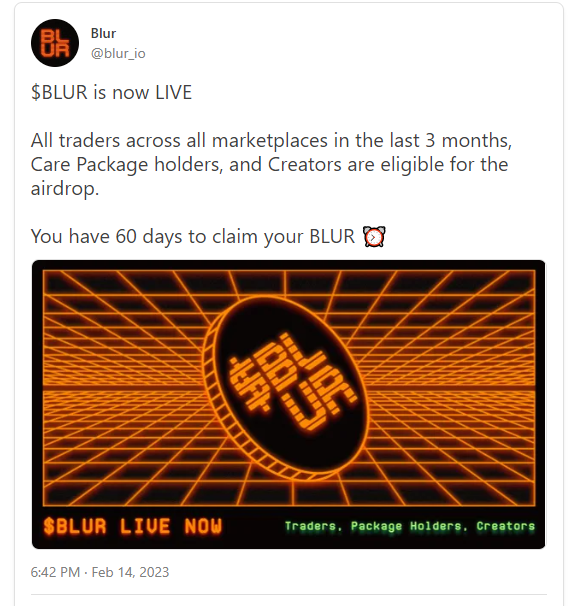
Blur, the NFT marketplace aggregator that’s been rivaling OpenSea as of late, launched claims for its highly anticipated $BLUR airdrop today, Tuesday, February 14th.
Why it matters: Blur’s $BLUR launch is a strategy to actualize decentralized governance for its marketplace, and it’s also a tactic to attract market share from rivals like OpenSea. The airdrop is the largest the NFT ecosystem has seen since early last year, and it’s causing a renewed surge of attention and activity around NFTs accordingly.
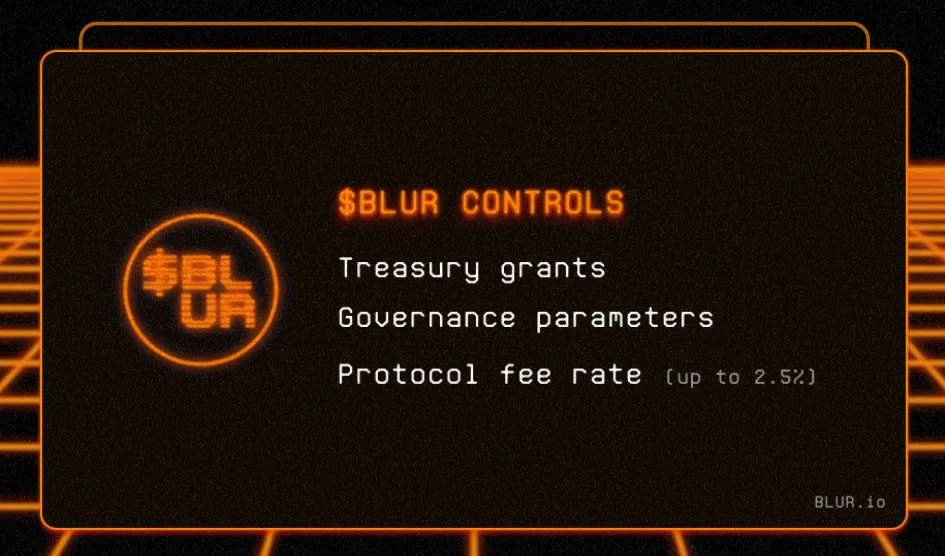
Key addresses: There have been some fake $BLUR addresses floating around attempting to capitalize on the airdrop excitement. These will fade in visibility now that the real $BLUR token is live and on center stage, but regardless in these early days make sure you’re using and reviewing the authoritative smart contracts.
- $BLUR token address: 0x5283D291DBCF85356A21bA090E6db59121208b44
- Airdrop smart contract: 0xf2d15c0a89428c9251d71a0e29b39ff1e86bce25
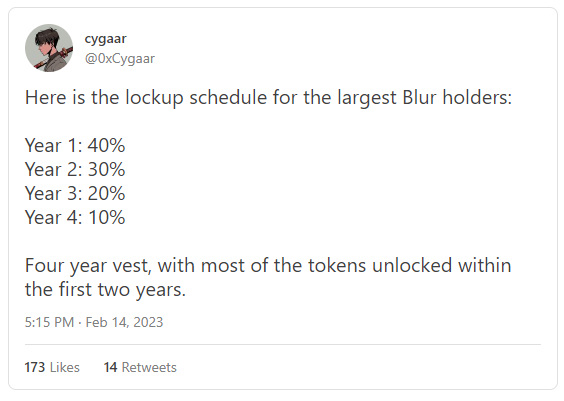
Tokenomics: The total supply of $BLUR is 3 billion tokens. The amount of airdrop tokens Blur just released to its community for claiming was 360 million $BLUR, or 12% of the total supply. 78% of the supply has been delivered to two of the team’s lockup smart contracts, while 9% of the remaining tokens will be controlled by a Blur multi-sig wallet. The team vesting will occur along this four-year schedule:
How to claim: Go to blur.io and click on the “Airdrop” tab. Click and wait through the intro animations and Blur Season 1 stats and then open any Care Packages you have to claim (US users are geoblocked). You’ll have to send out a “I claimed $BLUR…” verification tweet to finalize your claim and then complete a transaction to receive the $BLUR in your wallet.
Airdrop activity has made ETH gas prices surge at the time of this post’s writing, so feel free to claim your $BLUR later once gas calms down. You’ll have 60 days to complete your claim.
Current price action: $BLUR’s initial price discovery on Uniswap this morning put it higher than $3 USD a pop, but huge immediate sell pressure pushed that price back down as low as $0.49 before it steadily began rebounding up once more. At press time, $BLUR was back trading around the $0.70 mark. Only time will tell what happens next though if previous NFT airdrops like $LOOKS and $X2Y2 are any indication, the $BLUR price may top out over the next 72 hours, at least for its first market cycle.
Season 2 rewards: Many have speculated whether Blur would continue token incentives post-airdrop, and now such rewards have been confirmed as Blur has announced the arrival of its “Season 2” incentives.
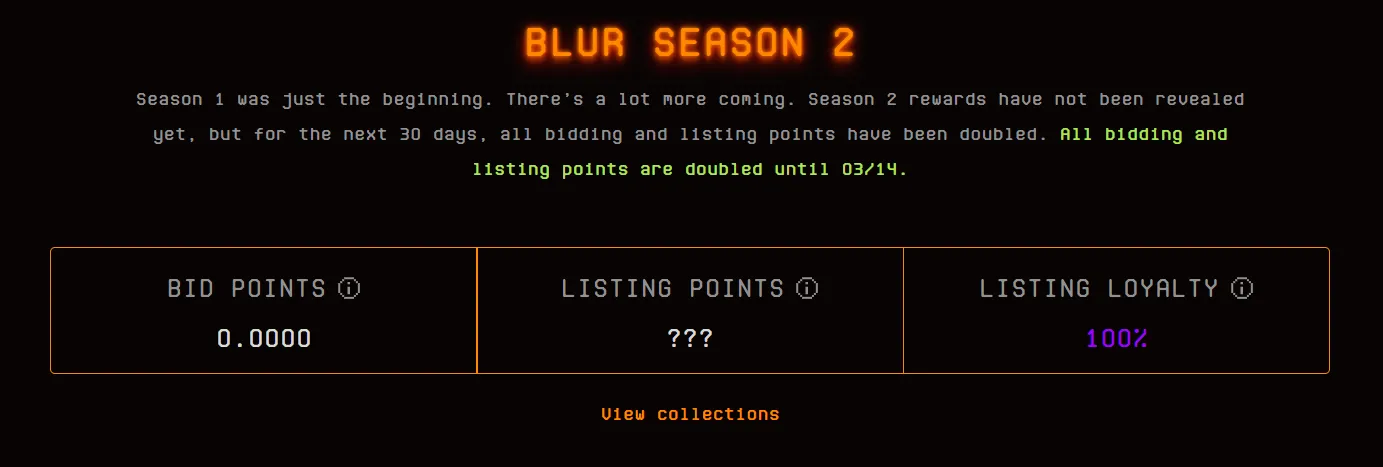
As such, for the next 30 days Blur is doubling all bidding and listing points on its marketplace, so keep an eye on racking up points for future $BLUR rewards.
The NFT marketplace wars: Right now $BLUR trading is extremely volatile, but current market activity is suggesting the token’s market cap is around $253M USD. That places the token in the ballpark of the market caps of the similarly constructed $LOOKS and $X2Y2 tokens, although Blur has facilitated way more NFT trading volume than LooksRare and X2Y2 lately.
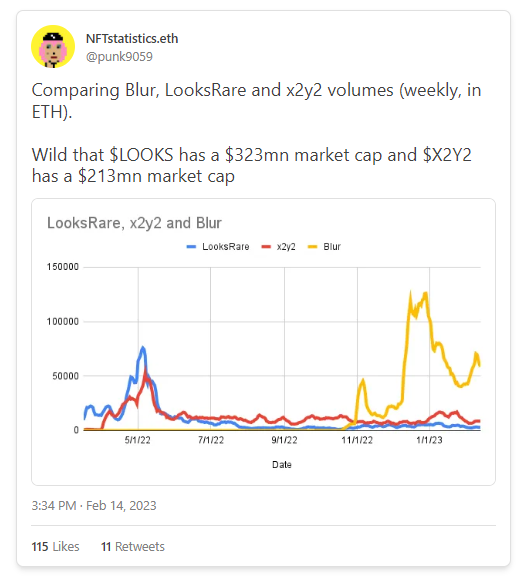
Tomorrow, I’ll have an op-ed out in Bankless proper about how Blur might convert its initial momentum into winning out over its competitors, including the NFT juggernaut OpenSea. Keep an eye out for that. Of course, a definitive Blur win is far from guaranteed and won’t be easy, but Blur’s got a fighting chance and the launch of $BLUR is a big strategic and tactical step in that direction. Whatever happens, it’ll be fascinating to see how the marketplace wars shake up from here.