Bears Beware: Bitcoin To Enter “Bucking Bull” Phase

newsbtcPublicado a 2023-02-10Actualizado a 2023-02-10

Resumen

Bitcoin formed a historically bullish pattern when its 50-day moving average crossed above its 200-day moving average. According to an analyst from on-chain analytics firm Jarvis Labs, this pattern is known in the market as a golden cross and forecast price appreciation in the coming months.

Bitcoin formed a historically bullish pattern when its 50-day moving average crossed above its 200-day moving average. According to an analyst from on-chain analytics firm Jarvis Labs, this pattern is known in the market as a golden cross and forecast price appreciation in the coming months.

Bitcoin’s last golden cross took place in 2021 and seems far in the rearview mirror for investors. At this time, the crypto was able to drive the bullish wave to new all-time highs (ATH).

510 days ago, in September 2021, Bitcoin saw a golden cross before hitting a low of $29,000. After that, The most prominent cryptocurrency in the market climbed to never explored territory in November 2021, surging 45% since that time.

In 2015, Bitcoin soared 6566% to an all-time high of $20,000. In April 2019, Bitcoin rose 154% and reached $14,000 when the price action saw a golden cross as it did today.

Furthermore, in 2021 Bitcoin surged 45% after the golden cross effect materialized and reached its latest and current all-time high of $69,000. But can Bitcoin confirm a new bullish macro?

The Bucking Bull

A recent newsletter from the Jarvis Labs team and its crew member under the pseudonym “JJ the Janitor” reviewed the macroeconomic environment and how the crypto market is positioned when the golden cross materializes on the Bitcoin charts. The analyst stated:

The “Golden Cross” can be thought of as the first blossoms of spring. It occurs when the 50-day moving average rises above the 200-day moving average. Every time this has happened to Bitcoin, it has confirmed that a new macro bullish trend is underway.
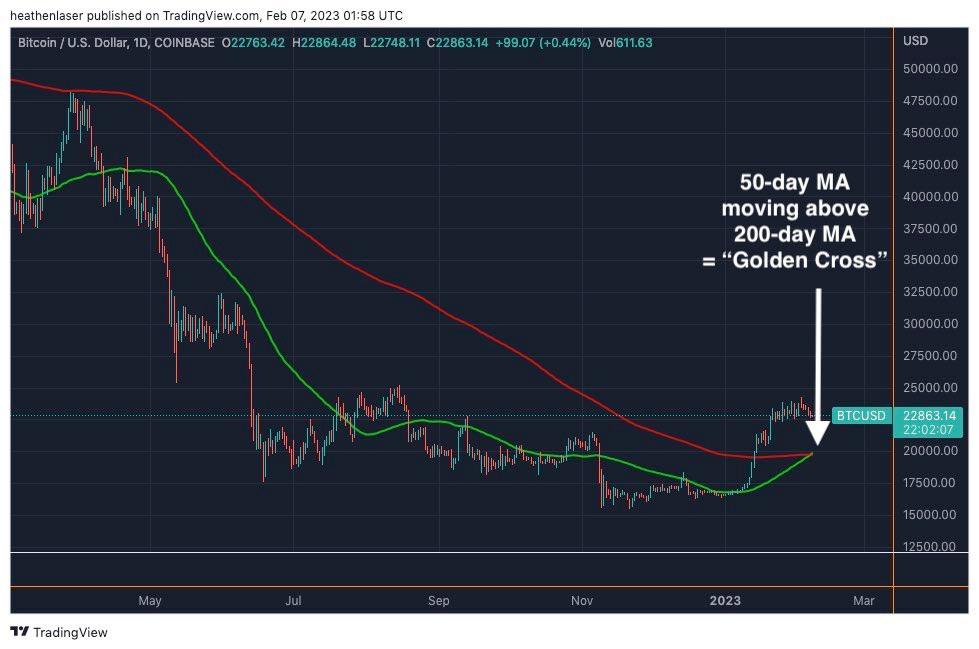
The 50-day ($19,820) has just surpassed the 200-day ($19,720), creating Bitcoin’s first “golden cross” since September 2021. The green line represents the 50-day Moving Average (MA), and the red line the 200-day MA.

According to Jarvis Labs, prices drop soon after each cross, causing a “brutal shake-out in the market” before it reaches new highs. This market shake-out allows the new trend to cement before the arrival of a “full-blown” bull market.

Before the bull run took over the market in September 2021, allowing the price of Bitcoin to reach the milestone of $69,000 from $48,000 (when the golden cross event occurred), BTC saw a minus -20% retracement sending it below $40,000.

The DXY Has Confluence With A New Bitcoin Bull Market

The U.S. Dollar Index (DXY) has been in a downtrend since Q4 2022. According to Jarvis Labs, since the dollar has an inverse correlation to crypto, the former’s downtrend could open the gates for an “early 2023 crypto rally.”

The DXY dropped 12% from its September 2022 high of 114.80 to 100,80. Meanwhile, Bitcoin climbed from the floor of $16,000 to over $24,000 by the end of January.
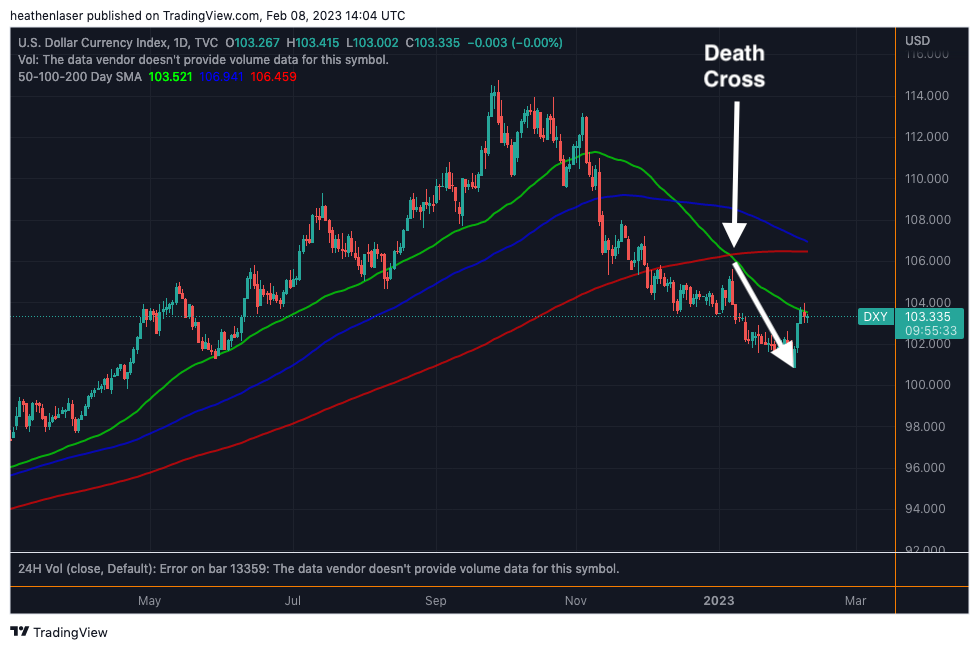
For Jarvis Labs, the DXY’s trend confluences with the idea of a crypto bull market. However, the nascent asset class could experience a “strong shake-out” before going full throttle.

In addition, the Jarvis Labs team has seen the return of large whale wallets, which signals big money has been accumulating since to start of 2023.
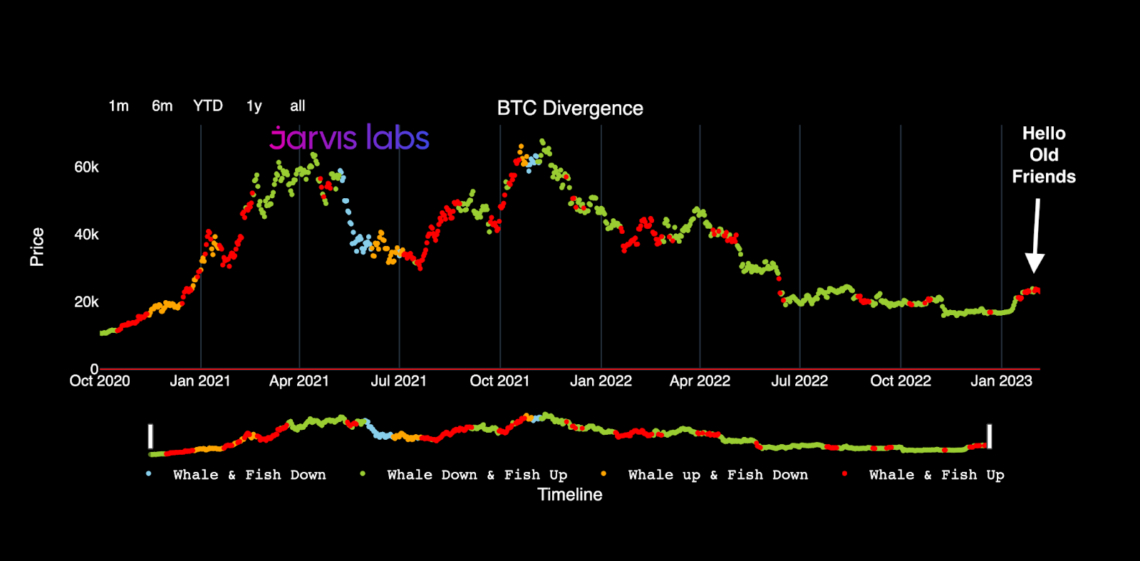
The analyst stated the following about the chart above and its potential bullish implication for Bitcoin:

This syncs with our “bucking bull” theory that there will be additional upside, but also more volatility in the time to come.
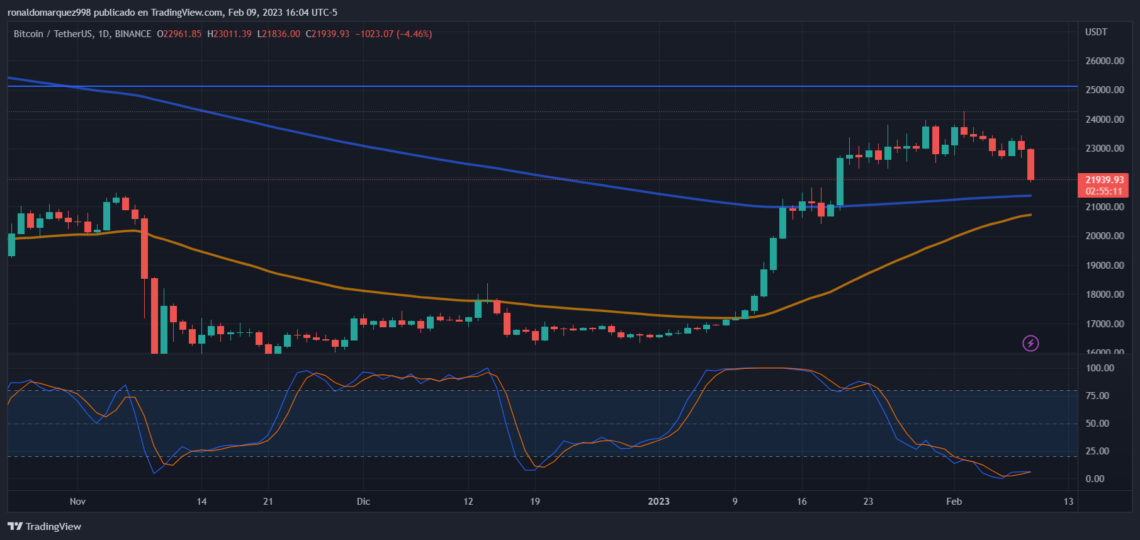
Bitcoin has dropped in the last 24 hours, down 4.1% since yesterday, and recorded a 7.4% retracement in the last seven days.


Lecturas Relacionadas

Grupos católicos y de seguridad advierten que la Ley CLARITY podría debilitar las salvaguardias contra el delito con criptomonedas

Una coalición de líderes católicos, grupos vinculados a la aplicación de la ley y defensores contra la trata de personas advierte que la Ley CLARITY podría debilitar las salvaguardias utilizadas para combatir los delitos habilitados por las criptomonedas. Las críticas se centran en disposiciones que protegerían a los desarrolladores de software no custodio de ser tratados como transmisores de dinero. Este debate aborda una de las cuestiones más difíciles en la regulación de las criptomonedas: cómo distinguir el software neutral de la intermediación financiera. Los defensores de las criptomonedas argumentan que los desarrolladores que publican código no custodio no deben ser regulados como exchanges o procesadores de pagos. Los críticos temen que exenciones amplias puedan dificultar el rastreo de las finanzas ilícitas. El software no custodio es central para las finanzas descentralizadas (DeFi). La Ley CLARITY busca crear reglas más claras de estructura de mercado, pero la oposición muestra que no todas las batallas políticas tratan sobre la protección del inversor. Algunos legisladores también considerarán el impacto en la trata de personas, la evasión de sanciones y la visibilidad para la aplicación de la ley. La resistencia no significa que el proyecto de ley esté muerto, pero podría llevar a enmiendas, salvaguardias más estrictas o requisitos de información adicionales. Para las empresas de criptomonedas, las consecuencias son altas: reglas más claras podrían desbloquear inversiones, pero si el proyecto se enmarca como un debilitamiento de las salvaguardias contra el crimen, su camino político será más difícil.

bitcoinistHace 3 hora(s)

Grupos católicos y de seguridad advierten que la Ley CLARITY podría debilitar las salvaguardias contra el delito con criptomonedas

bitcoinistHace 3 hora(s)

La crónica del fraude grave que envuelve al unicornio cripto Blockstream

A lo largo de 2024, Blockstream, la empresa de cripto del pionero de Bitcoin Adam Back, se ha visto envuelta en varias controversias. Una investigación de NatInfoSec lanzó graves acusaciones sobre su producto de notas mineras, Blockstream Mining Note (BMN). Los principales señalamientos incluyen: una discrepancia entre el poder de cómputo mostrado (15 EH/s) y el necesario para cumplir con las obligaciones de los BMN (20-45 EH/s); una falta de evidencia verificable pública sobre las operaciones mineras a esa escala; rendimientos anuales fijos inusualmente altos, cercanos al 20%; y el descubrimiento de que Christopher William Cook, figura clave de la operación minera de Blockstream a través de Exacore, tiene antecedentes penales por fraude postal, información no revelada a los inversores. Aunque BitMEX Research y otros como Samson Mow han cuestionado algunos puntos por falta de pruebas o por implicar incorrectamente a BSTR, la compañía de tesorería de Bitcoin asociada a Back, las preguntas centrales sobre los BMN persisten. La comunidad y los analistas exigen mayor transparencia y capacidad de verificación sobre: el tamaño real y los límites de responsabilidad de los BMN; la fuente de los altos rendimientos prometidos; la procedencia verificable de los BTC pagados a los inversores; y el papel exacto de Cook. Hasta ahora, Blockstream no ha emitido una respuesta oficial integral a estas acusaciones.

marsbitHace 6 hora(s)

La crónica del fraude grave que envuelve al unicornio cripto Blockstream

marsbitHace 6 hora(s)

Trading

Spot
Futuros
活动图片