Bitcoin exchange supply continues decline as holders push towards self-custody

BitcoinistPublicado a 2023-02-09Actualizado a 2023-02-09

Resumen

On-chain data shows the Bitcoin supply on exchanges has decreased recently as holders have been pushing towards self-custody.

On-chain data shows the Bitcoin supply on exchanges has decreased recently as holders have been pushing towards self-custody.


Bitcoin Supply On Exchanges Is At its Lowest Value Since November 2018

According to data from the on-chain analytics firm Santiment, only $29.2 billion worth of BTC is left on exchanges now. There are two indicators of relevance here: the “supply on exchanges” and the “supply outside of exchanges.”

As their names already imply, they measure the total amount of Bitcoin currently sitting in centralized exchange wallets and the supply being kept in self-custodial wallets, respectively.


Generally, one of the main reasons investors deposit to exchanges is for selling purposes, so the supply on exchanges can reflect Bitcoin’s available selling supply.


Thus, whenever this metric’s value increases, there is a chance that the selling pressure in the market also goes up, and BTC observes a bearish impulse. Similarly, if it decreases instead (meaning that the supply outside of exchanges rises), the BTC’s price could see a long-term bullish effect.

Earlier, investors used to believe that a supply shock could brew in the market if the supply on exchanges sufficiently decreased. But these days, the market environment is more diverse, so exchanges play a minor role.

Nonetheless, their supply can still hold some importance for the market. Here is a chart that shows the trend in the Bitcoin supply on exchanges, as well as the supply outside of these platforms, over the past year:
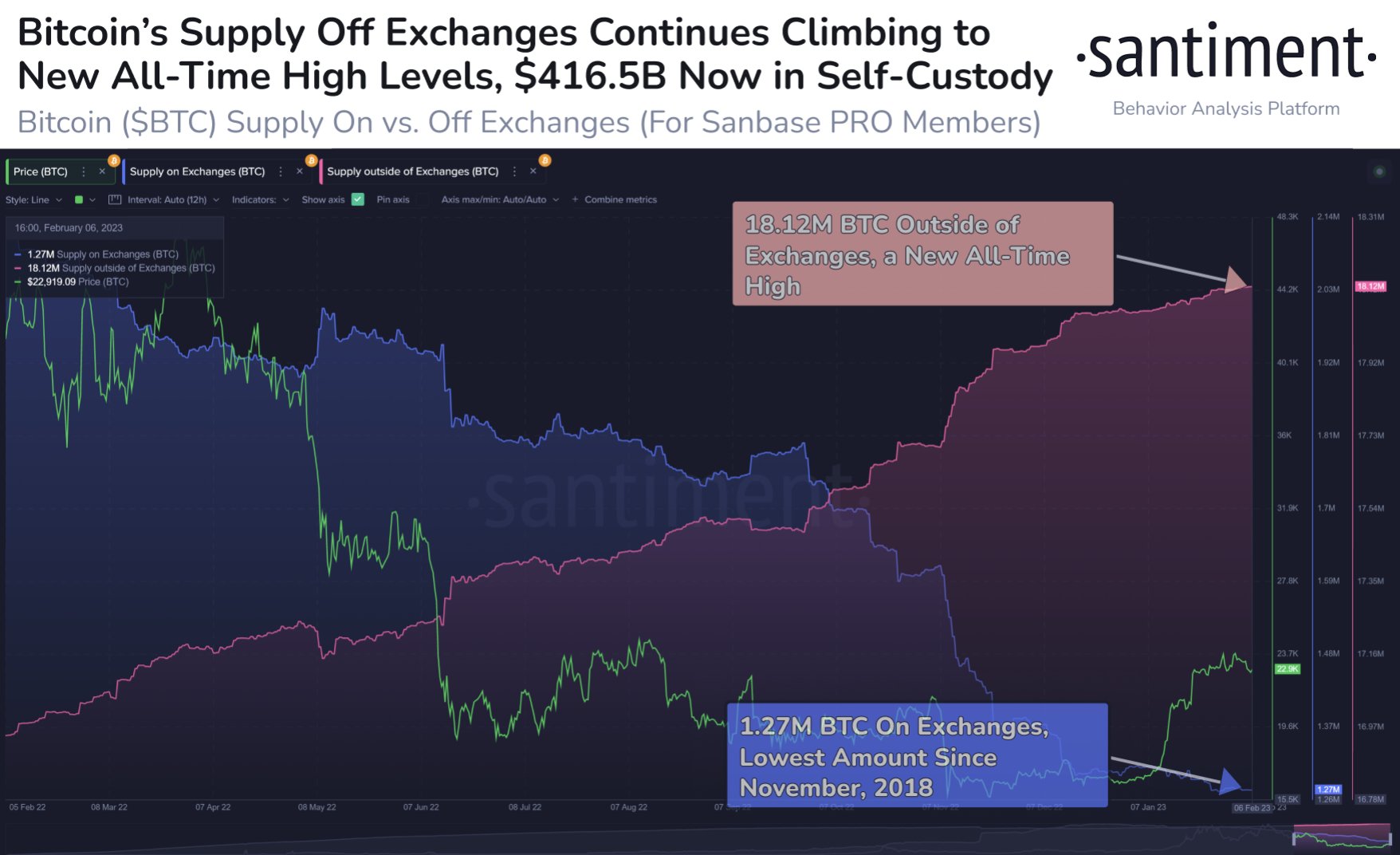
Bitcoin Supply on Exchanges

Looks like the value of the metric has declined in recent days | Source: Santiment on Twitter


As displayed in the above graph, the Bitcoin supply on exchanges has been going down for quite a while, suggesting that investors have constantly been taking out a net amount of coins off these platforms.


The most significant decline during the past year came following the collapse of the cryptocurrency exchange FTX, which forced investors to reconsider their trust in centralized platforms, leading to many of them withdrawing massive amounts to self-custodial wallets. Only users hold the private keys to these wallets.

The drawdown of the indicator has continued recently while the price of the cryptocurrency has been consolidating sideways around the $23,000 mark. This may signify that some new accumulation has taken place at this level.


With the latest continuation of the decline, the BTC supply on exchanges, as measured by Santiment, has fallen to just 1.27 million BTC. The supply outside of exchanges has naturally grown while this has happened and has hit a new all-time high of 18.12 million BTC.


This means that the Bitcoin supply outside exchanges is 14.26 times the supply inside these platforms. This dynamic could have a positive effect in the cryptocurrency’s price over the coming months.


BTC Price


At the time of writing, Bitcoin is trading around $23,000, down 1% in the last week.

Bitcoin Price Chart

BTC continues to move sideways | Source: BTCUSD on TradingView



Lecturas Relacionadas

Grupos católicos y de seguridad advierten que la Ley CLARITY podría debilitar las salvaguardias contra el delito con criptomonedas

Una coalición de líderes católicos, grupos vinculados a la aplicación de la ley y defensores contra la trata de personas advierte que la Ley CLARITY podría debilitar las salvaguardias utilizadas para combatir los delitos habilitados por las criptomonedas. Las críticas se centran en disposiciones que protegerían a los desarrolladores de software no custodio de ser tratados como transmisores de dinero. Este debate aborda una de las cuestiones más difíciles en la regulación de las criptomonedas: cómo distinguir el software neutral de la intermediación financiera. Los defensores de las criptomonedas argumentan que los desarrolladores que publican código no custodio no deben ser regulados como exchanges o procesadores de pagos. Los críticos temen que exenciones amplias puedan dificultar el rastreo de las finanzas ilícitas. El software no custodio es central para las finanzas descentralizadas (DeFi). La Ley CLARITY busca crear reglas más claras de estructura de mercado, pero la oposición muestra que no todas las batallas políticas tratan sobre la protección del inversor. Algunos legisladores también considerarán el impacto en la trata de personas, la evasión de sanciones y la visibilidad para la aplicación de la ley. La resistencia no significa que el proyecto de ley esté muerto, pero podría llevar a enmiendas, salvaguardias más estrictas o requisitos de información adicionales. Para las empresas de criptomonedas, las consecuencias son altas: reglas más claras podrían desbloquear inversiones, pero si el proyecto se enmarca como un debilitamiento de las salvaguardias contra el crimen, su camino político será más difícil.

bitcoinistHace 2 hora(s)

Grupos católicos y de seguridad advierten que la Ley CLARITY podría debilitar las salvaguardias contra el delito con criptomonedas

bitcoinistHace 2 hora(s)

La crónica del fraude grave que envuelve al unicornio cripto Blockstream

A lo largo de 2024, Blockstream, la empresa de cripto del pionero de Bitcoin Adam Back, se ha visto envuelta en varias controversias. Una investigación de NatInfoSec lanzó graves acusaciones sobre su producto de notas mineras, Blockstream Mining Note (BMN). Los principales señalamientos incluyen: una discrepancia entre el poder de cómputo mostrado (15 EH/s) y el necesario para cumplir con las obligaciones de los BMN (20-45 EH/s); una falta de evidencia verificable pública sobre las operaciones mineras a esa escala; rendimientos anuales fijos inusualmente altos, cercanos al 20%; y el descubrimiento de que Christopher William Cook, figura clave de la operación minera de Blockstream a través de Exacore, tiene antecedentes penales por fraude postal, información no revelada a los inversores. Aunque BitMEX Research y otros como Samson Mow han cuestionado algunos puntos por falta de pruebas o por implicar incorrectamente a BSTR, la compañía de tesorería de Bitcoin asociada a Back, las preguntas centrales sobre los BMN persisten. La comunidad y los analistas exigen mayor transparencia y capacidad de verificación sobre: el tamaño real y los límites de responsabilidad de los BMN; la fuente de los altos rendimientos prometidos; la procedencia verificable de los BTC pagados a los inversores; y el papel exacto de Cook. Hasta ahora, Blockstream no ha emitido una respuesta oficial integral a estas acusaciones.

marsbitHace 5 hora(s)

La crónica del fraude grave que envuelve al unicornio cripto Blockstream

marsbitHace 5 hora(s)

Trading

Spot
Futuros
活动图片