Federal Reserve Chair Jerome Powell said the labor market’s surprising strength underscores why bringing inflation down will take longer and require higher interest rates than many investors have been anticipating.
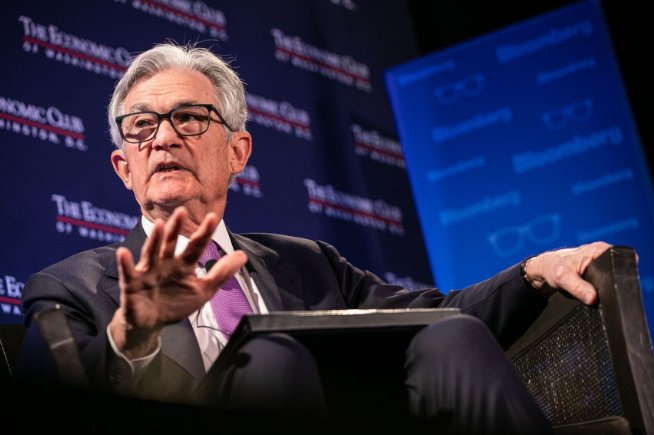
A government report Friday that showed hiring accelerated in January was “certainly strong—stronger than anyone I know expected,” Mr. Powell said Tuesday during a moderated discussion before the Economic Club of Washington, D.C. “It kind of shows you why we think this will be a process that takes a significant period of time.”
Mr. Powell didn’t say whether advance knowledge about Friday’s report would have changed the outcome of officials’ decision earlier in the week to slow rate increases for a second time in as many meetings. They approved lifting the benchmark federal-funds rate by a quarter-percentage point to a range between 4.5% and 4.75%. They raised it by a half point in December and 0.75 point in November.
The process of lowering inflation to the Fed’s goal of 2% “is likely to take quite a bit of time. It’s not going to be, we don’t think, smooth,” Mr. Powell said. “It’s probably going to be bumpy.”
The expectation that inflation “will go away quickly and painlessly…is not the base case,” he added. “The base case for me is that…we’ll have to do more rate increases, and then we’ll have to look around and see whether we’ve done enough.”
The central bank is seeking to slow economic growth to restrain inflation, which has eased recently after hitting a 40-year high last year. “Once again, Jay Powell said, ‘We really, really, really mean it,’” said Michael Farr, chief market strategist at Hightower Advisors.
Fed officials have raised rates by 4.5 percentage points over the past 12 months, the fastest pace since the 1980s, and have projected that the unemployment rate would rise to about 4.6% by the end of this year.
The Labor Department said Friday that employers added a robust 517,000 jobs in January, and the unemployment rate fell to 3.4%, the lowest since 1969. Forecasters surveyed by The Wall Street Journal had estimated that payrolls increased by 187,000 jobs last month, which would have extended a cooling trend in the labor market.
The department not only reported unusually large job growth in January but—more important for the Fed—it revised previous months’ reported gains higher, suggesting that the economy had entered the new year with more momentum than previously thought. Potential glimmers of softening in previous reports, such as a decline in temporary hiring or a drop in hours worked, reversed in January or were revised away.
According to projections released after their policy meeting in December, most Fed officials thought they would raise the fed-funds rate to 5.1% this year, which would imply quarter-point rate increases at their next two meetings, in March and May. More than a third of officials anticipated lifting the rate above 5.25%, which would call for another increase in June. No officials projected cuts this year.
Ahead of Mr. Powell’s remarks Tuesday, investors in interest-rate futures markets expected the Fed to raise rates by a quarter-point each at the Fed’s next two meetings, according to CME Group.
On Tuesday, Mr. Powell repeated his view that the central bank was prepared to raise rates higher if data suggested that economic activity was accelerating in ways that officials hadn’t anticipated.
“We’re going to react to the data,” he said. “So if we continue to get, for example, strong labor market reports or higher inflation reports, it may well be the case that we have to do more and raise rates more than has been priced in.”
Still, the remarks appeared to keep the Fed’s options open because Mr. Powell “didn’t exactly tell us when or how much more data he would need to increase his funds-rate target,” said Mr. Farr.
Signs that aggressive rate increases last year haven’t significantly cooled the labor market could fuel more difficult Fed debates over whether it has done enough to corral high inflation. The January job gains could unsettle officials if other coming reports also point to stronger economic growth. They will see one more employment report before their March meeting.
Overall inflation has been slowing largely because prices of energy and other goods are falling. Large increases in housing costs have slowed, but haven’t yet filtered through to official price gauges.
Mr. Powell has for the past three months justified continued interest-rate increases by noting still-tight labor markets, elevated wage pressures and high inflation for labor-intensive services. “We’re not seeing disinflation there yet, and that’s going to take some time,” he said Tuesday. “We’re going to need to be patient.”
Later, he returned to that component of service-sector inflation failing to slow down this year as one of the most concerning developments facing the Fed. “That’s what I worry about,” he said.
The Fed believes its rate rises work through markets by tightening financial conditions, such as by raising borrowing costs or lowering prices of stocks and other assets.
Investors’ optimism that inflation would be brought down more quickly this year than the Fed expects has led financial conditions to ease in recent weeks. The average 30-year mortgage rate, for example, has fallen by about a percentage point to just above 6% in recent weeks, according to the Mortgage Bankers Association.
Last week some investors thought they had detected a shift in Mr. Powell’s views because he declined to push back strongly against investors’ views that the path to bring inflation down this year would be easier than the central bank has signaled is likely. But after Friday’s jobs report, investors began to expect an interest-rate trajectory that is closer to what Fed officials have been suggesting is most likely.
“Late last year Powell and other Fed speakers seemed intent on managing market expectations,” said Michael Feroli, chief U.S. economist at JPMorgan Chase, in a report Tuesday. “More recently, they appear content conveying that they will respond to the data and letting the market take that as fair warning.”
That approach seems sensible given that the Fed is probably closer to its ultimate interest-rate destination compared with last year, he said. “This year, the market shouldn’t expect the same degree of hand holding,” he said.