Morpho Leads on Ethereum, Solana Steers DeFi TVL as Market Concentrates on Five Top Curators

cryptonews.ruPublished on 2026-08-25Last updated on 2026-08-25

Abstract

A report from vaults.fyi on August 24 indicates that managed DeFi vaults hold $11.29 billion, with over two-thirds controlled by just five curator firms. Despite differing total figures from DefiLlama due to methodology, both agree on high market concentration. The vaults.fyi study, covering 856 vaults, 131 curators, and 18 protocols as of August 20, shows 69.3% of the market is managed by the top five curators. Managed assets now represent 12.51% of total DeFi TVL, up from 5.24% a year ago. Morpho leads the sector, managing nearly half (46.2%) of all curated capital across Ethereum and Solana, thanks to its Morpho Blue and MetaMorpho systems that separate lending from risk management. Its dominance attracts traditional finance players like Bitwise Asset Management, which predicts on-chain vault assets ("ETF 2.0") will double by 2026. Rankings have shifted significantly in the past year. New entrants Concrete and Sentora now rank in the top five, while Usual fell from 4th to 34th place, partly due to stress events weeding out weaker managers. A separate DefiLlama report from July, using Sentora data, confirms the trend, with the top three curators controlling 75.9% of its measured $7.18 billion TVL. Major traditional firms are entering the space: Apollo with Securitize, Midas with Fasanara, and JPMorgan Chase launching tokenized money market fund vaults. Trading firm Wintermute also launched its Armitage curation platform. This growth occurs despite a sharp increase in D...

A report published by vaults.fyi on August 24 states that $11.29 billion is held in managed DeFi vaults, with over two-thirds of that amount controlled by just five management companies.

While Vaults.fyi and DeFiLlama published two reports that differ in total fund volume due to variances in counting vaults and protocols, they agree that the market is highly concentrated.
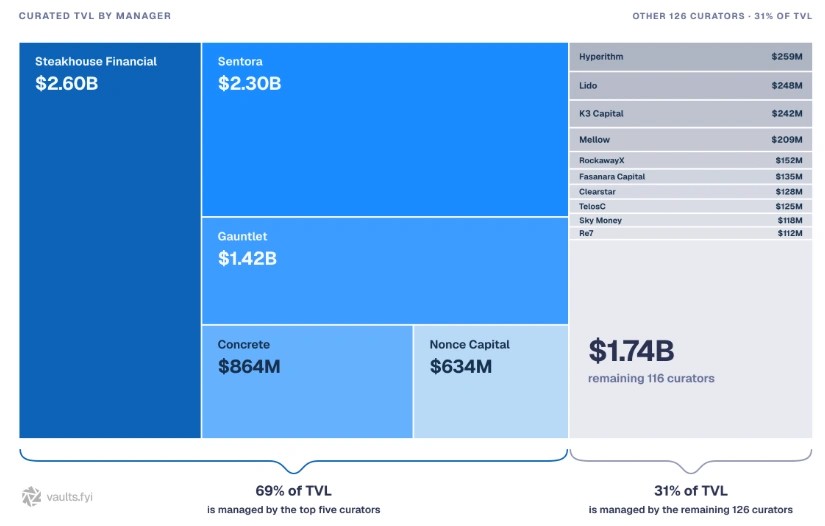
Five leading curators manage 69% of the curated DeFi volume (TVL). Source: vaults.fyi

Who are the main curators identified by vaults.fyi?

The vaults.fyi report, considered the most comprehensive study to date of curated markets in blockchain, reflects a volume of $11.29 billion distributed across 856 vaults, 131 curators, and 18 protocols. The data is current as of August 20.

Survey results show that 69.3% of the measured market is served by just five curators.

Distributing deposits across several vaults does not spread risk if they are all managed by the same team. A curator selects markets, collateral, limits, and risk thresholds. However, when five of them manage two-thirds of the capital, the choices of a few individuals determine the risk borne by thousands of depositors.

Over the past year, the market share managed by curators has grown to 12.51% of the total DeFi supply volume, up from 5.24% previously. The study found it increased by 39%, while the overall market supply grew by 41.8%.

According to the report, nearly half of all managed capital, about 46.2%, flows through Morpho on Ethereum-based and Solana blockchains. The remaining 53.8% is distributed among 17 other protocols.

Morpho's leading position is driven by a system developed in collaboration with Morpho Blue and MetaMorpho. This system separates the core lending function from risk management, allowing third-party managers to create distinct lending markets and pool them into unified vaults.

This development is now attracting major traditional financial companies, such as Bitwise Asset Management, which partnered with Morpho to launch non-custodial vaults. The first product targets a 6% annual yield. Bitwise also forecasts that assets under management in on-chain vaults, which the company calls 'ETF 2.0,' will double by 2026.

The report also notes that in Morpho's 25 largest stablecoin vaults, holding $3.71 billion, bitcoin backs 54.1% of the lending. A depositor believing they hold USDC assets may actually be providing loans collateralized by bitcoin, exposed to risks related to their liquidity, oracle availability, and the market's ability to liquidate collateral in a crash.

Has Morpho Always Been the Leader?

Companies Concrete and Sentora, which were not in the ranking twelve months ago, are now in the top five: Concrete ranks fourth and Sentora second.
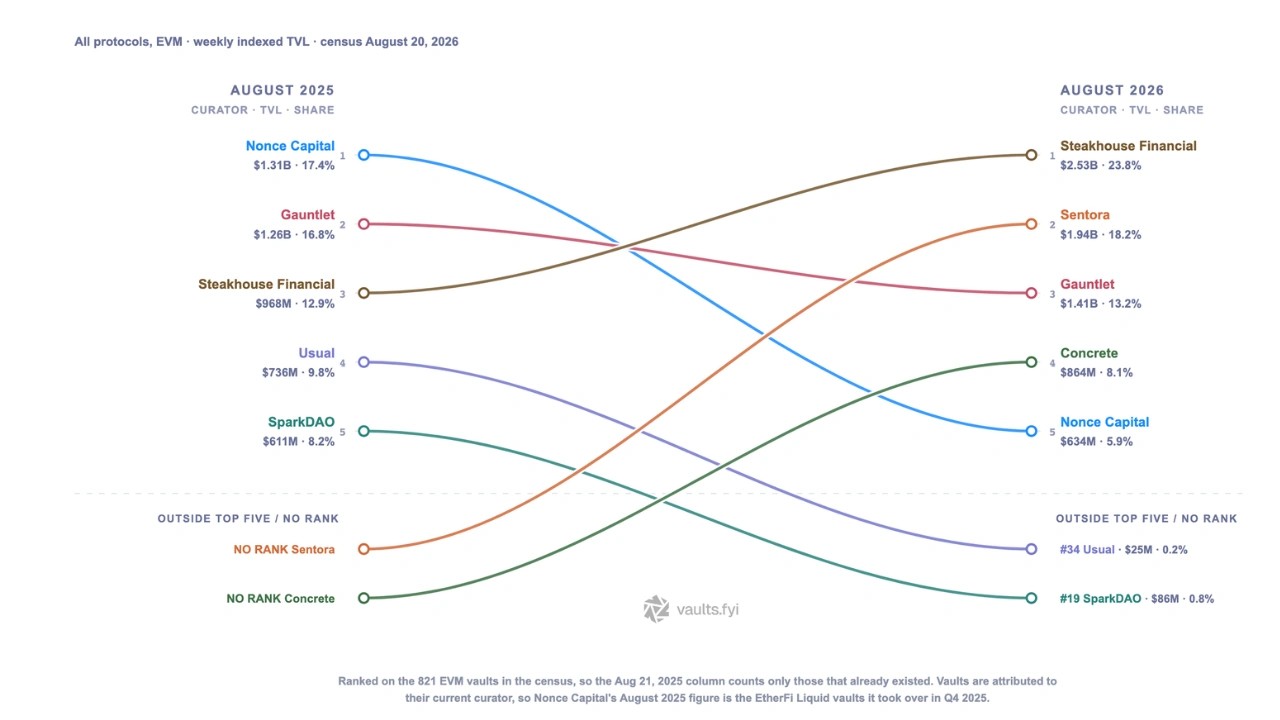
DeFi vaults over the past year: vaults.fyi

Usual's ranking dropped from fourth to thirty-fourth. The report states that reshuffling was partly driven by stress, noting that after issues with Stream and Resolv, weaker managers were sidelined and money flowed to the teams that remained.

A separate DefiLlama report, using Sentora data collected in July, confirms the same asset concentration trend. Using data from 55 management companies and a total of $7.18 billion, it names the top three: Steakhouse Financial ($2.03 billion), Sentora ($1.97 billion), and Gauntlet ($1.46 billion). Together they control 75.9% of TVL, while the top five companies control 80.9%.
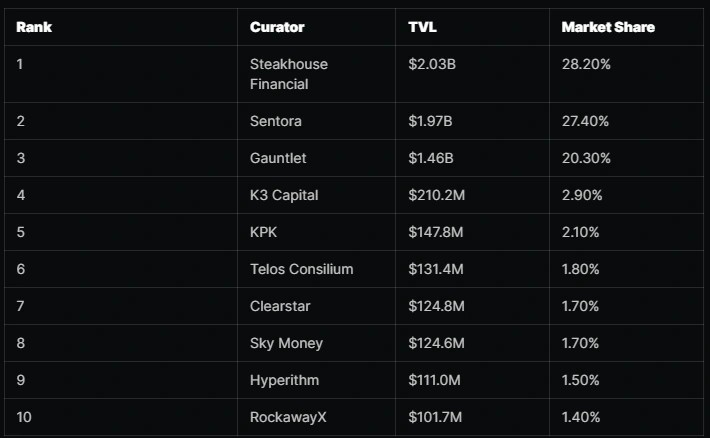
DeFi Vault ranking one year ago. Source: Defillama

The vaults.fyi report mentions that major players outside the crypto world are now beginning to create their own vaults for tokenized assets. For example, Apollo recently started collaborating with Securitize, Midas partnered with Fasanara, and JPMorganChase is launching vaults for tokenized money market funds.

In May, trading firm Wintermute also launched its own asset curation platform called Armitage. Wintermute stated it can accept collateral types that other curators cannot, as it handles liquidations in-house.

All this money is flowing in despite TRM Labs recording 207 DeFi exploits in the first half of 2026, more than double the 83 exploits recorded in the same period of 2025.

end-content

Trending Cryptos

Related Questions

QWhat is the total value locked (TVL) in managed DeFi vaults as of August 20th, according to the vaults.fyi report?

AAccording to the vaults.fyi report, the total value locked in managed DeFi vaults as of August 20th is $11.29 billion.

QAccording to the vaults.fyi report, what percentage of the curated DeFi TVL is controlled by the top five curators?

AThe top five curators control 69.3% of the total curated DeFi TVL measured by the vaults.fyi report.

QWhich platform is the dominant force in the curated DeFi market, and on which blockchain networks does it primarily operate?

AMorpho is the dominant force, controlling almost half (46.2%) of all curated capital, primarily operating on Ethereum and Solana-based blockchains.

QWhat does the data from both vaults.fyi and DeFiLlama agree on regarding the structure of the curated DeFi market?

ABoth reports agree that the curated DeFi market is highly concentrated, with a small number of leading firms controlling a large majority of the total value locked.

QWhat risk factor related to Bitcoin is highlighted in the article concerning certain Morpho vaults?

AThe article highlights that in the top 25 Morpho stablecoin vaults, Bitcoin provides 54.1% of the lending collateral. This exposes USDC depositors to the risks associated with Bitcoin's liquidity, oracle reliability, and the market's ability to liquidate the collateral during a crash.

Related Reads

Bitcoin Is Ready for "Parabolic Growth". Is Altseason Upon Us?

Amid a general market uptrend, experts are discussing the potential start of an 'altcoin season', where major cryptocurrencies could outpace Bitcoin's growth. This follows Bitcoin surpassing $81,000, predictions of a new bull market, and a capital shift from AI stocks toward Bitcoin and gold. Since August 17th, the crypto market has risen over 22%, primarily driven by Bitcoin (BTC) and Ethereum (ETH), which gained 25% and 30% respectively, reaching highs last seen in May. Analysts suggest the Bitcoin bear cycle has ended, anticipating a historically strong rally, with renewed institutional demand for cryptocurrency ETFs. BitMEX founder Arthur Hayes, in a recent interview, declared the start of a new bull market, predicting Bitcoin could quickly reach "hundreds of thousands" of dollars. Market observers interpret this as an expectation for 'parabolic growth.' Signs of a bull market revival include Bitcoin ETFs re-entering the top 10 most-traded ETFs, displacing some AI-focused funds. Analysts at CryptoQuant note capital is flowing from Bitcoin into riskier altcoins, with their bull market indicators showing the most optimistic signals since October 2025. However, the reality is more nuanced. The current surge is a rebound from yearly lows; Bitcoin's price is still down nearly 40% from its October peak. The Altcoin Season Index has dropped to 39 from 67 in early August, and Bitcoin's dominance remains around 60%, indicating investor focus is still on Bitcoin rather than altcoins. Experts predict the market is entering a phase where project fundamentals and real revenue, rather than speculation, will increasingly determine asset value.

cryptonews.ru10m ago

Bitcoin Is Ready for "Parabolic Growth". Is Altseason Upon Us?

cryptonews.ru10m ago

$120 Million Vanishes Overnight! Crypto's 'Steadiest Giant' Stumbles in South America

Summary: Tether's $120 million Bitcoin mining venture in Uruguay, initiated in May 2023, was abruptly shut down in July 2025 when the national power utility UTE cut off electricity. The project, developed in partnership with local firm Microfin in Florida province, was touted as a model for leveraging the country's nearly 98% renewable energy grid. The collapse stemmed from a fundamental contract dispute over electricity supply. Tether interpreted the agreed power volume as a "minimum guaranteed supply," expecting to request more as the mining operation expanded. UTE, however, viewed it as a "strict maximum cap." This disagreement led to frequent power curtailments for the 24/7 mining facility, causing significant revenue loss from lost computing power. Following the 2025 election of left-wing President Yamandú Orsi and a management change at UTE, negotiations broke down. Microfin stopped paying electricity bills in May 2025, formally notified UTE of contract termination in June, and did not attend a final meeting where UTE presented a revised contract. By the July 25 power cut, Microfin's debt approached $5 million. The operation ceased, laying off 30 of its 38 local staff, with all outstanding debts settled by December 2025. The failure highlights key risks for heavy-asset overseas investments: Uruguay's green energy proved not to be cheap energy, especially after the 2024 Bitcoin halving squeezed industry profits. Furthermore, political changes can swiftly alter utility company policies, undermining the long-term regulatory stability critical for such projects. While financially absorbable for Tether, the incident underscores that operational success depends on unambiguous contracts and genuine cost advantages, not just technological scale.

marsbit35m ago

$120 Million Vanishes Overnight! Crypto's 'Steadiest Giant' Stumbles in South America

marsbit35m ago

Is Bitcoin Price Lagging? Record Global M2 Money Supply Could Be a Springboard for BTC's Rise

Bitcoin Price Lagging? Record Global Money Supply M2 Could Springboard BTC Growth The global money supply (M2) is expanding rapidly, similar to global debt. The US M2, representing all money circulating in its economy, has reached a record $23.16 trillion. Combined with figures from major economies like the Eurozone, China, and Japan, the global M2 is approximately $103 trillion. Some estimates, however, place it closer to $195 trillion. This surge in liquidity is significant because excess capital often seeks higher returns in assets like precious metals, stocks, and cryptocurrencies. Bitcoin's recent price surge above $81,000 has brought the global M2 metric back into focus. Following a sharp rise in early August after a US Treasury bond buyback announcement, BTC still trades about 37% below its October 2025 all-time high exceeding $126,000. This gap presents a potential "catch-up" trade thesis. Bitcoin's fixed supply of 21 million contrasts with governments' ability to print fiat currency, making scarce assets like BTC attractive if monetary expansion continues. Historically, Bitcoin's bull cycles in 2017-2018 and 2020-2021 coincided with M2 expansion and increased liquidity. Over the past year, the correlation seemed broken as M2 grew while Bitcoin's price fell sharply from its peak. Observers believe fresh dollars may have remained locked in cash-favorable investments. Some, like Ash Crypto, now suggest a long-awaited alignment between Bitcoin and M2 may be starting, especially as a weakening US Dollar Index this month has seen assets like gold and Bitcoin surge. A softer dollar pressures cash havens and prompts holders to act. While record M2 doesn't guarantee higher Bitcoin prices, a sustained influx of liquidity, a weak dollar, and capital flowing into alternative assets could trigger a catch-up rally sooner than expected. However, changes in these conditions could lead to the opposite outcome.

cryptonews.ru1h ago

Is Bitcoin Price Lagging? Record Global M2 Money Supply Could Be a Springboard for BTC's Rise

cryptonews.ru1h ago

Trading

Spot

Hot Articles

Discussions

Welcome to the HTX Community. Here, you can stay informed about the latest platform developments and gain access to professional market insights. Users' opinions on the price of ETH (ETH) are presented below.

活动图片