BTC Sets the Stage, Altcoins Party: Who's the True Winner of This Rally?

marsbitPublished on 2026-08-24Last updated on 2026-08-24

Abstract

After a prolonged lull, the crypto market exploded last week, with Bitcoin surging over 26% to nearly $79,500, its biggest weekly gain since March 2023. This rally, fueled by a US long-term bond buyback program and pro-crypto signals from Trump, confirmed key market patterns: crypto's short-term direction is increasingly tied to US policy, Bitcoin spot ETFs act as a leading indicator, and Bitcoin's gains trigger a clear capital rotation into altcoins. Ethereum outperformed Bitcoin, rising nearly 30% due to strong ETF inflows and shrinking exchange supply. Among altcoins, the top weekly gainers were ENA (~101%), PUMP (~88-99%), STX (~82-94%), TRUMP (~79-91%), and ZEC (~75%). Zcash notably hit a new all-time high. Meme coins like "牛来" and BOME also saw explosive gains, demonstrating the sector's high elasticity. The rally outlined a clear path: Bitcoin sets the stage, major coins follow, and altcoins/Meme coins deliver the most dramatic performances, reflecting the market's shift from caution to exuberance.

Original Author: Joe Zhou, Foresight News

The cryptocurrency market, dormant for almost a whole year, suddenly exploded last week.

Bitcoin surged violently from around $62,800 at the beginning of the week, hitting an intraday high of $79,500 on August 21, marking a maximum weekly gain of over 26% and setting the record for the largest single-week percentage gain since March 2023. Voices proclaiming "the bull is back" have been echoing throughout the market.

A signal doesn't ring only once, but the real test lies in—can we accurately identify its nature? A more worthwhile question is: in this rebound, which assets' gains are justified, and which are merely drifting with the tide? The next stage's code is hidden within the answer.

Which Market Patterns Does This 'Bull's Return' Validate Once Again?

Every extreme market movement is not a random noise, but a stress test of the market structure. This rebound has once again confirmed several clear patterns.

Pattern One: Short-to-medium-term directional shifts in the crypto market have become highly dependent on the swings of the US policy cycle.

Looking back over the past four years, several major turning points in the cryptocurrency market—whether it was the approval of the Bitcoin spot ETF, the shift between the Fed's interest rate hike and cut cycles, or this recent US Treasury repurchase operation—have almost always resonated with the rhythm of US fiscal and regulatory policies. Market pricing power is gradually shifting from the crypto-native, on-chain leverage cycle to macro liquidity and regulatory expectations.

This time is no exception. Based on news attribution, the core drivers for the rebound can be summarized in two points:

First, the long-term bond repurchase policy triggered a reversal in macro liquidity expectations. On August 19, US Treasury Secretary Bessent announced that the single-operation repurchase size for long-term Treasuries (10 to 30-year) would be increased from $2 billion to at least $4 billion to address the previous situation of soaring long-end yields and heavy selling of long-term bonds. The market quickly interpreted this as: the US government is using accommodative operations to alleviate its own borrowing cost pressure → the US dollar weakens under pressure → funds flow towards alternative value storage assets like gold and Bitcoin. As Bitcoin possesses the attributes of a high-beta risk asset, its price increase stands out the most among similar assets.

Second, Trump's push for crypto legislation catalyzed a recovery in risk appetite. Almost simultaneously, Trump met with crypto industry executives from Coinbase, Kraken, Ripple, etc., at the White House, publicly urging Congress to quickly pass the Clarity for Digital Assets Act (CLARITY Act) to clarify the jurisdictional boundaries between the SEC and CFTC over digital assets. This move was seen by the market as a signal of reduced regulatory uncertainty, further boosting the recovery in risk appetite.

One point that deserves special mention: On August 18, the SEC also proposed a new draft rule for public crypto token sales, which the market viewed as a positive signal towards establishing clear rules for token issuance. The market called it the "legal version of ICO 2.0." This means that the previous wild ICO model is gradually "evolving," and the new ICO will be a fresh regulatory framework with caps, information disclosure requirements, and exit mechanisms.

Pattern Two: Bitcoin spot ETFs have become the market's bellwether and continue to lead the entire crypto market.

Bitcoin spot ETFs moving ahead of the market and leading the direction of the trend has become one of the most significant structural characteristics of the crypto market in the past two years. This pattern has been repeatedly verified across multiple market cycles.

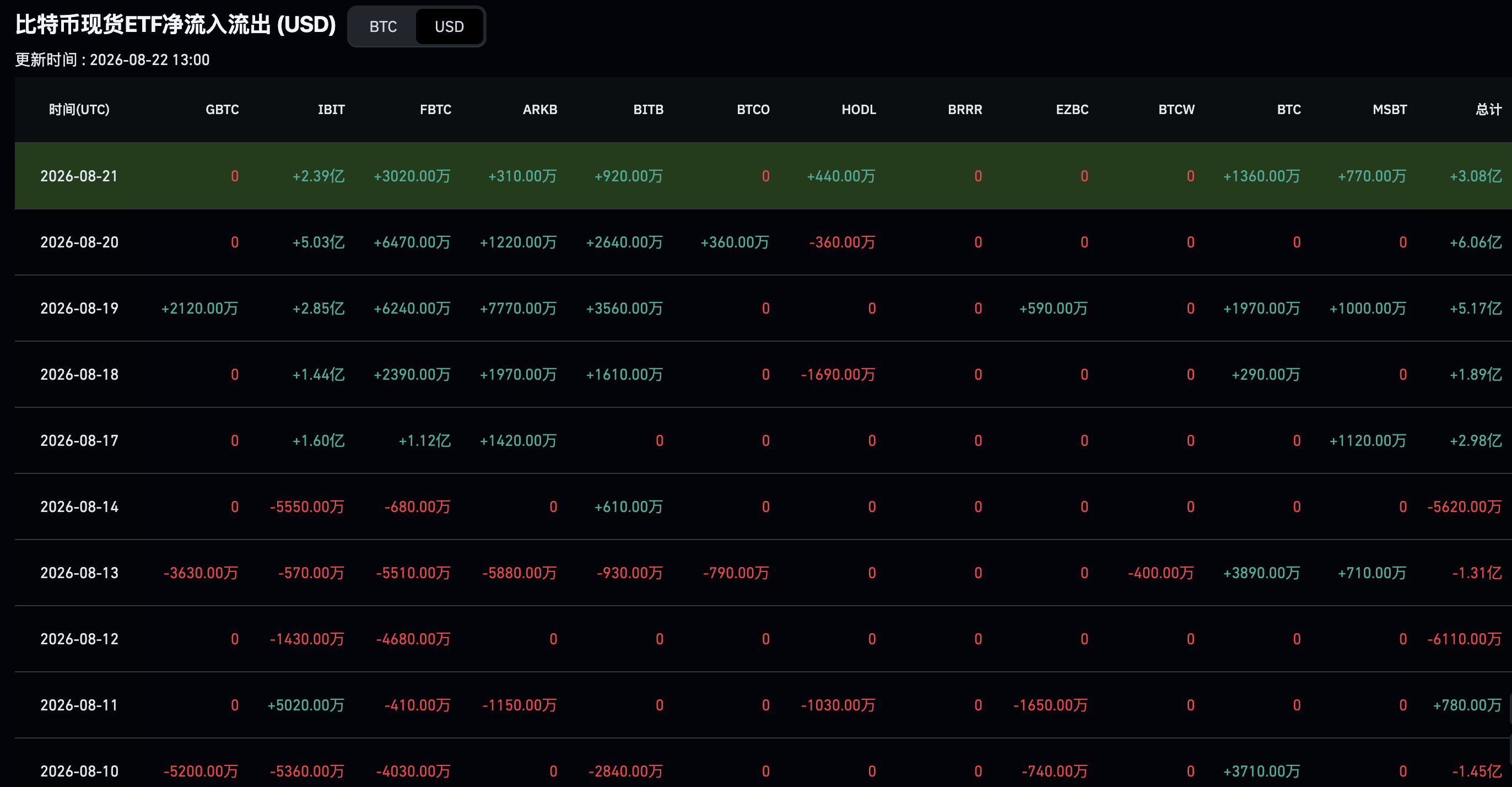
Take this rebound as an example—the comprehensive market explosion began on August 19, but Bitcoin spot ETFs had already shown a "determined" trend of sustained net buying days earlier, precisely timing the ignition point of this market movement.

From a data perspective, last week (the week ending August 21), US Bitcoin and Ethereum spot ETFs combined recorded a net inflow of $2.6 billion, the highest weekly record since October 2025. Among them, Bitcoin spot ETFs saw a net inflow of approximately $1.9 billion. Their weekly trading volume surged from $6.9 billion the previous week to $22.1 billion, an increase of 219%. Total net assets rose from $76.6 billion to $96.1 billion.

Ethereum spot ETFs also performed strongly, with a net inflow of $697.2 million last week, the highest since the week of October 3, 2025. Their weekly trading volume increased from $1.9 billion to $6.9 billion, a staggering growth of 259.4%.

Both types of ETFs recorded their largest single-week net inflows since 2026. In contrast, the combined net outflow of both types of ETFs was $392 million the previous week.

The synchronized surge in volume for both ETFs not only verifies the large-scale return of institutional capital but also further solidifies the market status of spot ETFs as the "leading indicator" for this bull cycle.
Pattern Three: A violent surge in Bitcoin almost inevitably triggers a comprehensive rise across the entire crypto sector—from major altcoins to smaller altcoins, and then to trending Meme coins, forming a clear chain of fund rotation.

This cycle once again validates this ironclad rule: Bitcoin breaks out first, then funds spill over progressively, with Ethereum, quality altcoins, and trending Meme coins taking turns, and the magnitude of gains exhibiting a ladder-like amplification.

Data is the most powerful proof—Ethereum gained nearly 30% for the week, ENA skyrocketed nearly 100%, the new BNB Chain ecosystem Meme coin "Bull Is Back" gained 30.3% on August 21 alone, with its market cap once touching $70 million. From large-cap blue chips to small-cap, high-beta varieties, none missed this rebound feast.

Bitcoin is the detonator, but what truly boils market sentiment are always those assets with more astonishing multiples—the altcoins and Meme coins. The gradient distribution of gains precisely outlines the complete roadmap of this fund flow back.

Crypto Bull Returns, Which Rebounded the Fiercest?

In this rebound, Bitcoin ignited first, but the real explosive elasticity concentrated in the relay of major altcoins and smaller altcoins.

Ethereum started last week from around $1,900, hitting a high of $2,546, with a weekly gain as high as 29.8%, significantly outperforming Bitcoin's 22.9%. The ETH/BTC exchange rate recovered to around 0.031, and its market capitalization returned above $280 billion.

Behind Ethereum's stronger elasticity, besides the common drivers of macro liquidity and short-squeeze dynamics, three unique factors are resonating:

First, massive inflows into spot Ethereum ETFs. Last week, Ethereum spot ETFs saw a net inflow of approximately $697 million, their strongest week since October 2025.

Second, a continuous tightening of exchange supply. Data shows that Ethereum held on exchanges decreased from about 7.7 million coins in early June to about 6.54 million coins by mid-August, a drop of about 15%. Meanwhile, over 42 million ETH has been staked, with the tradable circulating supply continuously shrinking, significantly amplifying the price effect of buy-side pressure.

Third, regulatory tailwinds. The SEC's proposal of a new draft rule for public crypto token sales on August 18 was seen by the market as a positive signal towards establishing clear rules for token issuance, further boosting market risk appetite for the Ethereum ecosystem.

Bitcoin up 22%, Ethereum up nearly 30%—that's already astonishing enough. But in the world of altcoins, there are even crazier performers.

According to statistics from multiple data platforms, among the top 50 altcoins by market cap last week (as of August 23), the five tokens with the highest gains were: ENA, PUMP, Stacks, Trump, Zcash.

One: ENA (Ethena). Weekly Gain: 100.75%, The All-Market Champion

ENA topped last week's cryptocurrency gainers list with a 100.75% weekly gain. This once again confirms the market's common perception—ENA has always been one of the highest-beta assets during market rebounds; every time the market warms up, it manages to deliver returns far exceeding the average.

The core catalysts for the surge are two: First, Coinbase announced a strategic partnership with Ethena, planning to offer products based on the USDe stablecoin to over 100 million users, and for the first time invested in Ethena by purchasing ENA tokens on the open market. Second, FalconX launched a $1 billion guaranteed storage facility, deploying USDe's underlying assets into institutional lending, significantly expanding the protocol's business boundaries.

However, it's worth noting that ENA's current price is still about 89.2% lower than its all-time high—though the gain is fierce, it's still far from truly recovering lost ground.

Two: PUMP (Pump.fun). Weekly Gain: 88-99%, The Victory of the Meme Launchpad

PUMP gained between 88% and 99% last week, with its market cap breaking $2 billion.

As the most active Meme coin launch platform on the Solana ecosystem, Pump.fun directly benefited from this round of Meme coin frenzy—new tokens kept emerging on the platform, and the surge in trading volume directly pushed up the price of the platform's token, PUMP. But similarly, PUMP is still about 39.7% lower than its all-time high.

Three: STX (Stacks). Weekly Gain: 82-94%, The Bitcoin Ecosystem Narrative Rekindled

STX gained approximately 82% to 94% last week, the most outstanding performer among Bitcoin Layer 2 ecosystem assets.

STX's rise is closely related to the rekindling of the Bitcoin ecosystem narrative. As Bitcoin's price broke above $77,000, market attention towards Bitcoin's scaling solutions rose again, and Stacks, as one of the most mature BTC Layer 2 projects, directly benefited. However, STX's current price is still about 94% lower than its all-time high, making it the token among the top five furthest from its peak.

Four: TRUMP (Official Trump). Weekly Gain: 79-91%, The Political Meme's Rebound

TRUMP gained between 79% and 91% last week. As a political Meme coin themed around Donald Trump, its rebound resonated with the news of Trump pushing for crypto legislation.

This Meme coin themed around the former US President had been under persistent pressure due to criticism from US lawmakers and Nansen data revealing nearly one million investors accumulated losses of about $3.8 billion. However, this rebound was more of an emotional recovery from being oversold rather than an improvement in fundamentals—TRUMP's current price is still about 96.4% lower than its all-time high.

Five: ZEC (Zcash). Weekly Gain: 75%, Hit a New All-Time High

Zcash rose 75.15% last week, trading at $851, and set a new all-time high during the week.

ZEC is the only one among the top five that set a new all-time high and the only asset that has completely recovered its historical losses during this rise. As an established privacy coin, Zcash's strong performance reflects a characteristic of this rebound—veteran projects are also favored by funds; it's not only new concepts that can lead the gains. The privacy sector often garners additional safe-haven premiums in environments of rising macro uncertainty.

Meme Coins: The Vortex of Sentiment, Maximum Elasticity

Beyond these, the Meme coin sector once again proved its status as the king of elasticity during bull markets. The new BNB Chain ecosystem Meme coin "Bull Is Back" gained 30.3% on August 21 alone, with its market cap once touching $70 million; Solana's Book of Meme (BOME) rose a hefty 95.57% for the week, also becoming one of the best-performing assets among Meme coins this time.

From Ethereum's steady lead, to the king's return of AAVE, to the multiple explosions of ENA and Meme coins—this rebound clearly sketches a fund transmission path: Bitcoin sets the stage, major altcoins perform, and altcoins and Meme coins take the spotlight. The gradient distribution of gains is precisely the complete portrayal of market sentiment shifting from caution to euphoria.


Trending Cryptos

Related Questions

QAccording to the article, what are the two main drivers identified for the recent cryptocurrency market rebound?

AThe two main drivers are: 1) The U.S. Treasury's announcement to increase long-term bond repurchases, which eased yields and pressured the dollar, boosting assets like Bitcoin. 2) Donald Trump's push for crypto legislation, which reduced regulatory uncertainty and improved risk appetite.

QWhat role did Bitcoin and Ethereum spot ETFs play in the recent market rally, according to the article's analysis?

ABitcoin and Ethereum spot ETFs acted as leading indicators. They saw massive net inflows and a surge in trading volume days before the broader market exploded, confirming the return of institutional capital and setting the direction for the rally.

QWhich cryptocurrency had the highest weekly gain mentioned in the article, and what were the key catalysts for its surge?

AENA (Ethena) had the highest weekly gain of 100.75%. The key catalysts were Coinbase announcing a strategic partnership with Ethena to offer USDe-based products and FalconX launching a $1 billion secured warehousing facility for USDe's underlying assets.

QAmong the top five gainers listed (excluding ENA), which was the only one to reach a new all-time high during the rebound, and what does the article suggest about its performance?

AZEC (Zcash) was the only one to reach a new all-time high. The article suggests its performance shows that older, established projects like privacy coins can also lead gains, often attracting a 'safe-haven premium' in times of macro uncertainty.

QWhat general market pattern does the article describe regarding price movements during this rally, from Bitcoin to other assets?

AThe article describes a clear pattern of capital rotation: Bitcoin's violent rally first, followed by funds flowing outward in stages. This created a cascading effect where Ethereum, quality altcoins, and finally hot Meme coins took turns rising, with gains increasing at each stage.

Related Reads

Grayscale Reassesses Zcash: In the Era of AI Surveillance, What is Financial Privacy Worth?

Grayscale Research reevaluates Zcash (ZEC) in the context of AI-powered financial surveillance. The report posits that stablecoins, transparent blockchains, and AI analytics tools are increasing the traceability of digital finance, potentially reigniting mainstream demand for financial privacy as a core monetary attribute. While AI could drive a third wave of privacy concern, Zcash's investment thesis hinges on whether this theoretical demand translates into sustained adoption. Zcash, operational for nearly a decade, uses zero-knowledge proofs to offer users a choice between transparent and shielded transactions, placing control of information disclosure back in users' hands. Recent infrastructure improvements—like wallet enhancements, mining pool expansions, and protocol upgrades—have reduced usability barriers. On-chain data shows shielded transactions comprise ~90% of transaction count, with ~25% of circulating ZEC in shielded pools, indicating existing use. However, significant risks remain. These include regulatory hurdles for exchanges and custodians dealing with shielded assets, past protocol vulnerabilities (theoretical, now patched), long-term quantum computing threats, and execution risks for future scalability upgrades. Grayscale's analysis suggests ZEC's current low market share (~0.6% of the "digital currency" crypto sector) offers valuation upside *if* the market reprices privacy. A scenario analysis notes that capturing 5% of this sector could imply a ~9x valuation increase, though this is a simplified sensitivity test, not a price target. Ultimately, Zcash's opportunity lies in the unresolved question: in an AI-monitored era, what price will the market assign to financial privacy? Validating the thesis requires monitoring growth in real shielded usage, wallet usability, upgrade timelines, and regulatory accessibility, not just price appreciation.

marsbit5m ago

Grayscale Reassesses Zcash: In the Era of AI Surveillance, What is Financial Privacy Worth?

marsbit5m ago

AI Democratizes Hacking, Bitcoin Red Team White Hats Race in Speed-Based Attack-Defense Contest

AI is democratizing powerful hacking tools, putting them in the hands of those with little cybersecurity expertise. Cryptocurrency developers are now in a race to find system vulnerabilities before attackers do. The Bitcoin Red Team, a group of 20-25 volunteers including anonymous developers like Calle, has formed to urgently address these AI-augmented security threats within the Bitcoin ecosystem. Calle emphasizes that while the Bitcoin core protocol itself is secure, the real risk lies in the wallets, applications, services, and other third-party software built on top of it—the software most users interact with. Incidents like the Coldcard wallet hack and the emergence of powerful Chinese AI models have accelerated their proactive security auditing efforts. The team both accepts audit requests from Bitcoin projects and proactively scans major open-source projects. They report found vulnerabilities to developers and refine their classification standards. Notably, Calle states the team frequently uses Chinese AI models over US counterparts, as the latter's strict safety guardrails often block cybersecurity research tasks, hindering their utility for finding or fixing vulnerabilities. Calle warns that AI is erasing the information asymmetry that previously protected some vulnerabilities. It lowers the technical barrier, allowing non-experts to exploit simple flaws. He describes the current state of Bitcoin software as "on fire" and believes the direct financial incentive of cryptocurrency makes it a first target in this industry-wide shift, with other sectors to follow. The era of security through obscurity is over.

marsbit25m ago

AI Democratizes Hacking, Bitcoin Red Team White Hats Race in Speed-Based Attack-Defense Contest

marsbit25m ago

Foreign Capital Sells Off $29 Billion in Short-Term US Treasuries, Why is the US Betting on Stablecoins to "Take Over"?

In June, foreign investors netted $133.5 billion into U.S. financial markets but simultaneously sold $29 billion in short-term U.S. Treasury bills. This divergence highlights a strong preference for U.S. equities over government debt. While overseas buyers purchased $181.4 billion in stocks, demand for Treasuries weakened significantly. This trend explains why the U.S. is looking to stablecoins as a potential new source of demand for its debt. Stablecoin issuers like Tether and Circle back their tokens primarily with highly liquid assets, including short-term Treasuries. As users buy stablecoins, issuers convert that dollar demand into Treasury purchases. Recent U.S. legislative efforts, such as the proposed rules under the *GENIUS Act*, formalize this by mandating stablecoin reserves be held in assets like cash and short-term Treasuries. Currently, stablecoins represent a substantial existing buyer base. For instance, Tether alone held nearly $115 billion in direct T-bill exposure in Q2. However, recent stablecoin supply growth has been minimal and does not account for the $29 billion sell-off by foreign investors in June. For stablecoins to act as a meaningful counterbalance to waning foreign demand, their circulating supply would need to expand significantly. The next TIC report will be crucial to monitor whether foreign selling continues and if stablecoin growth begins to fill the demand gap. Ultimately, the U.S. is strategically positioning the regulated stablecoin sector as a potential new pillar of demand for its government debt.

marsbit26m ago

Foreign Capital Sells Off $29 Billion in Short-Term US Treasuries, Why is the US Betting on Stablecoins to "Take Over"?

marsbit26m ago

Unitree Investors Jointly Heavy Bet on an Embodied Team

Unibot's early investors, including Meituan, Sequoia Capital, and Matrix Partners, have jointly invested in MiaoDong Technology, another humanoid robotics startup. Founded by former DJI employees—CEO Gao Jianrong, a 9-year DJI veteran who led multiple core business units, and CTO Yang Shuo, who previously worked in Tesla's Optimus team—MiaoDong is known for its combined expertise in hardware productization and advanced robotics cognition. Their core strategy centers on in-house motor R&D and full-stack software-hardware capabilities. The company recently made headlines with its first product, Beni, a wheel-legged "camera robot" designed for low-angle, ground-level filming and personal companionship. Successfully launched on Kickstarter, Beni set a record for the highest fundraising amount in the platform's robotics category. It received a perfect 10/10 rating from influential tech reviewer Marques Brownlee (MKBHD). Beni features capabilities like autonomous obstacle avoidance, the ability to jump 25cm, and self-righting after a fall. MiaoDong plans to leverage the technological and user data feedback from Beni's consumer launch to inform the development of future home-use humanoid robots. The company emphasizes a product-first, user-centric approach, prioritizing real-world applications and reliability over rapid, demo-focused scaling. With Beni set for global release in October and an internal target to sell millions of units, MiaoDong aims to establish itself as a significant player in the embodied AI space through steady, product-driven growth.

marsbit40m ago

Unitree Investors Jointly Heavy Bet on an Embodied Team

marsbit40m ago

Trading

Spot

Hot Articles

What is $BITCOIN

DIGITAL GOLD ($BITCOIN): A Comprehensive Analysis Introduction to DIGITAL GOLD ($BITCOIN) DIGITAL GOLD ($BITCOIN) is a blockchain-based project operating on the Solana network, which aims to combine the characteristics of traditional precious metals with the innovation of decentralized technologies. While it shares a name with Bitcoin, often referred to as “digital gold” due to its perception as a store of value, DIGITAL GOLD is a separate token designed to create a unique ecosystem within the Web3 landscape. Its goal is to position itself as a viable alternative digital asset, although specifics regarding its applications and functionalities are still developing. What is DIGITAL GOLD ($BITCOIN)? DIGITAL GOLD ($BITCOIN) is a cryptocurrency token explicitly designed for use on the Solana blockchain. In contrast to Bitcoin, which provides a widely recognized value storage role, this token appears to focus on broader applications and characteristics. Notable aspects include: Blockchain Infrastructure: The token is built on the Solana blockchain, known for its capacity to handle high-speed and low-cost transactions. Supply Dynamics: DIGITAL GOLD has a maximum supply capped at 100 quadrillion tokens (100P $BITCOIN), although details regarding its circulating supply are currently undisclosed. Utility: While precise functionalities are not explicitly outlined, there are indications that the token could be utilized for various applications, potentially involving decentralized applications (dApps) or asset tokenization strategies. Who is the Creator of DIGITAL GOLD ($BITCOIN)? At present, the identity of the creators and development team behind DIGITAL GOLD ($BITCOIN) remains unknown. This situation is typical among many innovative projects within the blockchain space, particularly those aligning with decentralized finance and meme coin phenomena. While such anonymity may foster a community-driven culture, it intensifies concerns about governance and accountability. Who are the Investors of DIGITAL GOLD ($BITCOIN)? The available information indicates that DIGITAL GOLD ($BITCOIN) does not have any known institutional backers or prominent venture capital investments. The project seems to operate on a peer-to-peer model focused on community support and adoption rather than traditional funding routes. Its activity and liquidity are primarily situated on decentralized exchanges (DEXs), such as PumpSwap, rather than established centralized trading platforms, further highlighting its grassroots approach. How DIGITAL GOLD ($BITCOIN) Works The operational mechanics of DIGITAL GOLD ($BITCOIN) can be elaborated on based on its blockchain design and network attributes: Consensus Mechanism: By leveraging Solana’s unique proof-of-history (PoH) combined with a proof-of-stake (PoS) model, the project ensures efficient transaction validation contributing to the network's high performance. Tokenomics: While specific deflationary mechanisms have not been extensively detailed, the vast maximum token supply implies that it may cater to microtransactions or niche use cases that are still to be defined. Interoperability: There exists the potential for integration with Solana’s broader ecosystem, including various decentralized finance (DeFi) platforms. However, the details regarding specific integrations remain unspecified. Timeline of Key Events Here is a timeline that highlights significant milestones concerning DIGITAL GOLD ($BITCOIN): 2023: The initial deployment of the token occurs on the Solana blockchain, marked by its contract address. 2024: DIGITAL GOLD gains visibility as it becomes available for trading on decentralized exchanges like PumpSwap, allowing users to trade it against SOL. 2025: The project witnesses sporadic trading activity and potential interest in community-led engagements, although no noteworthy partnerships or technical advancements have been documented as of yet. Critical Analysis Strengths Scalability: The underlying Solana infrastructure supports high transaction volumes, which could enhance the utility of $BITCOIN in various transaction scenarios. Accessibility: The potential low trading price per token could attract retail investors, facilitating wider participation due to fractional ownership opportunities. Risks Lack of Transparency: The absence of publicly known backers, developers, or an audit process may yield skepticism regarding the project's sustainability and trustworthiness. Market Volatility: The trading activity is heavily reliant on speculative behavior, which can result in significant price volatility and uncertainty for investors. Conclusion DIGITAL GOLD ($BITCOIN) emerges as an intriguing yet ambiguous project within the rapidly evolving Solana ecosystem. While it attempts to leverage the “digital gold” narrative, its departure from Bitcoin's established role as a store of value underscores the need for a clearer differentiation of its intended utility and governance structure. Future acceptance and adoption will likely depend on addressing the current opacity and defining its operational and economic strategies more explicitly. Note: This report encompasses synthesised information available as of October 2023, and developments may have transpired beyond the research period.

2.1k Total ViewsPublished 2025.05.13Updated 2025.05.13

What is $BITCOIN

Discussions

Welcome to the HTX Community. Here, you can stay informed about the latest platform developments and gain access to professional market insights. Users' opinions on the price of BTC (BTC) are presented below.

活动图片