Tron Network's USDT Issuance Surpasses Ethereum, Once Again Becoming the World's Largest USDT Issuance Network

marsbitPublished on 2026-08-13Last updated on 2026-08-13

Abstract

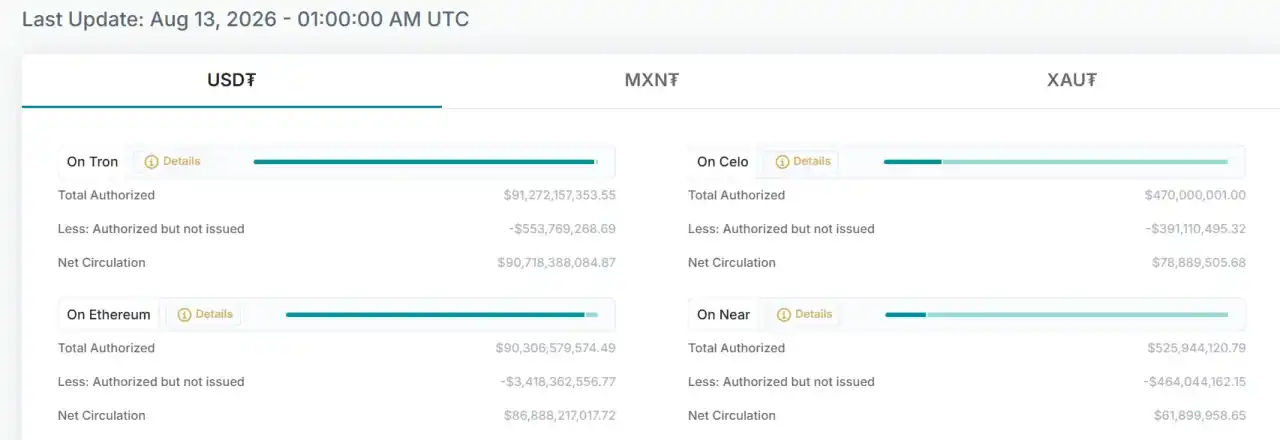
According to Tether's official data, as of August 13, 2026, the supply of USDT on the TRON network has increased by another $10 billion, reaching $91.2 billion. This has once again surpassed the USDT supply on the Ethereum network ($90.3 billion), making TRON the largest USDT issuance network globally. This milestone reinforces TRON's dominant position in the stablecoin sector and highlights the sustained appeal of its low-fee, high-efficiency settlement network for global stablecoin capital. The growth of TRC20-USDT is driven by genuine, sustainable demand. By August 2026, TRC20-USDT issuance on TRON exceeded $91.2 billion, with approximately 75.47 million holding accounts. TRON consistently handles about half of all global USDT transactions. Data shows TRON dominates in retail and small-to-medium value transfers, with its main use case being direct peer-to-peer value transfers for purposes like remittances, merchant payments, and freelance settlements. In Q1 2026 alone, TRON processed approximately $2.04 trillion in USDT transfer volume. TRON is also strengthening its infrastructure through broader ecosystem access, user experience improvements like GasFree mechanisms, and enhanced security governance. A key initiative is the T3 Financial Crime Unit (T3 FCU), a collaboration between TRON, Tether, and TRM Labs. By May 2026, T3 FCU had frozen over $450 million in illicit assets across 23 jurisdictions, demonstrating how blockchain transparency combined with public-private c...

According to official Tether data, as of August 13, 2026, the on-chain USDT issuance on the Tron Network increased by another $10 billion to reach $91.2 billion, once again surpassing the USDT issuance on the Ethereum network ($90.3 billion) to claim the top spot among all blockchain networks. This historic milestone further solidifies Tron's dominant position in the stablecoin sector and reaffirms the continued attractiveness of low-fee, high-efficiency settlement networks for global stablecoin capital.
From Trading Asset to Settlement Tool: TRC20-USDT Use Cases Continue to Expand

The growth of USDT on the Tron Network stems first and foremost from sustainable real-world usage demand. As of August 2026, the issuance of TRC20-USDT on the Tron Network officially surpassed $91.2 billion, setting a new historical record, with a cumulative increase of approximately 10 billion tokens year-to-date. The number of holding accounts has reached approximately 75.47 million. This volume means Tron has long carried about half of the global USDT issuance share, accounting for approximately 50%.

From a usage structure perspective, Tron's real-world payment attributes are becoming increasingly clear. CoinDesk Research data shows that in Q1 2026, Tron's quarterly average of daily active accounts rose to approximately 3.2 million, setting a new quarterly high. Meanwhile, Tron's share of retail USDT transfers under $1,000 is about 50%, and it maintains a dominant position in the $1,000 to $100,000 range, continuously reinforcing its positioning as a "user-friendly" public chain for retail and small-to-medium value settlements. This indicates that one of the primary uses of USDT on Tron has consistently been for actual value transfer between wallets.

Observing over a longer period, on-chain transfer and settlement volumes support this assessment. A Messari research report indicates that in Q1 2026, the USDT transfer volume processed by the Tron Network reached approximately $2.04 trillion, with a total of about 950 million transactions network-wide. Daily average transactions increased from about 10.2 million in the previous quarter to about 10.9 million, also setting a new quarterly record. Since the beginning of 2026, Tron has led all public chains with an annual USDT transfer volume of approximately $4.2 trillion.

This paints a picture not of ledger entries within a single trading platform, but of a vast number of wallets directly completing value transfers on an open blockchain.

Specifically, an overseas worker can send USDT to a family member's wallet, and the recipient can convert it into local currency; cross-border e-commerce merchants can settle payments with suppliers using USDT, reducing the impact of bank operating hours and intermediary bank processes; freelancers can receive payments from international clients and have on-chain confirmations within minutes; digital asset service providers can move liquidity between exchanges, custody wallets, and market-making accounts. The amounts and purposes differ across cases, but the common requirements are fast arrival, transparent fees, and 24/7 operation.

Furthermore, cost stability is particularly important in market environments with volatile network fees. Since August 2025, when Tron passed Governance Proposal 104, reducing the energy unit price by approximately 60%, on-chain transfer costs have been further lowered.

Ecological Integration and Security Collaboration Advance in Parallel, Stablecoin Infrastructure Continuously Improving

The long-term development of a stablecoin network depends not only on issuance volume but also on entry point coverage, liquidity depth, developer support, and risk governance capabilities. Tron is simultaneously building infrastructure in these directions.

In terms of application entry points, widespread support for TRC20-USDT by wallets, trading platforms, payment service providers, and DeFi protocols enables users to conduct deposits, withdrawals, transfers, exchanges, and on-chain interactions relatively conveniently. With new stablecoins like USDD joining the Tron ecosystem, the variety of stablecoin assets has been further enriched; protocols like JustLend DAO extend stablecoin usage to collateral and lending scenarios. Stablecoins are gradually evolving from a single transfer tool to a foundational asset for on-chain financial activities.

Regarding user experience, mechanisms like GasFree aim to address a common pain point: new users' wallets might hold USDT but cannot initiate transactions because they lack the native token. By supporting payment of related network fees with stablecoins, such solutions help simplify the initial usage process. For merchants, wallets, and payment applications, reducing the cognitive load for users to understand bandwidth, energy, and native gas tokens is also beneficial for stablecoin services to enter broader consumer-facing scenarios.

More importantly, scale expansion needs to be synchronized with security governance capabilities. In September 2024, Tron, Tether, and TRM Labs jointly established the T3 Financial Crime Unit (T3 FCU), combining Tron's network visibility, TRM Labs' on-chain intelligence capabilities, and Tether's issuer freeze capabilities, directly collaborating with law enforcement agencies across multiple jurisdictions. A typical process is: after law enforcement identifies wallets linked to illegal activities, TRM Labs traces the fund flow, Tron provides network-level fund movement information, and Tether implements a freeze at the issuer level.

As of May 2026, the T3 FCU announced it had frozen over $450 million in illicit assets globally, covering 23 jurisdictions across five continents. TRM Labs disclosed that the mechanism can complete relevant actions within 24 hours of receiving a law enforcement request. These results demonstrate that combining the transparency of public blockchains with public-private collaboration models can improve the efficiency of identifying and responding to suspicious funds.

While continuing to lead in the stablecoin settlement sector, Tron is accelerating its bets on the new frontier of artificial intelligence. B.AI (Chinese brand name "Bai B.AI"), officially launched in April this year, is positioned as the "underlying financial infrastructure for the AI Agent era." This strategic move is consistent with Tron's deep stablecoin liquidity and its advantages in high-frequency, low-cost payments. It signifies Tron's evolution from the "world's largest stablecoin settlement network" towards becoming the "underlying infrastructure for the AI agent economy," firmly betting on the long-term trend of AI and Web3 convergence.

From leading in issuance scale to expanding payment and settlement advantages, gradually improving security mechanisms, and actively deploying in the AI field, the competitiveness of USDT on the Tron Network is transitioning from "quantitative accumulation" to "qualitative enhancement."

Tron will continue to optimize network performance and user experience around stablecoin infrastructure, deepening collaboration with issuers, wallets, payment institutions, and security analysis firms to provide global users with more efficient, secure, and inclusive digital value circulation services.

Trending Cryptos

Related Questions

QAccording to the article, what milestone did Tron achieve regarding USDT issuance on August 13, 2026?

AAs of August 13, 2026, Tron became the largest network for USDT issuance again, with its on-chain USDT supply reaching $91.2 billion, surpassing Ethereum's supply of $90.3 billion.

QWhat are some of the primary use cases for TRC20-USDT on the Tron network mentioned in the text?

APrimary use cases include real value transfers between wallets for purposes such as overseas workers sending money to family, e-commerce merchants settling with suppliers, freelancers receiving payments from international clients, and digital asset service providers moving liquidity between accounts. These rely on fast settlement, transparent fees, and 24/7 operation.

QWhat is the T3 Financial Crime Unit (T3 FCU) and what is its purpose?

AThe T3 Financial Crime Unit (T3 FCU) is a collaboration established in September 2024 between Tron, Tether, and TRM Labs. Its purpose is to combat financial crime by combining Tron's network visibility, TRM Labs' on-chain intelligence, and Tether's issuer-level freezing capabilities to identify, track, and freeze assets linked to illicit activities in coordination with law enforcement agencies worldwide.

QHow did the Tron network's transaction activity perform in Q1 2026, according to the article?

AIn Q1 2026, the Tron network processed approximately $2.04 trillion in USDT transfer volume, handled a cumulative total of about 950 million transactions, and saw its average daily transactions rise to about 10.9 million, setting a new quarterly record.

QWhat new strategic area is Tron accelerating its investment in, as stated in the final part of the article?

ATron is accelerating its investment in the artificial intelligence (AI) sector, specifically through the launch of B.AI in April, which is positioned as the underlying financial infrastructure for the 'AI Agent era.' This marks Tron's strategic move from being the 'world's largest stablecoin settlement network' towards becoming the 'underlying infrastructure for the AI agent economy.'

Related Reads

Elon Musk Building Terafab: The Largest Chip Factory for AI, Robots, and Space Data Centers

Elon Musk's SpaceX and Tesla have launched the Terafab project to build a massive semiconductor facility in Grimes County, Texas. The plant, exceeding 9.3 million square meters, aims to integrate logic chip manufacturing, memory production, advanced packaging, and testing. The initial phase requires $16.8 billion in capital investment, with a long-term goal of producing over 1 terawatt of computing power annually. This capacity will support Tesla's Optimus robots and Cybercab autonomous vehicles, as well as SpaceX's orbital data centers. Texas Governor Greg Abbott confirmed the project's start in August 2026, highlighting 3,000 new jobs and a $30 million state grant. Elon Musk emphasized the strategic advantage of combining logic, memory, and packaging under one roof. Musk called the future complex the "largest and most valuable building on Earth," with an area roughly 50 times that of the Pentagon. Intel is the key technology partner, with plans to use its 14A process node for chip production. This partnership aims to diversify supply chains currently dominated by TSMC. The project aligns with the U.S. Pax Silica initiative to secure semiconductor supply chains. An AI analysis notes the project's scale and potential challenges, comparing it to delays seen in other U.S. megafab projects like Intel's Ohio facility. It questions whether Terafab can avoid similar pitfalls related to timelines, budgets, workforce, and supply chain stability. The facility's success could significantly shift the global semiconductor balance and strengthen the U.S. position in the tech race.

cryptonews.ru32m ago

Elon Musk Building Terafab: The Largest Chip Factory for AI, Robots, and Space Data Centers

cryptonews.ru32m ago

Elon Musk is Building Terafab: The Largest Chip Plant for AI, Robots, and Space Data Centers

Elon Musk's SpaceX and Tesla have launched the massive Terafab project to build a semiconductor plant in Grimes County, Texas. Spanning over 9.3 million square meters, the facility will integrate logic chip and memory production, advanced packaging, and testing. The initial phase requires $16.8 billion in capital investment, with a long-term goal of producing over 1 terawatt of computing power annually. This output is intended to supply Tesla's Optimus robots and Cybercab autonomous vehicles, as well as SpaceX's orbital data centers. Texas Governor Greg Abbott confirmed the project's start on August 6, 2026, highlighting the creation of 3,000 jobs and a $30 million grant from the Texas Enterprise Fund. Musk emphasized the strategic advantage of combining chip design, memory production, and packaging under one roof to accelerate hardware development. He stated the fully built complex would be "the largest and most valuable building on Earth," about 50 times larger than the Pentagon. An estimated 25% of production is earmarked for Tesla's robotics, with 75% for SpaceX's space-based AI systems. Earlier tax documents suggested a total project cost of up to $119 billion, but this has not been officially confirmed. Intel is the key technology partner, with plans to use its 14A process node for chip manufacturing. This partnership aims to diversify supply chains and reduce dependence on dominant foundries like TSMC. The initiative aligns with the broader U.S. Pax Silica program, which seeks to build secure international semiconductor supply chains with allied nations. An AI-driven analysis notes that megafab projects, such as Intel's delayed Ohio facility, often face schedule and budget overruns. While Terafab represents a significant step toward U.S. semiconductor self-sufficiency and could shift the global tech balance, its success will depend on factors like skilled labor availability, energy supply, and supply chain stability. The final outcome may not be clear until the late 2030s.

cryptonews.ru46m ago

Elon Musk is Building Terafab: The Largest Chip Plant for AI, Robots, and Space Data Centers

cryptonews.ru46m ago

"AI God of Stocks" Blowup Dragged Down, Jane Street Suffered Massive 15 Billion Loss in July, First Monthly Loss in a Decade

Jane Street, a major proprietary trading firm, suffered an estimated $15 billion loss in July, marking its first monthly loss in about a decade. The loss was primarily triggered by the blow-up of the AI-focused hedge fund Situational Awareness, which faced massive margin calls amid a sharp sell-off in AI and semiconductor stocks in July. Jane Street, an investor in the fund, was significantly impacted. Compounding the loss were substantial declines in Jane Street's own Asian non-AI equity long positions, which had performed well earlier in the year. The firm described the losses as a concentrated reversal of previously successful trading strategies in AI and tech sectors. Despite the historic monthly loss, Jane Street's net trading income for the year to date remains strong at over $40 billion. In response, the firm stated it has become more selective in risk-taking, closing specific losing exposures and reducing risk in other strategies. Coinciding with the loss, Jane Street is undergoing a major debt refinancing of approximately $14.6 billion, led by JPMorgan. The move aims to shift more debt from public markets to private investors like Pimco and Fidelity, accepting higher costs for greater flexibility and less public disclosure. The Situational Awareness incident highlights systemic risks in the prime brokerage ecosystem, where leveraged bets on crowded AI trades can lead to forced liquidations and market volatility. Jane Street's subsequent risk reduction and debt restructuring are seen as key responses to this costly lesson.

marsbit52m ago

"AI God of Stocks" Blowup Dragged Down, Jane Street Suffered Massive 15 Billion Loss in July, First Monthly Loss in a Decade

marsbit52m ago

QCP Capital Analysts Explained Why Bitcoin Stalled at $63,000

QCP Capital's latest report explains that Bitcoin has stalled around $63,000, testing the lower boundary of its recent trading range ($62,500–$64,000). The retreat wasn't due to a single catalyst but stems from several cross-market pressures: heightened geopolitical risks, rising oil prices, uncertainty around global liquidity, and a muted reaction to positive U.S. macroeconomic data. While U.S. inflation and jobs data softened, reducing expectations of imminent Fed tightening, Bitcoin's price response has been subdued. This highlights the importance of other factors like trader positioning, liquidity conditions, and overall risk appetite. The regulatory landscape is progressing on two tracks: congressional legislation (like the CLARITY Act) is delayed, but SEC rulemaking continues. Corporate treasury activity, exemplified by Strategy's new Bitcoin monetization program, now creates a potential two-way flow, adding complexity to supply dynamics. Geopolitical tensions around the Strait of Hormuz keep oil prices elevated, impacting crypto indirectly through inflation expectations and financial conditions. Historical seasonality shows August and September are typically weak for Bitcoin, but this is descriptive, not predictive, in today's ETF-driven market. In conclusion, Bitcoin has shown resilience by absorbing multiple negative forces without a decisive breakdown. However, it has failed to convert improving macro fundamentals into sustained upward momentum. The market awaits key events like the U.S. PCE data, the Jackson Hole symposium, and the September FOMC meeting for a potential catalyst to break the current range.

cryptonews.ru1h ago

QCP Capital Analysts Explained Why Bitcoin Stalled at $63,000

cryptonews.ru1h ago

Trading

Spot

Hot Articles

Discussions

Welcome to the HTX Community. Here, you can stay informed about the latest platform developments and gain access to professional market insights. Users' opinions on the price of S (S) are presented below.

活动图片