How 40.8M staked ETH could strengthen Ethereum’s edge over Bitcoin

ambcryptoPublished on 2026-07-21Last updated on 2026-07-21

Abstract

Ethereum is showing signs of strengthening against Bitcoin, driven by two key trends. First, significant whale accumulation is occurring, with large holders not just buying ETH but immediately staking 100% of it. This locks away supply, signaling long-term conviction. Ethereum's total staked ETH has reached a record 40.8 million, with a growing entry queue and 33.5% of supply now staked, further tightening liquid availability. Second, Ethereum's DeFi ecosystem is experiencing robust activity, with WETH whale transactions at a multi-year high and Total Value Locked (TVL) rising sharply. These converging factors—reduced supply from staking and increased on-chain demand—are translating into technical strength. The ETH/BTC ratio has broken above resistance and is approaching the 0.03 level, setting the stage for potential continued outperformance against Bitcoin.

Two key divergences show why Ethereum’s [ETH] outperformance against Bitcoin [BTC] may only be beginning.

Notably, Lookonchain flagged consecutive whale accumulation, with one whale withdrawing over 74,000 ETH and another more than 10,000 ETH. The key detail? Both whales staked 100% of the ETH they accumulated, marking a clear divergence from a typical whale accumulation setup. Simply put, instead of leaving the ETH idle, they’re locking it into staking, reducing the liquid supply while signaling long-term conviction.

Ethereum’s staking data only reinforces that trend. As the chart below shows, the validator exit queue currently sits at zero, while the entry queue has climbed to 2.4 million ETH. At the same time, total staked ETH has climbed to a record 40.8 million, with 33.5% of the total ETH supply now sitting in staking. To put that into perspective, users have added nearly 600,000 ETH to staking in less than ten days.
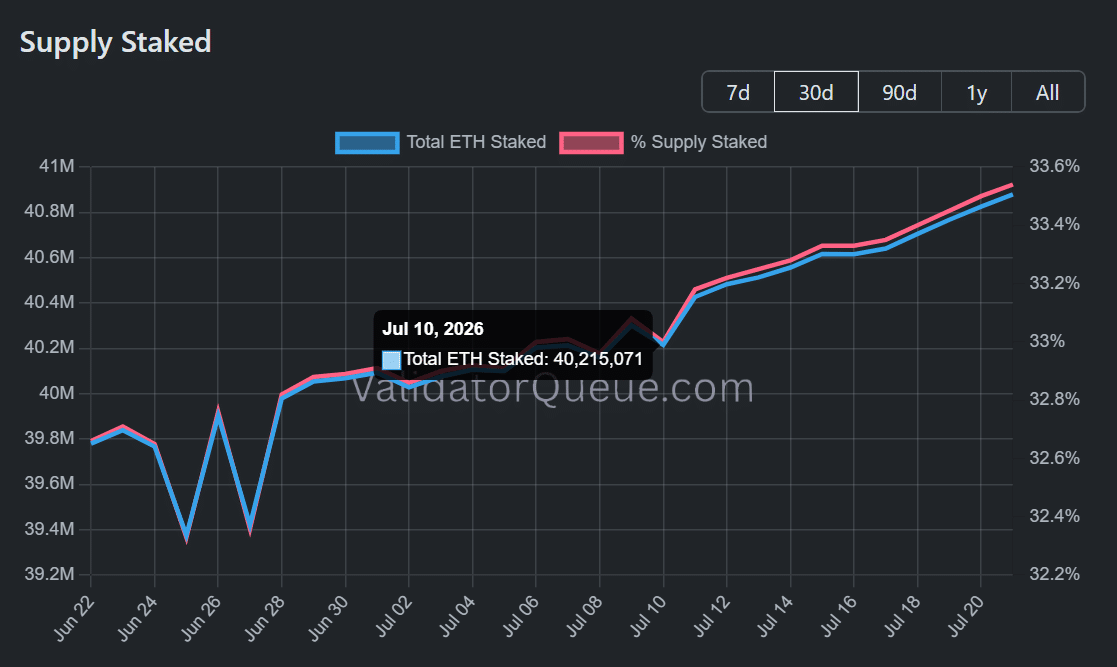
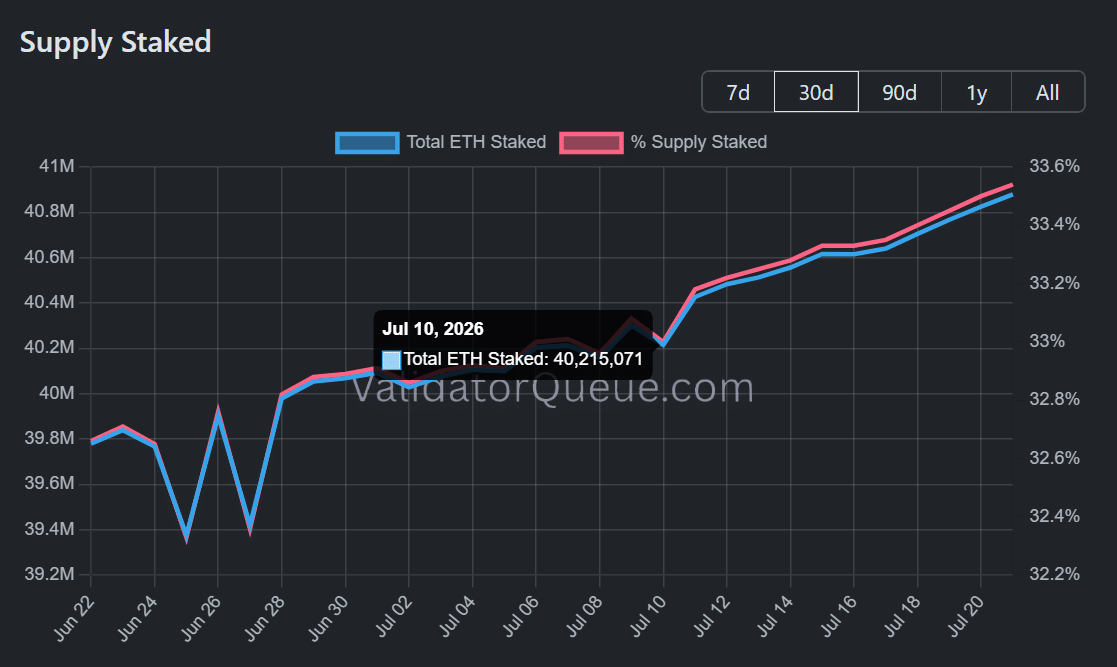
Source: ValidatorQueue

In that context, these two whales staking 100% of their newly accumulated ETH isn’t an isolated event.

Instead, it aligns with a broader trend of supply being locked away, further tightening liquid ETH as staking demand continues to grow. And the impact is starting to show on the technical side.

On the daily chart, the rise in ETH staking flows has lined up with ETH/BTC breaking above the 0.025 resistance level, showing that stronger supply dynamics are beginning to translate into better Ethereum performance against Bitcoin.

Now, looking at the second divergence. While staking flows highlight long-term conviction, Ethereum’s DeFi ecosystem adds another important layer by shaping liquidity and on-chain activity across the network, creating another tailwind for Ethereum’s performance against Bitcoin.

Ethereum accumulation signals a bigger move

Random accumulation doesn’t really mean much on its own.

However, Ethereum’s whale accumulation is telling a much bigger story. While staking flows support long-term conviction, combining that with strong DeFi flows adds another layer of strength to Ethereum’s ecosystem. Currently, this combination could be highlighting ETH’s underlying demand.

As the chart below shows, Wrapped Ethereum (WETH) recorded 113k whale transactions above $100k over the past week, marking its highest level since May 2021. This shows that large players are becoming more active on-chain. With Ethereum’s TVL also increasing by over $5 billion in less than ten days, the data points to rising liquidity and stronger activity across the Ethereum ecosystem.
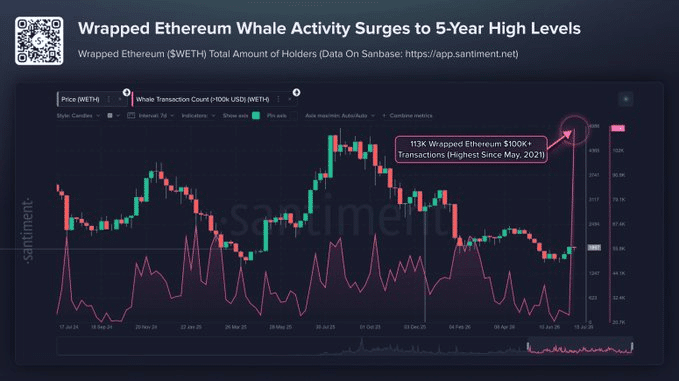
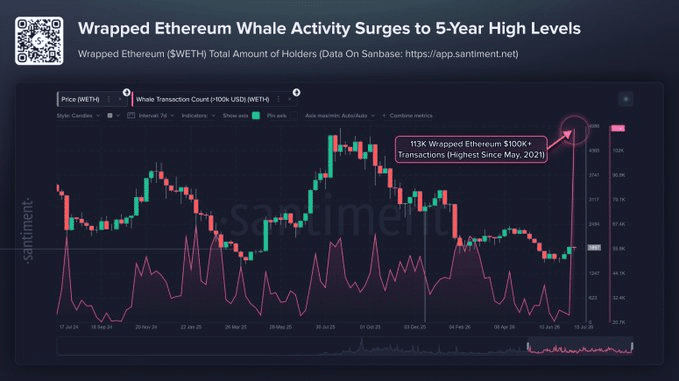
Source: Santiment

And the impact is starting to show.

On the technical side, Ethereum just posted its strongest weekly close against Bitcoin in eleven weeks. With the ETH/BTC ratio now approaching the key 0.03 resistance zone, the ongoing supply squeeze is adding more strength to the breakout setup, setting the stage for the next leg of ETH’s outperformance against BTC.


Final Summary

  • Whales are buying ETH and locking it into staking, reducing available supply while DeFi activity continues to grow.
  • ETH/BTC is showing strength, with the ratio nearing key resistance as supply tightening supports a potential breakout.


Trending Cryptos

Related Questions

QAccording to the article, what is the key difference between the recent whale accumulation of ETH and a typical whale accumulation setup?

AThe key difference is that the whales mentioned staked 100% of the ETH they accumulated, rather than leaving it idle. This locks the supply into staking, signaling long-term conviction and reducing the liquid supply.

QWhat specific data point does the article use to show the strong and growing demand for Ethereum staking?

AThe article states that the validator entry queue has climbed to 2.4 million ETH, while the exit queue is zero. Furthermore, nearly 600,000 ETH was added to staking in less than ten days, bringing the total staked ETH to a record 40.8 million.

QBesides staking flows, what other ecosystem factor does the article say is creating a tailwind for Ethereum's performance against Bitcoin?

AThe article cites Ethereum's DeFi (Decentralized Finance) ecosystem as another important factor. It shapes liquidity and on-chain activity, with rising Total Value Locked (TVL) and high whale transaction counts indicating stronger network activity.

QWhat on-chain metric for Wrapped Ethereum (WETH) reached its highest level since May 2021, and what does it signify?

AWETH recorded 113,000 whale transactions above $100,000 in the past week, its highest level since May 2021. This signifies that large players are becoming significantly more active on the Ethereum network.

QWhat is the key technical resistance level that the ETH/BTC ratio is approaching, according to the article's conclusion?

AThe ETH/BTC ratio is approaching the key 0.03 resistance zone. The ongoing supply squeeze from staking is adding strength to this breakout setup.

Related Reads

SEC Proposal a ‘Significant’ Step Forward From ‘Ill-Suited’ Crypto Rules: Commissioner Peirce

A U.S. Securities and Exchange Commission (SEC) commissioner, Hester M. Peirce, has called a new SEC proposal a significant improvement over what she termed a "misfit" set of crypto rules. Peirce stated that a whole generation has struggled due to the SEC's insistence on applying unsuitable regulations to cryptocurrencies, but the new proposal moves toward "clear, sensible, and enforceable rules for crypto offerings." SEC Chairman Paul S. Atkins also welcomed the initiative, noting in a separate statement that the agency's previous enforcement-heavy approach had driven investment overseas, limiting investor protections domestically. The proposal, announced on Tuesday, outlines new rules aimed at creating a clear and purposeful framework for certain investment contracts involving crypto assets, designed to allow organizations to raise capital while protecting investors. This move comes shortly after the U.S. Senate failed to advance the comprehensive Digital Asset Market Clarity (CLARITY) Act. Atkins had previously stated the SEC was prepared to develop rules for digital assets if the Senate could not pass the CLARITY Act. Meanwhile, Galaxy Digital has lowered its estimated odds of the CLARITY Act passing by 2026 to just 10%, citing numerous unresolved policy questions and the Senate's limited time—only about two to three weeks after reconvening on September 14—to pass it.

cryptonews.ru10m ago

SEC Proposal a ‘Significant’ Step Forward From ‘Ill-Suited’ Crypto Rules: Commissioner Peirce

cryptonews.ru10m ago

13F Reveals New Signal: AI Has Not Faded, Wall Street Is Just Getting 'Pickier'

Title: 13F New Signal: AI Is Not Receding, Wall Street Just Became "Selective" Analysis of 13F filings from the second quarter of 2026, which disclose institutional holdings, reveals a key trend: the AI investment theme persists, but Wall Street is now scrutinizing opportunities more selectively rather than chasing the sector broadly. While nearly 44% of the 6,371 institutions analyzed reduced holdings in the "Magnificent Seven" tech giants, semiconductors saw net buying from 48% of institutions. This indicates the core AI infrastructure thesis remains intact. However, significant internal shifts are occurring as major funds prioritize "risk-reward" or "betting odds" over simple sector exposure. Four prominent investors exemplify this new selectivity: 1. **Berkshire Hathaway** made a major new bet on Alphabet, valuing its strong cash flow and core businesses despite AI-related uncertainties. 2. **Tiger Global** reduced crowded mega-cap tech positions (e.g., Alphabet, NVIDIA) but increased exposure to other AI-related names like AMD and semiconductor manufacturing, rebalancing within the theme. 3. **Third Point** fully exited several first-wave AI winners (NVIDIA, Broadcom) to lock in gains, reallocating to names like Alphabet and Taiwan Semiconductor, and diversifying into media and industrials. 4. **Duquesne Family Office** (Stanley Druckenmiller) also sold some semiconductor holdings while buying others (e.g., Taiwan Semiconductor), focusing on individual companies' valuation and expectation gaps rather than the sector beta. Key conclusions from the filings: * **Alphabet is becoming a "divisive asset"** with significant institutional disagreement, representing a potential source of alpha. * The **"buy any chip stock" phase is over**. Semiconductor investing is now an alpha game, requiring stock-specific analysis over blanket sector bets. * **Non-AI assets are reappearing** in portfolios (e.g., airlines, homebuilders, media) as diversification and correlation-management tools. In summary, the AI investment cycle has not ended, but the phase of easy, broad-based gains is concluding. The next phase will be defined by selective stock-picking and precise calculation of risk versus reward within the AI ecosystem.

marsbit34m ago

13F Reveals New Signal: AI Has Not Faded, Wall Street Is Just Getting 'Pickier'

marsbit34m ago

Trading

Spot

Hot Articles

Discussions

Welcome to the HTX Community. Here, you can stay informed about the latest platform developments and gain access to professional market insights. Users' opinions on the price of S (S) are presented below.

活动图片