TRUMP holds $1.50 – Breakout setup or another Q3 bull trap?

ambcryptoPublished on 2026-07-20Last updated on 2026-07-20

Abstract

The TRUMP memecoin is consolidating around $1.50 with rising Open Interest (OI), hinting at a potential breakout setup as bulls buy the dip. However, the broader context is bearish. TRUMP is down over 5.3% in Q3, underperforming Bitcoin and continuing a streak of quarterly losses. Bullish catalysts are fading, including declining odds for the pro-crypto CLARITY Act. With the wider memecoin sector struggling and speculative demand cooling, TRUMP's recent bounce may be a short-term rotation rather than a reversal. A break below $1.50 support could confirm a bull trap, leading to a deeper Q3 breakdown.

With bullish catalysts fading, is TRUMP’s bearish Q3 trend only just beginning?

Zooming in, the setup looks less straightforward. The Official Trump memecoin has been holding a tight consolidation range around the $1.5 level, with nearly two weeks of steady upside, hinting that a potential accumulation zone could be forming as bulls continue to buy the dip.

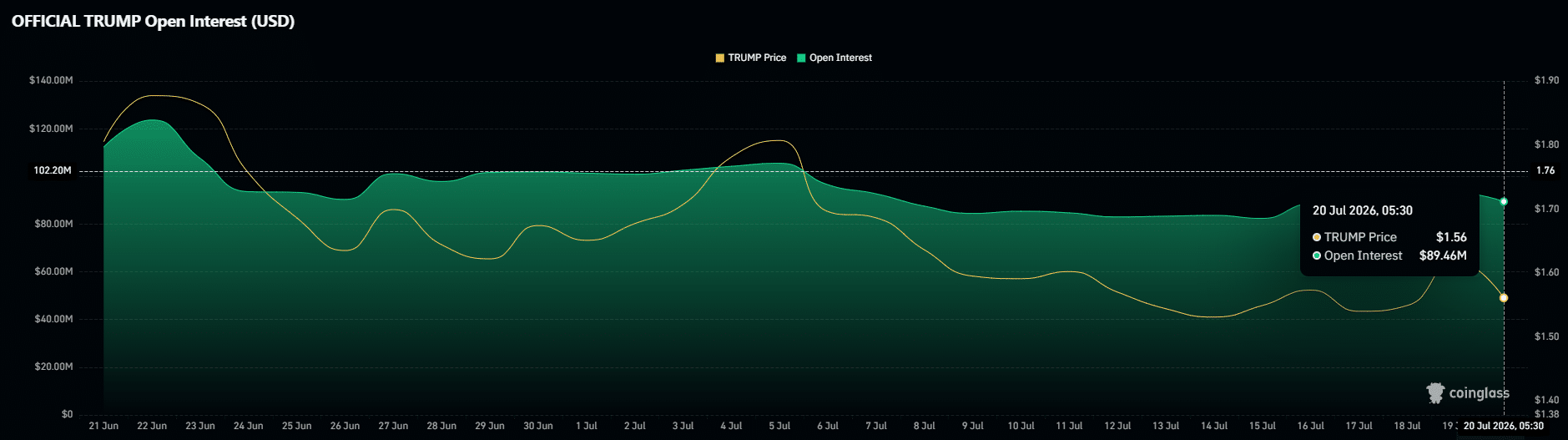
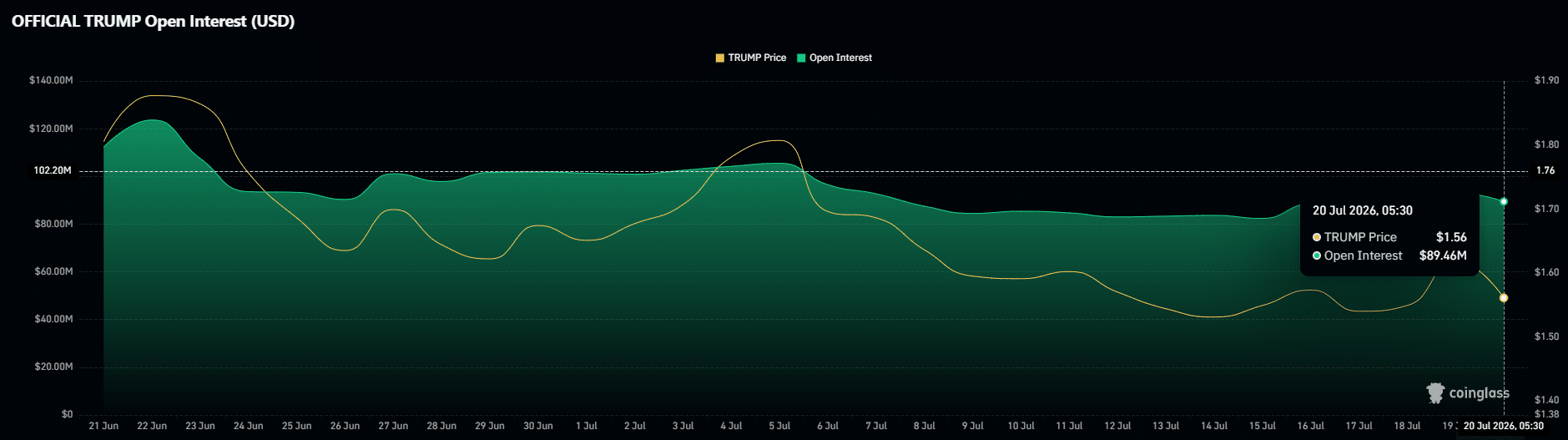
TRUMP’s rising Open Interest (OI) is adding another bullish angle. As the chart below shows, Open Interest has climbed back toward early July levels, approaching the $100 million mark.

Interestingly, nearly $10 million in OI has been added this week alone, matching the token’s tight range consolidation.
Source: CoinGlass

Technically, rising OI when the price is compressed often signals that traders are positioning for a big move.

Zooming out, though, the broader setup starts to look weaker. TRUMP is currently down over 5.3% in Q3, which may seem minor at first glance.

But compared with Bitcoin’s nearly 10% during the same period and TRUMP’s streak of six straight quarterly losses, the risk of another Q3 breakdown cannot be ignored.

This is especially notable as one of Official Trump’s [TRUMP] major bullish catalysts begins to lose momentum. So, with sentiment shifting, is the current 5% decline just the start of a larger Q3 breakdown?

TRUMP breakout hopes meet fading catalysts

TRUMP’s technical weakness is becoming a bearish outliner.

Looking across the memecoin sector, the overall setup looks weak, with total market cap down over 15% in the past 30 days. This shows that despite the broader macro FUD, investor appetite for speculative assets continues to cool.

However, a few names are still bucking the trend and attracting fresh capital.

Take Pepe [PEPE], for example, which has gained over 20% in Q3, showing that selective demand still exists even as the broader memecoin market struggles. Unfortunately for TRUMP, it has yet to join that group of outperformers.
Source: Polymarket

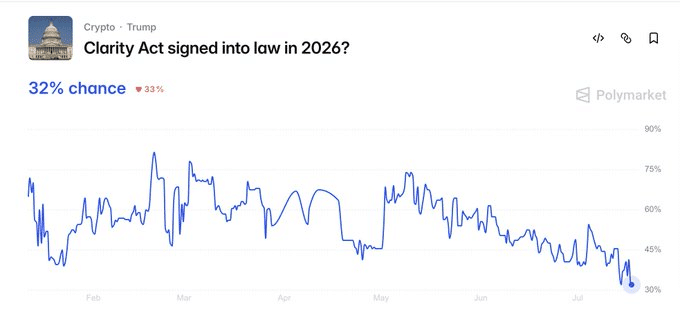
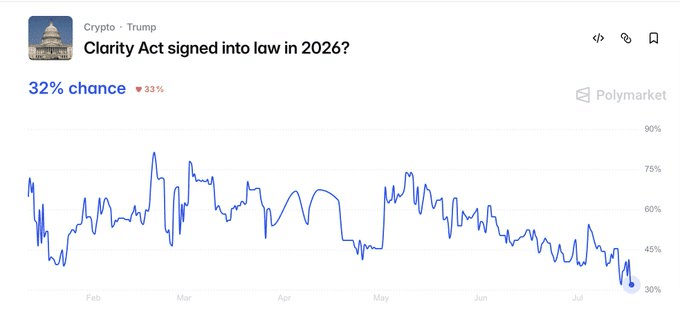
Adding to the pressure, recent Polymarket odds show the chances of the CLARITY Act becoming law by the end of 2026 have fallen to a record low of 32%, weakening a major bullish catalyst.

Against this backdrop, TRUMP’s quarterly weakness looks like a broader trend issue.

With the broader memecoin sector struggling, momentum around the CLARITY Act fading, and speculative demand becoming more selective, TRUMP is failing to attract consistent capital inflows.

This makes the recent bounce look more like a short-term rotation rather than a confirmed reversal, putting the rising OI under the microscope.

If this setup holds and TRUMP breaks below the $1.5 support level, the recent recovery could be a bull trap, raising the risk of a deeper Q3 breakdown.


Final Summary

  • TRUMP is holding near $1.50, with rising Open Interest suggesting traders are preparing for a bigger move.
  • With memecoin demand cooling and CLARITY Act hopes fading, TRUMP’s recent bounce could turn into a bull trap.

Related Questions

QWhat are the two main possibilities for TRUMP's price action suggested by the article's title?

AThe article's title suggests TRUMP's price holding at $1.50 could either be a breakout setup or a Q3 bull trap.

QWhat are the two conflicting signals mentioned regarding TRUMP's current price setup?

AThe conflicting signals are: 1) A tight consolidation range and rising Open Interest hinting at a potential accumulation/breakout. 2) Broader market weakness, fading catalysts, and the token's poor quarterly performance suggesting a potential breakdown.

QAccording to the article, what is the primary bullish catalyst for TRUMP that is losing momentum?

AThe primary bullish catalyst losing momentum is the CLARITY Act, as Polymarket odds for it becoming law by end-2026 have fallen to a record low of 32%.

QHow does TRUMP's Q3 performance compare to Bitcoin's and the broader memecoin sector?

ATRUMP is down over 5.3% in Q3, underperforming Bitcoin's nearly 10% gain in the same period. It also contrasts with the broader memecoin sector's ~15% drop and specific outperformers like PEPE, which gained over 20% in Q3.

QWhat does the rising Open Interest (OI) combined with a compressed price range typically signal, according to the article?

ATechnically, rising Open Interest when the price is compressed often signals that traders are positioning for a big move.

Related Reads

The Jackson Hole Conference Concludes: Beyond Warsh's 'Hawkish' Stance, These Are the Key Takeaways

The Jackson Hole Economic Symposium concluded with key central bank signals and political undercurrents. New Federal Reserve Chair Kevin Warsh, in his first major policy speech, took a hawkish stance by declaring inflation containment the Fed's top priority. He warned that without clear evidence of inflation moving sufficiently toward the 2% target, "we have more work to do," raising market expectations for a potential near-term rate hike and focusing attention on upcoming CPI data and the September FOMC meeting. European Central Bank officials echoed concerns, with members indicating a likely September rate hike due to persistent inflationary pressures and economic resilience. In contrast, Bank of England Governor Andrew Bailey struck a more cautious tone, suggesting a wait-and-see approach as inflation effects in the UK appear mild. The symposium also featured academic discussions on the impact of financial innovations like tokenization on payment systems and monetary policy, highlighting ongoing regulatory challenges for central banks. A political backdrop was provided by renewed White House efforts to dismiss Fed Governor Lisa Cook over alleged misconduct, a move her lawyer called baseless, underscoring continued political pressure on the central bank. Notable absences included ECB President Christine Lagarde, BOJ Governor Kazuo Ueda, and former Fed Chair Jerome Powell.

marsbit17m ago

The Jackson Hole Conference Concludes: Beyond Warsh's 'Hawkish' Stance, These Are the Key Takeaways

marsbit17m ago

Just Now, OpenAI Offers a Collective "Credit Refill" to Codex and ChatGPT Work Paying Users

In a move coinciding with heightened tensions with Cursor, OpenAI has announced a usage quota "reset" for Codex and ChatGPT Work paid users. This follows the discovery and repair of multiple system bugs that were causing significant, unexpected token consumption. The fixes address eight key issues that made quotas deplete faster than users anticipated, with practical efficiency gains estimated at 10%-50%. Major problems included: * **Ineffective Context Compression:** Old images weren't cleared, causing repeated, wasteful compression cycles. * **Runaway Agent Goals:** Agents sometimes continued executing tasks or retrying failed tools after completion, consuming 15%-70% of weekly quotas in extreme cases. * **Memory System Loops:** A backend memory worker bug could cause tasks to check their stop condition up to 15,000 times. * **Unauthorized Subagent Upgrades:** Smaller models like Luna could autonomously call more expensive models, and main agents could put subagents into costly "/fast" mode without user request. * **Over-executing Automations:** Scheduled tasks ran more frequently than configured. * **Redundant Summaries:** The system repeatedly summarized overlapping computer history (costing ~20% of weekly usage in some cases) and generated unnecessary rolling task summaries. * **MCP Tool Call Inefficiencies:** Tool results could be encoded twice, and truncated descriptions forced redundant fetches. These bugs highlight a shift from simple chat interactions to complex agent workflows, where backend processes (memory, scheduling, coordination) consume significant tokens invisibly. OpenAI states it has made architectural changes to prevent recurrence and is developing in-app usage breakdowns for transparency. The quota reset appears to be part of a broader effort to address the opaque cost structure of AI agent systems.

marsbit2h ago

Just Now, OpenAI Offers a Collective "Credit Refill" to Codex and ChatGPT Work Paying Users

marsbit2h ago

From Contract to Cryptocurrency Payment: Sberbank Unveils Legal Scheme for Settlements with Foreigners

Sber Bank plans to launch international business settlements in digital currencies via its SberBusiness app by the end of 2026. The bank's deputy chairman, Anatoly Popov, announced this ahead of the Eastern Economic Forum, stating the goal is to simplify digital currency use for businesses in cross-border trade. The legal basis is Federal Law No. 282-FZ "On Digital Currency and Digital Rights," effective September 1, 2026, which permits foreign trade crypto settlements through licensed intermediaries. A published guide outlines the process: a company signs a contract, transfers rubles to a licensed intermediary, who then buys and sends cryptocurrency to the recipient, with reporting for regulators generated automatically. This service is positioned as an alternative channel for foreign trade, especially where traditional bank transfers face sanctions. Sber aims to integrate crypto payments into standard business tools within SberBusiness, avoiding the need for specialized technical knowledge. Development will depend on the practical application of the new law. From a macro perspective, this initiative is seen not just as a technical innovation but also within the context of sanctions pressure on crypto markets. The article notes that licensed intermediaries could become targets for secondary sanctions, as seen with UK actions against crypto exchanges in summer 2026. The long-term viability of Sber's scheme may depend more on political dynamics than technology, following a historical pattern where new payment channels face regulatory countermeasures.

cryptonews.ru4h ago

From Contract to Cryptocurrency Payment: Sberbank Unveils Legal Scheme for Settlements with Foreigners

cryptonews.ru4h ago

Trading

Spot
活动图片