Rebound or liquidation? SOL at a make or break point!

ambcryptoPublished on 2026-07-10Last updated on 2026-07-10

Abstract

Solana (SOL) traders are facing a critical juncture as market sentiment hits yearly lows. Trading volume has plummeted to approximately $2.27 billion, its lowest in 2026, while negative sentiment has surged significantly. This frustration stems from SOL's price performance lagging behind its growing ecosystem activity. Despite the prevailing negativity, which can sometimes precede a bullish reversal, the derivatives market shows a heavy skew towards long positions, with $7.4 billion in long exposure versus $3.1 billion in shorts. A major cluster of long liquidations sits around $61-$62, posing a risk if the price declines. Although technical indicators like the RSI are neutral and the MACD is positive, the upward momentum is cooling. SOL's price, near $77.95, is testing resistance. The crowded long positions remain a potential source of selling pressure, meaning SOL needs to break above recent highs to rebuild trader confidence and avoid a deeper downturn.

Solana [SOL] traders are openly losing confidence in the market. However, another set of long positions may still be open. Hence, the question: Will SOL rebound or fall and experience further downside?

Solana sentiment and trading activity at YTD lows

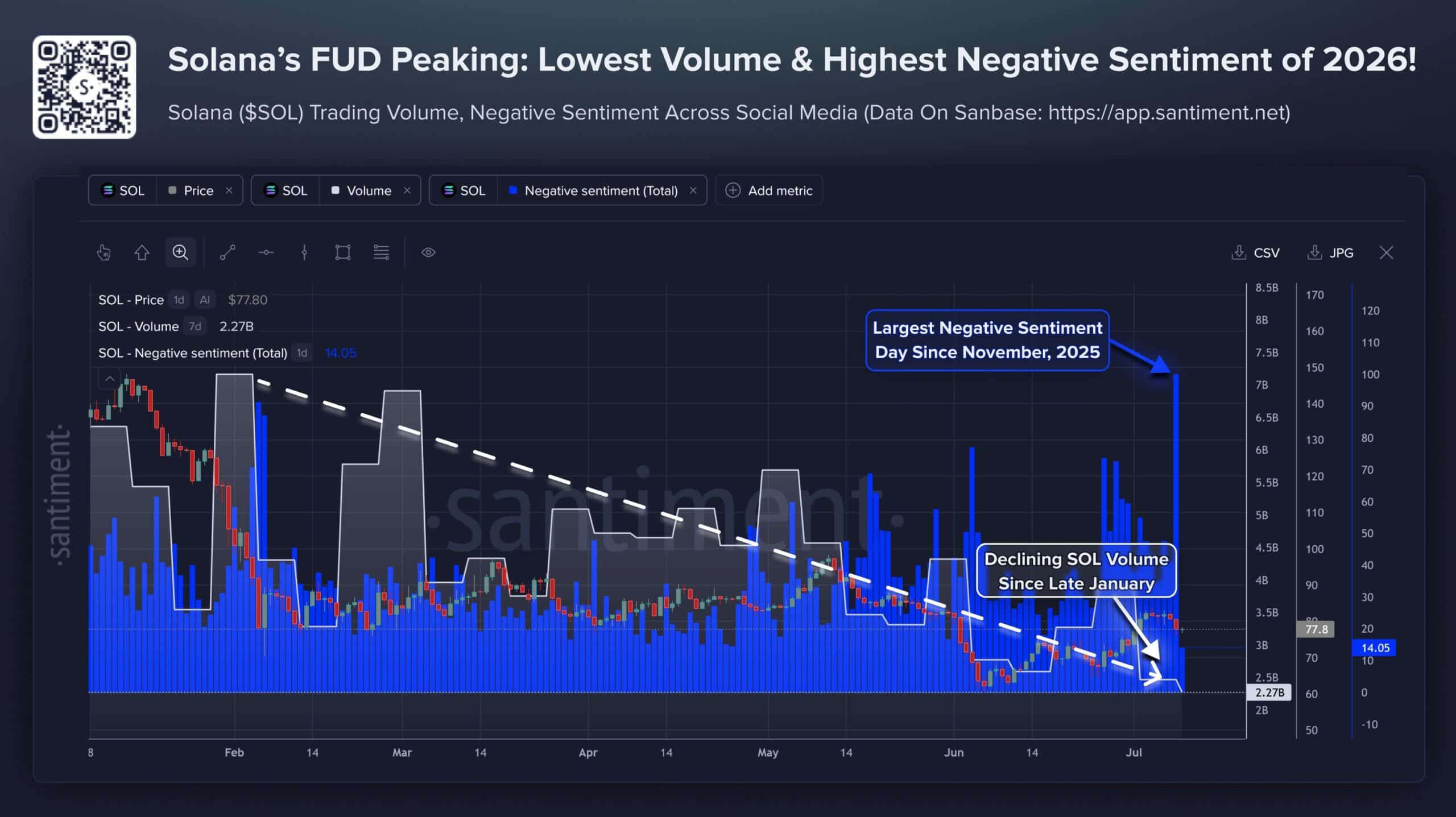
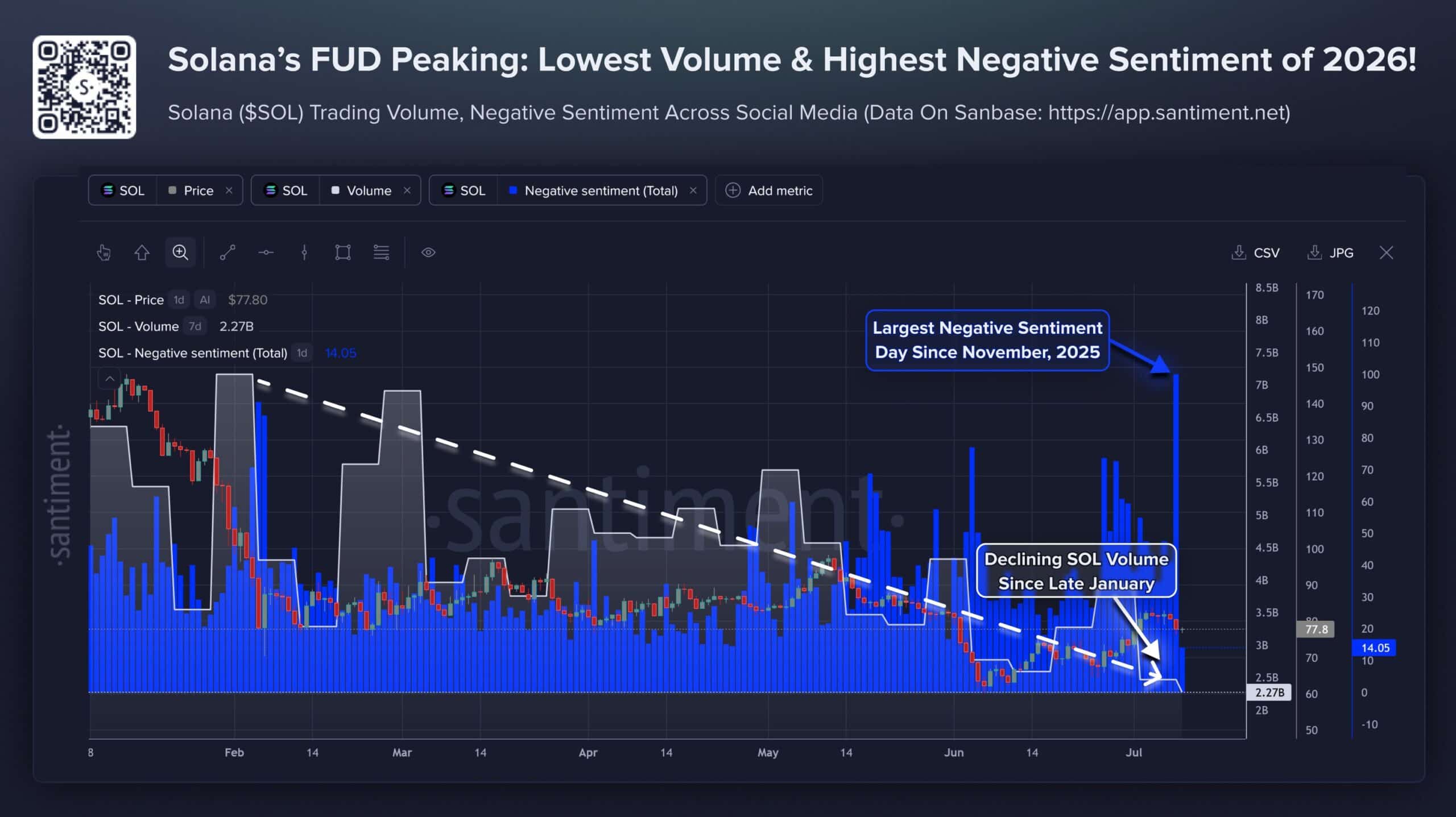
At the time of writing, SOL’s trading volume had fallen to around $2.27 billion – Its lowest level in 2026. Meanwhile, the negative sentiment score also shot up to 14.05.

This has been the biggest wave of negativity around the token since November 2025.
Source: Santiment Intelligence

Much of the frustration comes from the gap between Solana’s growing ecosystem and its price performance. Despite pickup around the tokenized stocks and RWA narratives, traders are yet to see light.

Note that extreme negativity can sometimes make room for an unexpected move up. As it stands, even a modest return of demand could lead to a positive price move.

There’s a catch though!

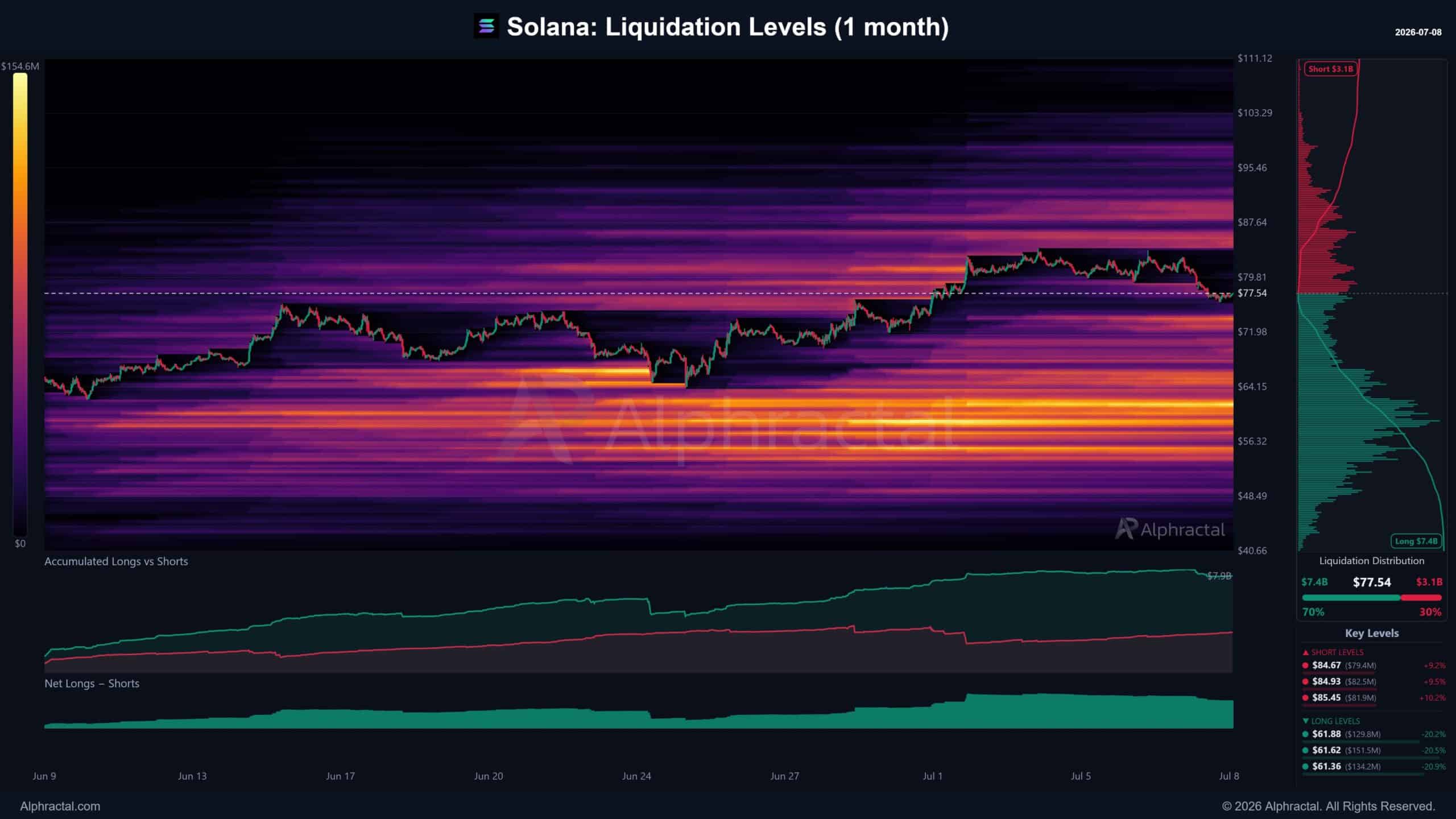
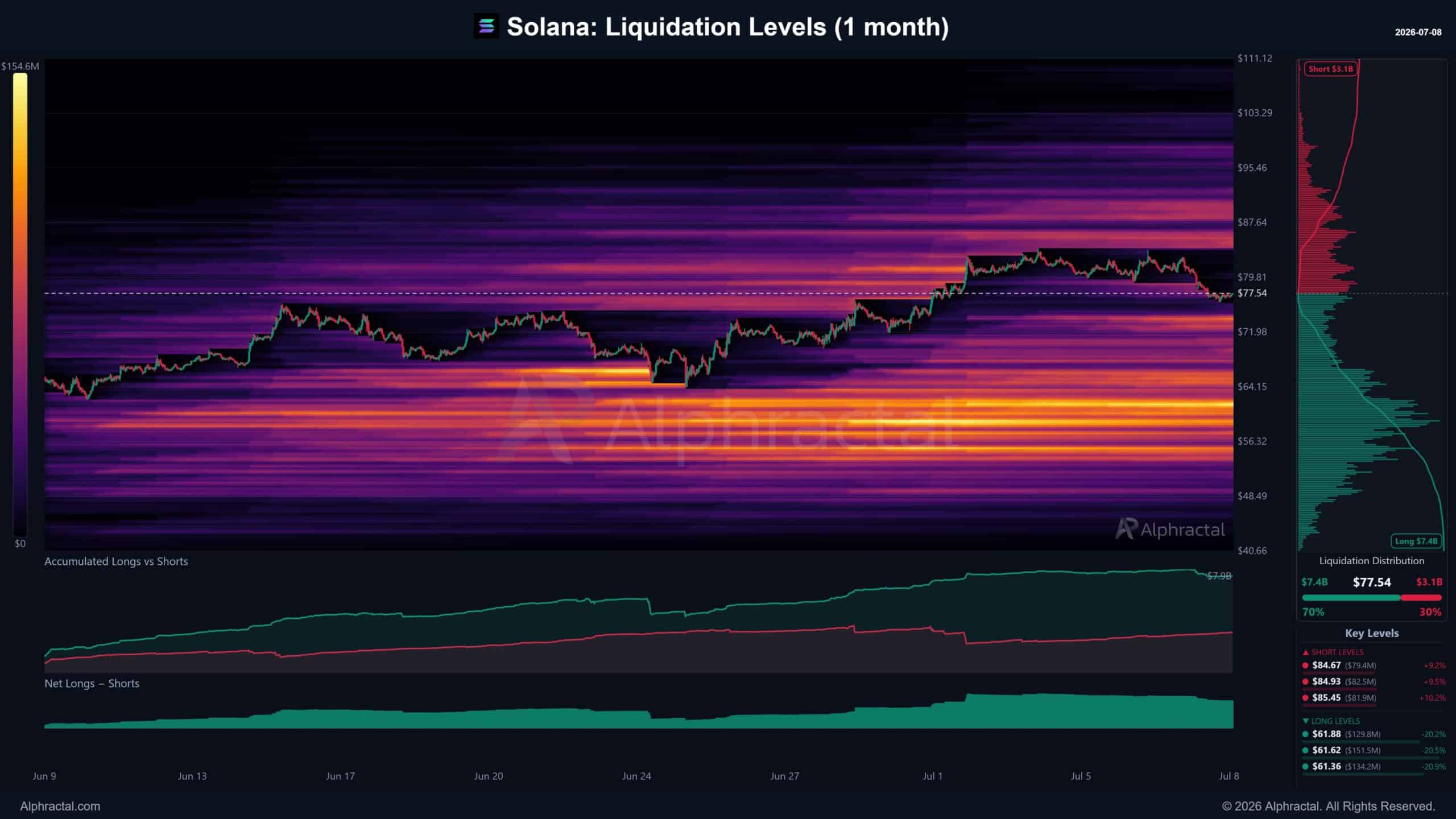
Solana’s derivatives market did seem inclined towards long positions though. In fact, the liquidation map showed around $7.4 billion in long exposure, compared to roughly $3.1 billion in shorts.
Source: Alphractal

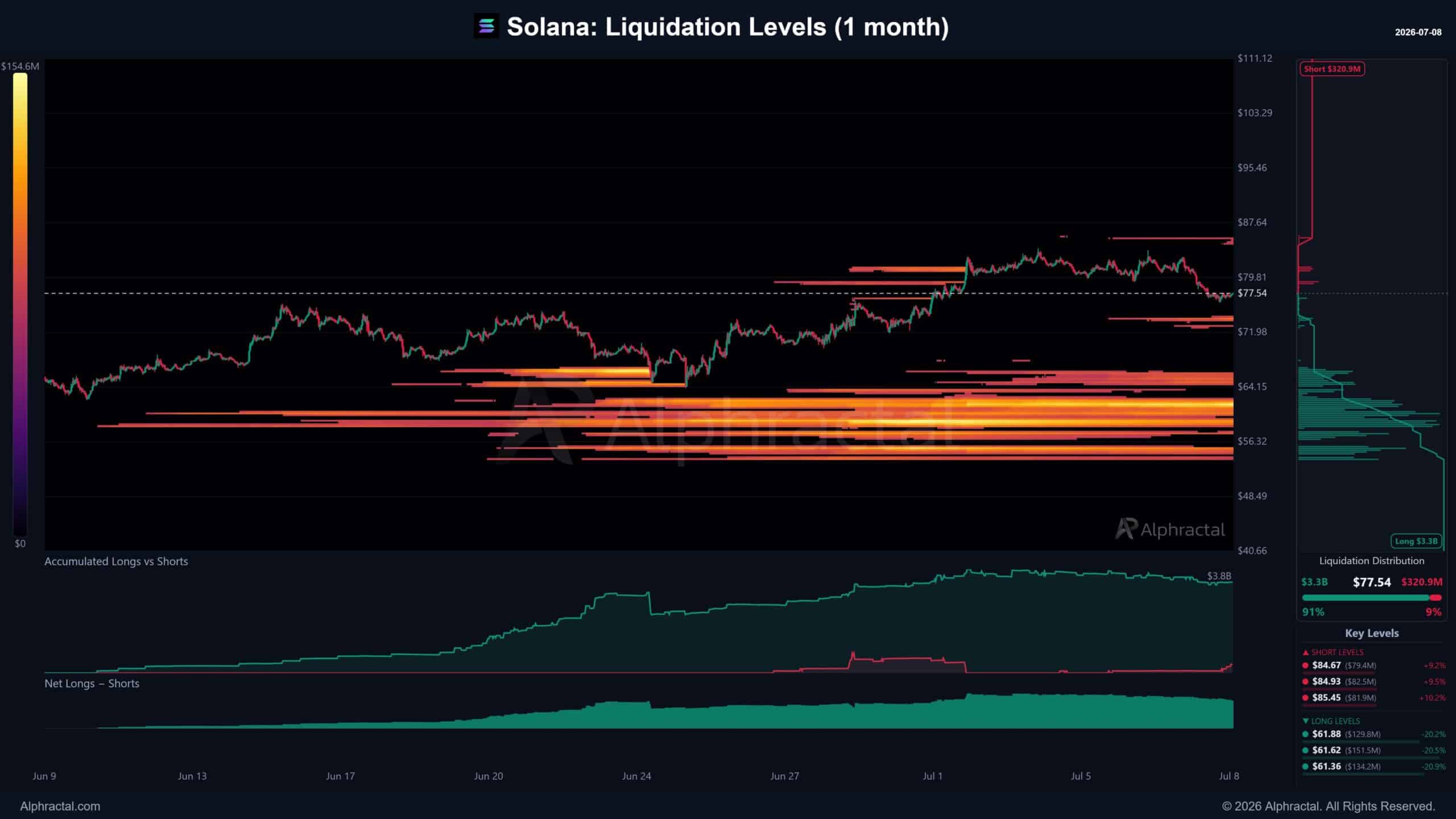
The largest long liquidation cluster was at around $61-$62, roughly 20% below the press time price.
Source: Alphractal

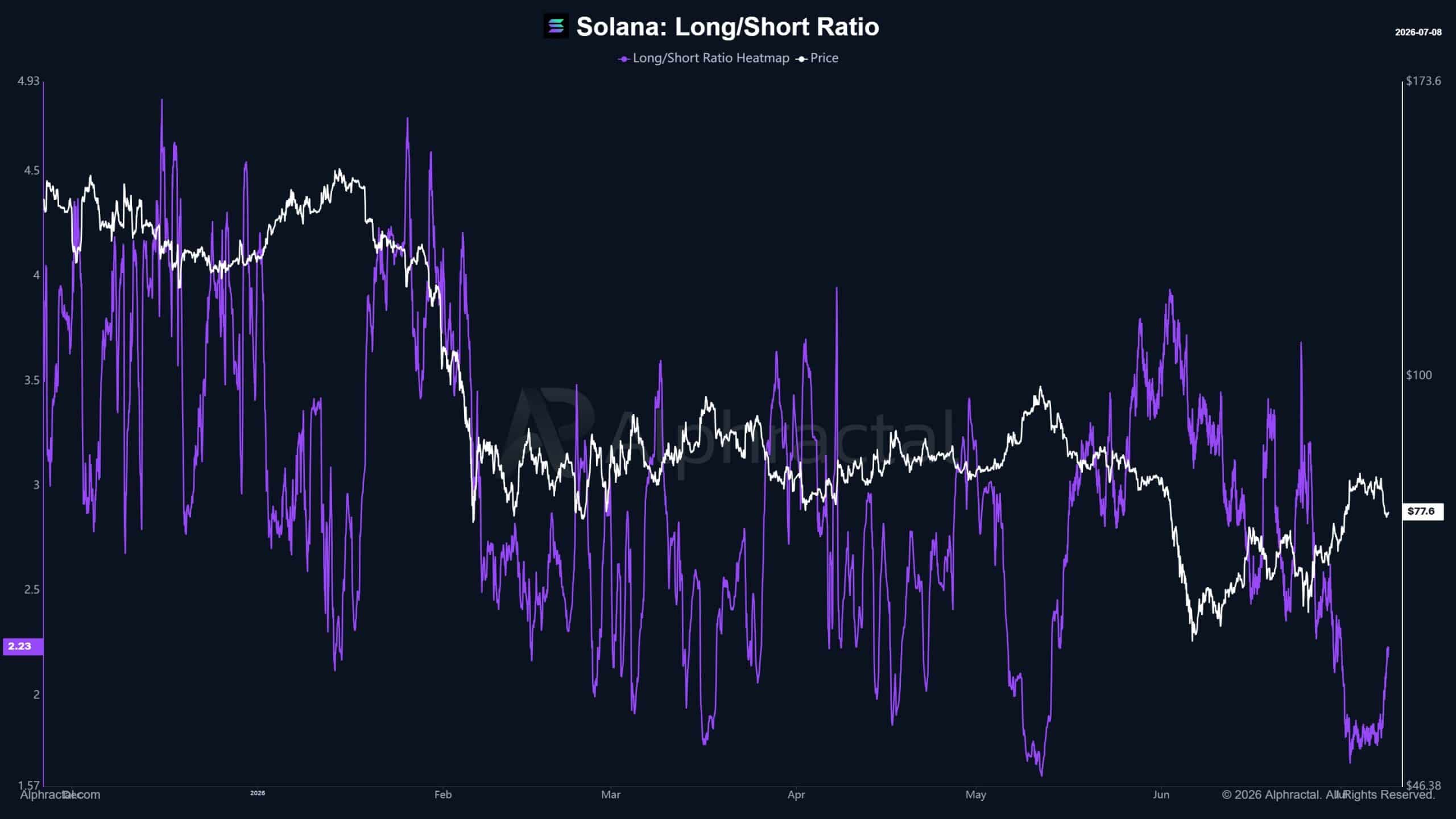
Meanwhile, the long/short ratio across major exchanges had started recovering and was near 2.23 at press time. Traders appeared to be bullish again.
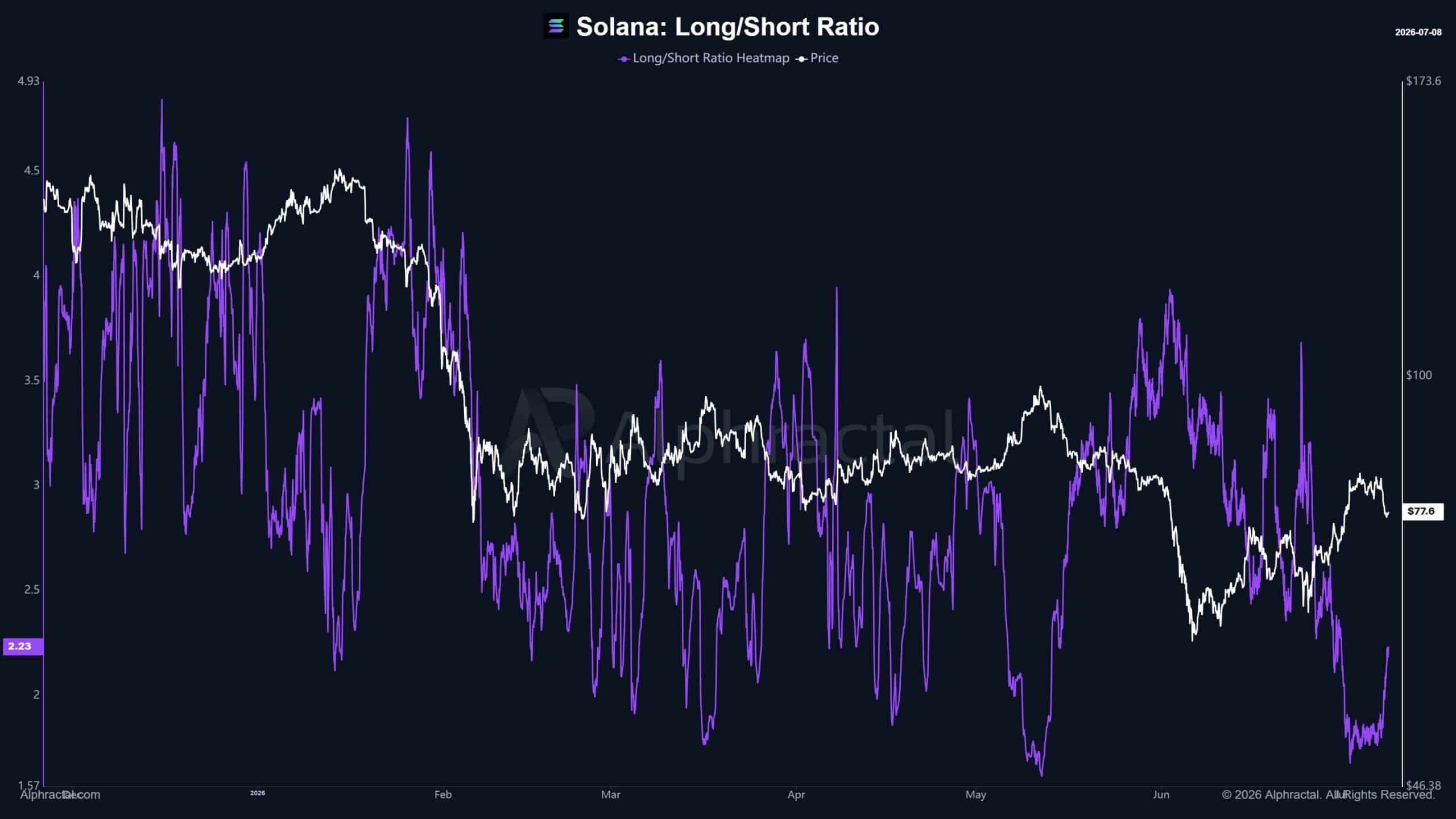
Source: Cryptoquant

Now, none of this guarantees a sell-off. However, if SOL drops, crowded long positions could add to the pressure.

SOL holds, but the bullishness is starting to cool

Despite the heavy long positioning, Solana’s price chart seemed to give way to hope. SOL was trading near $77.95 at the time of writing. It had recovered from its June lows and was testing the $82-$83 area.

The RSI was in neutral territory rather than an overbought market. The MACD was also positive, with the MACD line at 1.91, above the signal line at 1.38.
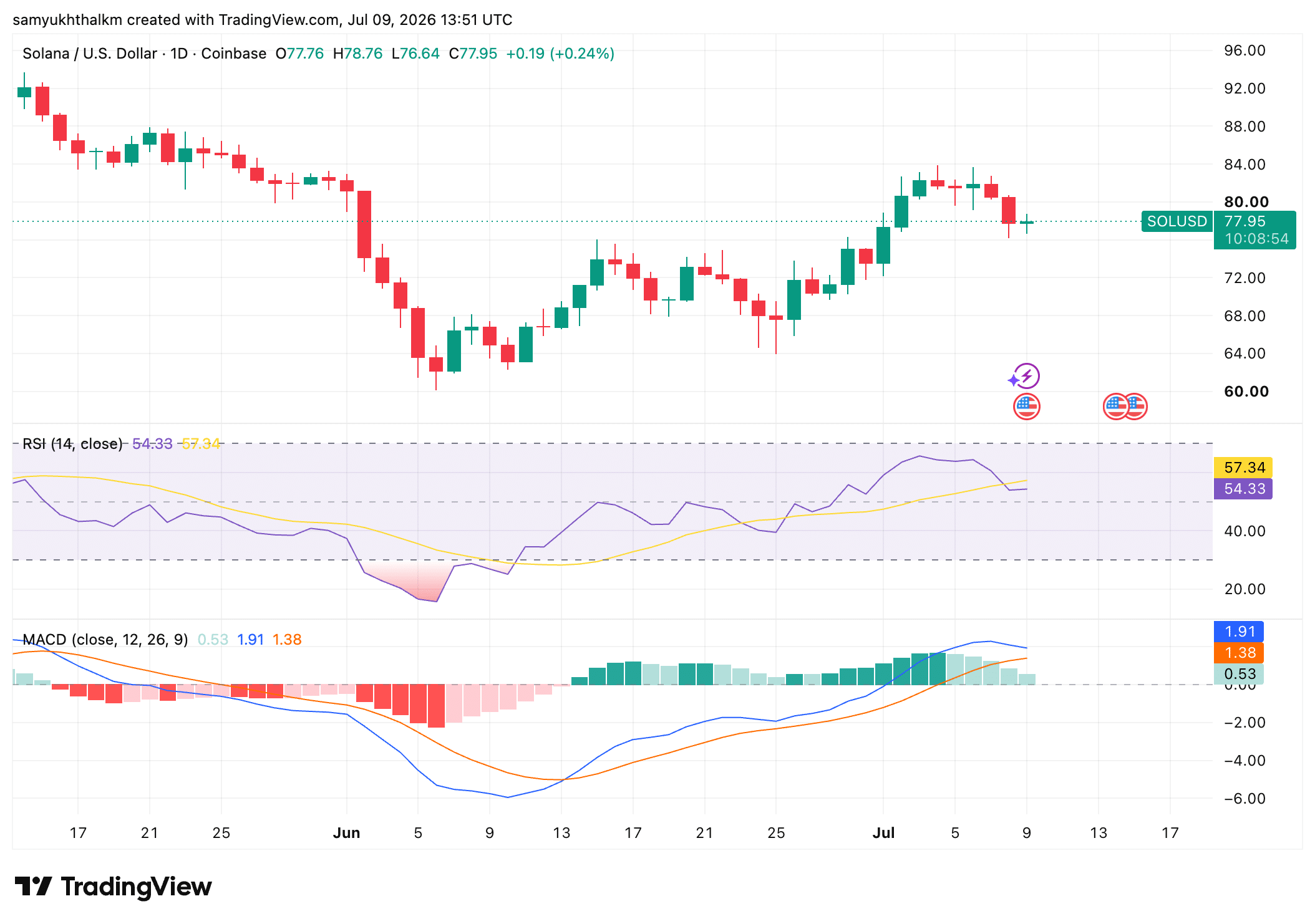
Source: TradingView

However, the upward pace appeared to be slowing down.

A move back above the recent highs may be needed to rebuild confidence. Until then, crowded long positions could be a risk.


Final Summary

  • SOL’s trading volume and negative sentiment are now at their worst levels of the year.
  • Downside risk was also relatively higher at press time.

Trending Cryptos

Related Questions

QWhat are the two main factors indicating a loss of confidence in the Solana (SOL) market according to the article?

AAccording to the article, the two main factors indicating a loss of confidence are SOL's trading volume falling to its lowest level in 2026 (around $2.27 billion) and its negative sentiment score shooting up to 14.05, which is the biggest wave of negativity since November 2025.

QWhat is the potential risk posed by the crowded long positions in SOL's derivatives market?

AThe crowded long positions, with around $7.4 billion in long exposure compared to roughly $3.1 billion in shorts, pose a liquidation risk. If SOL's price drops, these long positions could be liquidated (especially with a large cluster around $61-$62), which would add significant selling pressure and potentially accelerate a price decline.

QWhat technical indicators are mentioned as showing potential for a positive price move for SOL?

AThe article mentions that the RSI (Relative Strength Index) was in neutral territory (not overbought), and the MACD (Moving Average Convergence Divergence) was positive, with the MACD line (1.91) above the signal line (1.38). These indicators suggest there is room for upward movement if demand returns.

QWhat contradiction does the article highlight regarding trader sentiment and positioning?

AThe article highlights a contradiction between widespread negative market sentiment and the positioning in the derivatives market. While general sentiment is very negative (at a yearly low), traders in the derivatives market appear bullish, as indicated by a recovering long/short ratio of 2.23 and significant long exposure.

QWhat price level does the article suggest SOL needs to reclaim to rebuild trader confidence?

AThe article suggests that SOL needs to move back above its recent highs. Specifically, it was testing the $82-$83 area at the time of writing, and reclaiming levels above this recent high is implied as necessary to rebuild confidence.

Related Reads

The Verdict in Choi Tae-won's Divorce Case: Revealing the Inheritance Undercurrent Behind SK Hynix's Trillion-Won Empire

SK Group Chairman Chey Tae-won's high-profile divorce case, involving a record 1.38 trillion won settlement, has drawn attention to the succession plans for Korea's second-largest conglomerate, especially its crown jewel, SK hynix. Unlike traditional chaebol scripts centered on the eldest son, Chey's three children from his marriage to former President Roh Tae-woo's daughter, Roh Soh-yeong, are carving distinct, non-traditional paths. Eldest daughter Chey Yun-jung (b. 1989) is seen as the most evident successor. With a scientific and consulting background, she holds executive roles at SK bioscience and SK Inc.'s growth support department, focusing on future strategy and biopharma. Her marriage is to an AI infrastructure entrepreneur, not a traditional business alliance. Second daughter Chey Min-jung (b. 1991) took a unique route, voluntarily serving as a South Korean naval officer, including an anti-piracy deployment. She later worked on policy and strategy for SK hynix in Washington D.C. before co-founding an AI-driven healthcare startup. She married a former U.S. Marine Corps officer, connecting her to U.S. defense and policy circles—networks crucial for a global semiconductor giant. The only son, Chey In-geun (b. 1995), who studied physics like his father, worked briefly at SK E&S before joining McKinsey. Despite fitting the traditional "heir" profile as the eldest son, he remains silent and holds no public position or shares in SK, suggesting the old succession playbook is obsolete. As SK hynix's valuation soars, becoming a geopolitical asset in the AI era, the heirs' legitimacy is no longer automatic. They must prove themselves in fields like AI biotech, global policy, and strategic consulting. Their marriages also reflect new elite networks in tech and defense, not old political alliances. Their inheritance is the complex challenge of navigating a globalized, tech-driven world, not just a corporate throne.

marsbit2 days ago 09:06

The Verdict in Choi Tae-won's Divorce Case: Revealing the Inheritance Undercurrent Behind SK Hynix's Trillion-Won Empire

marsbit2 days ago 09:06

From OpenSea to OpenRouter: Is Alex Atallah Repeating His 'Exit at the Peak' Playbook?

From OpenSea to OpenRouter: Is Alex Atallah Repeating His "Exit at the Peak" Playbook? According to the Wall Street Journal, payments giant Stripe is in talks to acquire the AI model aggregation platform OpenRouter in a potential deal valuing the company near $100 billion. This would mark founder Alex Atallah's second creation of a company reaching a $100 billion valuation, following his co-founding of NFT marketplace OpenSea. OpenRouter, founded just over three years ago, has grown rapidly by acting as a unified gateway for developers to access over 400 AI models. It currently has about 10 million users and processes over 200 trillion tokens monthly. While the platform's annualized revenue is around $50 million, its valuation has skyrocketed from $1.3 billion in March 2026. The potential acquisition by Stripe, a company OpenRouter's founder once likened it to, represents a major expansion into AI infrastructure for the payments leader. This move echoes Atallah's previous timing with OpenSea, where he departed before the NFT market's significant downturn. For OpenRouter, selling now may be strategic. Despite its scale, its business model—charging a 5-5.5% fee on AI inference calls—faces pressure from competition, open-source models, and potential price wars among model providers, limiting its profitability narrative for an IPO. A key asset for potential acquirers like Stripe is OpenRouter's vast repository of real-world AI usage data, which offers unique insights into model performance and developer preferences that are difficult to replicate. Whether this potential deal signifies a new valuation benchmark for AI infrastructure or another market peak signal remains to be seen.

链捕手2 days ago 08:42

From OpenSea to OpenRouter: Is Alex Atallah Repeating His 'Exit at the Peak' Playbook?

链捕手2 days ago 08:42

Trading

Spot

Hot Articles

Discussions

Welcome to the HTX Community. Here, you can stay informed about the latest platform developments and gain access to professional market insights. Users' opinions on the price of SOL (SOL) are presented below.

活动图片