Author: New Zhiyuan
Stripe is in talks to acquire OpenRouter
According to separate reports from The Wall Street Journal and The Information citing people familiar with the matter, the transaction price could be close to $10 billion (approximately RMB 68 billion).

-
https://www.wsj.com/tech/ai/stripe-in-talks-to-buy-buzzy-ai-model-marketplace-openrouter-decc6a74

-
https://www.theinformation.com/briefings/stripe-talks-buy-startup-openrouter
Just two months ago, OpenRouter's valuation was only $1.3 billion (approximately RMB 8.8 billion), representing a premium of nearly 7 times.
The deal could be announced within a month, but it may also fall through.
The Information reported that Databricks had also previously discussed an acquisition with OpenRouter, with unclear subsequent developments.
A Stripe spokesperson told The Wall Street Journal they "do not comment on rumors and speculation."
Most people may not have heard the name OpenRouter, but what it does is relevant to every AI user.
The AI App You Use Has a Price Comparison Engine Behind It
Open an AI translation tool, input a passage, and get the result a few seconds later.
What you don't see is: whether that passage was sent to GPT, Claude, or a much cheaper open-source model.
The decision of "which model to choose" is increasingly being made by middleware layers like OpenRouter.
A simple analogy: if AI models are flights, OpenRouter is Qunar (a travel search engine).
Developers can access over 400 large models through one API, automatically matching tasks based on complexity, cost, and response speed.
Summarizing a routine email doesn't require the most expensive cutting-edge model, while processing a legal contract would be routed to a more capable one.
The user experience remains the same, but the bill behind it can differ by several times.
This also explains one thing: why many AI products can maintain low prices or even be free.
OpenRouter was founded in 2023 by Alex Atallah and Louis Vichy.

Alex Atallah

Louis Vichy
Atallah's previous venture was the NFT marketplace OpenSea, which was valued at $13.3 billion at its peak.
After the NFT wave receded, he left in 2022 and turned to AI infrastructure.
He once said in an interview:
Inference is the fastest-growing cost for enterprises, and it often comes from more than four different models.
Growth data validates this assessment.
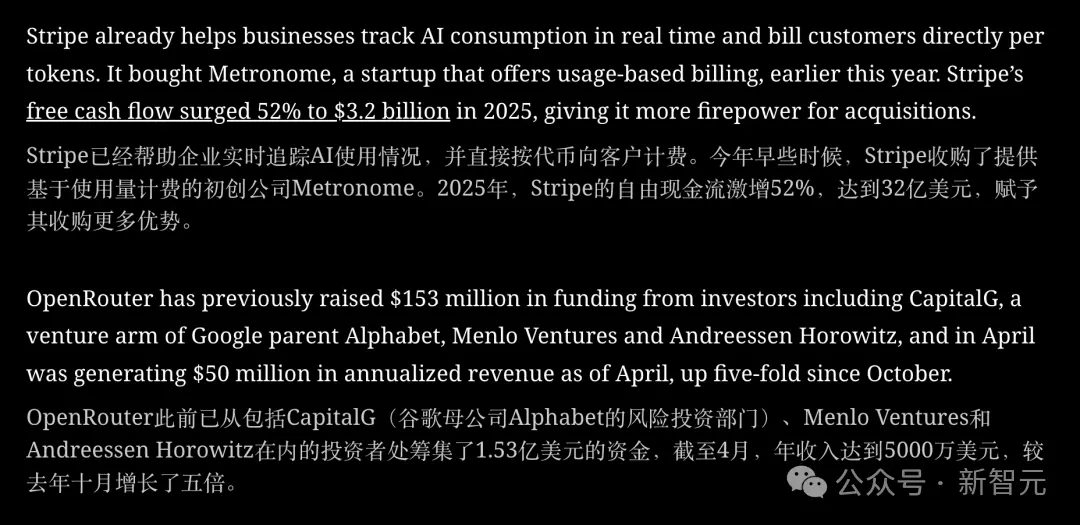
According to The Information, as of April this year, OpenRouter's annualized revenue reached $50 million, a fivefold increase in half a year.
The platform lists over 400 large models, with over 1 million developer users.
Investors include CapitalG (Alphabet's growth fund), Menlo Ventures, and a16z, with a cumulative financing of $153 million.
Stripe Aims to Be the Cashier and Dispatch Center of the AI Economy
Stripe is the world's largest internet payment processor, helping millions of businesses with online collection.
Over the past year, the company has been aggressively extending its business into AI infrastructure.
In December 2025, Stripe spent approximately $1 billion to acquire the usage-based billing platform Metronome.
Metronome helps AI companies charge customers based on token usage, with clients including OpenAI and Anthropic.
Stripe CEO Patrick Collison said at the time:
Usage-based pricing is the native business model for the AI era.
With the addition of OpenRouter, Stripe's intent becomes clear: selecting models, billing, and collecting payments, all integrated into one seamless chain.
If an AI application is compared to a restaurant, Stripe simultaneously becomes the ingredient dispatcher (helping you choose models), the utility meter (usage-based billing), and the cash register (payment processing).
For enterprise clients, a single supplier can manage all AI usage and billing.
Stripe has the resources to do this.
According to The Information, Stripe's free cash flow in 2025 was $3.2 billion, a year-on-year increase of 52%, with annual revenue of approximately $6.8 billion.
A secondary share sale in February pushed its valuation to $159 billion.
During the same period, Stripe, together with private equity firm Advent International, made an acquisition offer of approximately $53 billion to PayPal. PayPal considered the price too low, and negotiations are still ongoing.
Paying $10 billion for a company with $50 million in annual revenue seems like a sky-high price.
But OpenRouter's revenue grew fivefold in half a year, placing the bet on its growth rate.
More crucially, it's about position: as enterprises shift from being tied to a single AI model to using a mix of multiple models, whoever controls the routing layer gains the power to allocate traffic.
Which model gets prioritized and which gets pushed down the list is decided at this layer.
For the average user, the change won't come tomorrow, but the direction is already visible.
By acquiring Metronome, Stripe secured the "how to collect money." By acquiring OpenRouter, it secures "whose model to use." Combining these two questions creates the gateway for AI applications.
The cost of every AI product you use in the future, and the model choices behind it, are shifting downward from the hands of application developers to this infrastructure layer.
References:
-
https://www.wsj.com/tech/ai/stripe-in-talks-to-buy-buzzy-ai-model-marketplace-openrouter-decc6a74
-
https://www.theinformation.com/briefings/stripe-talks-buy-startup-openrouter
-
https://www.theinformation.com/articles/needs-openrouter