Loopring Ends Its Pioneer zk-Rollup DEX After Years of Limited User Adoption

TheNewsCryptoPublished on 2026-06-29Last updated on 2026-06-29

Abstract

Loopring has officially shut down its decentralized exchange, ending one of Ethereum's earliest zk-rollup platforms. The project, which raised $45 million in 2017, pioneered scaling solutions but ultimately failed to achieve significant user adoption. The team cited several reasons for the closure: the platform's lack of a virtual machine limited developer innovation, business execution was insufficient, and new zkEVM networks like zkSync and StarkNet surpassed its technology. User funds remain safe, with a two-week balance verification period before direct distribution to wallets begins. This follows the discontinuation of its wallet services in 2025, marking Loopring's complete exit from the DEX business.

Loopring officially shut down its decentralized exchange, marking the end of one of Ethereum’s earliest zk-rollup platforms. All trading functionalities were immediately stopped, and the relayer was turned off right after the official announcement made via Loopring’s X account.

The shutdown ends a project that once demonstrated how zero-knowledge rollups could efficiently scale Ethereum. Loopring raised $45 million through its initial coin offering in 2017.

Despite its technical merits, Loopring acknowledged that users never adopted the platform on a meaningful scale. The team pointed out that the lack of a virtual machine on the platform did not allow developers to compose and develop more advanced real-world applications. Without payment use cases and an evolving ecosystem, Loopring found it difficult to compete with new infrastructure built for blockchain technology.
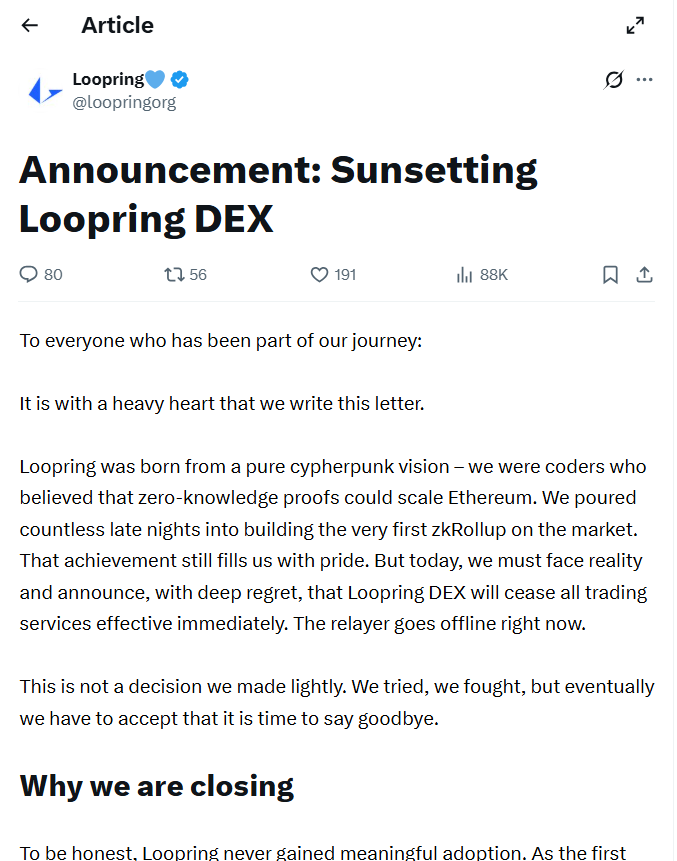
Source: X Article

Additionally, Loopring admitted it was good at the software but failed to build the business acumen needed to drive adoption. Furthermore, it mentioned that the delisting of the LRC token throughout 2026 only worsened the problems.

New zkEVM Networks Outperformed Loopring’s Technology

Finally, the development team admitted that modern zkEVM-based networks were able to surpass its proprietary technology. New projects such as zkSync, Scroll, and StarkNet created Ethereum-based environments that allowed deploying smart contracts more easily and developing a decentralized applications ecosystem.

The team admitted that it simply did not make sense anymore to continue working on Loopring. This is why the exchange was closed down in an orderly fashion. The project had earlier ended wallet services in July 2025 owing to scaling issues. The latest update marks Loopring’s eventual exit from the original decentralized exchange business.

Direct Distribution of Assets by Team

The Loopring team made assurances that all user funds are still safe despite the imminent closure. Final balances will be computed, an inventory of assets provided, and two weeks allocated to check balances before any distribution can take place.

Distributions will follow after the two-week period, whereby the Loopring team will distribute assets directly to the wallets in batches. The team will automatically convert liquidity pool holdings to the respective token, take care of all gas fees, and undertake the whole process without the need for Merkle proofs.

Highlighted Crypto News:

$3M Exploit Hits Polymarket: Users to Receive Full Refunds After Third-Party Breach

TagsBlockchainCryptocurrencyDEXETHEREUMEthereum (ETH)LoopringZK-rollupszkrollup

Trending Cryptos

Related Questions

QWhat was the official reason given by Loopring for shutting down its decentralized exchange?

ALoopring officially shut down its DEX due to years of limited user adoption. The team acknowledged a lack of business acumen to drive growth, the technical limitation of not having a virtual machine for advanced applications, and the inability to compete with newer zkEVM-based networks like zkSync, Scroll, and StarkNet.

QAccording to the article, what key technological feature did newer zk-rollup projects have that Loopring lacked?

ANewer zk-rollup projects like zkSync, Scroll, and StarkNet are based on zkEVM (Zero-Knowledge Ethereum Virtual Machine) technology. This allowed them to create environments where developers could easily deploy smart contracts and build a decentralized applications ecosystem, surpassing Loopring's proprietary technology which did not include a virtual machine.

QHow will the Loopring team handle the distribution of user assets after the shutdown?

AThe Loopring team will compute final user balances, provide an asset inventory, and allow a two-week period for balance verification. After this, they will distribute assets directly to user wallets in batches. They will automatically convert liquidity pool holdings, cover all gas fees, and conduct the process without requiring Merkle proofs.

QWhat earlier service did Loopring end in July 2025, and why?

ALoopring ended its wallet services in July 2025 due to scaling issues.

QHow much funding did Loopring raise in its 2017 initial coin offering (ICO)?

ALoopring raised $45 million through its initial coin offering (ICO) in 2017.

Related Reads

Can Open USD Support Stripe's Ambitions?

Can Open USD support Stripe's ambition? The article argues that OUSD represents a pivotal strategic move for Stripe, shifting its narrative from being a superior payments API company to becoming a "money movement network." Unlike simply facilitating payments, this new model aims to organize and define the settlement layer, default assets, and economic distribution rules for future commerce. The analysis highlights OUSD's role in giving Stripe a potential default settlement asset, enabling deeper economics through reserve earnings, and providing a programmable money layer for emerging use cases like AI agentic commerce. Crucially, OUSD is presented not as a direct "USDC killer" but as an attempt to redefine the business model of stablecoins, proposing a collaborative governance structure where contributing partners share in the network's economic benefits and governance. For Stripe, this is about evolving from a powerful "abstraction layer" over traditional financial rails into an active participant and potential architect of the next-generation global settlement network. While OUSD alone cannot immediately realize this ambition, it signals Stripe's intent to move closer to the money layer itself, positioning itself at the center of future money flows in an increasingly automated, platform-driven, and AI-powered economy. The ultimate question is whether Stripe can transition from being a best-in-class payment processor to becoming the foundational infrastructure for internet-native money movement.

marsbit6m ago

Can Open USD Support Stripe's Ambitions?

marsbit6m ago

This Week's Crypto Watchlist|Jupiter, NEAR, Jito, and 7 Other Projects are Active. Understand Who's Worth Monitoring with a 'Catalyst Calendar'

This week brings a concentrated wave of catalysts for several crypto projects, based on a schedule compiled by an analyst. Jupiter (JUP) leads by launching a private testnet for its GUM unified market on July 6th, aiming to aggregate diverse assets on Solana. On July 7th, NEAR hosts a major livestream reveal focused on enterprise "black box" tech, likely detailing its SPICE upgrade. Also on July 7th-8th, Berachain executes its largest mainnet upgrade, "PoL Next," simplifying its tokenomics by retiring the BGT token and consolidating value into BERA. Zcash (ZEC) eyes recovery with its critical Ironwood network upgrade slated for July 21st, designed to restore trust after a recent privacy vulnerability scare. Looking ahead, Lighter (LIT) plans to launch tokenized stocks next week, leveraging its key position as the default perpetual DEX on the new Robinhood Chain. Jito (JTO) is rumored to launch its JTX trading platform in mid-July, targeting professional traders and promising substantial protocol revenue sharing. Lastly, Ether.fi (ETHFI) has proposed deploying a dedicated Aave V4 instance to power its EtherFi Cash Visa card, though this remains in the early governance stage. The week presents a mix of product launches, major upgrades, and strategic expansions, each carrying its own potential for momentum and associated risks like token unlocks or execution challenges.

marsbit19m ago

This Week's Crypto Watchlist|Jupiter, NEAR, Jito, and 7 Other Projects are Active. Understand Who's Worth Monitoring with a 'Catalyst Calendar'

marsbit19m ago

Trading

Spot

Hot Articles

How to Buy ZK

Welcome to HTX.com! We've made purchasing ZKsync (ZK) simple and convenient. Follow our step-by-step guide to embark on your crypto journey.Step 1: Create Your HTX AccountUse your email or phone number to sign up for a free account on HTX. Experience a hassle-free registration journey and unlock all features.Get My AccountStep 2: Go to Buy Crypto and Choose Your Payment MethodCredit/Debit Card: Use your Visa or Mastercard to buy ZKsync (ZK) instantly.Balance: Use funds from your HTX account balance to trade seamlessly.Third Parties: We've added popular payment methods such as Google Pay and Apple Pay to enhance convenience.P2P: Trade directly with other users on HTX.Over-the-Counter (OTC): We offer tailor-made services and competitive exchange rates for traders.Step 3: Store Your ZKsync (ZK)After purchasing your ZKsync (ZK), store it in your HTX account. Alternatively, you can send it elsewhere via blockchain transfer or use it to trade other cryptocurrencies.Step 4: Trade ZKsync (ZK)Easily trade ZKsync (ZK) on HTX's spot market. Simply access your account, select your trading pair, execute your trades, and monitor in real-time. We offer a user-friendly experience for both beginners and seasoned traders.

3.3k Total ViewsPublished 2024.06.17Updated 2026.06.02

How to Buy ZK

Discussions

Welcome to the HTX Community. Here, you can stay informed about the latest platform developments and gain access to professional market insights. Users' opinions on the price of ZK (ZK) are presented below.

活动图片