SKYAI hits monthly lows after 36% drop – Yet THIS group isn’t backing off

ambcryptoPublished on 2026-06-28Last updated on 2026-06-28

Abstract

SKYAI plummeted 36.2% in 24 hours, hitting monthly lows, with its market cap falling to $238.26M. Despite a 70.85% surge in daily trading volume to $43.16M, the activity was driven by aggressive selling, not buying. Open Interest in derivatives dropped 36.65% to ~$69.66M, indicating traders closed leveraged positions. A modest positive exchange netflow of ~$340.75K signaled some holders moved tokens to exchanges, potentially for future sales. Buyers defended a key support zone around $0.168, preventing an immediate breakdown. However, technical indicators like MACD and Parabolic SAR remained bearish. The token's near-term direction depends on whether this support holds, allowing a potential recovery toward $0.335, or breaks, leading to further declines.

SKYAI recorded one of its steepest daily declines after losing 36.2% of its value over the last 24 hours, while traders continued flooding the market with fresh activity.

Daily trading volume climbed 70.85% to $43.16 million despite the heavy sell-off, showing that participants remained highly engaged throughout the correction.

The token’s market capitalization also dropped to $238.26 million, reflecting the broad decline in valuation.

However, the surge in trading activity did not translate into sustained buying strength.

Instead, the elevated volume accompanied aggressive selling pressure, indicating that market participants actively repositioned as volatility intensified across both spot and derivatives markets.

Such conditions reflected heightened uncertainty rather than renewed confidence, leaving SkyAI [SKYAI] under pressure as traders searched for signs of stability.

Why did traders cut leverage?

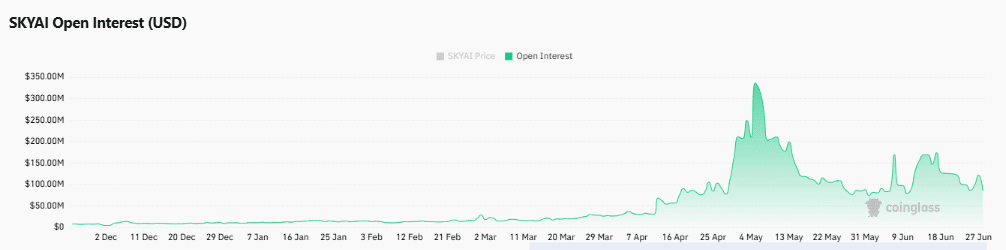
Derivatives activity weakened sharply after Open Interest declined [OI] by 36.65% to approximately $69.66 million.

The sharp reduction suggested that traders had rapidly closed leveraged positions during the correction instead of adding fresh exposure.

Rather than reflecting new bearish bets alone, the decline pointed to widespread liquidation and voluntary position exits across the futures market.

However, the sizeable contraction also reduced speculative leverage that had previously amplified price swings. This reset left the derivatives market considerably lighter than before the sell-off.

Even so, the shrinking OI failed to encourage an immediate recovery because buyers remained cautious after the aggressive decline.

Until traders gradually rebuilt conviction, leveraged participation would likely remain subdued despite the elevated trading activity.
Source: CoinGlass

Are exchange inflows becoming a concern?

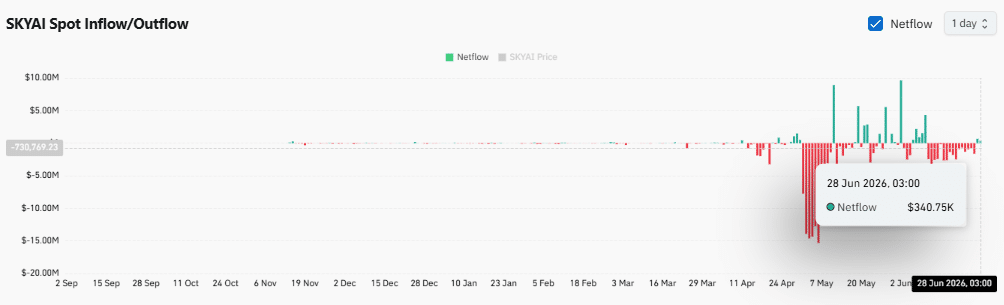
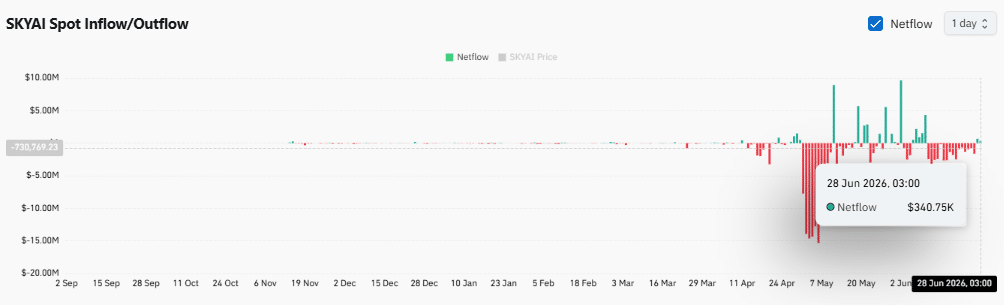
Spot flow data revealed a positive Exchange Netflow of roughly $340.75K during the latest session. The reading showed that more SKYAI tokens moved onto exchanges than left them, increasing the amount of supply immediately available for trading.

Unlike exchange outflows, which often reduce near-term selling pressure, these inflows suggested that holders prepared tokens for potential sales.

However, the relatively modest size of the inflow indicated that market participants had not yet triggered large-scale distribution.

Instead, traders appeared to react cautiously while monitoring price behaviour near an important support area.

If exchange inflows continue increasing over the coming sessions, additional selling pressure could emerge.

On the other hand, weakening inflows would suggest that distribution had begun to stabilize after the recent correction.
Source: CoinGlass

Can buyers defend support?

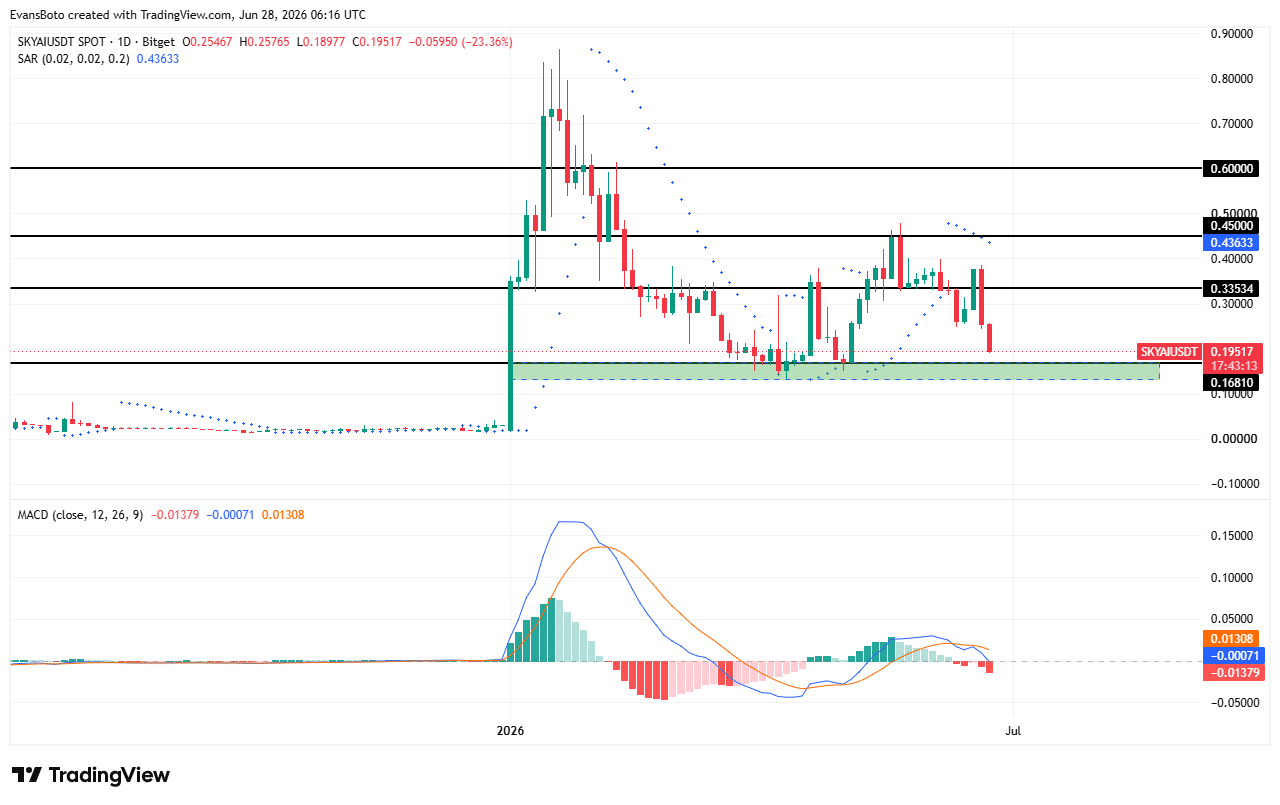
SKYAI revisited the demand zone around $0.168 after the latest sell-off erased much of its recent recovery.

Buyers responded near this region and prevented an immediate breakdown below support, allowing the price to stabilize above the highlighted zone.

Even so, the broader technical picture remained fragile. MACD stayed below the zero line while its histogram continued printing negative bars, showing that bearish pressure had persisted throughout the correction.

In addition, the Parabolic SAR remained above the price near $0.436, confirming that sellers still controlled the prevailing trend.

However, the repeated defense of the $0.168 support suggested buyers had not completely surrendered.

If this demand zone continues attracting fresh demand, SKYAI could attempt a recovery toward the $0.335 resistance. Otherwise, losing this support would likely expose the token to another leg lower.
Source: TradingView

Can SKYAI avoid another breakdown?

SKYAI remained under pressure as strong trading activity accompanied falling prices, shrinking Open Interest, and positive Exchange Netflow.

Buyers defended the $0.168 demand zone, but technical indicators continued to favor sellers.

If demand continued strengthening around the current support, the token could attempt a recovery toward higher resistance levels.

However, another decisive break below $0.168 would likely extend the correction before a sustainable rebound develops.


Final Summary

  • SKYAI buyers defended the $0.168 demand zone despite rising exchange inflows and selling pressure.
  • Falling Open Interest suggested leverage cooled, but bearish indicators still favored another downside test.


Trending Cryptos

Related Questions

QWhat was the main event described in the article regarding SKYAI's price action?

ASKYAI experienced one of its steepest daily declines, losing 36.2% of its value over 24 hours and hitting monthly lows, despite a 70.85% surge in daily trading volume.

QWhat does the sharp decline in Open Interest (OI) for SKYAI derivatives suggest according to the article?

AThe 36.65% decline in Open Interest suggests traders rapidly closed leveraged positions during the correction, indicating widespread liquidation and voluntary exits rather than just new bearish bets, which reduced speculative leverage.

QWhat is the significance of the positive Exchange Netflow mentioned in the article?

AA positive Exchange Netflow of roughly $340.75K indicates that more SKYAI tokens were moved onto exchanges than off them, increasing the immediate supply available for trading and suggesting some holders were preparing tokens for potential sales.

QWhat critical price level are buyers attempting to defend for SKYAI, and what is the potential consequence of losing it?

ABuyers are attempting to defend the demand zone/support level around $0.168. Losing this support would likely expose the token to another leg lower in its price correction.

QBased on the article's final summary, what two key factors create a mixed outlook for SKYAI's immediate future?

AThe mixed outlook comes from 1) Buyers defending the $0.168 demand zone, but 2) Bearish technical indicators still favoring another downside test despite the cooling of leverage (falling Open Interest).

Related Reads

You Use Claude and Codex Every Day, but Meta Has Restricted Internal Use

In May, Meta imposed internal restrictions on its engineers regarding the use of Claude Code and Codex, two widely used AI programming tools. Despite being a major client, Meta's guidelines, still in effect, prohibit these external models from being used for specific tasks to prevent potential "escalations with partners." The core concern is "distillation"—the risk that outputs from Claude or Codex could inadvertently contaminate the training data and evaluation processes for Meta's in-house AI coding assistant, MetaCode. If MetaCode is trained or evaluated using data generated by these external models, it risks learning their capabilities rather than developing its own, blurring the line of intellectual origin. The restrictions are precise: engineers cannot use the external models to generate test questions, debug source code, or suggest test cases. AI-generated content is also barred from environments accessible to MetaCode. However, AI can still assist with peripheral tasks like workflow setup and code organization, provided all outputs are manually reviewed. This caution reflects a broader industry dilemma. While distillation is a common technique, using a competitor's model output for training raises legal and ethical questions about the ownership of derived capabilities. Contractual terms from companies like OpenAI and Anthropic explicitly forbid using their outputs to build competing products, putting enforcement power in the hands of rivals. The move is also financially motivated, as Meta seeks to reduce its hefty internal AI spending, estimated in the billions this year. Meta's policy illustrates the delicate balance companies must strike: leveraging powerful external AI tools while safeguarding the integrity and independence of their own AI development. As AI systems increasingly help build other AIs, distinguishing the origin of capabilities becomes a fundamental challenge for the entire industry.

marsbit2h ago

You Use Claude and Codex Every Day, but Meta Has Restricted Internal Use

marsbit2h ago

Why Do We Need an AI Content Perspective Today?

The article "Why Do We Need an AI Content Perspective Today?" explores the complex and often contentious integration of AI into the cultural and creative industries, particularly film and television. It begins with the cancellation of Amazon's AI-generated animation "Punky Duck," highlighting the ethical debates surrounding AI content. AI's rapid advancement is transforming video production, enabling cost-effective, full-length AI films (e.g., "RAPHAEL," "Dreams of Violets") while sparking industry resistance over issues like "synthetic actors." The core debate has shifted from whether to use AI to how to use it responsibly. The article analyzes why AI's entry into film is uniquely unsettling. It distinguishes between "cultural fast food" (short-form, fast-paced content like micro-dramas) and "cultural main courses" (traditional, long-form film/TV). AI currently excels at the former, matching its fragmented narratives, shallow emotional needs, and free-to-consumer models. However, venturing into the latter challenges the human-centric essence of storytelling—creativity, emotional depth, and the unique value of human labor and experience. While AI can generate massive volumes of content and lower costs, it risks devaluing human creativity, leading to homogenized output, and creating unfair competition through potential intellectual property infringement. Its efficiency also amplifies content safety risks, making preemptive governance crucial. To counter these risks, the article proposes establishing clear boundaries guided by a human-centered AI content perspective. It outlines four principles: 1) Amplify, rather than displace, human creative space; 2) Respect and protect human creative output; 3) Ensure human creative control and responsibility remain paramount; and 4) Guarantee transparency and traceability in AI creation. The conclusion emphasizes that humans must act as the "helmsmen" of technology, steering AI development to enhance, not replace, the core human values at the heart of cultural expression.

marsbit3h ago

Why Do We Need an AI Content Perspective Today?

marsbit3h ago

Trading

Spot

Hot Articles

How to Buy SKYAI

Welcome to HTX.com! We've made purchasing SKYAI (SKYAI) simple and convenient. Follow our step-by-step guide to embark on your crypto journey.Step 1: Create Your HTX AccountUse your email or phone number to sign up for a free account on HTX. Experience a hassle-free registration journey and unlock all features.Get My AccountStep 2: Go to Buy Crypto and Choose Your Payment MethodCredit/Debit Card: Use your Visa or Mastercard to buy SKYAI (SKYAI) instantly.Balance: Use funds from your HTX account balance to trade seamlessly.Third Parties: We've added popular payment methods such as Google Pay and Apple Pay to enhance convenience.P2P: Trade directly with other users on HTX.Over-the-Counter (OTC): We offer tailor-made services and competitive exchange rates for traders.Step 3: Store Your SKYAI (SKYAI)After purchasing your SKYAI (SKYAI), store it in your HTX account. Alternatively, you can send it elsewhere via blockchain transfer or use it to trade other cryptocurrencies.Step 4: Trade SKYAI (SKYAI)Easily trade SKYAI (SKYAI) on HTX's spot market. Simply access your account, select your trading pair, execute your trades, and monitor in real-time. We offer a user-friendly experience for both beginners and seasoned traders.

4.3k Total ViewsPublished 2025.04.22Updated 2026.06.02

How to Buy SKYAI

Discussions

Welcome to the HTX Community. Here, you can stay informed about the latest platform developments and gain access to professional market insights. Users' opinions on the price of SKYAI (SKYAI) are presented below.

活动图片