Author: Ada, Deep Tide TechFlow
Recently, NVentures, NVIDIA's venture capital arm, made a new investment in the French quantum computing company Alice & Bob, focusing on fault-tolerant quantum computing.
It is a common misconception to attribute all of NVIDIA's external investments under the name NVentures. In fact, the collective scale of this venture division's approximately 30 annual investments, established in 2021, pales in comparison to a single investment made casually by the Corporate Development team. The latter's $2 billion equity investment in Synopsys at the end of 2025 alone is several times larger than NVentures' cumulative investment amount over nearly three years.
To understand how NVIDIA uses capital to weave the AI ecosystem, one must start with the "Three-Track Architecture" of its investment system. The Corporate Development team handles strategic large-scale investments and mergers & acquisitions ranging from billions to hundreds of billions of dollars. NVentures is responsible for early-stage, broadly scoped financial investments across industries. NVIDIA Inception is a startup accelerator that provides resource connections without direct capital investment. These three parts work in synergy, forming the largest and fastest-paced capital deployment machine in Silicon Valley's history, and also becoming the core target of "circular financing" allegations in the eyes of short-sellers.
The True Face of NVentures: 2-Person Team, 79 Companies, 20 Unicorns
Although bearing NVIDIA's brand, NVentures' internal size is surprisingly small. According to private equity data firm Tracxn, as of May 2026, the entire team consists of only 2 people, having cumulatively invested in 79 companies, fostering 20 unicorns, including AI video generation platform Synthesia, clinical AI company Abridge, quantum computing company PsiQuantum, and others. In the past 12 months, the team completed 43 new investments, with 20 deals in the first five months of 2026 alone, indicating a significantly accelerated pace.
Leading NVentures is Mohamed "Sid" Siddeek, corporate vice president and head of NVentures. Siddeek's resume itself reflects NVIDIA's positioning for this division. He worked at Morgan Stanley in the late 1990s, accompanying Jensen Huang during NVIDIA's IPO roadshow; then served for nearly a decade as head of TMT & Telecom investments at the UAE sovereign wealth fund Mubadala; later managed enterprise software and healthcare investments at SoftBank's Vision Fund; and finally returned to NVIDIA in 2021 to establish NVentures.
Siddeek's own description of the investment scope is: "The real screening criteria are only two layers: the first is anywhere NVIDIA can reach, the second is which areas are investable." In an interview with Global Corporate Venturing, he revealed this means horizontal coverage across almost all industries AI can transform—healthcare, manufacturing, robotics, autonomous driving, quantum, etc.—and vertical coverage from underlying tools to the application layer, all within NVentures' investment scope.
Three-Track Architecture: Corp Dev for Strategy, NVentures for Early-Stage, Inception for Ecosystem
NVIDIA's external investment system consists of three distinct parts with clear division of labor.
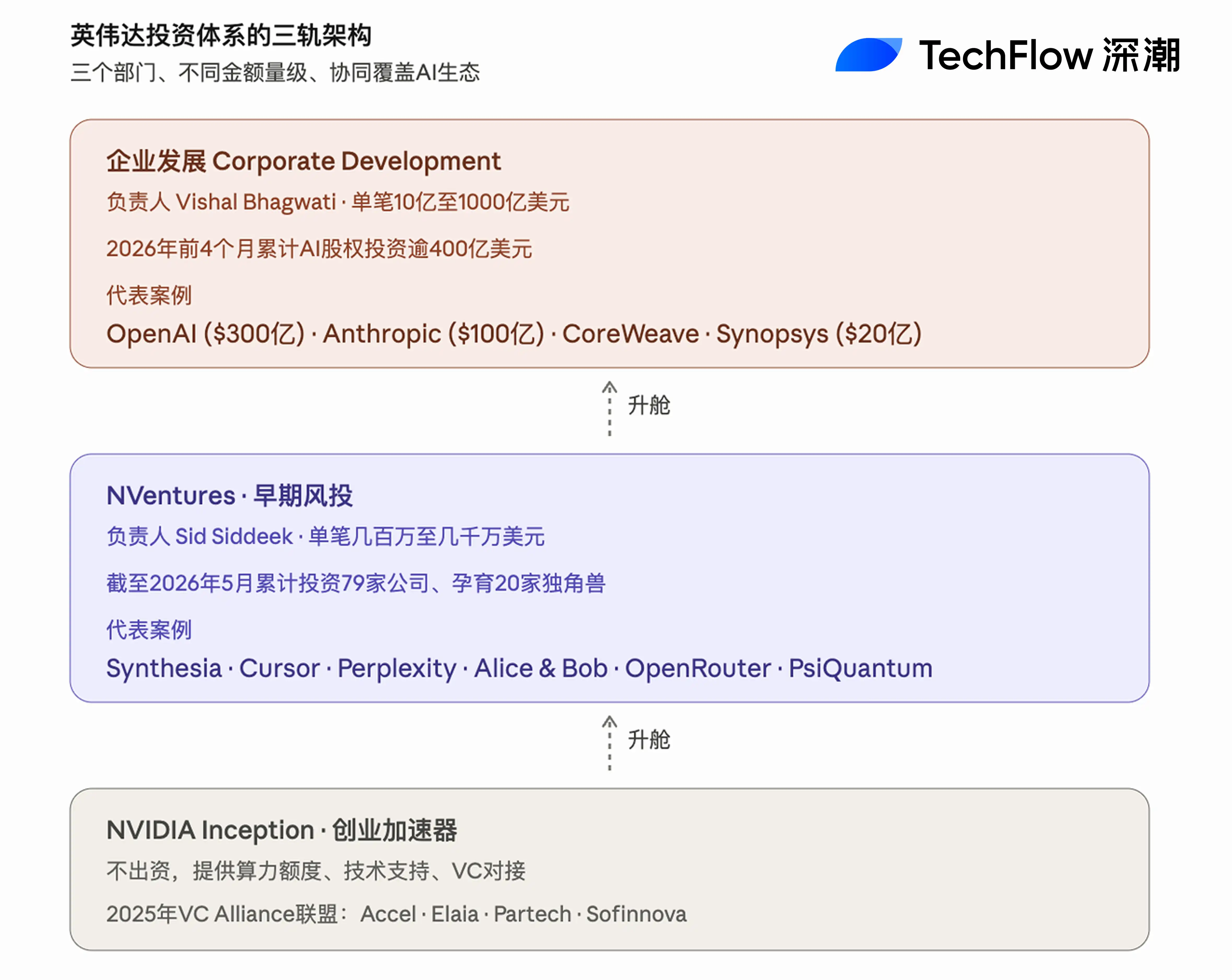
The first layer is the Corporate Development team, led by Vishal Bhagwati, responsible for all strategic-level large-scale investments, joint ventures, and M&A. The magnitude of deals on this track is completely different from NVentures. Representative moves from the second half of 2025 to the first half of 2026 include leading a $30 billion investment in OpenAI in February 2026 (as part of a roughly $110 billion funding round), with a commitment to potentially increase to $100 billion in the future; a $10 billion commitment to Anthropic in November 2025; a $2 billion injection into Synopsys at the end of 2025; a $2 billion follow-on investment in CoreWeave in early 2026, accompanied by a $6.3 billion cloud capacity purchase agreement; a $2 billion investment in Nebius in March 2026; and an equity commitment of up to $2 billion in xAI.
According to CNBC, in just the first four months of 2026, AI-related equity investments led by the Corporate Development team exceeded $40 billion. NVIDIA invested a total of $17.5 billion in private companies and infrastructure funds during fiscal year 2025.
The second layer is NVentures, led by Sid Siddeek, positioned as a traditional venture capital firm pursuing financial returns. Individual deal sizes range from a few million to tens of millions of dollars, primarily investing at Seed to Series B stages. Siddeek explicitly told Global Venturing that NVentures "primarily focuses on early-stage investments, while the Corporate Development team handles larger, more directly strategic investments." Behaviorally, NVentures predominantly participates as a co-investor, leading only about one-eighth of its investments, more often joining rounds led by top VCs like Accel, a16z, and Sequoia, leveraging the NVIDIA endorsement.
The third layer is NVIDIA Inception, essentially a startup accelerator program that does not directly invest capital but provides startups with NVIDIA hardware credits, technical support, market promotion, and VC connection channels. NVIDIA's upgraded "VC Alliance" launched in 2025, partnering with institutions like Accel, Elaia, Partech, and Sofinnova, distributes NVIDIA DGX Cloud Lepton compute credits to their portfolio companies, representing an extension of Inception in Europe.
There is a clear "funnel" relationship among the three. Inception discovers early-stage projects and integrates them into the NVIDIA ecosystem. Those with investment potential come into NVentures' view and may receive early-stage checks from a few million to tens of millions of dollars. When a company grows to a size significant enough to impact NVIDIA's strategic landscape (becoming a major customer, key supplier, or potential acquisition target), it "upgrades" to the Corporate Development team, entering cooperation frameworks worth billions or even hundreds of billions of dollars.
NVentures' Recent Moves: Quantum, Inference Routing, AI Security
NVentures' activity in May 2026 was notable. Just within the recent month, there have been four publicly disclosed deals. On May 22, French quantum computing company Alice & Bob announced NVentures participated in the extension of its €100 million Series B round. Alice & Bob's core technology is a fault-tolerant quantum computing architecture based on "cat qubits," deeply collaborating with NVIDIA's hybrid quantum-classical computing stack like CUDA-Q, cuQuantum, Dynamiqs, and NVQLink. On May 26, AI model routing platform OpenRouter completed a $113 million Series B round, with NVentures co-investing alongside Google CapitalG, Snowflake, and others. OpenRouter's business provides developers a unified interface to access APIs from dozens of different model providers globally. On May 28, AI inference infrastructure startup Tensormesh completed a $20 million seed extension round, with NVentures co-investing alongside CoreWeave, AMD, and others. On May 6, AI cybersecurity company Xbow completed a $35 million Series C extension, with NVentures participating.
Judging by the investment targets, NVentures' recent tilt clearly leans toward three directions: quantum computing (Alice & Bob, Quantinuum, PsiQuantum), AI biopharma (Relation Therapeutics, Genesis Therapeutics), and AI Agent & inference layer (OpenRouter, Tensormesh, etc.). This aligns with Siddeek's statement "anywhere NVIDIA can reach" and also corresponds precisely to the directions NVIDIA is investing in for its next-generation software stacks like CUDA-Q, CUDA-X, and Triton.
Geographically, NVentures' European deployment has notably accelerated. It completed 14 European investments in 2025, double the 7 investments in 2024.
Panoramic View of the Three-Tier Investment Portfolio
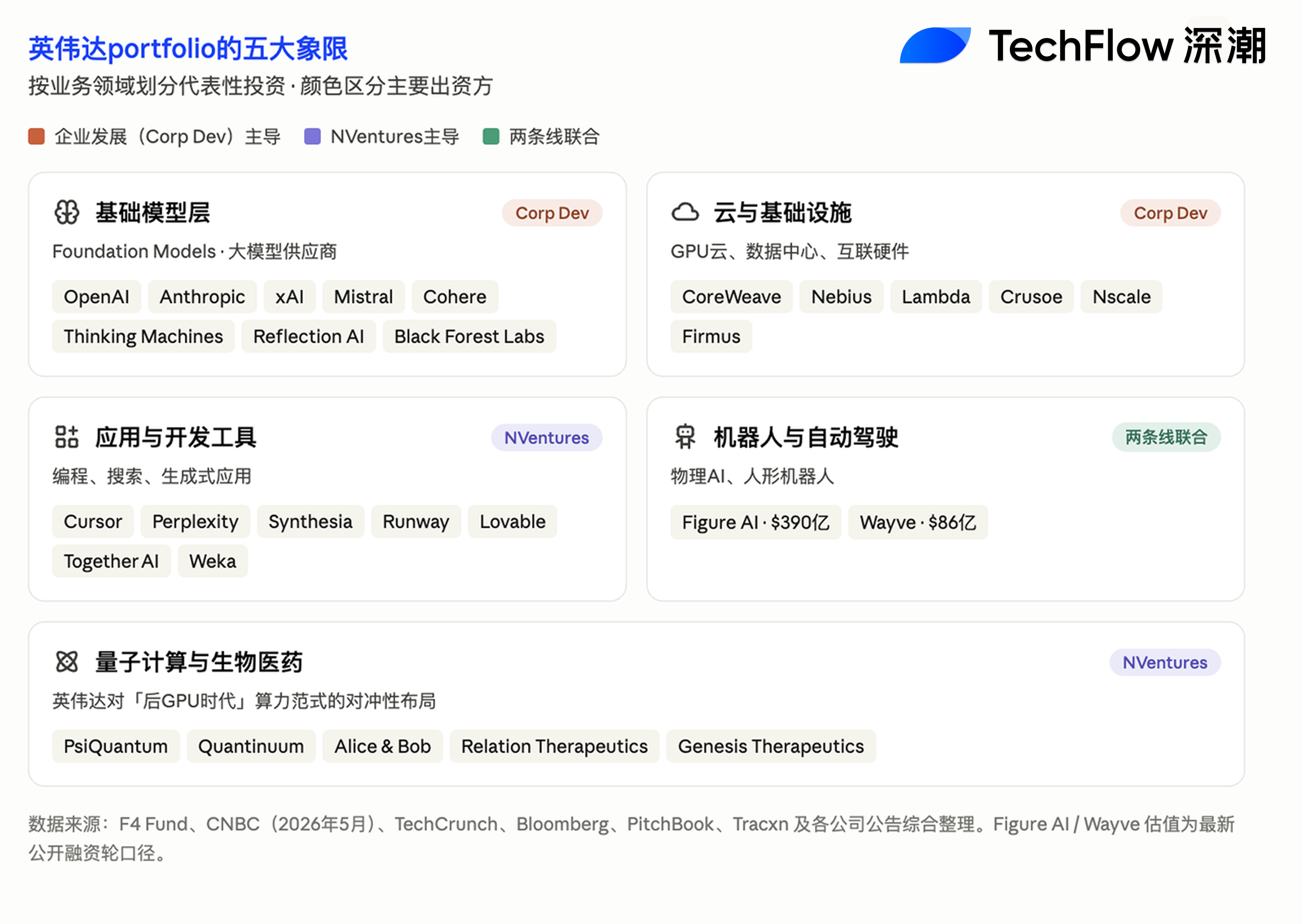
If we overlay the portfolios of the three investment tiers on the same map, NVIDIA's "capital radiation" on the AI ecosystem can be summarized into five main quadrants.
The foundation model layer includes OpenAI, Anthropic, xAI, Mistral, Cohere, Thinking Machines Lab, Reflection AI, Black Forest Labs. This layer is primarily funded by the Corporate Development team, with NVentures participating in smaller shares.
The cloud & infrastructure layer includes CoreWeave, Nebius, Lambda, Crusoe, Nscale, Firmus Technologies. This layer is also dominated by the Corporate Development team, with individual investments often reaching billions of dollars, accompanied by long-term compute purchase contracts.
The application & developer tools layer includes Cursor, Perplexity, Synthesia, Runway, Lovable, Together AI, Weka. NVentures has higher participation in this layer, with relatively smaller amounts.
The robotics & autonomous driving layer includes Figure AI (latest valuation $39 billion) and Wayve (valuation $8.6 billion). This involves combined efforts from both Corporate Development and NVentures.
The quantum computing & biopharma layer includes PsiQuantum, Quantinuum, Alice & Bob, Relation Therapeutics. This consists mainly of early-stage investments led by NVentures, serving as NVIDIA's hedging bets on post-GPU-era computing paradigms.
According to venture capital research firm F4 Fund, from 2025 to early 2026, in the investment rounds participated in by NVIDIA (Corporate Development + NVentures), at least 10 companies crossed the $1 billion valuation threshold, including OpenAI, Anthropic, xAI, Mistral, Figure AI, Cursor, Perplexity, Scale AI, Wayve, and others.
Controversy: Burry's Shorts and the Question of "Circular Financing"
However, NVIDIA's massive external investment landscape is attracting increasing scrutiny. The most representative criticism comes from hedge fund manager Michael Burry, famous from the movie "The Big Short."
According to Scion Asset Management's Q3 2025 13F filing, Burry established short positions against NVIDIA and Palantir before September 30, 2025, including put options for approximately 1 million NVIDIA shares, representing a nominal exposure of about $187 million based on the stock price at the time; and 50,000 put option contracts (each for 100 shares) on Palantir, with actual premium payments of about $9.2 million. Burry posted on his X account "Cassandra Unchained" with a screenshot from "The Big Short," captioning "Sometimes, we can see bubbles," and later retweeted a Bloomberg chart about NVIDIA's circular financing, directly pointing the finger at NVIDIA's capital deployment model.
Burry's specific accusations are technical. He estimated in a Substack post that between 2026 and 2028, cloud providers including Microsoft, Google, Oracle, and Meta would cumulatively understate depreciation by about $176 billion by extending the accounting depreciation period for NVIDIA GPUs, thereby inflating profits during that period. This accounting adjustment resonates with NVIDIA's equity investments in customers. The former gives buyers higher "paper profits" to absorb larger capital expenditures, while the latter directly provides buyers with funds to purchase NVIDIA hardware.
At the institutional level, similar suspicions are accumulating. The EU competition regulator explicitly included the "risk of circular spending" within NVIDIA's investment system in its review scope in March 2026. Seaport Research estimates that for every $1 of equity NVIDIA invests, it corresponds to about $3.5 in downstream chip purchase revenue. Bloomberg's March 2026 feature on "AI Circular Trades" mapped the dense web of fund flows among NVIDIA, CoreWeave, OpenAI, Oracle, and Anthropic. NVIDIA holds about a 7% stake in CoreWeave, CoreWeave uses NVIDIA GPUs as collateral for financing, in turn uses cash to purchase more GPUs from NVIDIA, and NVIDIA then signs a $6.3 billion cloud capacity purchase agreement, committing to absorb CoreWeave's excess capacity through 2032. NVIDIA committed up to $100 billion in investment to OpenAI, OpenAI commits to purchasing NVIDIA hardware and building a $300 billion data center via Oracle, and Oracle then purchases GPUs from NVIDIA. NVIDIA invests $10 billion in Anthropic, Anthropic commits to deploying Claude on Microsoft Azure, and Azure purchases NVIDIA Grace Blackwell and Vera Rubin systems.
Counterarguments from supporters also exist. Asset manager Janus Henderson characterized this model as a "virtuous cycle," arguing that in an era of extreme compute scarcity, binding supply and demand through "equity + long-term purchase contracts" is a reasonable commercial arrangement. Morningstar's analysis pointed out that NVIDIA's arrangement with CoreWeave to "commit to purchasing excess capacity" actually makes NVIDIA bear CoreWeave's inventory risk, thus constituting a constraint on the impulse to push hardware sales in the short term.
In this controversy, NVentures' position is rather delicate. Its early-stage, small-scale, co-investment-focused, and industry-dispersed investment style forms a stark contrast to the "circular trade" model of the Corporate Development team. Companies like Alice & Bob, Tensormesh, and OpenRouter, which NVentures invests in, are not large enough to form the "both NVIDIA customer and NVIDIA investee" cycle; their investment behavior is closer to the financial investment logic of a traditional CVC. However, from the perspective of NVIDIA's overall investment system, whether NVentures, to some extent, acts as the "compliant venture capital facade" in external disclosures, making it easier for outsiders to interpret NVIDIA's investment activities as normal venture capital behavior rather than systematic seller financing, is the unspoken but implied question from Burry and EU regulators.
NVIDIA's consistent official stance is that all investments are based on independent business judgment and are not linked to hardware sales. But market observers are increasingly quoting a phrase: in an era of compute shortage, whether to believe "the entanglement of equity and purchase contracts is coincidental" is itself a question of trust.