SBF Legal Saga Continues: Prosecutors Question Authenticity Of FTX Founder’s Retrial Motion Letter

bitcoinistPublished on 2026-03-24Last updated on 2026-03-24

Abstract

Federal prosecutors have raised significant doubts about the authenticity of a letter submitted by Sam Bankman-Fried (SBF) from prison in support of his motion for a new trial. The DOJ highlighted multiple inconsistencies: the letter was sent via FedEx, which is prohibited for inmates; the return address incorrectly identified the facility; tracking showed it originated from Palo Alto, not the prison; and it was signed with an "/s/" rather than a physical signature. SBF, previously convicted and sentenced to 25 years for fraud, claims new evidence and judicial bias warrant a retrial. The DOJ has urged the court to deny his request, arguing the defense fails to meet legal standards for a new trial.

FTX founder’s legal saga continues as federal prosecutors question the authenticity of a retrial letter attributed to Sam Bankman-Fried (SBF) due to major inconsistencies in signature, address, and delivery method.

SBF’s Retrial Motion Letter Under Scrutiny

On Sunday, the US Department of Justice (DOJ) questioned the authenticity of a letter submitted by Sam Bankman-Fried from prison in support of his motion for a new trial, citing inconsistencies in the signature, address, and delivery method.

In the filing, prosecutors told Judge Lewis Kaplan that the Government did not object “to a reasonable extension for the filing of the defendant’s reply in support of his motion for a new trial.”

However, they affirmed that “there is reason to doubt” that the letter, docketed March 16, was actually submitted by the former FTX CEO. As they stated, the letter was delivered via FedEx, and according to the Federal Bureau of Prisons’ Program Statement 5800.16, inmates are not allowed to send mail via FedEx or other private carriers.

In addition, the envelope indicates that the letter was sent by “S. Bankman-Fried at Terminal Island DOC, San Pedro, CA 90731.” Prosecutors noted that the BOP facility at Terminal Island is a Federal Correctional Institution (FCI), not a Department of Corrections (DOC) facility.

“While the return address indicates it was sent from ‘San Pedro,’ where the facility is located, FedEx tracking shows the package was picked up and shipped from Palo Alto or Menlo Park, California,” the filing highlighted.
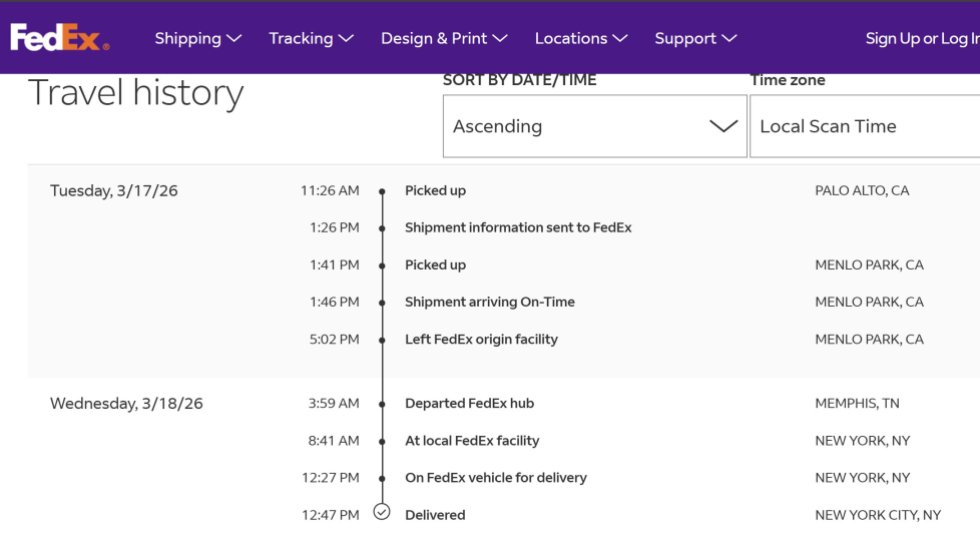
Alleged travel history of SBF's retrial motion letter. Source: Inner Press City on X

Lastly, they also argued that the letter was signed with an “/s/” instead of the SBF’s actual signature. This format is commonly used in electronic legal filings rather than physical prison correspondence.

According to previous reports, Judge Kaplan had extended the FTX founder’s deadline for SBF or his lawyers to request more time to reply to the government’s arguments until March 23, but emphasized that the court doesn’t accept phone calls from litigants or family members.

The judge’s extension and disclaimer follow Barbara Fried’s, SBF’s mother, attempts to request additional time to file papers on her son’s behalf, citing the FTX founder’s limited prison access to files and an anticipated transfer.

DOJ Requests Denial Of FTX Founder’s New Trial Bid

In November 2023, Bankman-Fried was found guilty of seven criminal counts, including fraud and conspiracy. He was later sentenced to 25 years in prison and ordered to pay back $11 billion to FTX customers.

Last year, SBF’s lawyers claimed that the crypto-exchange founder was unjustly convicted and denied a fair opportunity to present his defense due to undue pressure from the media and prosecutors.

In February, Bankman-Fried filed a motion for a new trial without assistance from his legal team, arguing new evidence could tilt the scales in his favor. In his new-trial bid, he affirmed that the testimony from two former FTX executives, Ryan Salame and Daniel Chapsky, could have weakened the government’s case against SBF at trial.

Moreover, he claimed he was a victim of a “weaponized” Biden-era Department of Justice, while requesting a new judge under the argument that Kaplan had “manifest prejudice” toward SBF.

The Department of Justice urged Judge Kaplan to deny Bankman-Fried’s request for a retrial earlier this month, asserting that the defense has not come close to meeting the legal requirements necessary for one.

As reported by Bitcoinist, prosecutors refuted SBF’s claims. They stated that the two former FTX executives were already known to the defense prior to the 2023 trial, rendering any new evidence they presented as irrelevant.
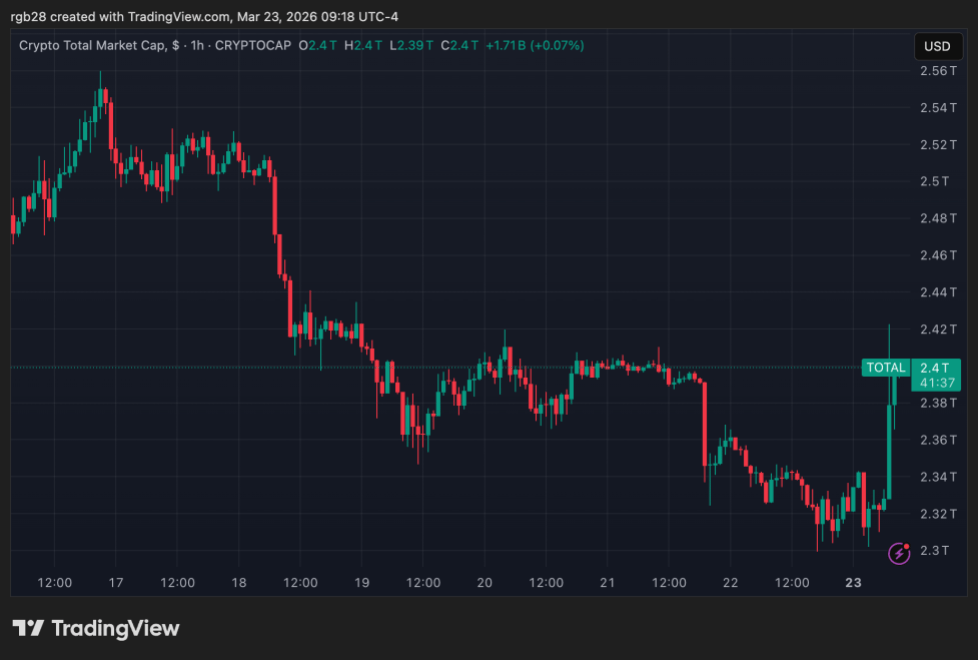
The total crypto market capitalization is at $2.4 trillion in the one-week chart. Source: TOTAL on TradingView


Trending Cryptos

Related Questions

QWhat are the main reasons federal prosecutors question the authenticity of SBF's retrial motion letter?

AFederal prosecutors question the authenticity due to major inconsistencies: the letter was delivered via FedEx, which inmates are not allowed to use; the return address incorrectly identifies the facility as a 'Department of Corrections (DOC)' instead of a 'Federal Correctional Institution (FCI)'; FedEx tracking shows it was shipped from Palo Alto or Menlo Park, not San Pedro where the prison is located; and it was signed with an '/s/' instead of SBF's actual signature.

QWhat was Sam Bankman-Fried convicted of and what was his sentence?

AIn November 2023, Sam Bankman-Fried was found guilty of seven criminal counts, including fraud and conspiracy. He was later sentenced to 25 years in prison and ordered to pay back $11 billion to FTX customers.

QOn what grounds did SBF's lawyers claim he was unjustly convicted and denied a fair trial?

ASBF's lawyers claimed he was unjustly convicted and denied a fair opportunity to present his defense due to undue pressure from the media and prosecutors.

QWhat was the Department of Justice's response to SBF's request for a new trial earlier this month?

AThe Department of Justice urged Judge Kaplan to deny Bankman-Fried's request for a retrial, asserting that the defense has not come close to meeting the legal requirements necessary for one.

QWhat new evidence did SBF claim could have weakened the government's case, and why did prosecutors refute this?

ASBF claimed that testimony from two former FTX executives, Ryan Salame and Daniel Chapsky, could have weakened the government's case. Prosecutors refuted this by stating that these individuals were already known to the defense prior to the 2023 trial, rendering any new evidence they presented as irrelevant.

Related Reads

STRC Must Re-Anchor for a BTC Bull Market to Happen

Title: STRC's Depegging Threatens MicroStrategy's Bitcoin-Buying Machine, and Thus the BTC Bull Run Summary: The sustained depegging of MicroStrategy's priority share STRC (trading ~25% below its $100 target) is severely disrupting the company's core business model and poses a major risk to Bitcoin (BTC) price support. STRC was MicroStrategy's most efficient and low-cost funding tool, designed to allow continuous capital raises near its $100 par value to fuel relentless BTC accumulation. Its depegging has effectively blocked this primary funding channel. The situation creates a severe cash flow crisis. STRC and other priority shares now obligate MicroStrategy to pay approximately $1.7 billion in annual cash dividends, while the company's cash reserves are only about $1.4 billion — insufficient to cover one year of payments. To raise cash, MicroStrategy is increasingly resorting to issuing common stock (MSTR) through ATM offerings. However, recent raises show most proceeds (around 90% in one week) are now used to bolster cash reserves rather than buy Bitcoin. This dilutes the key metric of Bitcoin per MSTR share, eroding the fundamental value proposition for equity investors. The company faces grim alternatives: issuing high-cost debt or selling its massive Bitcoin holdings. The latter, though hinted at, would likely trigger significant negative market reactions. Conclusion: As BTC's largest corporate holder and a major marginal buyer, MicroStrategy's funding woes mean reduced, and potentially reversing, institutional buy-side pressure. The company has shifted from being a guaranteed source of BTC demand to a significant overhang on the market. The article argues that without STRC re-anchoring to restore its funding engine, a sustained BTC bull market is in jeopardy.

marsbit13m ago

STRC Must Re-Anchor for a BTC Bull Market to Happen

marsbit13m ago

No Bull Market for BTC Without STRC Re-pegging

Summary: The sustained de-pegging of MicroStrategy's (MSTR) Strategy Preferred Shares (STRC) poses a severe threat to Bitcoin (BTC) and could prevent a bull market. STRC, designed to trade near a $100 target, has plunged to around $75, effectively shutting down MicroStrategy's cheapest and most efficient funding channel. This channel was critical for its "raise funds, buy BTC" business model. More critically, MicroStrategy now faces a massive cash outflow from these preferred shares. With approximately $10.49 billion of STRC outstanding at an 11.5% dividend yield, the annual cash obligation exceeds $1.2 billion. Combined with other preferred shares, the total annual payout nears $1.7 billion, depleting its current ~$1.4 billion cash reserve within a year. To address this, MicroStrategy is increasingly relying on common stock (MSTR) offerings via its ATM program. However, recent sales show most raised capital is now used to bolster cash reserves rather than buy more Bitcoin. This dilutes the key metric of BTC per share for common stockholders, eroding the foundation of its premium valuation. If STRC cannot re-peg, this costly dilution may continue. Worse, if cash pressure intensifies, selling Bitcoin becomes a real risk. As the largest corporate BTC holder (~847,363 BTC), any significant sales could crash the market. Thus, MicroStrategy is transforming from BTC's most reliable institutional buyer into a major potential seller, casting a significant shadow over Bitcoin's price prospects.

Odaily星球日报14m ago

No Bull Market for BTC Without STRC Re-pegging

Odaily星球日报14m ago

Tornado Cash Suffers Another Governance Attack: A Fake Proposal Targets $23 Million Community Treasury

On June 25, 2026, a deceptive governance proposal (#67) appeared in the Tornado Cash DAO, masquerading as an upgrade to implement fee adjustments and token burns. Security researchers, including Sergey Shemyakov and Pascal Caversaccio, quickly identified it as malicious. The proposal's unverified code contained a hidden function designed to stealthily replace the protocol's legitimate governance address (0x5efda50f22d34F262c29268506C5Fa42cB56A1Ce) with an attacker-controlled address (0x5efda50f22d34f272c7077689d6abc42f15e285f). If passed, this would have granted the attacker control over the DAO's treasury, containing approximately $23 million in TORN tokens, and the ability to drain all relayers. The attacker's wallet (0xd4eca8c9242b9f9faa3cf19a78defc21dc97a925) was funded via the privacy protocol Railgun four days prior, obscuring the source. The community response was swift, with the proposal receiving 27,163 TORN votes against (100%) and 0 for, far below the 100,000 TORN quorum required for validity. It is set to expire on June 30. This incident marks the second major governance attack on Tornado Cash, following a May 2023 exploit that stole $2.17 million. It highlights persistent vulnerabilities in DAO structures where power derives from token ownership. The article advises users to follow security researchers, vote against unverified proposals, and delegate voting power. For developers, implementing timelocks—a delay between proposal approval and execution—is presented as a critical security measure to allow for community review and intervention.

Foresight News34m ago

Tornado Cash Suffers Another Governance Attack: A Fake Proposal Targets $23 Million Community Treasury

Foresight News34m ago

Trading

Spot
Futures

Hot Articles

How to Buy SAGA

Welcome to HTX.com! We've made purchasing Saga (SAGA) simple and convenient. Follow our step-by-step guide to embark on your crypto journey.Step 1: Create Your HTX AccountUse your email or phone number to sign up for a free account on HTX. Experience a hassle-free registration journey and unlock all features.Get My AccountStep 2: Go to Buy Crypto and Choose Your Payment MethodCredit/Debit Card: Use your Visa or Mastercard to buy Saga (SAGA) instantly.Balance: Use funds from your HTX account balance to trade seamlessly.Third Parties: We've added popular payment methods such as Google Pay and Apple Pay to enhance convenience.P2P: Trade directly with other users on HTX.Over-the-Counter (OTC): We offer tailor-made services and competitive exchange rates for traders.Step 3: Store Your Saga (SAGA)After purchasing your Saga (SAGA), store it in your HTX account. Alternatively, you can send it elsewhere via blockchain transfer or use it to trade other cryptocurrencies.Step 4: Trade Saga (SAGA)Easily trade Saga (SAGA) on HTX's spot market. Simply access your account, select your trading pair, execute your trades, and monitor in real-time. We offer a user-friendly experience for both beginners and seasoned traders.

2.0k Total ViewsPublished 2024.04.09Updated 2026.06.02

How to Buy SAGA

Discussions

Welcome to the HTX Community. Here, you can stay informed about the latest platform developments and gain access to professional market insights. Users' opinions on the price of SAGA (SAGA) are presented below.

活动图片