The Boundaries and Channels of Finance: The New Pricing Logic of Global Markets

比推Опубликовано 2026-03-11Обновлено 2026-03-11

Введение

The article "Financial Boundaries and Channels: The New Pricing Logic of Global Markets" explores the evolving relationship between traditional finance and decentralized finance (DeFi), focusing on the growing interest of asset management giants like BlackRock and Apollo in on-chain vaults and RWA (Real World Assets). It argues that while DeFi has adopted USDT/USDC as de facto standards due to their scale, this reliance on U.S. Treasury-backed stablecoins means DeFi is subject to external monetary policies without reciprocal influence. The piece highlights the absence of a native DeFi risk-free rate and examines past attempts, like algorithmic stablecoins, which failed to challenge this dominance. The author suggests that vaults and curators may become central to a new financial architecture, facilitating global capital flow and efficiency. However, these structures currently lack mechanisms for asset price inflation and face risks from code vulnerabilities and governance issues. The future may lie in broker-like channels that enhance capital fluidity beyond centralized exchanges, potentially leading to a more integrated and efficient global market system. Ultimately, the article concludes that while DeFi infrastructure matures, the real innovation opportunity resides in creating channels that enable seamless, scalable capital interaction, moving beyond traditional token economics.

Written by: Zuo Ye

Original Title: The Limits of Finance, The Channel Value of Global Markets


On-Chain Asset Management Vaults and Channels

No matter how many lies are woven, the truth will still illuminate the outline of light.

Asset management giants' interest in on-chain Vaults is growing daily, and the mainstreaming of the DeFi dream seems to be becoming a reality.

This is the best of times: BlackRock buys $UNI tokens, Apollo commits to buying hundreds of millions of dollars worth of $Morpho tokens, and Wall Street is collectively bullish on the future of DeFi.

This is the worst of times: BlackRock, Blackstone, and Blue Owl face concentrated redemption waves, and the founder of Aave warns that Wall Street is using RWA as a liquidity exit channel.

Crises always contain rare bargain prices. Faced with future asset price inflation, emerging forces are excited, completely disregarding the iceberg ahead.

No matter what it's called—DeFi/RWA/Vault—on-chain finance must eat the sugar coating and fire the cannonball back. Only by being good at breaking an old world can a new Eden possibly be built.

This sweet apple can even be made concrete—the risk-free rate.

The Dream of a Risk-Free Rate

Establish a risk-free rate market based on on-chain asset-backed stablecoins to have bargaining power against traditional asset management giants.

Let's start with a question to anchor our discussion: Why has DeFi not yet achieved a risk-free rate?

Or, reframe it as the linear narrative of how "U.S. Treasuries" became the benchmark rate for DeFi.
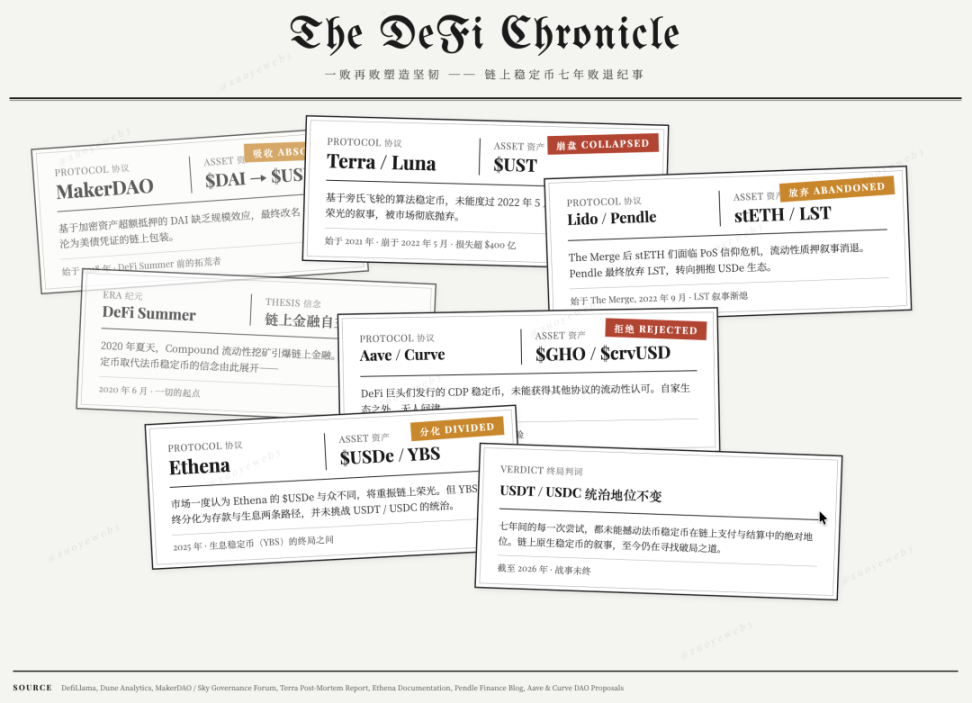
Image Caption: Stablecoin Chronicle

Image Source: @zuoyeweb3

Starting from the DeFi Summer of 2020, repeated defeats have forged resilience:

  • Starting in 2018, DAI based on crypto assets lacked scale, $USDS ultimately became a U.S. Treasury certificate

  • Starting in 2021, the ponzi-based $UST did not survive the 2022 bank run crisis; the story of rebuilding algorithmic stablecoin glory was abandoned

  • In 2022, stETH and others faced a PoS faith crisis post-The Merge; Pendle ultimately abandoned LST for USDe

  • In 2023/24, CDP stablecoins issued by DeFi giants like Aave/Curve were not recognized by other protocols

  • In 2025, the market once believed Ethena's $USDe was different, reviving on-chain glory, but yield-bearing stablecoins ultimately split into deposit and yield-bearing activities, failing to challenge the dominance of USDT/USDC in their respective domains.

The facts are very clear: it's not that USDT swallowed user profits, but that DeFi chose the scale effect of USDT/USDC.

Exchanging the Treasury profits generated by $300 billion for the entire market's trading foundation is not a bad deal for DeFi and the crypto market.

But at what cost?

The cost is not the evil claimed by yield-bearing stablecoin challengers that Tether takes profits, or the selfishness accused by Coinbase and Trump Jr. that banks prohibit interest-bearing accounts.

The bitter pill DeFi swallowed is that the U.S. Treasury rate, as the risk-free rate, is transmitted on-chain via stablecoins, but the U.S. Treasury is an asset of the U.S. government and its actions do not care about on-chain sentiments.

This is also the fundamental reason for the bankruptcy of tokenomics: UNI relies on A16Z, A16Z relies on USD financing, the USD is the embodiment of U.S. Treasuries, so UNI is just the fourth derivative relying on U.S. Treasuries. Why not just buy Treasuries directly, with no middleman taking a cut?

U.S. Treasuries are the de facto DeFi benchmark, but DeFi can only passively endure it, unable to interact with it bidirectionally. This is the root of all happiness or pain.
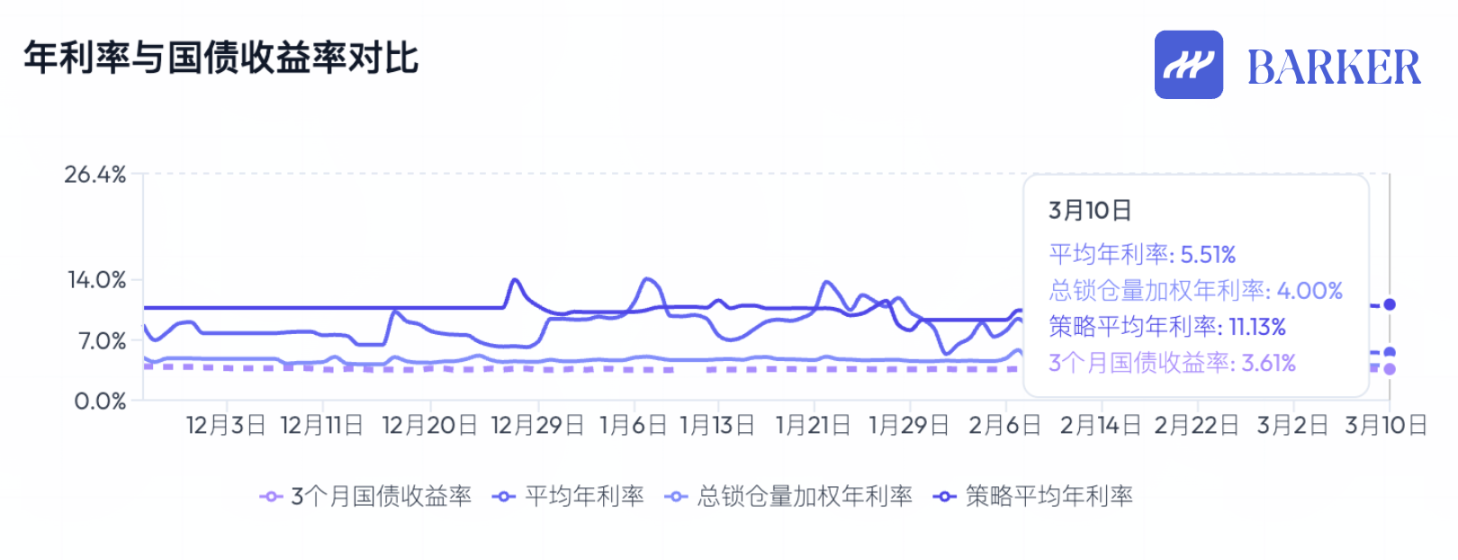
Image Caption: Comparison of On-Chain Stablecoin Yield APY and U.S. Treasuries

Image Source: @BarkerMoneyX

The salvation of DeFi never stops. Although tokenomics are bankrupt and DAO governance structures have collapsed, the overall direction of DeFi remains clear:

  1. Fixed-rate investment and financing,公认 risk grading system, unsecured credit lending –> The main themes of the next stage,蕴含某种形式的 mass-market products;

  2. The expansion period for public chains, exchanges, and DeFi protocols is over; new application forms are evolving into Vaults. It's not yet certain that Vaults are the form of mass-market products, but this is the starting point of the new stage.

Note here that public chains and exchanges are no longer the central links for value capture, but this does not mean their time is zero. Their period of asset price inflation is over, and only linear, steady growth remains.

This can also connect to the progressive relationship between UNI and U.S. Treasuries. Aave/Morpho are closer to asset management itself; their businesses don't have much narrative space, but are indispensable for the industry.

The real star products will definitely be Vaults used by the masses, based on public chains and DeFi protocols, utilizing分散 RWA assets, and triggering asset price inflation mechanisms.

For mass usage, Curators choose to ally with exchanges: Morpho enters Coinbase via Stakehouse, Aave expands to C-end users via Metamask and other U-cards.

Based on RWA assets, Curators partner with custodians like Galaxy to constantly maneuver between crypto and real-world assets, such as Grove buying Galaxy's CLO bonds.

But what's missing is the Vault that triggers the price inflation mechanism. Even before this wave of large-scale asset management moving on-chain, BlackRock's BUILD token was already live, and Circle's USYC also supports yield, but neither could replicate their own success.

It's not important that Vaults lack their own tokens. Asset price inflation is a mechanism. U.S. stocks, real estate, bonds, tulips, graphics cards, and Mac Minis all have their own price cycles. Current Vaults only have yield-bearing black boxes but始终 fail to solve two problems:

  1. Where does the high yield actually come from?

  2. How is high risk actually handled?

Towards a New Financial System

The form of channels is evolving; Vaults are not the endpoint.

The crypto industry evolves extremely fast. Before this year, we never dared to imagine that the global financial system would truly move on-chain, but today this is an undeniable ongoing process.

It's not yet time for a victory banquet. RWA can only serve as a funding source, Vaults are still boring deposit products, various Curators haven't demonstrated brand effects, and white-label Vaults like Veda are highly similar to SaaS, with the operator Curator only earning management fees.

This has no imagination for price inflation. If traditional asset management, with a scale of $2 trillion, endures cyclical煎熬, it's hard to imagine Vaults can withstand it.
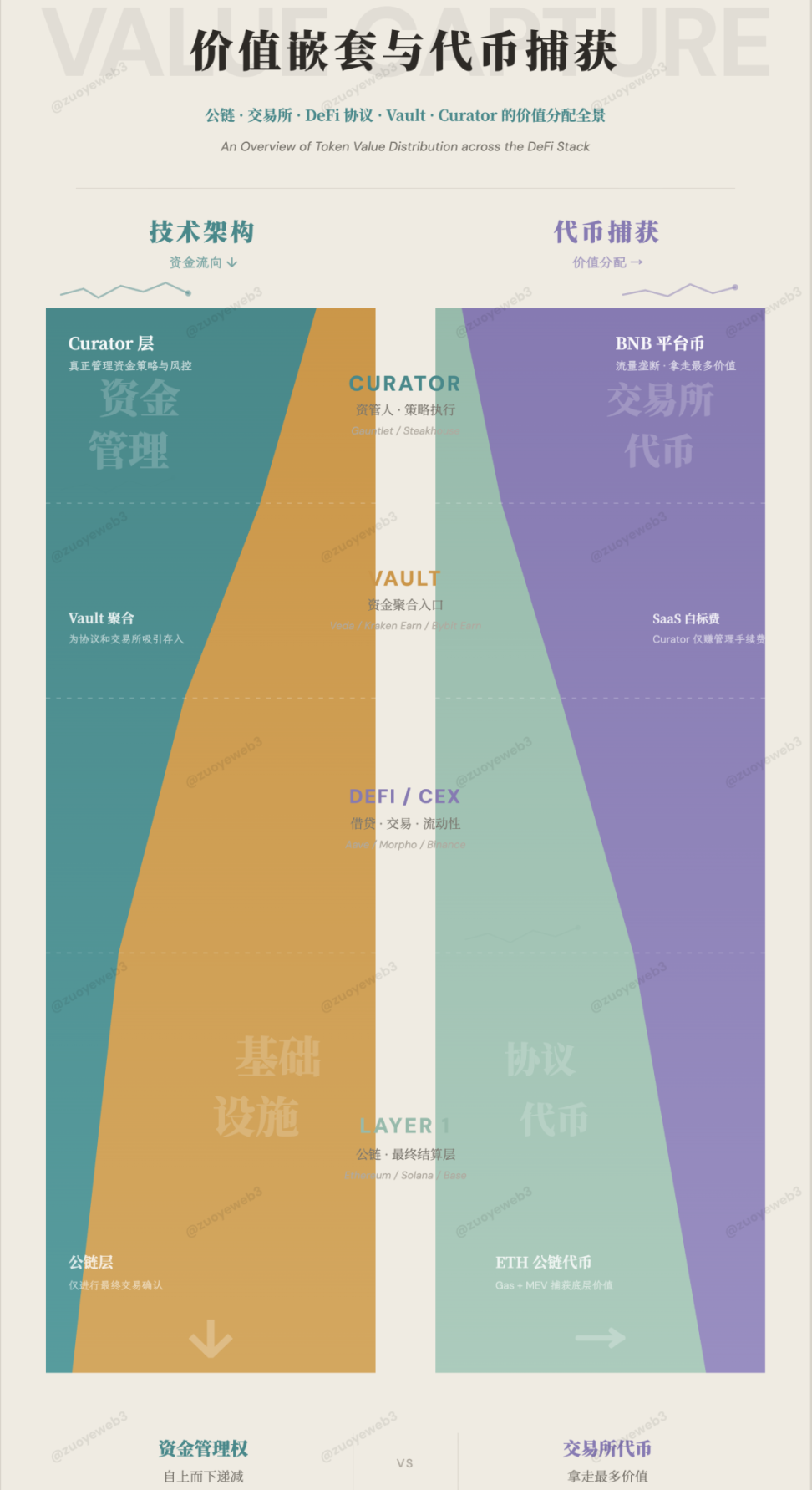
Image Caption: Fund Flows and Value Distribution

Image Source: @zuoyeweb3

Asset management moving on-chain is not driven by短暂 sentiment. In a sense, it's like the banking industry's IOE—you can't go back to the paper era. Even Spark has begun unifying the calculation of CEX/DEX position adjustment margins. DeFi is becoming the next step for TradFi.

Whether Vaults, after absorbing sufficient funds, will trigger the establishment of a risk-free rate is the biggest博弈 point of this cycle.

During the previous DeFi Summer, TVL was the decisive metric. The amount of资金 mapped to the get-rich coefficient of tokens, creating mining that continued into airdrop farming, studios, and Binance Alpha. The core logic was "projects need more funds to support token growth."

But with Vaults, for the first time, there is a huge demand for deposits but an inability to support their own tokens. Even if Morpho captures more market share from Aave, it cannot trigger a token surge.

Extending this, Hyperliquid compared to Binance, Lighter compared to Hyperliquid—their market sizes and token prices show a huge inversion. This is a great change unprecedented in DeFi.

On one hand, old infrastructure continues to吸血. For example, after the listing effect disappeared, $BNB should have declined, but CEXs still have a larger user base than the entire on-chain + DeFi. A very ironic fact: exchanges have retail users; DeFi protocols like Aave and Morpho have completely become the domain of a few professionals.

In this context, the high risk of Vault&Curator comes from code and structure:

  • Curve's immutable contract programming language can have problems; the xUSD team self-issued tokens

  • Aave ended the表面 harmony between the DAO and the development team; Re7 severely damaged on-chain asset management credibility

In this context, where does the high yield of Vault&Curator come from?

I know it's not regulatory arbitrage, HLP fees, or token incentives, but many still cling to these three, believing traditional finance's compliance creates too-big-to-fail credibility.

They completely forget that tokenomics are already bankrupt, while Vault deposits keep growing. Sky is already deeply integrated into the Morpho system, and the future of Aave V4 is also institutionalization and modularization.

Moreover, this article has always emphasized that the scale of Vault funds has not triggered some price inflation mechanism. This is the structural dilemma of Vaults.

The yield of Vaults essentially comes from the trading efficiency of global markets. If CEXs don't provide a certain Vault, then configure it on-chain. The personified Curator happens to be suitable for dealing with all sorts of people.

Even in TradFi's global markets, like U.S. stocks, one faces lengthy account opening, trading times, and process limitations. Can we really say that the gradual move towards全天候 trading for U.S. stocks and DTCC going on-chain is also for arbitrage?

The final question: What mechanism can actually trigger asset price inflation, allowing the funds沉淀 in Vaults to create a legendary price-to-dream ratio?

In other words, what is missing between Vaults and asset price inflation?

Channels are missing. Channels for funds to couple with each other. The personification of Curators hinders the programmability of DeFi Legos.

Currently, CEXs serve as a placeholder, still the fastest place for funds to intertwine.

Referencing the evolution of Perp DEXs, they are capturing market share from CEX futures. RWA funding sources are also抢夺 CEX market share.

CEXs only have存量. They themselves cannot solve user acquisition problems, let alone help Vaults expand to hundreds of millions of users. Vaults start by white-labeling, but in the future, they must build their own超级 factories.

I speculate the channel will be some form of Broker product.

Under高度 social division of labor, Super Apps like exchanges that integrate deposit/withdrawal, trading, custody, and清算 will gradually separate into different businesses. Binance's compliance framework in Abu Dhabi's ADGM is already divided into three parts.

This will fundamentally facilitate the professionalism of fund handling, utilize the unified ledger system of blockchain, and require the居中 coordination of Vault&Curator.

Referencing Neobrokers like Robinhood/Trade Republic, they attract年轻化, retail users to participate in professional trading, then build asset management, wealth management, and other business forms. The model of stablecoins at the front end and Curators managing Vaults is more efficient.

In summary, Binance monopolizes fund flow, BNB gets the strongest empowerment. Next, Brokers handle fund interaction. Some asset form, or even纯粹 business flow, could be highly profitable. After all, Robinhood is just a little disguise for a profitable market maker.

Conclusion

Compared to code and trading, regulation and tokens appear more stable.

Private credit and the RWA cycle have halted.抢先 issuing the 402 document feels prophetic. DeFi can serve as a liquidity exit channel, but it lacks the asset price inflation mechanism.

Asset Management ≈ Aave/Morpho will slowly, like public chains, end their historical mission. They will exist long-term but only with scale growth and stable token prices;

Vault&Curator ≈ Star fund managers are quickly acquiring customers and monopolizing markets. Giantization already shows preliminary signs. Whether they can continuously capture value is highly doubtful;

Channel ≈ CEX (temporary)反而 has the most innovation space. Facilitating the freedom of funds will always receive the highest reward.

A highly efficient global market is operating on a next-generation blockchain that doesn't need traditional tokens. This is the proposition of the next era, and everyone must provide an answer.


Twitter:https://twitter.com/BitpushNewsCN

Bitpush TG Discussion Group:https://t.me/BitPushCommunity

Bitpush TG Subscription: https://t.me/bitpush

Original Link:https://www.bitpush.news/articles/7618714

Связанные с этим вопросы

QWhy does the article claim that DeFi has no risk-free rate, and what is the role of US Treasury bonds in this context?

AThe article states that DeFi lacks a true risk-free rate because it relies on USDT and USDC, which are backed by US Treasury bonds. These stablecoins transmit the US Treasury yield on-chain, but DeFi cannot interact with or influence US monetary policy, making it a passive recipient of this benchmark rate rather than an active participant in setting it.

QWhat is the significance of Vaults in the current evolution of DeFi and traditional finance integration?

AVaults represent a new application layer in DeFi, acting as on-chain asset management products that attract institutional and retail capital. They are seen as the starting point for mass adoption and value capture, but they currently lack a mechanism for asset price inflation and face challenges in generating sustainable yields and managing risks.

QHow does the article describe the relationship between CeFi (like CEXs) and DeFi in the context of global financial markets?

AThe article suggests that centralized exchanges (CEXs) currently serve as temporary channels for capital flow and liquidity, but their role may evolve as DeFi infrastructure matures. It predicts that super-apps like CEXs will eventually unbundle into specialized services (e.g., brokerage, custody), with DeFi Vaults and Curators facilitating more efficient global market operations.

QWhat are the main challenges facing Vaults and Curators in achieving sustainable growth and value capture?

AVaults and Curators struggle with two core issues: the source of high yields (beyond temporary incentives like token rewards or regulatory arbitrage) and the management of high risks (including smart contract vulnerabilities and governance failures). They also lack a price inflation mechanism to drive token value, unlike earlier DeFi protocols that benefited from TVL-driven speculation.

QWhat does the article propose as the potential solution to DeFi's structural limitations in establishing a independent financial system?

AThe article suggests that the future lies in creating efficient 'channels' or brokerage-like products that enhance capital fluidity and interoperability between TradFi and DeFi. This would involve unbundling CEX functions into specialized services, leveraging blockchain's unified ledger, and enabling Vaults to act as intermediaries for global asset allocation, ultimately fostering a new price discovery mechanism.

Похожее

Solana Privacy Ecosystem Panorama: A Complete Privacy Stack from Compute to AI

**Title: The Solana Privacy Ecosystem: A Full-Stack View from Compute to AI** **Summary:** This article provides a comprehensive overview of the emerging privacy landscape on the Solana blockchain, characterizing it as still in early development. It identifies two primary verticals—Neobanks and Private DeFi—as key drivers, while noting gaps in tooling and user experience. The discussion centers on two main approaches to private computation: Arcium, which utilizes Multi-Party Computation (MPC) networks (Multi-Party eXecution Environments) to process encrypted data with final settlement on Solana; and Magic Block, which leverages Trusted Execution Environments (TEEs) via its Private Ephemeral Rollup (PER). Both enable confidential applications like dark pools and private DeFi with minimal code changes. Building on this infrastructure, projects are creating privacy-focused applications. Umbra, built on Arcium, offers Encrypted Token Accounts (ETAs) for private balances, transfers, and selective disclosure for compliance. Other wallets like Privacy Cash and Hush provide mixer-like functionality for SOL. For private trading, encifherio uses TEEs to encrypt swap details routed through Jupiter, while VanishTrade and Darklake focus on shielding transaction intent and liquidity routing, with Darklake introducing a "blind slippage pool" to prevent front-running. Further applications include private prediction markets (e.g., Melee Markets using Arcium's encrypted order books) and private AI. Loyal exemplifies the latter, using both Magic Block and Arcium to enable decentralized AI agents that store user data, conversations, and transactions confidentially on-chain. The article concludes by framing privacy not as a single technology but as an evolving "ultimate privacy stack," with experts like Helius's Mert envisioning a future combination of Fully Homomorphic Encryption (FHE) and Zero-Knowledge proofs (ZK). Helius Privacy itself is developing a ZK-based UTXO privacy layer for Solana.

Foresight News2 мин. назад

Solana Privacy Ecosystem Panorama: A Complete Privacy Stack from Compute to AI

Foresight News2 мин. назад

7 Key Questions Regarding 'DeepSeek Completes Over 50 Billion Yuan in Financing'

DeepSeek, the prominent Chinese AI company, has reportedly completed its first external funding round, raising over 50 billion RMB (approximately $6.9 billion USD), according to foreign media reports. This financing values the company at over $50 billion USD, a significant increase from a $10 billion valuation when the round began in April 2026. Founder Liang Wenfeng personally contributed 20 billion RMB, with other investors including Tencent, CATL (Contemporary Amperex Technology), JD.com, NetEase, and IDG Capital. Notably, the National Artificial Intelligence Industry Investment Fund also participated with a direct investment of 1 billion RMB. The funding round is distinctive for its structure. Most investors' capital is channeled into a limited partnership controlled by CEO Liang Wenfeng, rather than directly into DeepSeek. These investors face a five-year lock-up period, have no voting rights, but receive priority financial information and future investment rights. This arrangement is seen as a measure to ensure Liang's absolute control over the company's direction, aligning with its stated principles of prioritizing groundbreaking AGI (Artificial General Intelligence) research over short-term profitability. The report highlights strategic reasons for key investors. Tencent's involvement is viewed as a strategic alignment, building on existing collaborations. CATL's investment is linked to the critical energy and power infrastructure needed for AI data centers, a key growth area for the battery giant. The participation of a state-backed fund underscores the national strategic importance of AI development. Post-funding, DeepSeek is expected to accelerate infrastructure development, including building its own data centers, hire more talent, and release new model versions with enhanced capabilities like image and audio support. While this marks a major step, the company's long-term journey towards AGI remains a challenging path that will require balancing its foundational ideals with the expectations of its new investors.

marsbit47 мин. назад

7 Key Questions Regarding 'DeepSeek Completes Over 50 Billion Yuan in Financing'

marsbit47 мин. назад

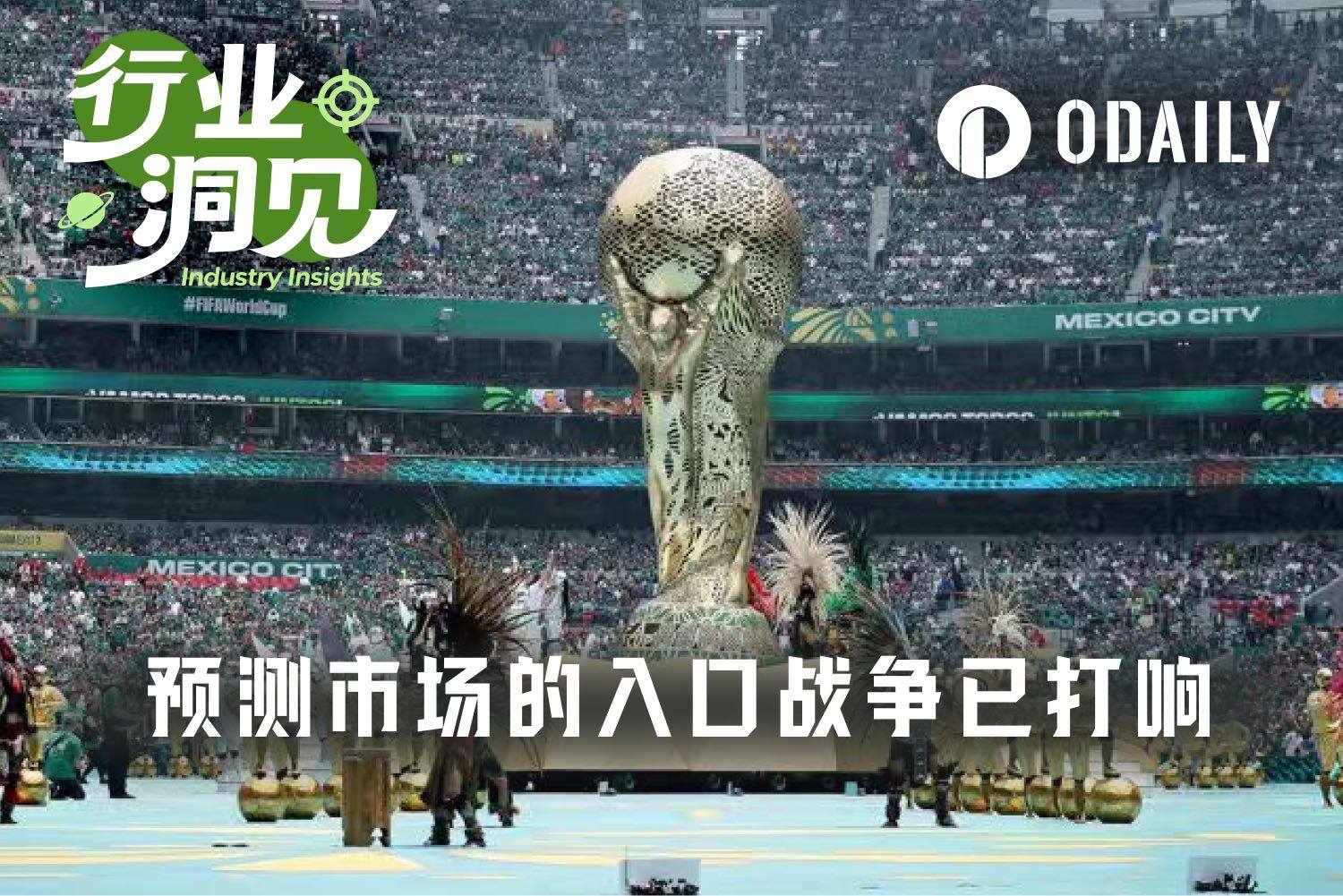
The World Cup is Here: The Battle for Entry into Prediction Markets Has Begun

The 2026 FIFA World Cup has begun, and alongside the on-field competition, a new off-field battleground is emerging: prediction markets. These blockchain-based platforms, which convert crowd wisdom into tradable probabilities, are gaining significant traction. However, their complexity—involving wallets, gas fees, and smart contracts—has historically limited participation to crypto-native users. Centralized exchanges (CEXs), like Gate, are tackling this adoption barrier. By integrating with leading prediction market protocol Polymarket, Gate simplifies the user experience. Users can participate directly with their exchange account and USDT, bypassing complex Web3 steps. Gate offers a streamlined "Prediction Mode" for casual users and a professional "Trading Mode" with advanced tools. Key features include two-way trading (allowing users to buy or sell positions before event resolution), support for diverse markets (sports, crypto, macroeconomics), and a suite of information tools like a "Smart Money" leaderboard, wallet tracking, and AI-powered insights. For the World Cup, Gate launched a dedicated hub aggregating schedules, standings, and relevant markets. This allows fans to seamlessly follow games and trade on outcomes, transforming passive viewing into active participation where they can monetize their predictions and trade on shifting consensus throughout a match. The article argues that prediction markets have proven their value in event forecasting. The next challenge is mass adoption. The competition is shifting from building effective protocols to creating accessible user entry points. By lowering technical barriers and building a complete ecosystem for information and trading, platforms like Gate aim to transition prediction markets from a niche crypto tool to a mainstream platform for expressing and trading on collective intelligence.

Odaily星球日报57 мин. назад

The World Cup is Here: The Battle for Entry into Prediction Markets Has Begun

Odaily星球日报57 мин. назад

Spain Held to a Draw by Cape Verde, Jucom Prediction Market Witnesses Historic Upset

In a major upset at the 2026 FIFA World Cup, tournament favorites Spain were held to a surprising 0-0 draw by debutants Cape Verde in their Group H opener on June 16, Beijing time. Despite dominating possession (74%) and recording 27 shots with an expected goals figure of 2.16, Spain failed to break down a resilient Cape Verde defense, with their 40-year-old goalkeeper Vozinha making 7 saves to earn Man of the Match. Pre-match predictions on the Jucom prediction market had heavily favored Spain, assigning them a 92% win probability. The actual result, a goalless draw, triggered significant volatility across related prediction markets. This outcome forces a market-wide reassessment of several key probabilities, including Spain's likelihood of winning the group and the tournament itself, while Cape Verde's previously near-zero chance of advancing is now being re-evaluated. The event highlights both the efficiency and the inherent limitations of prediction markets. While prices aggregate known information, football's low-scoring, high-variance nature means unquantifiable in-game factors can lead to unlikely results. The core value of such markets lies not in perfect foresight but in their ability to dynamically reflect how new information is incorporated into collective expectations. Platforms like Jucom, which track outcomes from single matches to the final champion, provide a real-time lens into how global consensus evolves with each game.

链捕手1 ч. назад

Spain Held to a Draw by Cape Verde, Jucom Prediction Market Witnesses Historic Upset

链捕手1 ч. назад

Торговля

Спот
Фьючерсы

Популярные статьи

Что такое G$

Понимание GoodDollar ($G$): План децентрализованного универсального базового дохода Введение В постоянно эволюционирующем ландшафте криптовалют и технологий блокчейн инициативы, стремящиеся решить актуальные социальные проблемы, привлекают все больше внимания. Один из таких проектов — GoodDollar ($G$), решение универсального базового дохода (UBI) на базе Web3. GoodDollar ставит целью бороться с неравенством и сокращать разрыв в богатстве, создавая и распределяя доступные экономические ресурсы для наиболее нуждающихся. Благодаря инновационному использованию децентрализованных финансов (DeFi) GoodDollar представляет собой уникальную модель, которая потенциально может изменить восприятие и предоставление финансовой помощи на глобальном уровне. Что такое GoodDollar ($G$)? GoodDollar — это криптовалютный протокол, который облегчает выпуск и распределение цифровых токенов, именуемых $G$, своим зарегистрированным пользователям ежедневно. Эти токены функционируют как форма универсального базового дохода, способствуя финансовой независимости для людей из различных слоев общества, особенно тех, кто традиционно исключен из финансовой системы. Работая на блокчейне, GoodDollar использует несколько цепочек, включая Ethereum, Celo и Fuse, обеспечивая широкий доступ и удобство использования. Основная цель GoodDollar — сделать криптовалюту доступной и полезной для всех, независимо от их экономического старта. Создатель GoodDollar ($G$) Данные о создателе GoodDollar остаются несколько неясными. Однако особенно отмечается, что проект имеет сильную поддержку от eToro, широко признанной инвестиционной платформы, предоставившей начальное финансирование и базовую поддержку для разработки GoodDollar. Видение, стоящее за проектом, не преследует исключительно прибыльные цели, а в значительной степени ориентировано на социальное предпринимательство, нацеленное на системные изменения в экономической доступности. Инвесторы GoodDollar ($G$) GoodDollar пользуется финансовой поддержкой и операционной помощью от eToro. Это партнерство сыграло важную роль в запуске протокола и его последующих разработках. Хотя eToro был ключевым в установлении основы проекта, GoodDollar планирует перейти к модели, финансируемой своим сообществом, в долгосрочной перспективе. Этот переход к сообществу финансирования соответствует обязательству GoodDollar по децентрализации, позволяя пользователям иметь непосредственный интерес в будущем проекта. Как работает GoodDollar ($G$)? Операционная структура GoodDollar в значительной степени полагается на принципы DeFi для генерации дохода от ставленных криптовалют. Этот механизм позволяет проекту создавать и распределять токены $G$ как цифровой базовый доход для пользователей по всему миру. Несколько ключевых особенностей способствуют уникальности и инновациям GoodDollar: Универсальный базовый доход (UBI): Каждый день зарегистрированные пользователи получают бесплатные токены, устанавливая автоматический поток дохода, предназначенный для облегчения финансовых нагрузок. Устойчивый экономический модель: Токеномика проекта нацелена на балансировку спроса и предложения токенов $G$, обеспечивая стабильность их стоимости со временем. Токены с резервами: Каждый токен $G$ обеспечен резервом криптовалют, что придает ему внутреннюю ценность и надежность, что является важным аспектом для поддержания доверия пользователей. Децентрализованное управление: GoodDollar включает демократический подход к принятию решений через децентрализованное управление на основе токенов. Это позволяет членам сообщества активно участвовать в формировании траектории проекта, делая его действительно ориентированным на сообщество. Глобальная доступность: GoodDollar создал значительное сообщество, насчитывающее более 640 000 участников из 181 страны. Такая широкая доступность служит важным инструментом для реализации UBI на глобальном уровне. Хронология GoodDollar ($G$) Эволюция GoodDollar отмечена несколькими значительными вехами в его истории: 2019: Запуск кошелька GoodDollar стал первым шагом к реализации его видения предоставления UBI через криптовалюту. 2020: После успешного запуска кошелька GoodDollar официально дебютировал протокол. Это ознаменовало ключевую фазу в его миссии по обеспечению ежедневного распределенного дохода. 2021: Проект продвинулся дальше с введением своей децентрализованной автономной организации (DAO), способствуя большему уровню вовлеченности и управления сообществом. 2022: GoodDollar представил свою дружелюбную к DeFi версию 2 (V2), стремясь улучшить вовлеченность пользователей и оперативную эффективность. В тот же год также произошел переход к структуре децентрализованного управления через GoodDAO. 2022: Была разработана новая дорожная карта, сосредоточенная на инициативах, таких как грантовая программа, направленная на поддержку предпринимательских инициатив, связанных с $G$, и улучшенный рынок GoodDollar. Ключевые особенности GoodDollar ($G$) Проект GoodDollar представляет множество важных особенностей, направленных на переопределение ландшафта базового дохода: Универсальный базовый доход: Ежедневная выдача бесплатных токенов пользователям, по сути, подчеркивает его миссию по ликвидации экономической нестабильности. Многоцепочечная операция: Использование нескольких блокчейн-сетей повышает доступность и масштабируемость, обеспечивая более широкое участие. Взаимодействие с децентрализованными финансами: Использование DeFi позволяет обеспечивать устойчивое финансирование модели UBI, укрепляя ее жизнеспособность как экономического решения. Вовлеченность сообщества и управление: GoodDollar предполагает модель, в которой сообщество влияет на операции через демократическое участие, способствуя прозрачности и подотчетности. Глобальное сообщество: Обладая разнообразным глобальным сообществом, проект способен реализовывать UBI-решения, адаптированные к различным культурным и экономическим контекстам. Заключение GoodDollar представляет собой преобразующий шаг к внедрению принципов универсального базового дохода через инновационную призму технологий блокчейн. Используя децентрализованные финансы, проект не только предлагает решение для финансового неравенства, но и активно вовлекает пользователей в управление и операции. С растущим сообществом и развивающейся дорожной картой GoodDollar занимает важное место на стыке криптовалюты и социального блага, прокладывая путь к более справедливому финансовому будущему. По мере его дальнейшей эволюции путь GoodDollar, возможно, вдохновит другие инициативы рассмотреть аналогичные модели, способствуя экономическому расширению для всех.

107 просмотров всегоОпубликовано 2024.04.05Обновлено 2024.12.03

Что такое G$

Как купить G

Добро пожаловать на HTX.com! Мы сделали приобретение Gravity (G) простым и удобным. Следуйте нашему пошаговому руководству и отправляйтесь в свое крипто-путешествие.Шаг 1: Создайте аккаунт на HTXИспользуйте свой адрес электронной почты или номер телефона, чтобы зарегистрироваться и бесплатно создать аккаунт на HTX. Пройдите удобную регистрацию и откройте для себя весь функционал.Создать аккаунтШаг 2: Перейдите в Купить криптовалюту и выберите свой способ оплатыКредитная/Дебетовая Карта: Используйте свою карту Visa или Mastercard для мгновенной покупки Gravity (G).Баланс: Используйте средства с баланса вашего аккаунта HTX для простой торговли.Третьи Лица: Мы добавили популярные способы оплаты, такие как Google Pay и Apple Pay, для повышения удобства.P2P: Торгуйте напрямую с другими пользователями на HTX.Внебиржевая Торговля (OTC): Мы предлагаем индивидуальные услуги и конкурентоспособные обменные курсы для трейдеров.Шаг 3: Хранение Gravity (G)После приобретения вами Gravity (G) храните их в своем аккаунте на HTX. В качестве альтернативы вы можете отправить их куда-либо с помощью перевода в блокчейне или использовать для торговли с другими криптовалютами.Шаг 4: Торговля Gravity (G)С легкостью торгуйте Gravity (G) на спотовом рынке HTX. Просто зайдите в свой аккаунт, выберите торговую пару, совершайте сделки и следите за ними в режиме реального времени. Мы предлагаем удобный интерфейс как для начинающих, так и для опытных трейдеров.

411 просмотров всегоОпубликовано 2024.12.10Обновлено 2026.06.02

Как купить G

Что такое @G

Graphite Network, $@G: Соединение TradFi и Web3 Введение в Graphite Network, $@G В ярком мире криптовалют и проектов web3 Graphite Network выступает как маяк инноваций. С его нативным токеном, $@G, эта блокчейн-сеть первого уровня с доказательством авторитета (PoA) предназначена для преодоления разрыва между традиционными финансами (TradFi) и быстро развивающейся экосистемой Web3. Поскольку цифровые валюты набирают популярность, Graphite Network стремится предложить блокчейн-платформу, которая придает приоритет безопасности, соблюдению норм и скорости, представляя себя как посредника доверия и ответственности. Что такое Graphite Network, $@G? Graphite Network — это не просто еще один блокчейн-проект; он нацелен на переосмысление того, как децентрализация, безопасность и ответственность пользователей воспринимаются в области цифровых финансов. Проект обладает рядом отличительных особенностей: Блокчейн на основе репутации: В своей основе Graphite Network реализует политику один пользователь — один аккаунт, укрепленную интегрированной проверкой «Знай своего клиента» (KYC) и механизмами оценки. Этот дизайн обеспечивает баланс между конфиденциальностью пользователей и прозрачностью — критически важный аспект финансовых операций в современном цифровом мире. Доход от узлов входа: Сеть поощряет пользователей настраивать узлы входа, позволяя операторам зарабатывать вознаграждения от транзакций в сети. Эта модель генерации дохода не только повышает вовлеченность пользователей, но и укрепляет здоровье сети и децентрализацию. Совместимость с EVM: С совместимой с Ethereum виртуальной машиной (VM) Graphite Network позволяет бесшовную интеграцию существующих децентрализованных приложений (dApps) на Solidity и смарт-контрактов, тем самым приглашая разработчиков использовать ее возможности без значительных модификаций. Интеграция KYC: В эпоху, когда соблюдение норм имеет первостепенное значение, интегрированная KYC-структура с несколькими уровнями проверки усиливает контроль над финансовыми операциями без обязательного участия, устанавливая прецедент для автономии пользователей. Кто является создателем Graphite Network, $@G? Graphite Network возникла в результате усилий Фонда Graphite, некоммерческой организации, посвященной разработке, поддержке и эволюции Graphite Network. Обязательство фонда подчеркивает видение проекта по созданию безопасной и устойчивой блокчейн-среды, сосредоточенной на подлинном вовлечении пользователей и соблюдении норм. Кто являются инвесторами Graphite Network, $@G? В настоящее время доступно ограниченное количество информации о конкретных инвесторах, поддерживающих инициативу Graphite Network. Учредительная организация, Фонд Graphite, функционирует независимо, способствуя росту проекта, одновременно ища партнерства, которые соответствуют ее видению соблюдаемой и доступной блокчейн-платформы. Как работает Graphite Network, $@G? Операции Graphite Network основаны на уникальном механизме консенсуса Proof-of-Authority, который достигает впечатляющего баланса между высокой пропускной способностью и децентрализацией. Давайте углубимся в различные компоненты, которые определяют ее работу: Транспортные узлы: Служащие узлами входа, они критически важны для экосистемы. Операторы могут зарабатывать доход от транзакций, проходящих через сеть, что не только дает возможность отдельным пользователям, но и укрепляет децентрализацию сети. Уполномоченные узлы: В сердце Graphite Network находятся основные валидаторы, которые проходят строгие тесты на соблюдение норм, включая надежную проверку KYC и технические оценки. Этот уровень доверия необходим для обеспечения того, чтобы транзакции в сети поддерживали высокий уровень целостности. Система тикеров: Graphite Network использует уникальную систему тикеров для своих обернутых токенов, обозначаемых как @G. Эта функция повышает ясность интеграции активов, делая транзакции пользователей понятными и простыми. Инновационный подход Graphite Network отражает значительный шаг в решении ключевых проблем цифровых финансов, позиционируя себя благоприятно для будущего, поскольку все больше пользователей переходит от традиционных форм финансов к миру децентрализованных приложений. Хронология Graphite Network, $@G Чтобы понять прогресс и вехи Graphite Network, полезно просмотреть ключевые события в ее хронологии: 2021: Создание Graphite Network Фондом Graphite знаменует начало новой главы в разработке блокчейнов, сосредоточенной на соблюдении норм и расширении прав пользователей. Ключевые события: После своего запуска внедрение дохода от узлов входа, создание модели на основе репутации, интегрированная проверка KYC и предоставление совместимости с EVM представляют собой значительные достижения в проекте. Недавние активности: Непрерывные усилия по разработке и поддержке Фонда Graphite сосредоточены на увеличении функциональности сети, одновременно способствуя росту экосистемы, демонстрируя долгосрочную приверженность устойчивости и инновациям. Дополнительные ключевые моменты Помимо своих основных компонентов, Graphite Network включает в себя несколько инструментов и функций, которые укрепляют ее удобство: Graphite Wallet: Удобное расширение для Chrome, которое облегчает доступ к различным функциям и приложениям сети на совместимых с Ethereum цепочках, повышая удобство для пользователей. Graphite Bridge: Этот инструмент позволяет бесшовные переводы активов Graphite между различными сетями, способствуя интегрированной и взаимосвязанной экосистеме. Graphite Explorer: Служит важным инструментом в экосистеме, позволяя пользователям просматривать и проверять исходный код смарт-контрактов, отслеживать транзакции и исследовать другую важную информацию в реальном времени. Graphite Testnet: Проект предоставляет надежную тестовую среду для разработчиков, позволяя им обеспечить стабильность и масштабируемость перед развертыванием в основной сети. Эта инициатива не только дает возможность разработчикам, но и повышает надежность всей сети. Заключение Graphite Network с его нативным токеном $@G представляет собой значительный шаг к соединению традиционных финансов и передовых блокчейн-технологий. Сосредоточившись на безопасности, соблюдении норм и децентрализации, эта инновационная платформа готова возглавить переход в эпоху Web3. По мере роста вовлеченности пользователей и увеличения числа проектов, использующих ее возможности, Graphite Network готова внести долговременные вклады в быстро развивающийся цифровой ландшафт. В заключение, Graphite Network является свидетельством того, что можно достичь, когда инновационное мышление встречается с растущими требованиями современного финансирования и технологий. Поскольку мир исследует потенциал децентрализованных финансов, Graphite Network, безусловно, останется заметным игроком в этой области.

9 просмотров всегоОпубликовано 2025.01.06Обновлено 2025.01.06

Что такое @G

Обсуждения

Добро пожаловать в Сообщество HTX. Здесь вы сможете быть в курсе последних новостей о развитии платформы и получить доступ к профессиональной аналитической информации о рынке. Мнения пользователей о цене на G (G) представлены ниже.

活动图片