Dual Governance empowers stETH and wstETH holders to safeguard their assets in the event of contentious or harmful governance decisions within the Lido protocol. If necessary, it enables holders to delay or block proposed changes until they have safely exited the protocol.
This guide outlines how Dual Governance works, possible scenarios where it may be activated, and step-by-step instructions for stETH holders.
What is Dual Governance?
Dual Governance introduces a mechanism that gives stakers a direct role in protocol governance through the dynamic timelock system. This mechanism ensures that holders can exit the protocol before potentially harmful proposals are enacted.
The mechanism relies on an immutable escrow contract, which accepts stETH, wstETH, and unstETH withdrawal NFTs. Two thresholds apply to the escrow:
- 1% threshold: Once 1% of the total stETH supply is deposited, Veto Signalling is triggered. This delays governance proposals for 5 to 45 days, depending on the level of opposition.
- 10% threshold: Once 10% of the total stETH supply is deposited, Rage Quit is triggered. This blocks all governance motions until all escrowed stETH, wstETH, and unstETH tokens are fully withdrawn.
While LDO holders maintain voting power, Dual Governance ensures stETH holders can signal opposition, delay execution, and exit the protocol before changes impact their assets.
For more details on the underlying design, see:
Withdrawals and Their Role in Dual Governance
Although the withdrawal process itself has not changed, it is central to Dual Governance:
- Request withdrawal: Lock your stETH/wstETH at stake.lido.fi/withdrawals/request. Each withdrawal request mints a unique NFT (unstETH). Your stETH is burned, and ETH is sourced to fulfill the request.
- Claim: Once the withdrawal is finalized, the unstETH NFT updates to “finalized,” allowing you to claim ETH.
Why it matters: Withdrawal NFTs can be deposited into the Veto Signalling escrow alongside stETH/wstETH. This lets you signal opposition while keeping your place in the withdrawal queue—a key option in both moderate and severe threat scenarios.
For a walkthrough, see:
Two Categories of Scenarios
Dual Governance responses fall into two broad categories:
- Moderately bad proposals: Well-intentioned but flawed proposals, mistakes, or governance gaps.
- Severe threats: Deliberate attempts to exploit governance or impose hostile protocol changes.
Each scenario has specific strategies available to stETH holders.
Scenario 1: Moderately Bad Proposals
These are usually unintended mistakes, compromises, or unclear proposals. While problematic, they do not represent immediate existential threats.
Examples include:
- Security oversights or misaligned parameters.
- Governance decisions that unintentionally harm stETH holders.
- Technical changes that reduce validator decentralization.
- Honest errors in fees or reward mechanics.
- Poor communication of proposal rationale or impact.
Step by Step Response
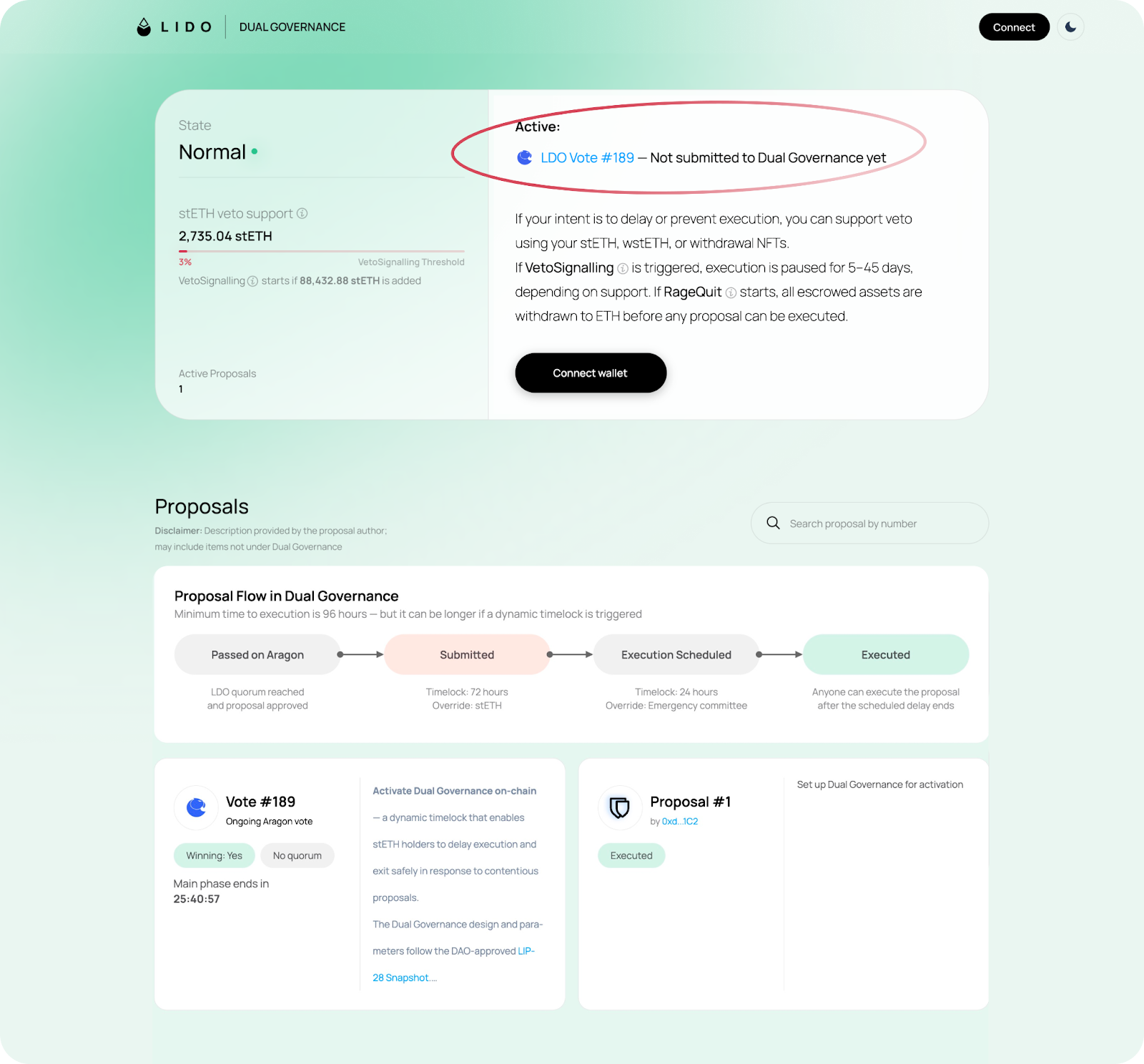
After LDO holders approve a proposal, it enters the Dual Governance review process. You can find all active proposals at dg.lido.fi. Click each proposal to review details and verify the items under consideration.
1. Place tokens in the Veto Signalling Escrow
Veto Signalling does not fully block execution, but it activates a dynamic timelock: the more exit signals from stETH holders, the longer governance motions are delayed.
If you believe a submitted or active proposal is problematic:
- Connect your wallet.
- Click the Support Veto button.
- Select the token type (stETH, wstETH, or unstETH) and the amount to deposit into the Veto Signalling contract.
For detailed instructions, see the Dual Governance UI guide.
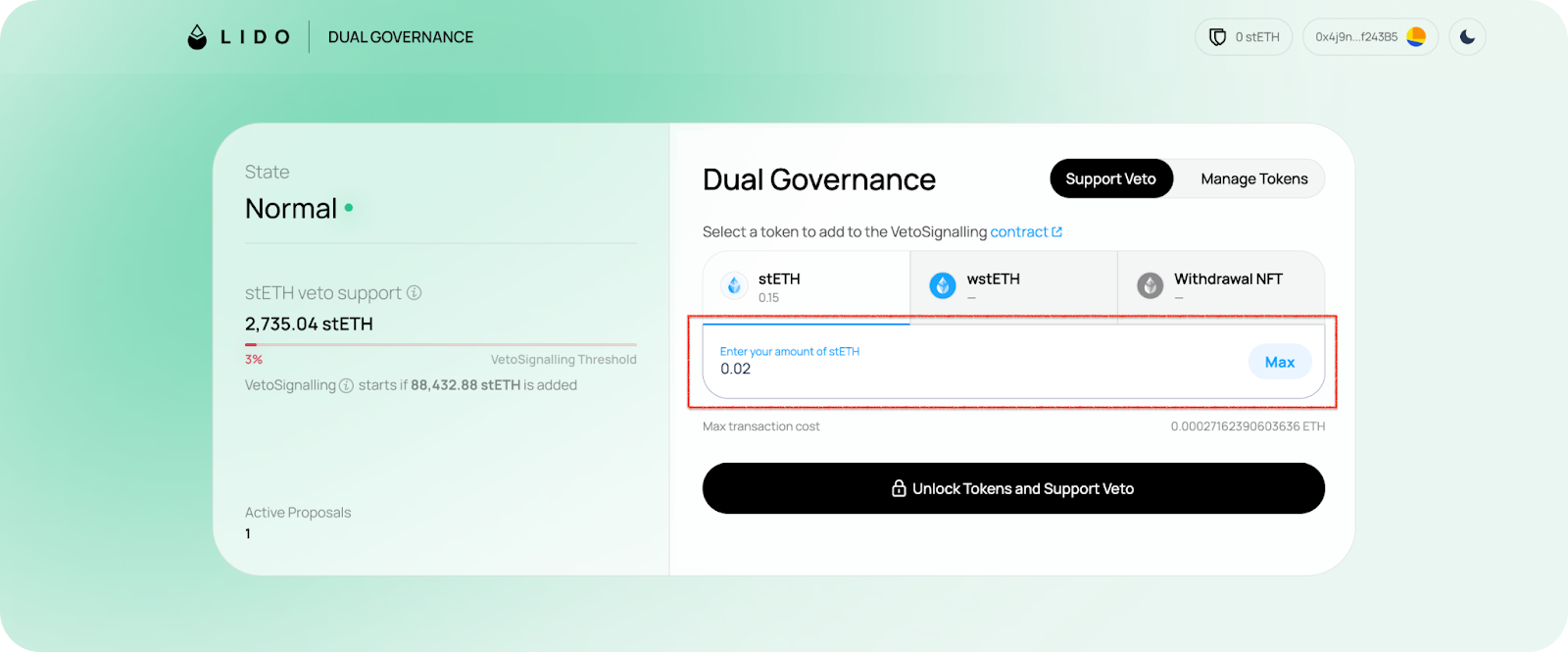
Note: stETH/wstETH deposited in escrow remains staked. You can choose any amount to support Veto Signalling.
If the 1% threshold is NOT reached
The Veto is not supported by enough stETH holders (<1% of total supply). In this case, the governance process is unaffected, and the proposal will be enacted once the pending time ends (3 days + 1 day technical buffer).
During and after this time, stETH holders may either exit the protocol via the withdrawal queue or revoke tokens from the Veto Signalling escrow. Proposals can still be executed even while opponents are in the process of exiting.
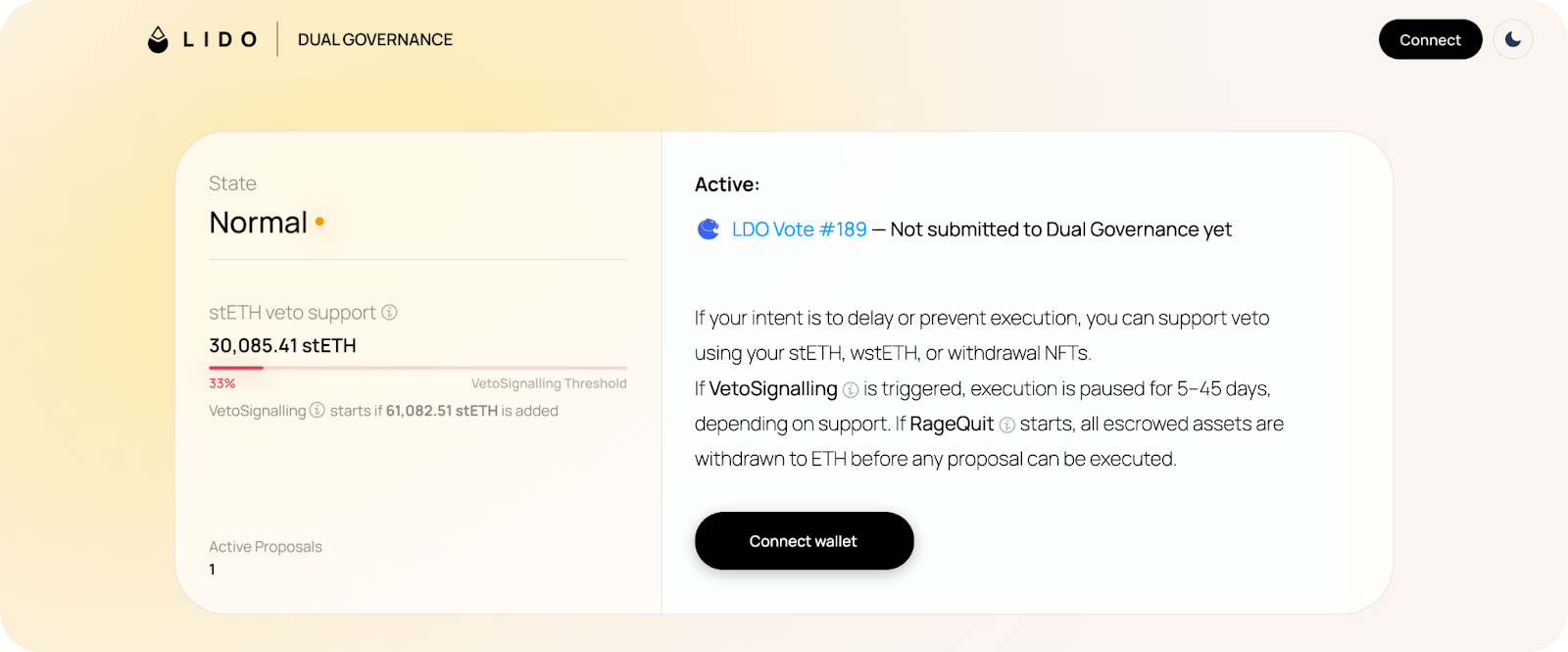
Indicator: A yellow “Normal” state background means 30% of the amount required for the next threshold has been gathered (a sign of significant opposition).
If the 1% threshold IS reached
More than 1% of stETH is deposited, triggering Veto Signalling. Execution is paused, giving stakers and LDO holders time to coordinate.
From here, two outcomes are possible:
- DAO cancels or revises the proposal
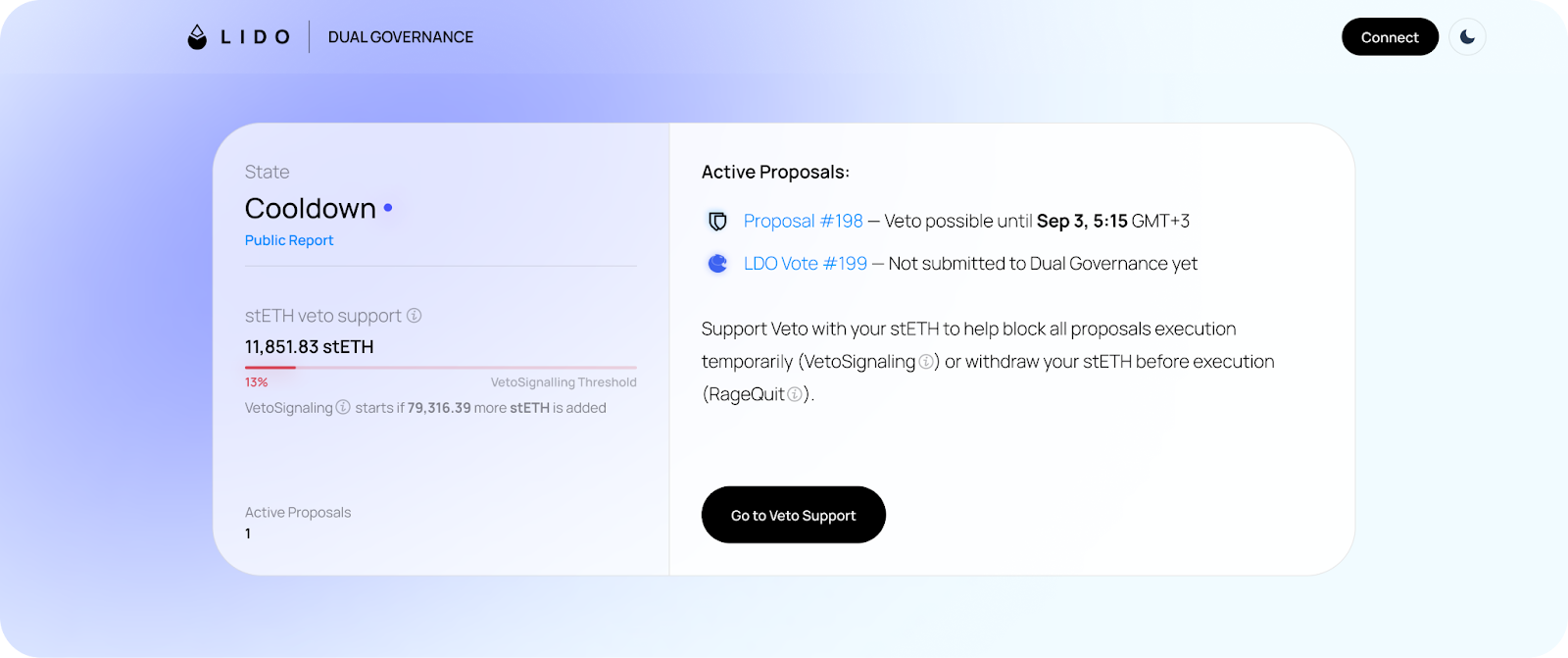
The DAO may cancel the proposal, gather feedback, and revise it. stETH holders can then revoke their tokens. After the dynamic timelock expires, the system enters a Deactivation sub-state, followed by the Veto Cooldown state:- Transitional phase (5 hours) where uncancelled proposals may still be executed.
- After cooldown, the system returns to Normal.
- DAO proceeds with the proposal
Once the Veto Signalling dynamic timelock has elapsed, if the DAO continues despite opposition, the system enters the Deactivation sub-state (up to 3 days).- This informs stakers that Veto Signalling is about to end, giving them time to either stay or exit.
- stETH holders who remain should revoke their tokens from escrow.
- Those exiting should revoke from escrow, then request withdrawals at stake.lido.fi/withdrawals/request.
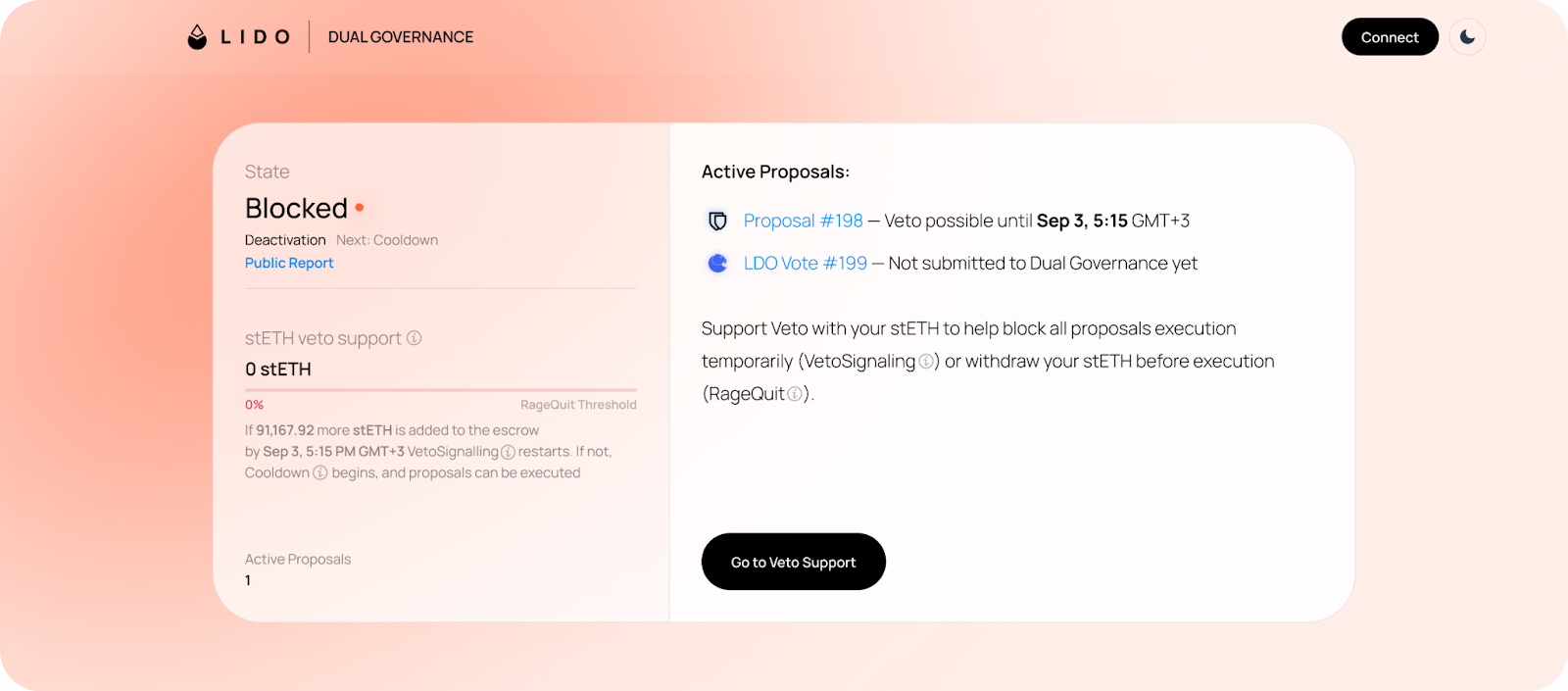
⚠️ Escalation risk: If more stETH holders join Veto Signalling during Deactivation, it can escalate into Rage Quit.
Scenario 2: Severe Protocol Threats
These are deliberate and hostile attempts to exploit governance or undermine the protocol.
Examples include:
- Malicious governance attacks by concentrated LDO holders.
- Hostile changes to withdrawal contracts, fees, or security parameters.
Step by Step Response
1. Withdraw tokens
In case of a governance attack or hostile proposal, the safest action is to exit as soon as possible.
- Tokens in the Veto Signalling escrow will automatically exit if Rage Quit is triggered, but this may take time depending on Ethereum validator exit capacity.
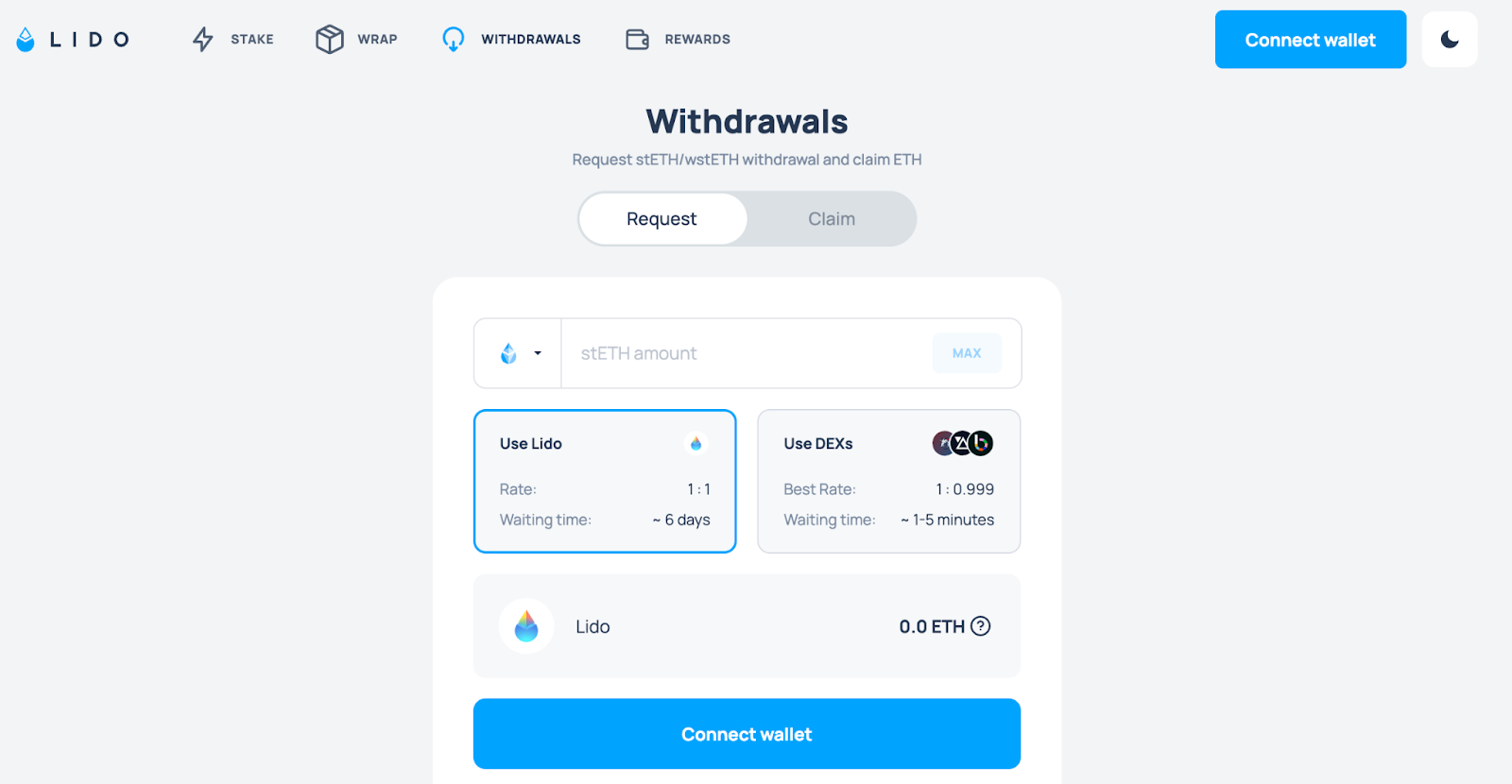
- To secure an earlier position, request withdrawals directly at stake.lido.fi/withdrawals/request. This ensures your exit is processed before the Rage Quit batch.
2. Place withdrawal NFTs into the Veto Signalling escrow
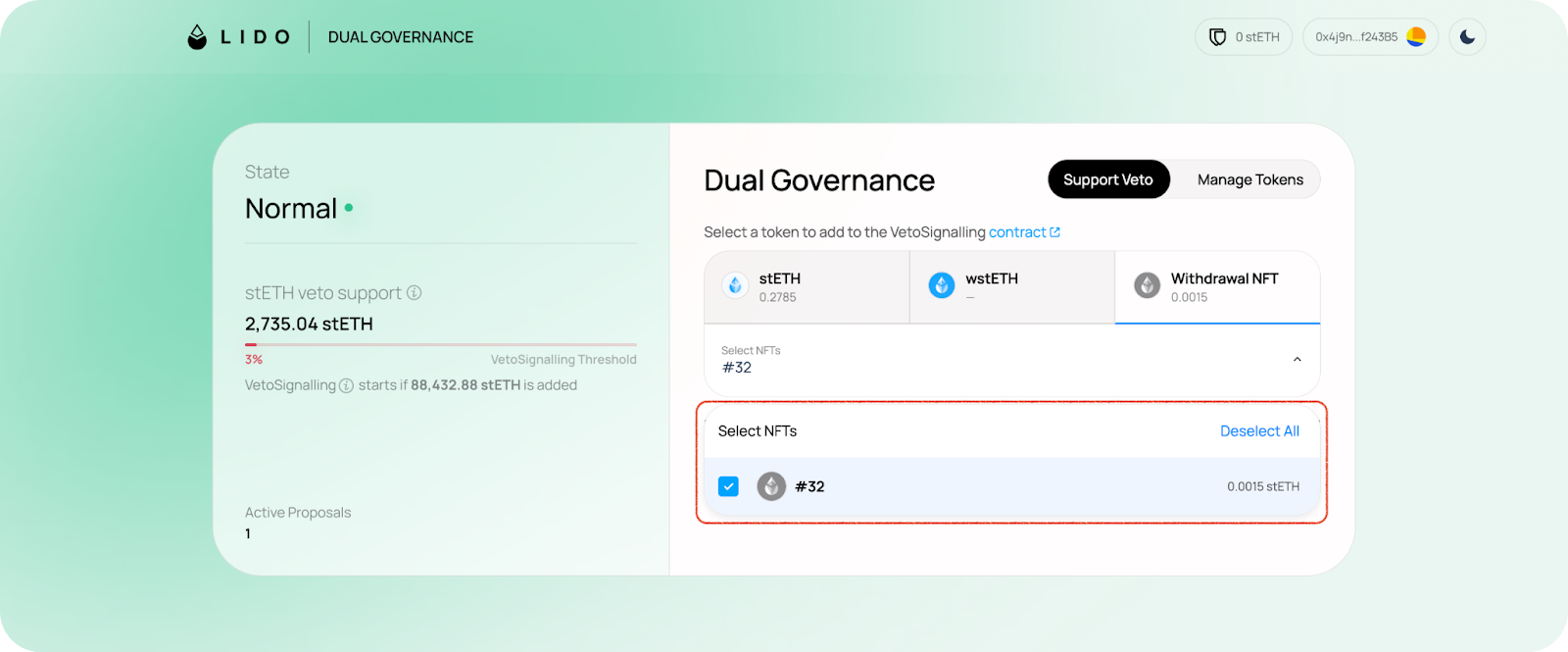
After initiating a withdrawal, you can still support a governance freeze by depositing your unstETH NFT into the Veto Signalling escrow.
- These NFTs count toward thresholds and extend the dynamic timelock.
- This gives stETH holders more time to exit while proposals remain blocked.
Note: If Rage Quit is triggered, withdrawal NFTs placed in escrow become subject to a 60–180 day timelock.
To support Veto while your withdrawal request is processing, return to the Dual Governance website, click the "Support Veto" button and place your withdrawal NFT there →
If Rage Quit is not triggered
- Your tokens will finalize via the normal withdrawal queue.
- To claim, first remove NFTs from the Veto Signalling escrow (5-hour minimum timelock applies).
- Then use the Lido staking widget to claim ETH to your wallet.
You may revoke tokens or NFTs from the Veto Signalling escrow at any time before Rage Quit is triggered.
If the 10% threshold is reached
- Rage Quit activates at the end of the Veto Signalling period (maximum 45 days).
- All escrowed tokens are forced into exit.
- Tokens cannot be revoked, restaked, or prevented from leaving.
- A withdrawal timelock of 60–180 days applies, depending on escalation.
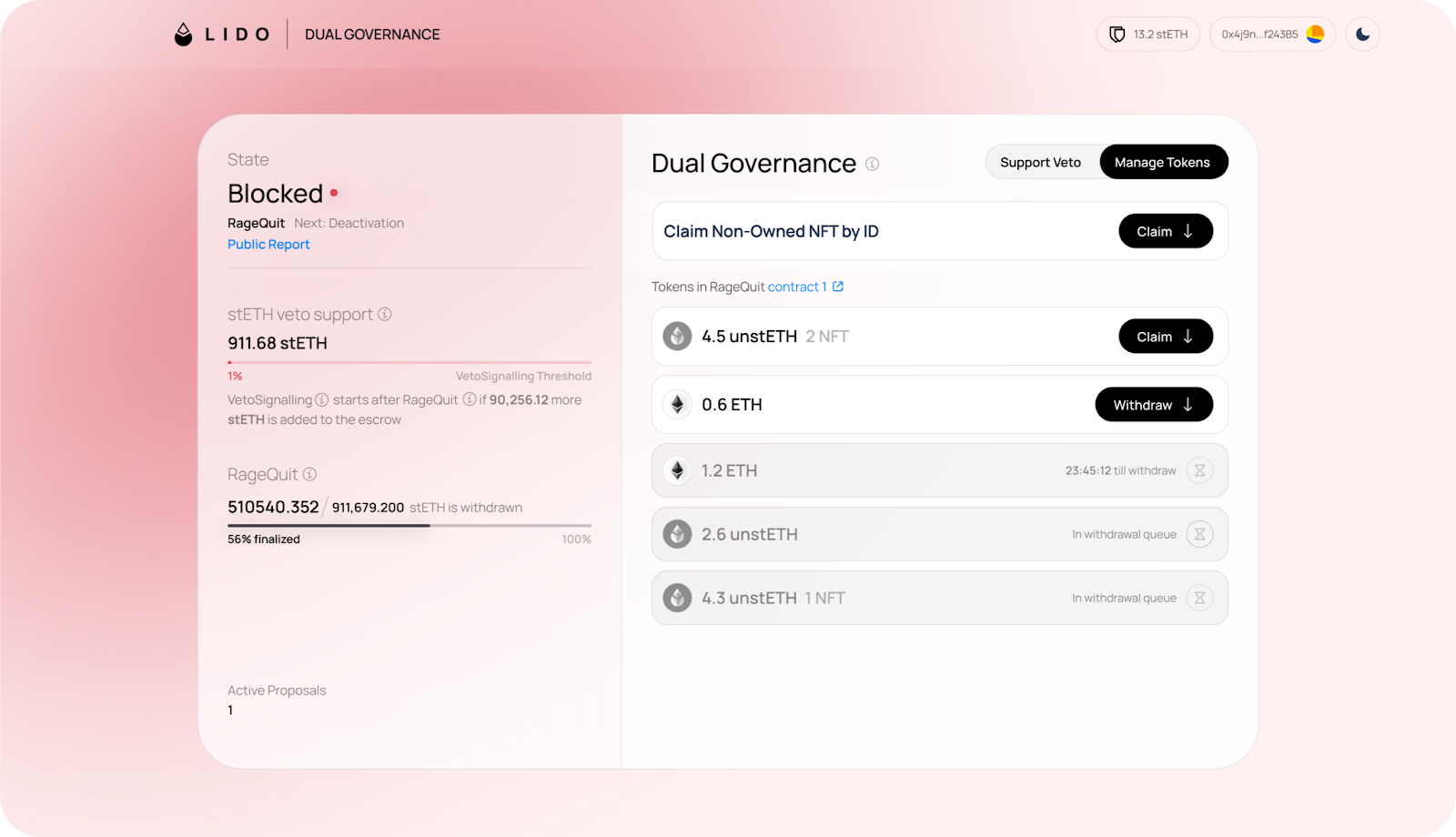
During Rage Quit:
- stETH/wstETH is automatically exited and claimed.
- Withdrawal NFTs must be claimed manually.
- A new Veto Signalling escrow is deployed to allow continued opposition.
If successive escrows also reach 10%, additional Rage Quits occur, extending timelocks by 15 days each time (capped at 180 days). This prevents abuse of Rage Quit as a governance attack vector.
After all Rage Quit exits complete and the 7-day extension ends, the system transitions to Veto Cooldown, then back to Normal, unless ≥1% of stETH remains in the active escrow, in which case a new cycle begins.
Dual Governance - Frequently Asked Questions
What if the 1% threshold isn’t reached?
You can still exit normally. However, proposals will be enacted after the default timelock.
Can I revoke tokens after Rage Quit is triggered?
No. Once Rage Quit begins, all escrowed tokens are irreversibly queued for withdrawal.
Do standard withdrawals face the 60-180 day lock?
No. The timelock applies only to tokens in the Rage Quit escrow. Standard withdrawals can be claimed immediately once finalized.
What if I withdraw during Rage Quit but never joined vetoing?
Your withdrawal follows the normal process, unaffected by Rage Quit timelocks. Important to note however that the withdrawal order will be placed after the batch withdrawal NFTs of the Rage Quit, and processing time could therefore be longer than usual.
What if withdrawals are paused (GateSeal/Reseal)?
All exits, including Rage Quit and standard, are temporarily suspended until the DAO resolves the issue. More information on this here.
What if my stETH is on a centralized exchange?
You cannot participate in Dual Governance from a CEX. To take part:
- Transfer stETH to a self-custody wallet.
- Connect to dg.lido.fi.
- Deposit tokens into the Veto Signalling escrow.
Final Notes
Dual Governance adds an essential layer of protection for stETH holders, giving them time and tools to respond to contentious governance outcomes. Whether dealing with minor missteps or major protocol threats, stETH holders have clear, enforceable options to safeguard their assets.



















