Trump Family To ‘Legally Challenge’ Magic Eden’s ‘Official’ Crypto Wallet – Report

bitcoinistPublished on 2025-06-05Last updated on 2025-06-05

Abstract

Amid the controversial announcement of an “official” TRUMP crypto wallet, the Trump family is allegedly considering taking legal action against...

Trusted Editorial content, reviewed by leading industry experts and seasoned editors. Ad Disclosure

Amid the controversial announcement of an “official” TRUMP crypto wallet, the Trump family is allegedly considering taking legal action against the project for using the likeness of the US President.

Trump Family Denies Crypto Wallet Involvement

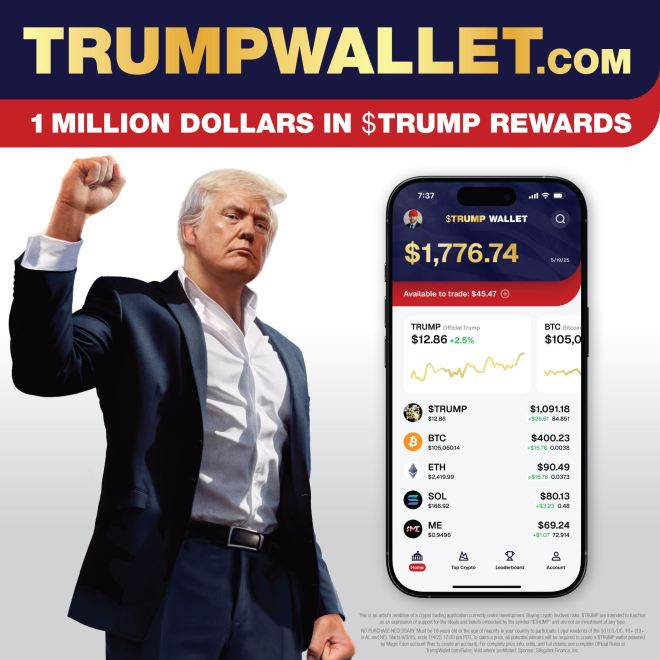
On Tuesday, the crypto community was taken by storm after the announcement of an upcoming “official” Trump crypto wallet by non-fungible Token (NFT) marketplace Magic Eden in partnership with the team behind the president’s official memecoin, TRUMP.

According to the official website, the wallet will be “the first and only crypto wallet for true Trump fans,” supporting the trade of the TRUMP token and other digital assets, including Bitcoin (BTC). Users who join the wallet’s waitlist will reportedly have an opportunity to share $1 million worth of the memecoin’s rewards.
Crypto

TRUMP Wallet annoucement. Source: Magic Eden on X

Magic Eden’s CEO, Jack Lu, confirmed the news, affirming that with the project, “DeFi can finally support seamless UX and regulatory clarity is finally allowing crypto to thrive in the US. The time to take big bets & onboard mainstream is now.”

Nonetheless, the Trump family distanced itself from the wallet, with the President’s sons taking to social media to clarify the family’s involvement. Eric Trump said in a post that he knows “nothing about this project,” despite running The Trump Organization.

He affirmed that the Magic Eden crypto wallet “is not authorized” by the Trump Family, warning their team to be “extremely careful” using the Trump name in an unauthorized project that is unknown to their organization.

Meanwhile, Donald Trump Jr also denied any involvement with the wallet and announced that World Liberty Financial (WLFI) is working on launching an official wallet soon.

The New York Times reported that Eric Trump “escalated the dispute,” affirming that the Trump family would “legally challenge the creation” of the unofficial wallet in a series of texts to the news media outlet.

“There is no deal for this product,” he stated, reaffirming that “There is no agreement for this product. It has not been approved.” Since then, the “TrumpWalletApp” X account has been suspended, despite reportedly having a Magic Eden verification badge.

A ‘Bizarre’ Miscommunication?

Journalist and podcast host Eleanor Terret shared a response from Magic Eden’s team regarding the claims of being the “official” wallet.

In the Tuesday statement, the NFT marketplace affirmed that “It is the official $TRUMP Wallet carrying the official Trump branding and IP. Magic Eden has historically worked with the $TRUMP project to support their prior NFT launches and are excited that we’re working on a much larger project now with $TRUMP Wallet.”

Molly White, who first reported the story, called the announcement an “absolute chaos,” noting that “Trump memecoin team is Fight Fight Fight LLC (Bill Zanker), though the Trump Organization-affiliated CIC Digital also holds a substantial quantity of tokens.”

To White, “It seems like the breakdown is between the Zanker team and the Trump sons, but pretty incredible they claim never to have even heard of it.” Similarly, Ripple’s CTO, David Schwartz, called the incident “a very bizarre situation,” suggesting that the most likely explanation is a miscommunication or misunderstanding.

He theorized that the TRUMP token team possibly didn’t need approval from or to inform CIC Digital or The Trump organization to launch the project, which could explain the Trump family’s remarks about the wallet:

Depending on the deal The Trump Organization negotiated here, Fight Fight Fight LLC might be trying to use its connection to $TRUMP (which it seems to have bought for 80% of the supply) to connect Trump to other projects (like this wallet) which only benefit Trump through possible appreciation of $TRUMP. Fight Fight Fight LLC is heavily incentivized to monetize these products other ways since Trump owns 80% of $TRUMP.

Schwartz concluded that, “If this is correct, The Trump Organization may be very unhappy with this announcement — especially if they planned to launch their own wallet.”
Crypto, TRUMP, TRUMPUSDT

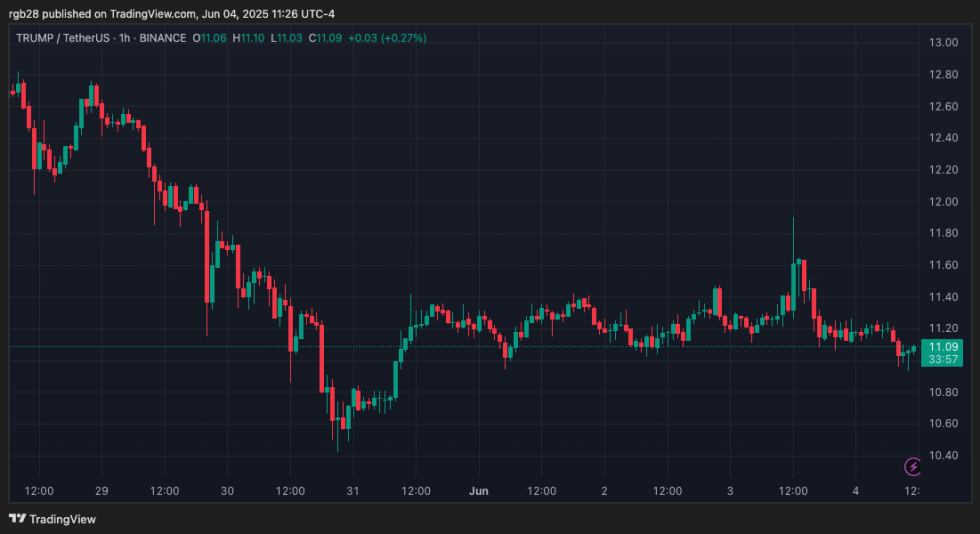
TRUMP trades at $11.09 in the one-week chart. Source: TRUMPUSDT on TradingView
Featured Image from Unsplash.com, Chart from TradingView.com
Editorial Process for bitcoinist is centered on delivering thoroughly researched, accurate, and unbiased content. We uphold strict sourcing standards, and each page undergoes diligent review by our team of top technology experts and seasoned editors. This process ensures the integrity, relevance, and value of our content for our readers.

Rubmar is a crypto enthusiast who likes learning and improving constantly. She enjoys reporting on the latest news and developments in the crypto industry. Rubmar also enjoys scrapbooking, crafting, simulation games, and watching football.

Trending Cryptos

Related Reads

Collateral Dollars: How Does a 'Second-Layer Dollar' Above Stablecoins Form?

Collateral Dollars: How Does a "Second Layer of Dollars" Form on Top of Stablecoins? Most assume stablecoins replicate Eurodollar functions, expanding the offshore dollar system. However, stablecoins primarily replace specific functions like operational dollar balances for settlement. They do not inherently create new dollar credit; they substitute existing claims. The key question is: what happens when financial intermediaries use stablecoins as collateral to create a new layer of dollar-denominated claims? This "collateral dollar" channel operates through secured lending, not direct money creation. A money-like event only occurs when a liability issued against the controlled stablecoin is funded, rolled over, or accepted at near-par value by another balance sheet. The discount (haircut) prices the gap between "effective control over the token" and "reliable convertibility to bank dollars." Elasticity stems not from the stablecoin itself but from the liability issued against it and the willingness of third-party balance sheets to treat that liability as a near-par asset. Compared to the traditional Eurodollar system—where elasticity originates from bank deposit creation—the stablecoin collateral chain is structurally different. Eurodollar deposits are credit-expansive from inception. Stablecoins are initially substitutive; elasticity emerges later if an intermediary's liability against them gains monetary acceptance. Stablecoins disrupt specific tiers of the offshore dollar system, mainly replacing operational settlement balances. They do not replace the need for full dollar balance-sheet capacity (credit lines, hedging, maturity transformation). For systemic impact, the second-layer liability must pass three tests: transferability, funding capacity, and monetary acceptance (being fundable or held at par by others). Pressure transmission also differs. In the Eurodollar system, stress moves up a hierarchy of claims. In a stablecoin collateral chain, the second-layer liability can lose its money-like status well before the underlying stablecoin faces a run, often triggered by haircut increases and margin calls that create a dynamic spiral of falling token prices and rising discounts. In conclusion, the "collateral dollar" is not the stablecoin itself. It is the second-layer liability issued against a controlled token balance that is willing to be funded and maintained at near-par value. Its existence depends on that liability surviving the leap from "token liquidity" to "bank dollar liquidity."

marsbit36m ago

Collateral Dollars: How Does a 'Second-Layer Dollar' Above Stablecoins Form?

marsbit36m ago

Collateral Dollars: How the 'Second-Layer Dollar' Above Stablecoins Takes Shape?

"Collateralized Dollars: How a 'Second Layer of Dollars' Forms on Top of Stablecoins" Most assume stablecoins replicate Eurodollars and expand the offshore dollar system, but this is not accurate. Stablecoins primarily replace certain functions within the existing system, especially operational dollar balances for daily settlement. The critical question is what happens when financial intermediaries create a new layer of dollar claims *on top of* stablecoins. This article explains how this new collateralized funding channel works. Stablecoins introduce tokenized private dollar claims. Even if issuers and reserves are within the US legal perimeter, their circulation and use as collateral can become economically "offshore." Enforceable control over collateral opens a secured credit channel but does not itself create a monetary claim. A true monetary event occurs only when another balance sheet funds, rolls over, or accepts a liability issued against the controlled token at near-par value. The discount prices the gap between "effective control over the token" and "reliable convertibility into bank dollars." Elasticity comes from the balance sheet issuing the liability against the token and from third-party willingness to treat that liability as a near-par asset. Collateralized Dollars are not the stablecoins themselves; they are the second-layer liability that another balance sheet is willing to issue, fund, and maintain at near-par against a controlled token balance. The Eurodollar system is a hierarchy of claims, with elasticity originating in expandable bank liabilities. In contrast, the stablecoin collateral chain starts with a tokenized asset. It gains systemic significance only when an intermediary's liability against that token is treated as money-like by other balance sheets. Key determining factors include: who has effective control, the legal/operational path to bank dollars, and whether the resulting claim can still be financed near-par under stress. Pressure in this new channel manifests differently. The upper-layer (intermediary) claim fails first, losing its money-like status, potentially while the underlying stablecoin remains solvent. Increased haircuts and forced sales can create a destructive feedback loop, widening the very gap the discount measures. In conclusion, the Eurodollar analogy has limits. Reserve quality supports the underlying token's solvency, but the leverage, credit, and liabilities built atop it face a separate test. Collateral eligibility is not monetary acceptance. Only when a claim built on stablecoins survives the leap from "token liquidity" to "bank dollar liquidity" do Collateralized Dollars truly exist.

链捕手42m ago

Collateral Dollars: How the 'Second-Layer Dollar' Above Stablecoins Takes Shape?

链捕手42m ago

Don't Be Misled by the $1.25 Billion Cap: MicroStrategy's Three-Pronged Bitcoin Sale Pools Hide Massive Selling Pressure

Don't Be Misled by the $1.25B Cap: Strategy's Three-Tier Bitcoin Sales Plan Hides Massive Potential Selling Pressure Strategy recently sold 3,588 BTC (~$216M) to fund a dividend and replenish its dollar reserve, while claiming its $1.25B "reserve build" capacity remains fully available. This highlights a key nuance: the widely cited $1.25B limit applies only to sales for "Building" the reserve. Strategy's broader capital framework, however, allows Bitcoin sales for three primary purposes, each with different scales: 1. **Building the Reserve:** Selling BTC to raise up to $1.25B for the reserve. 2. **Covering Priority Share Expenses:** Selling BTC to pay dividends/interest or to replenish the reserve after such payments are made from it (no specified limit). 3. **Share Repurchase Funding:** Selling BTC to fund up to $1B each in convertible note and common stock repurchases (totaling $2B potential). Combined, just the capped "Build" and "Repurchase" channels could facilitate over $3B in Bitcoin sales, excluding the uncapped "Cover Expenses" channel. The accounting distinction between "Building" (adding cash before a payout) and "Replenishing" (adding cash after a payout) is operationally blurry but allows sales like the recent $216M transaction without touching the $1.25B "Build" quota. This gives Strategy significant flexibility. The move signifies a strategic shift: Strategy is transforming from a simple Bitcoin accumulator into an active capital manager, akin to a hedge fund. Bitcoin is now a financial lever to balance pressures between common stock, convertible notes, dollar reserves, and Bitcoin holdings. This creates inherent tensions—actions benefiting one part of the capital structure may harm another. Investors must understand that the potential Bitcoin sales are far greater than the surface-level $1.25B figure. Strategy has become a complex financial entity where every term in its disclosures matters. Betting on it now is a wager on its active capital management skill to navigate these internal contradictions without a systemic failure.

Foresight News49m ago

Don't Be Misled by the $1.25 Billion Cap: MicroStrategy's Three-Pronged Bitcoin Sale Pools Hide Massive Selling Pressure

Foresight News49m ago

When the Largest BTC Buyer Becomes a Seller, Who's Buying After MicroStrategy Sells 3,588 Bitcoin?

MicroStrategy, once the largest corporate buyer of Bitcoin, sold 3,588 BTC for approximately $216 million to fund its preferred stock dividends, marking a significant shift from buyer to seller. This move occurred after its market-to-NAV premium vanished, breaking its "print stock to buy Bitcoin" financial model. A roundtable discussion featuring Austin Campbell, Ram Ahluwalia, and Chris Perkins analyzed the implications. They noted that MicroStrategy's dominance has become a narrative bottleneck for the broader crypto market, with some speculating that Bitcoin's price might only surge significantly after the company's influence wanes. The conversation expanded to examine the capital structure conflict between traditional equity and crypto tokens, arguing that most current tokens will fail as they don't fit neatly into existing debt/equity frameworks. A "stablecoin war" was identified as a major trend, with entities like Tether, Robinhood, and the OUSD alliance competing. Tether's decision to abandon the European MiCA market highlights strategic divergences. The panelists argued that bank-issued stablecoins could revolutionize global finance by allowing US banks to capture net interest margins from international transactions, potentially making JPMorgan the first trillion-dollar bank. They concluded that while capital is currently being siphoned by AI/semiconductors, markets will eventually refocus on fundamentals and cash flow, which could benefit cryptocurrencies with real utility.

marsbit56m ago

When the Largest BTC Buyer Becomes a Seller, Who's Buying After MicroStrategy Sells 3,588 Bitcoin?

marsbit56m ago

Trading

Spot

Hot Articles

How to Buy MAGIC

Welcome to HTX.com! We've made purchasing MAGIC (MAGIC) simple and convenient. Follow our step-by-step guide to embark on your crypto journey.Step 1: Create Your HTX AccountUse your email or phone number to sign up for a free account on HTX. Experience a hassle-free registration journey and unlock all features.Get My AccountStep 2: Go to Buy Crypto and Choose Your Payment MethodCredit/Debit Card: Use your Visa or Mastercard to buy MAGIC (MAGIC) instantly.Balance: Use funds from your HTX account balance to trade seamlessly.Third Parties: We've added popular payment methods such as Google Pay and Apple Pay to enhance convenience.P2P: Trade directly with other users on HTX.Over-the-Counter (OTC): We offer tailor-made services and competitive exchange rates for traders.Step 3: Store Your MAGIC (MAGIC)After purchasing your MAGIC (MAGIC), store it in your HTX account. Alternatively, you can send it elsewhere via blockchain transfer or use it to trade other cryptocurrencies.Step 4: Trade MAGIC (MAGIC)Easily trade MAGIC (MAGIC) on HTX's spot market. Simply access your account, select your trading pair, execute your trades, and monitor in real-time. We offer a user-friendly experience for both beginners and seasoned traders.

4.7k Total ViewsPublished 2024.03.29Updated 2026.06.02

How to Buy MAGIC

Discussions

Welcome to the HTX Community. Here, you can stay informed about the latest platform developments and gain access to professional market insights. Users' opinions on the price of MAGIC (MAGIC) are presented below.

活动图片