Tron Founder Justin Sun Addresses Controversy After Bitcoin Removal From USDD’s Collateral

bitcoinistPublished on 2024-08-23Last updated on 2024-08-23

Abstract

Amid the memecoin frenzy on the Tron network, Justin Sun is facing backlash for the controversial removal of over $700...

Amid the memecoin frenzy on the Tron network, Justin Sun is facing backlash for the controversial removal of over $700 million in Bitcoin (BTC) as USDD’s collateral without the Tron DAO Reserve’s vote. Sun has now addressed the situation after the move raised concerns about the stablecoin’s decentralization.

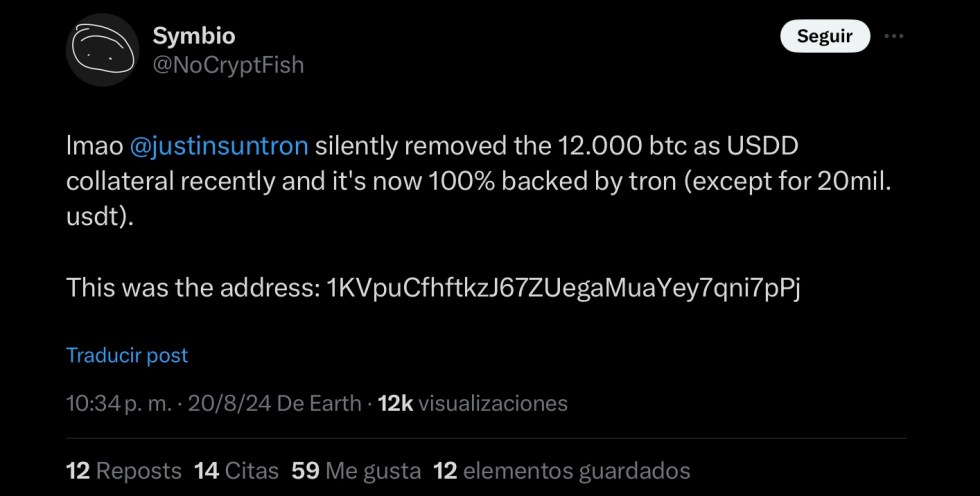
12,000 Bitcoin Removed From USDD Collateral

On Wednesday, online reports revealed that 12,000 Bitcoin, worth around $732 million, were removed from Tron’s Decentralized USD (USDD) stablecoin collateral reserves.

USDD is a decentralized over-collateralized stablecoin pegged to the US Dollar through TRX and governed by the Tron DAO Reserve. According to the report, the significant change means the stablecoin is now almost fully backed by TRX, except for 20 million USDT.
Tron

Online reports unveil BTC removal from USDD collateral. Source: Symbio on X

The modification was done “silently” without the DAO’s consultation or approval despite the continued emphasis on community governance. Reportedly, the USDD transparency page listed 12,000 Bitcoin under an address, which has now been removed.

The removal raised questions among investors who criticized the lack of transparency. Many X users questioned the “decentralized stablecoin” narrative claim by the Tron Foundation.

Other community members drew parallels between Sun’s “shady” actions and the behavior that led to the collapses of UST or FTX. Meanwhile, others noted that the news seemed like “100 red flags.”

Veritas Protocol alleged this is not the first issue with USDD’s collateral. Per the post, it “has also faced issues with its collateral, such as storing significant amounts of HTX without consulting the DAO.”

Justin Sun Addresses Concerns

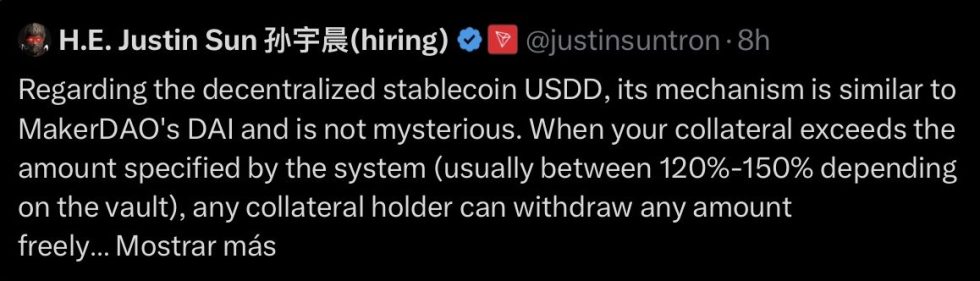
Following the criticism, Justin Sun addressed users’ concerns in an X post. Tron’s founder claimed that USDD’s mechanism is “not mysterious” since it works like MakerDAO’s DAI.

Sun explained that when the collateral exceeds the amount specified by the system, collateral holders can move the funds. Per the post, this amount is usually set between 125% and 150%, and if the collateral falls below a certain level, “it needs to be topped up; otherwise, the collateral may trigger liquidation.”
Tron

Tron's Founder addresses BTC removal without DAO's vote. Source: Justin Sun on X

Based on it, Sun alleges that “any collateral holder can withdraw any amount freely without anyone’s approval.” He also noted that USDD currently “has a long-term collateralization rate exceeding 300%,” which is inefficient for capital utilization and is planned to be upgraded.

Currently, USDD has a long-term collateralization rate exceeding 300%, which means that the capital utilization is not very efficient. The TRON DAO Reserve plans to spend time upgrading USDD in the future to make it a more competitive decentralized stablecoin in the market. Remember, Tron is also a kingdom of stablecoins.

USDD’s X account cited Sun’s response, echoing TRD’s plans to upgrade and enhance the stablecoin. Nonetheless, Bennet Tomlin, co-host of Crypto Critic Pod, questioned Tron founder’s statement. Tomlin claims Sun’s description does not match the issuance process described on USDD’s page.

Moreover, he stated that, according to the whitepaper, the removed Bitcoin is “explicitly supposed to be managed by the TRON DAO Reserve (…), not whatever collateral holders Sun is imagining. At the time of writing, Sun has not responded to the apparent discrepancies raised by Tomlin.
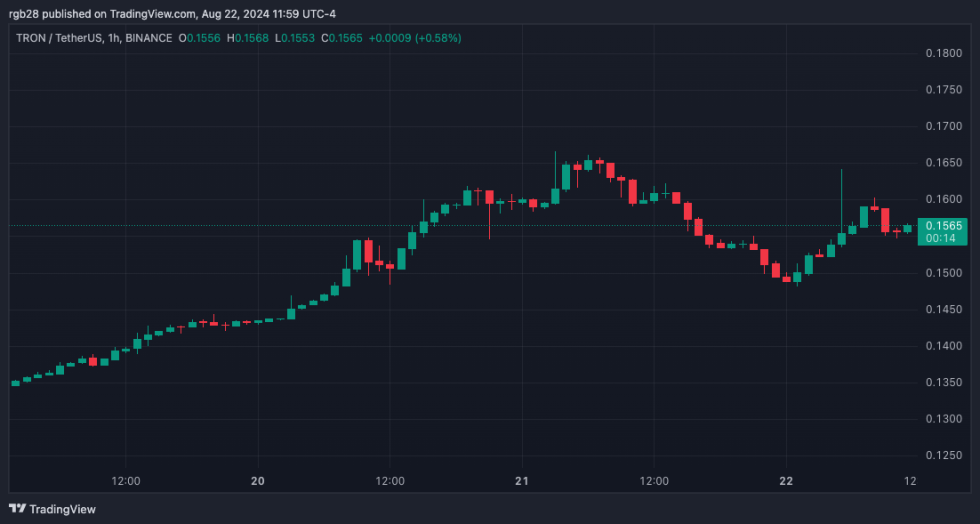
Tron, TRX, TRXUSDT

TRX is trading at $0.15 in the three-day chart. Source: TRXUSDT on TradingView
Featured Image from Unsplash.com, Chart from TradingView.com
Rubmar Garcia

Rubmar Garcia

Rubmar is a crypto enthusiast who likes learning and improving constantly. She enjoys reporting on the latest news and developments in the crypto industry. Rubmar also enjoys scrapbooking, crafting, simulation games, and watching football.

Trending Cryptos

Related Reads

Analyzing the Impact of AI on Economic Growth and Productivity

**Title: Analyzing AI's Impact on Economic Growth and Productivity** This article examines three contrasting views on AI's influence on economic growth and productivity. **The Optimistic View** posits that AI, especially through automating R&D ("recursive self-improvement"), could dramatically accelerate growth, even triggering a technological "singularity" with explosive, potentially infinite, economic expansion. **The Moderate/Mainstream View** acknowledges AI's productivity benefits but emphasizes significant real-world constraints that could limit its impact. These include: limited cost savings per task, structural ceilings on which jobs and industries are "exposed" to AI, adoption bottlenecks (e.g., compute, energy, regulatory hurdles), and the "weak link" effect where non-automatable tasks cap overall gains. Consequently, the realized AI dividend may be far lower than optimistic projections, with estimates typically ranging from 0.1% to 1.3% annual productivity growth. **The Pessimistic View** stems from two strands. The first aligns with the moderate view but applies extremely conservative assumptions about task exposure and efficiency gains, yielding minimal projected impact. The second introduces a demand-side critique: if AI primarily replaces rather than augments labor, it could depress labor's share of income, weaken consumer demand, and create a "demand trap" that ultimately stifles growth, unless offset by redistribution policies. **The authors' assessment** is nuanced: * **Short-term (1-2 years):** AI will support growth primarily through investment spending, not significant productivity gains. * **Medium-term (3-5 years):** Three potential paths emerge based on AI demand and bottleneck severity: 1. **"Optimistic Path":** High demand, few bottlenecks. Rapid productivity gains but risk of major job displacement and social conflict without redistribution. 2. **"Moderate Path" (most likely):** High demand but significant, surmountable bottlenecks. Leads to moderate productivity gains, financial market volatility (K-shaped returns), and sectoral job losses. 3. **"Pessimistic Path":** Low demand or severe bottlenecks. Minimal productivity and growth impact, triggering financial market corrections but allowing a smoother societal transition with less labor disruption. * **Long-term:** AI holds potential for a major productivity revolution and prosperity. The conclusion stresses that no path is smooth. Technologically "optimistic" outcomes could be socially detrimental, while "pessimistic" technological diffusion might be more socially stable. Policymakers must monitor developments and prepare balanced responses to manage economic, financial, and social sustainability.

marsbit15m ago

Analyzing the Impact of AI on Economic Growth and Productivity

marsbit15m ago

The New Cold War is a Tech Stock War

The New Cold War is a Tech Stock War The article argues that the contemporary geopolitical and economic rivalry between the US and China represents a "New Cold War," but one fundamentally fought through technology and financial markets, not physical barriers or conventional trade. Historically, US dominance was secured through financial systems. The Soviet Union, reliant on the rigid "Transferable Ruble," was ultimately undermined by its dependency on the US dollar for oil trade. Later, Japan's semiconductor challenge was countered not just by tariffs (e.g., Plaza Accord, 301 investigations) but by binding it to US Treasury bonds. China presents a more complex, "embedded" challenger. While it holds vast dollar reserves and US debt like Japan, its industrial base is stronger and more diversified than the Soviet Union's. Surviving the initial 2018 trade war phase, the conflict has evolved into a "tech-financial war." The core battlefield is now the stock market. US tech stocks (AI, semiconductors) are treated as sovereign assets, buoyed by bipartisan national will. China is pushing to strengthen its own financial markets to convert industrial strength into financial power and fund its tech ambitions. Companies like ChangXin (semiconductors), Moonshot AI, and DJI compete not just for market share but as financial proxies for their respective systems. The new paradigm is moving from globally efficient monopolies (Apple, Google) towards companies that achieve monopolistic profits within their respective geopolitical spheres. This competition over "pricing power" and financial valuation in segmented markets defines the current era, making the stock market the primary arena for this tech-centric struggle.

marsbit24m ago

The New Cold War is a Tech Stock War

marsbit24m ago

RWA Weekly: Ten European Financial Institutions Establish Tokenized Asset Cooperative; Ondo Launches New Execution Network Ondo Network

RWA Weekly: European Banks Form Tokenized Asset Cooperative; Ondo Launches New Execution Network Ondo Network Covering July 24-31, 2026, the RWA sector saw a steady on-chain total value locked (TVL) of $36.8 billion, with holder count hitting a record high. However, stablecoin transfer volumes fell sharply (~30%), indicating low on-chain settlement demand. Key regulatory moves include South Korea advancing stablecoin legislation and a push to scrap crypto taxes, Kenya lowering capital requirements for stablecoin issuers, and Zimbabwe approving seven projects for its crypto sandbox. In project developments, BIS-led Project Agorá successfully tested cross-border payments with tokenized funds across six currencies. Ten major European financial institutions formed the RL1 blockchain cooperative to build tokenized asset infrastructure. Other notable updates: Aviva launched a tokenized dollar liquidity fund on XRPL, POSCO International tokenized commercial invoices on Injective, and a Brazilian farmer used tokenized cattle as collateral for a loan. Additional progress includes BNY Mellon migrating its core transfer agent operations to blockchain, Securitize gaining SEC investment advisor registration, and Tether’s compliant stablecoin USA₮ launching on Celo. Ondo Finance introduced Ondo Network, a new execution layer focused on speed and privacy, moving away from its initial chain plans. An analysis highlights that despite the growing scale of on-chain RWAs (~$32B), approximately 90% remain underutilized in DeFi, pointing to a critical challenge in unlocking liquidity and fostering real-world application beyond mere issuance.

marsbit25m ago

RWA Weekly: Ten European Financial Institutions Establish Tokenized Asset Cooperative; Ondo Launches New Execution Network Ondo Network

marsbit25m ago

Trading

Spot

Hot Articles

How to Buy SUN

Welcome to HTX.com! We've made purchasing SUN (SUN) simple and convenient. Follow our step-by-step guide to embark on your crypto journey.Step 1: Create Your HTX AccountUse your email or phone number to sign up for a free account on HTX. Experience a hassle-free registration journey and unlock all features.Get My AccountStep 2: Go to Buy Crypto and Choose Your Payment MethodCredit/Debit Card: Use your Visa or Mastercard to buy SUN (SUN) instantly.Balance: Use funds from your HTX account balance to trade seamlessly.Third Parties: We've added popular payment methods such as Google Pay and Apple Pay to enhance convenience.P2P: Trade directly with other users on HTX.Over-the-Counter (OTC): We offer tailor-made services and competitive exchange rates for traders.Step 3: Store Your SUN (SUN)After purchasing your SUN (SUN), store it in your HTX account. Alternatively, you can send it elsewhere via blockchain transfer or use it to trade other cryptocurrencies.Step 4: Trade SUN (SUN)Easily trade SUN (SUN) on HTX's spot market. Simply access your account, select your trading pair, execute your trades, and monitor in real-time. We offer a user-friendly experience for both beginners and seasoned traders.

7.6k Total ViewsPublished 2024.03.29Updated 2026.06.02

How to Buy SUN

Discussions

Welcome to the HTX Community. Here, you can stay informed about the latest platform developments and gain access to professional market insights. Users' opinions on the price of SUN (SUN) are presented below.

活动图片