XLM falls despite Stellar’s $114T tokenization opportunity – Just bad timing?

ambcryptoPublished on 2026-07-17Last updated on 2026-07-17

Abstract

Stellar (XLM) is a leading blockchain for tokenization, partnering with DTCC to potentially tokenize over $114 trillion in securities by 2027 and securing $1 billion in private credit transfers. This has fueled significant network activity, with daily transactions averaging 5.5 million and tokenized market cap exceeding $2.9 billion. Despite these strong fundamentals and institutional backing, the price of XLM has declined slightly, trading near $0.183. Analysts note the price is consolidating in a symmetrical triangle pattern, with an impending breakout likely to determine its next major price move. The current lag is attributed to capital outflow, but the long-term tokenization opportunity remains substantial.

Stellar [XLM] has been among the top chains when it comes to tokenization. However, it trails behind Securitize, Ondo Finance [ONDO], and Centrifuge [CFG], among others. They occupy the top three positions in terms of tokenized market cap.

Despite being among the trendy tokens, the price of XLM crypto is down about 2.60% in the past 24 hours, trading at around $0.1830. Interestingly, its chain activity remains sizeable.

XLM’s tokenization influence on its chain activity

The tokenization narrative is making XLM crypto one of the trendiest chains. The good news is that its fault tolerance and institutional trust have been improved. This is because MoneyGram, Figure, and Range became XLM’s tier 1 validators.

On top of that, Stellar has partnered with DTCC to tokenize more than $114 trillion in securities by 2027. Moreover, Tradable would make a transfer of $1 billion in private credit through Stellar.

Both moves bridge traditional finance (TradFi) and decentralized finance (DeFi), enhancing blockchain infrastructure in financial markets.

As such, it is expected to grow the market cap of tokenized securities on XLM even further. At press time, this cap had already exceeded $2.90 billion.
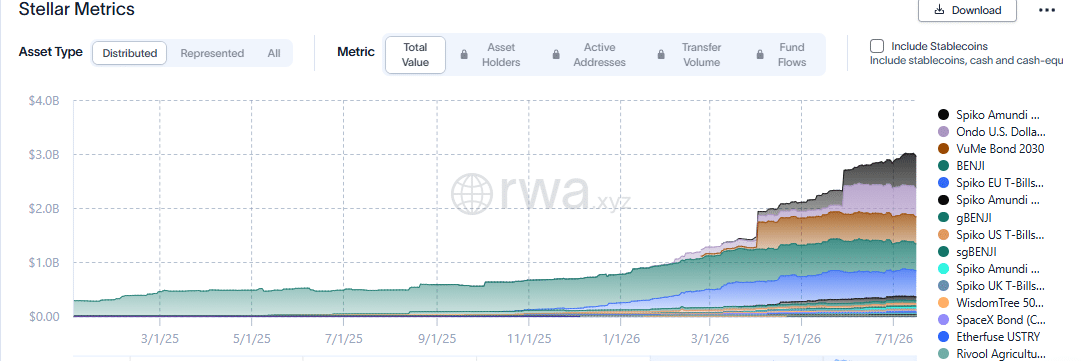
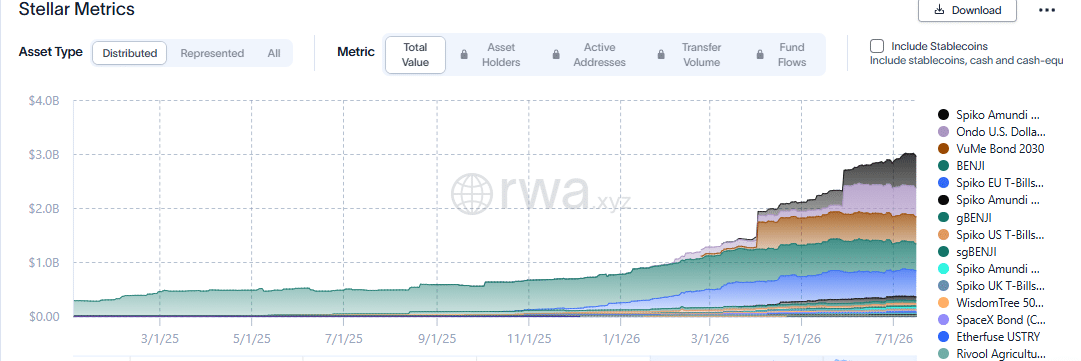
Source: rwa.xyz

The tokenized stablecoin market cap on Stellar was above $689 million at press time. This showed a big chunk of capital was moving through the chain. This resulted in high network activity.

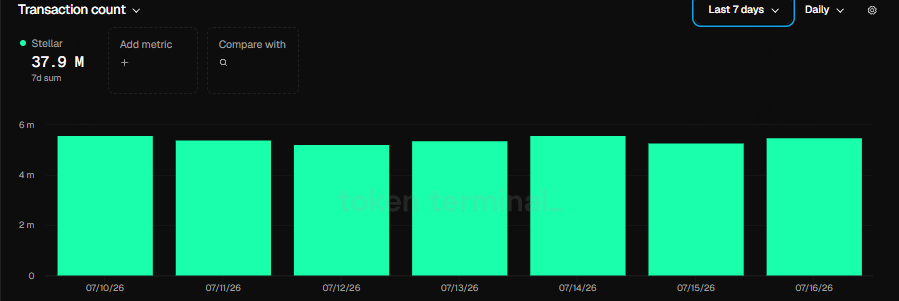
In fact, the number of transactions on XLM was averaging 5.5 million per day. In total, more than 37.9 million transactions were processed this week, reinforcing the chain’s usage for tokenization.
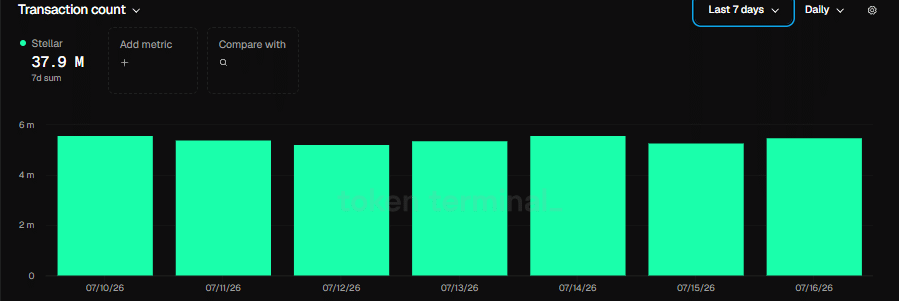
Source: Token Terminal

XLM price prediction – Should traders buy?

Despite the high network usage and a roadmap to tokenize $114 trillion in securities, the price of XLM is still lagging.

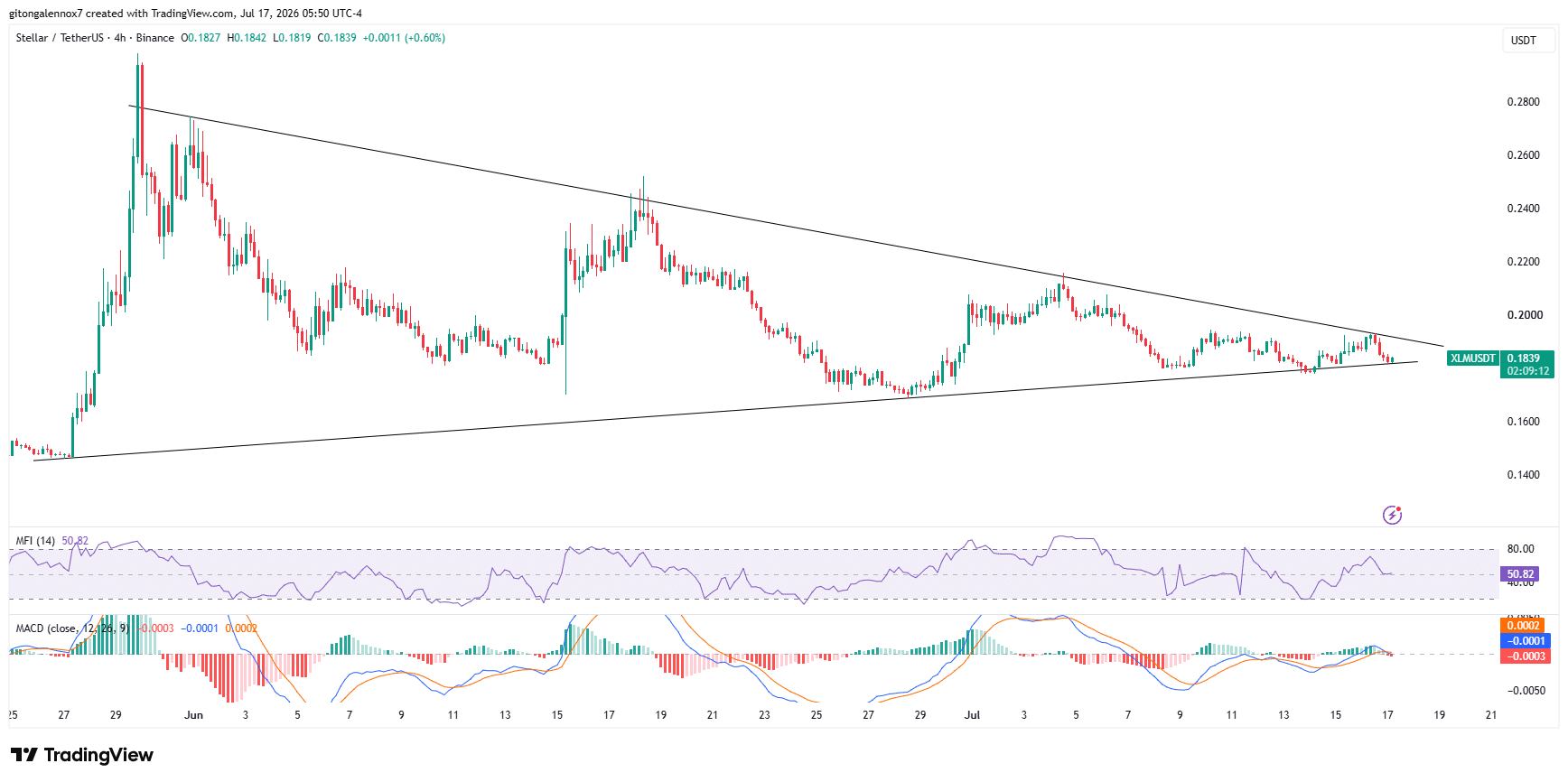
The altcoin has been consolidating in a symmetrical triangle pattern since late May. However, it’s nearing a breakout as it trades at the apex of the pattern. The breakout is anticipated because contraction is usually followed by expansion.

The lag is as a result of capital outflow, as the Money Flow Index (MFI) is declining but above the neutral level. Moreover, the MACD shows bears are in control, though their strength is minimal.
Source: XLM/USDT on TradingView

A breakout and hold above the pattern would suggest prices are likely to go up. On the other hand, a breakdown would extend the bearish market structure that has been in place since last August.


Final Summary

  • XLM crypto partners with DTCC to tokenize $114 trillion, as tokenization on the chain continues to grow and fuel network activity.
  • XLM price action is trading inside a massive triangle pattern where a breakout on either side would determine the altcoin’s next trajectory.


Trending Cryptos

Related Questions

QWhat major partnership did Stellar (XLM) recently announce, and what is its potential impact?

AStellar has partnered with DTCC (Depository Trust & Clearing Corporation) to tokenize over $114 trillion in securities by 2027. This partnership bridges traditional finance (TradFi) and decentralized finance (DeFi) and is expected to significantly grow the market cap of tokenized securities on the Stellar network.

QDespite positive developments, why is the price of XLM falling?

AThe price of XLM is falling (down about 2.60% in the past 24 hours) due to capital outflow, as indicated by a declining Money Flow Index (MFI), and bearish control shown by the MACD indicator. It's also consolidating within a symmetrical triangle pattern after a bearish market structure since last August.

QHow does Stellar's current tokenized market cap compare to other leading platforms?

AWhile Stellar (XLM) is among the top chains for tokenization, it trails behind platforms like Securitize, Ondo Finance (ONDO), and Centrifuge (CFG), which occupy the top three positions in terms of tokenized market cap.

QWhat key metric indicates high network activity on the Stellar blockchain?

AThe Stellar network is processing an average of 5.5 million transactions per day, with over 37.9 million transactions processed in the week of the report. Additionally, the tokenized stablecoin market cap on Stellar was above $689 million, indicating significant capital movement.

QWhat technical pattern is XLM's price action currently in, and what does it suggest for future price movement?

AXLM's price is consolidating in a symmetrical triangle pattern. It is nearing the apex of the pattern, which typically precedes a breakout. A breakout and hold above the pattern would suggest a bullish move, while a breakdown would extend the existing bearish trend.

Related Reads

Live-Action Short Series Forced onto the Big Screen by AI

Live-action short dramas, originally a popular online format, are now attempting to enter the cinema. Several top IPs like "What a Good Girl" and "One Family, Same Class" have received approval for film adaptations. This shift is driven by several pressures within the short drama industry. After rapid growth fueled by low costs and platform support, the sector now faces a slowdown with fewer hits and reduced investment. A major disruptor is the explosive rise of AI-generated short dramas, which dominate new releases and challenge the traditional model with their speed and low cost. Platform policy changes, such as adjustments to revenue guarantees, have further squeezed producers. In this context, film adaptation is seen as a potential new growth path. It offers a chance to extend a short-lived online hit into a longer-lasting IP asset, moving beyond the "fast production, fast consumption" cycle. Established short dramas bring pre-validated stories and emotional appeal to the table, potentially lowering the risk for film investors. However, significant challenges remain. Translating a fast-paced, fragmented viewing experience designed for phones into a compelling cinematic narrative is difficult. Past attempts by popular TV shows and variety programs to make films have often failed due to weak content. A short drama's massive online viewership does not guarantee box office success, as cinema requires a higher commitment of time and money from audiences. Ultimately, the success of these adaptations will depend not on their original popularity, but on their ability to tell complete, emotionally resonant stories that meet the standards of the theatrical market.

marsbit55m ago

Live-Action Short Series Forced onto the Big Screen by AI

marsbit55m ago

Asymmetry of Algorithmic Agency: When AI Makes Decisions for You, You Don't Even Have the Right to Oppose

As AI increasingly makes decisions on our behalf, a critical asymmetry emerges: the entities deploying these systems understand and refine their algorithms, while individuals merely endure the consequences. This article explores the three layers of this "algorithmic agency asymmetry." First, opacity shields system goals, incentives, and flaws, creating a "black box fallacy" where outputs seem objective. Second, algorithms amplify historical biases, repackaging past inequalities in a seemingly neutral, computational form. Third, recursive systems lead to "algorithmic drift," where users train the system and are simultaneously trained by it, shaping their own choices and behaviors. This asymmetry has profound implications, extending into hiring, education, policing, and daily life. Users adapt to what the system rewards, but only see the end result—a score, recommendation, or price—without understanding the underlying logic or manipulated conditions. To rebalance this power dynamic, the article proposes policy interventions: 1) Meaningful transparency and explainability for users affected by AI decisions. 2) Enforceable impact assessments before deploying high-risk systems. 3) Genuine human oversight with the power to challenge outputs. 4) Mandatory post-deployment monitoring and auditing. 5) Outright bans on manipulative or exploitative systems. Finally, fostering widespread "algorithmic literacy" is essential public infrastructure. Ultimately, this asymmetry is a structural power imbalance. Good policy cannot eliminate it but can narrow the gap by making automated influence visible, contestable, auditable, and governable.

marsbit59m ago

Asymmetry of Algorithmic Agency: When AI Makes Decisions for You, You Don't Even Have the Right to Oppose

marsbit59m ago

From StepFun to Galaxy Robots: The Capital Migration Path Behind WAIC Exhibiting Companies

From Stellar Steps to Galactic Generals: The Capital Migration Route Behind WAIC 2026 Exhibiting Enterprises The 2026 World Artificial Intelligence Conference (WAIC) in Shanghai showcased over 1100 exhibitors. Analyzing their financing activities over the past 18 months reveals key capital trends in China's AI industry, with the total raised exceeding 100 billion RMB. **Large Language Models: IPO Window Opens, Capital Concentrates on Leaders** This sector attracted the most capital. Companies like Zhipu and MiniMax have completed Hong Kong IPOs, setting exit benchmarks. StepFun (Stellar Steps), a star example, saw its valuation soar to an estimated $12B through rapid, escalating funding rounds—from millions in 2023 to a $2.5B Pre-IPO round in mid-2026 led by industrial players like ZTE. The trend shows a shift: IPO paths are clear, industrial capital is entering for strategic deployment, and large, concentrated funding rounds favor commercially viable leaders. **Embodied AI: Hyper-Compressed Financing Cycles** This field entered a capital explosion phase. Companies like Galbot (Galactic General) epitomize the trend, raising over 7B RMB across 5 rounds in under 2 years. Early VC backing quickly gave way to investments from industrial giants (Meituan, CATL, SAIC) and finally "national team" funds, signaling its status as a strategic industry. The compressed fundraising pace, as seen with other leaders, indicates high consensus on the sector's potential and intense competition. **AI Chips: Domestic Substitution Enters Deep Waters** Represented by companies like Moore Threads (which completed an 8B RMB IPO as the "first domestic GPU stock"), this sector differs. It faces longer R&D cycles, higher capital thresholds, and stronger policy reliance. Funding often involves state-backed capital and telecom operators, with lower VC participation compared to other AI sectors, reflecting the industry's inherent challenges. **Capital Flow Panorama: Five Key Trends** 1. **Winner-Takes-Most:** Funding is highly concentrated in top players within each sector. 2. **Embodied AI as a New Growth Pole:** It attracts rapid, large-scale funding from industrial chains, akin to the automotive sector. 3. **Industrial Capital Ascendancy:** Strategic investors like ZTE and SAIC are replacing pure financial VCs for technology synergy. 4. **"National Team" Prominence:** State-guided investment funds are actively co-investing, aligning AI with national strategy. 5. **Diversified Exit Paths:** Beyond IPOs, options like M&A and strategic investment are increasing. **Conclusion: Capital is Not Omnipotent** While massive capital influx signals strong market confidence in China's AI outlook, it brings risks: reduced ecosystem diversity due to concentration, potential compromise of corporate independence, and valuation bubble concerns amidst compressed financing. The investor's motive behind a company often reveals more than its technical specs.

marsbit1h ago

From StepFun to Galaxy Robots: The Capital Migration Path Behind WAIC Exhibiting Companies

marsbit1h ago

Before Second Attempt to List on HKEX, Performance of Semiconductor 'Little Giant' Suddenly Deteriorates

Shenzhen Vanguard Semiconductor, a state-level "little giant" specializing in power semiconductor devices, has once again filed for a listing on the Hong Kong Stock Exchange main board, with GF Securities as the sole sponsor. This is its second attempt this year. Backed by prominent investors like Intel Asia-Pacific, OPPO, Xiaomi, and CATL, the company's post-investment valuation soared over 500% to approximately RMB 2.9 billion in just two and a half years. However, a month before its application, China's securities regulator raised six inquiries, focusing on the fairness of share prices for recent new shareholders and potential conflicts of interest related to two employee incentive platforms, suggesting concerns over improper benefit transfers. Financially, the company's performance shifted in the first five months of 2026, recording a net loss of RMB 510,000 compared to a profit of RMB 26.53 million a year earlier. Its overall gross margin also dropped from 22.4% to 17.9%. This was attributed to a decline in revenue share from its high-margin WLCSP products, driven by conservative smartphone maker procurement plans amid market adjustments, leading to a situation of increased revenue but decreased profitability. Furthermore, Vanguard Semiconductor's distribution network underwent a significant overhaul, with the number of authorized distributors plummeting from 658 to 103 within three years, mostly terminated for failing performance metrics. Sales remain heavily reliant on distributors, accounting for 84.1% of revenue in early 2026. Concurrently, customer and supplier concentration risks are rising, with the top five customers contributing 67.9% of revenue. While industry observers note that high customer concentration is common, attention is drawn to whether shareholder relationships, such as with Huaqin Technology's affiliate holding a 2.12% stake, extend to the client level.

marsbit1h ago

Before Second Attempt to List on HKEX, Performance of Semiconductor 'Little Giant' Suddenly Deteriorates

marsbit1h ago

Trading

Spot

Hot Articles

How to Buy XLM

Welcome to HTX.com! We've made purchasing Stellar (XLM) simple and convenient. Follow our step-by-step guide to embark on your crypto journey.Step 1: Create Your HTX AccountUse your email or phone number to sign up for a free account on HTX. Experience a hassle-free registration journey and unlock all features.Get My AccountStep 2: Go to Buy Crypto and Choose Your Payment MethodCredit/Debit Card: Use your Visa or Mastercard to buy Stellar (XLM) instantly.Balance: Use funds from your HTX account balance to trade seamlessly.Third Parties: We've added popular payment methods such as Google Pay and Apple Pay to enhance convenience.P2P: Trade directly with other users on HTX.Over-the-Counter (OTC): We offer tailor-made services and competitive exchange rates for traders.Step 3: Store Your Stellar (XLM)After purchasing your Stellar (XLM), store it in your HTX account. Alternatively, you can send it elsewhere via blockchain transfer or use it to trade other cryptocurrencies.Step 4: Trade Stellar (XLM)Easily trade Stellar (XLM) on HTX's spot market. Simply access your account, select your trading pair, execute your trades, and monitor in real-time. We offer a user-friendly experience for both beginners and seasoned traders.

4.9k Total ViewsPublished 2024.03.29Updated 2026.06.02

How to Buy XLM

Discussions

Welcome to the HTX Community. Here, you can stay informed about the latest platform developments and gain access to professional market insights. Users' opinions on the price of XLM (XLM) are presented below.

活动图片