Worldcoin corrects nearly 50% in two weeks—but here’s why bulls remain hopeful

ambcryptoPublished on 2026-07-02Last updated on 2026-07-02

Abstract

Worldcoin (WLD) has experienced a sharp correction of nearly 50% over the past two weeks, falling from $0.7229 to $0.3686. This decline was accompanied by significant liquidations, with over $8 million in WLD long positions liquidated recently. Despite the severe pullback, technical analysis suggests reasons for cautious bullishness. The price drop has brought WLD into a key Fibonacci retracement zone (61.8%-78.6%), and while short-term indicators are bearish, the higher timeframe trend structure remains upward. Key support levels to watch are $0.333 and $0.348. The article concludes that while buyers have an opportunity to resume the uptrend, a move back above $0.416 would provide a safer entry signal, contingent on Bitcoin not entering a broader sell-off.

Within the past 24 hours, Bitcoin [BTC] bounced from a local low of $57,800 to $60,536. This 4.73% bounce has begun to recede, and the leading crypto was trading at $60,048 at the time of writing.

On Tuesday, June 30, close to $410 million worth of leveraged positions were liquidated across the market. This included $8.3 million worth of Worldcoin [WLD] positions, with $8.06 million worth of longs alone.

Worldcoin traders were willing to go long but have been met with relentless losses over the past two weeks. The altcoin has fallen from $0.7229 to $0.3686, a 49% depreciation within a fortnight.

Yet, there’s reason for swing traders and investors to be bullish.

Worldcoin bulls have the potential to fight off the sellers
Source: WLD/USDT on TradingView

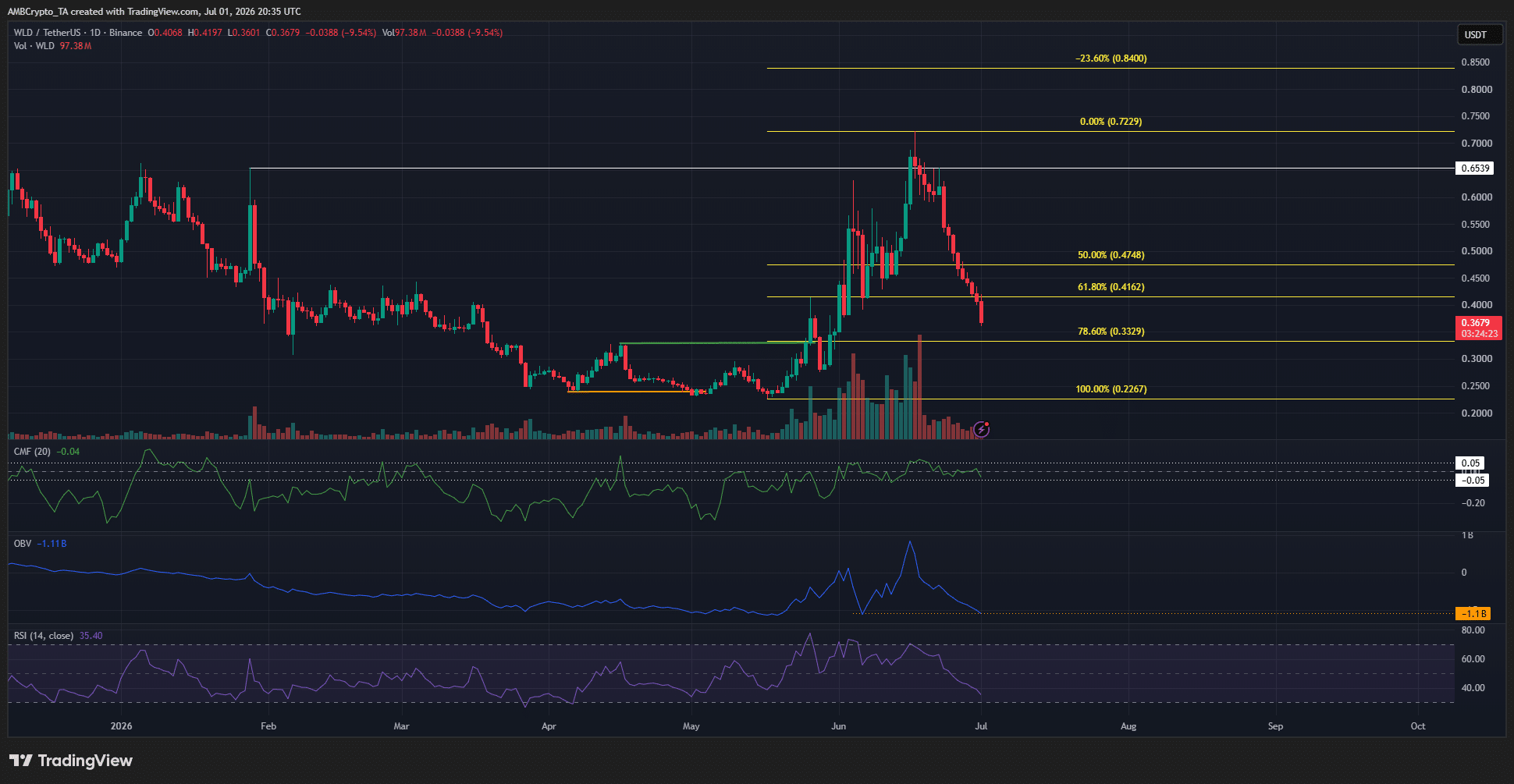
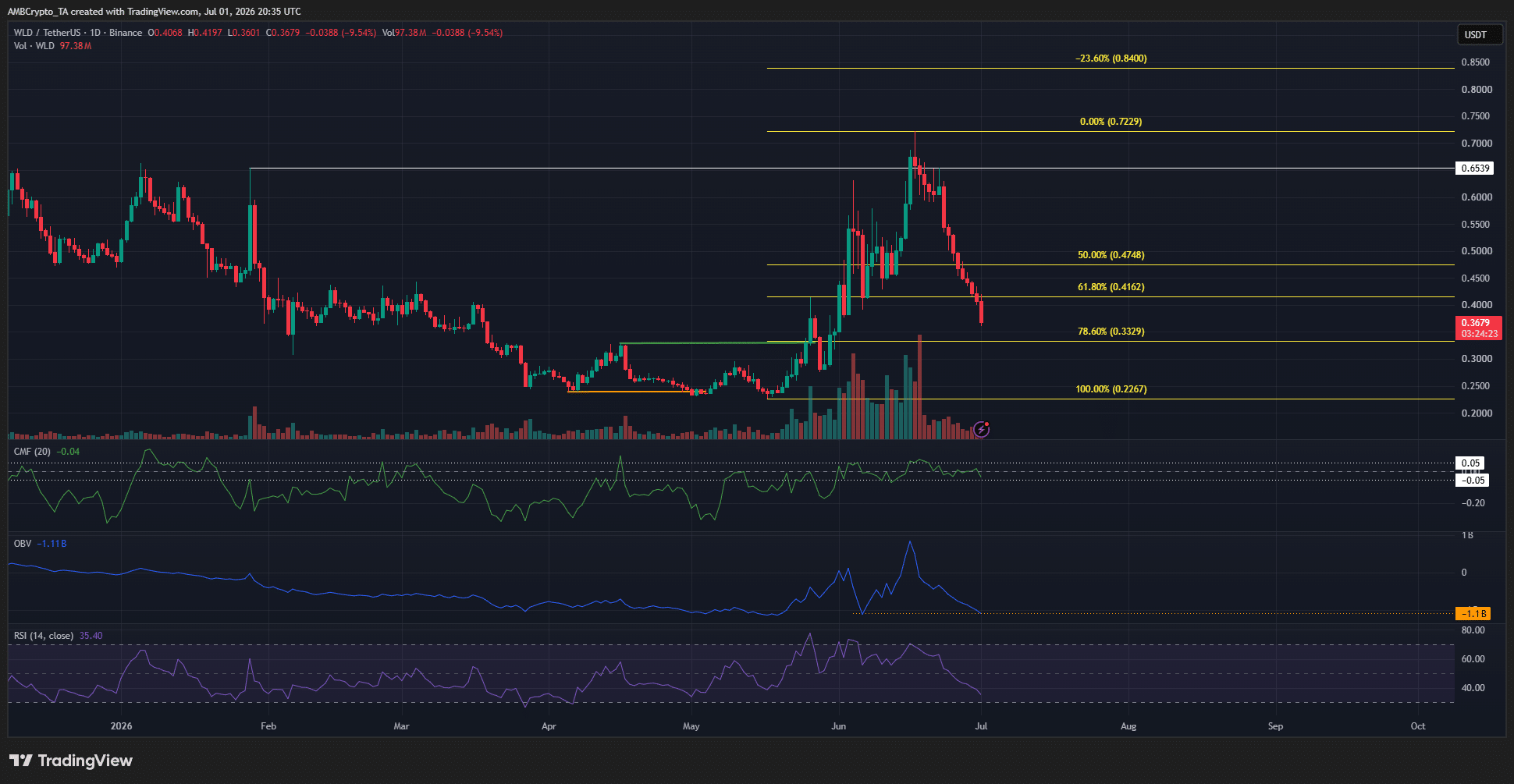
The rally above $0.65 in June brought about a bullish swing structure break for WLD. Since then, a deep correction has come about. The OBV was at the June lows once again, and the RSI was falling toward the oversold level at 30.

Yet, from a structural point of view, the trend remained bullish for the altcoin. Moreover, it has fallen into the golden pocket between the 61.8% and 78.6% Fibonacci retracement levels.

Moreover, despite the OBV’s deep drop, the CMF signaled short-term stability. If the CMF drops below -0.05, the OBV loses the local low, and Worldcoin prices fall below $0.333, a bearish shift would become more likely.

Traders’ call to action- Cautious bullishness
Source: WLD/USDT on TradingView

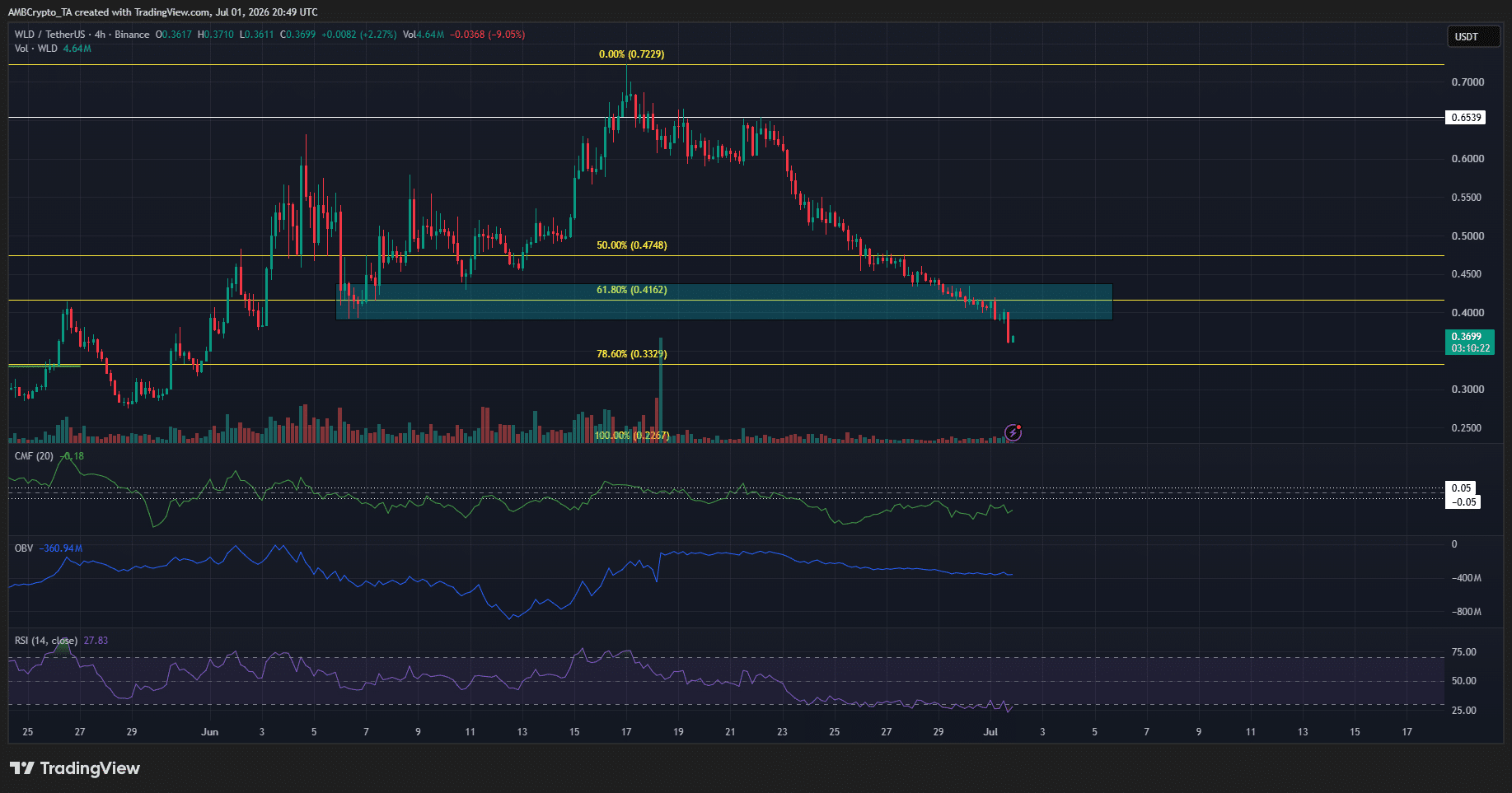
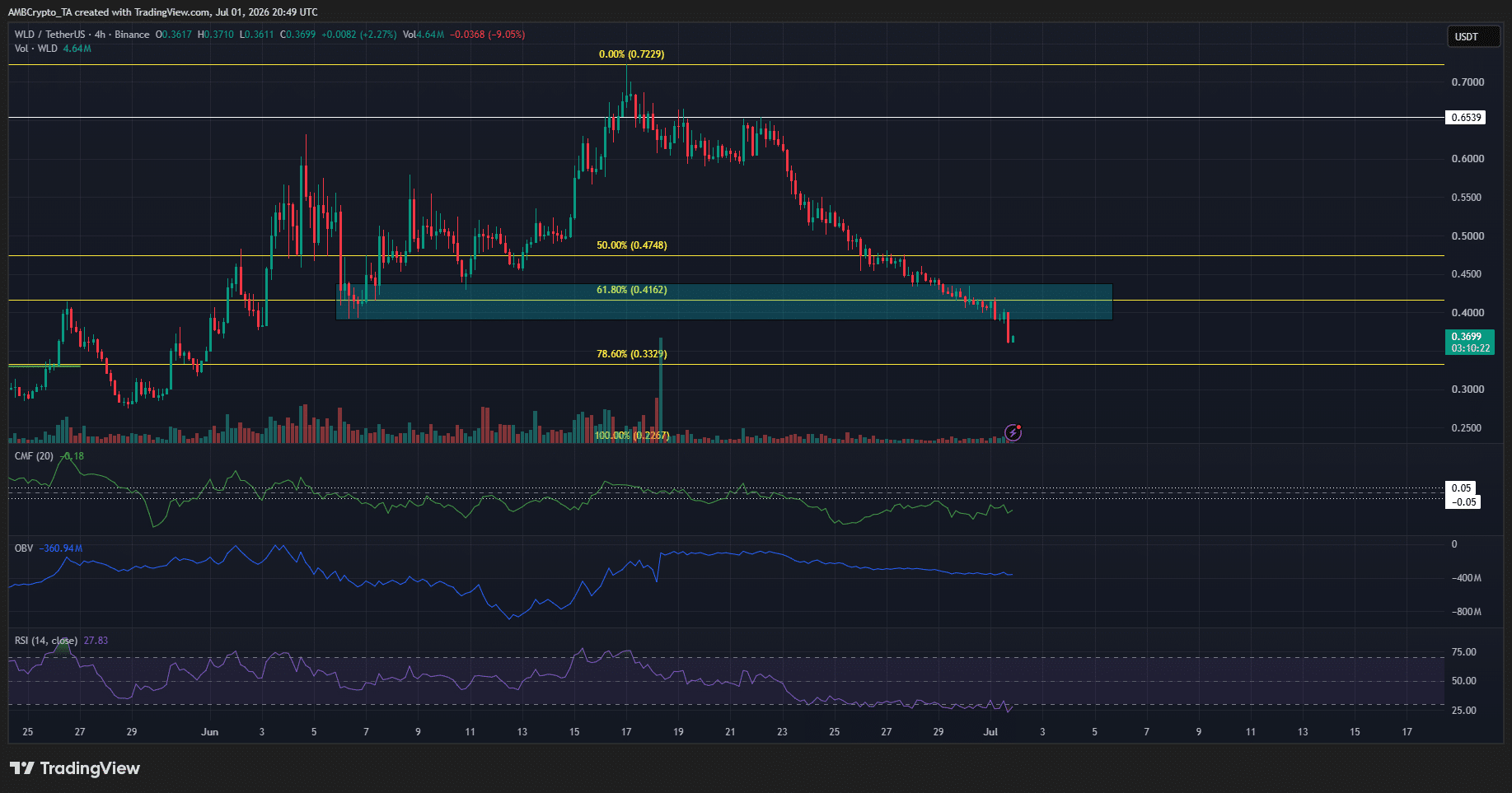
The 4-hour chart showed that this lower timeframe’s latest impulse move to $0.723 originated from $0.416. This short-term support has been ceded without much of a fight. It appeared likely that the $0.333 support would soon be tested.

The technical indicators were unanimously bearish on this timeframe for the past two weeks of correction.
Source: CoinGlass

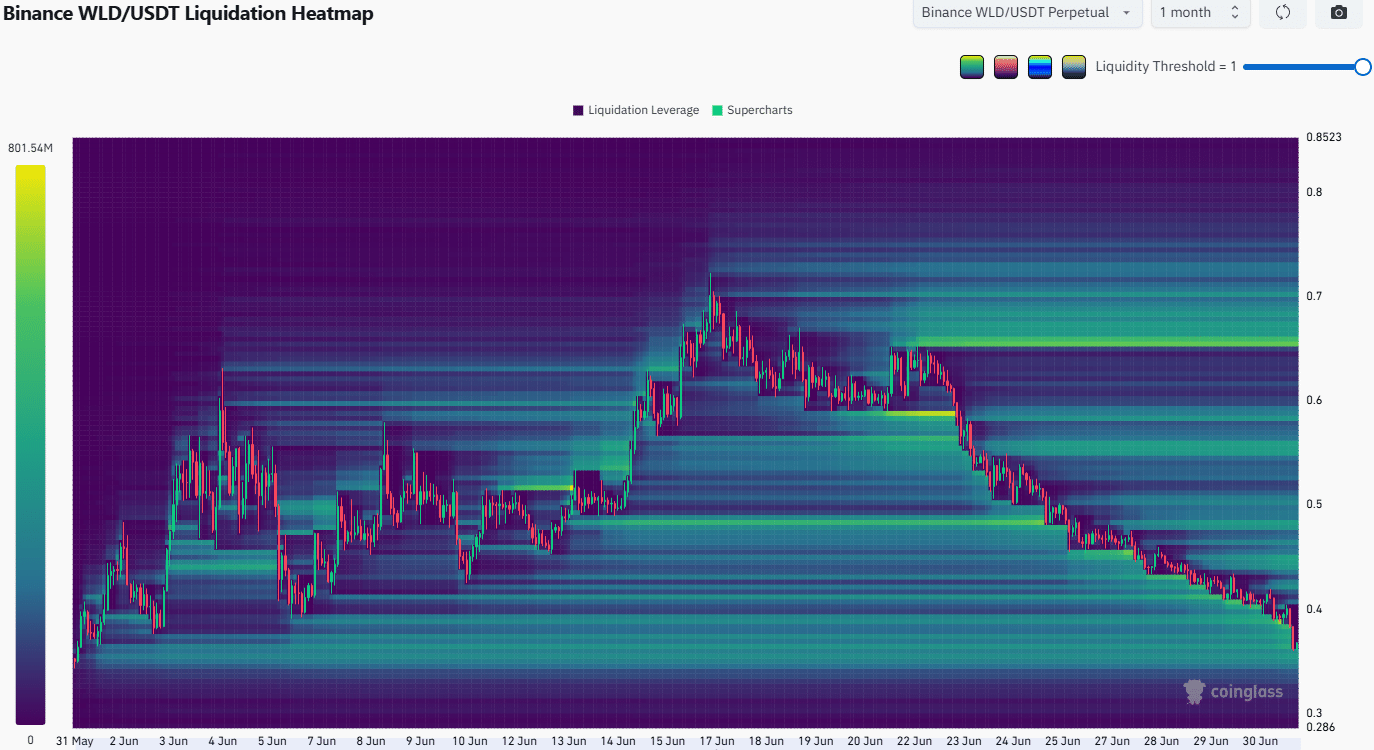
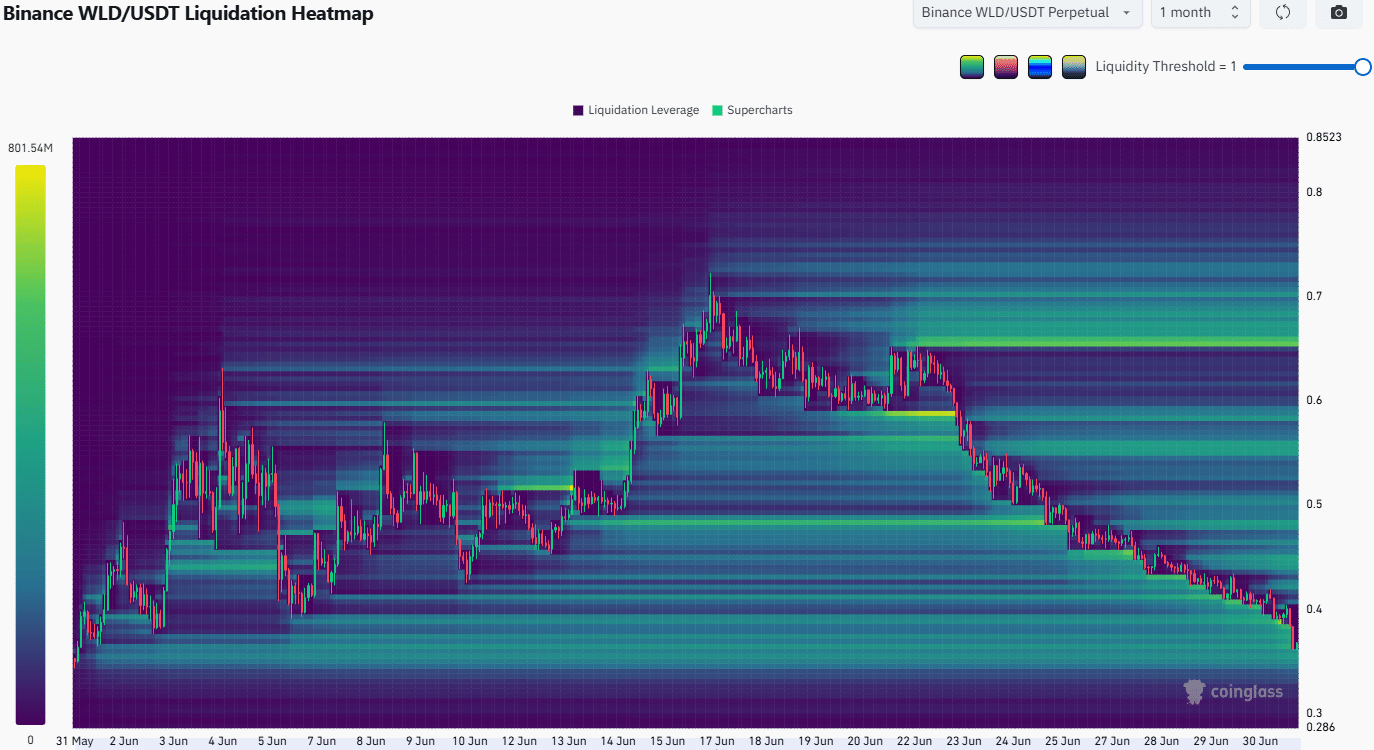
The liquidation data revealed that many of the magnetic zones built up over the past month have been swept and cleared, with $0.348 being the next to watch out for.

As things stand, the drive southward, which has been forced by steady waves of liquidations and forced selling, could soon be ending.

Worldcoin traders and investors have reason to be cautiously bullish, but a Bitcoin sell-off could negatively impact WLD trends. Therefore, a move back above $0.416 could be a safe trigger for the buyers.


Final Summary

  • The Worldcoin correction measured just over 49% in the past two weeks, a large figure that has impacted holder sentiment.
  • Despite the large drawdown since June’s high, buyers have another chance to keep the higher timeframe upward trend going.


Trending Cryptos

Related Questions

QWhat is the main reason Worldcoin bulls remain hopeful despite the recent sharp correction?

ADespite the correction, the trend remains bullish from a structural point of view. The price has fallen into the golden pocket between the 61.8% and 78.6% Fibonacci retracement levels, and the Chaikin Money Flow (CMF) signals short-term stability.

QBy what percentage did Worldcoin's price depreciate over the past two weeks?

AWorldcoin's price depreciated by 49% over the past two weeks, falling from approximately $0.7229 to $0.3686.

QAccording to the article, what three conditions would make a bearish shift for Worldcoin more likely?

AA bearish shift would become more likely if: 1) the Chaikin Money Flow (CMF) drops below -0.05, 2) the On-Balance Volume (OBV) loses the local low, and 3) Worldcoin prices fall below $0.333.

QWhat does the article suggest could be a safe trigger for buyers to re-enter the Worldcoin market?

AThe article suggests that a move back above the $0.416 support level could be a safe trigger for buyers.

QWhat major external factor could negatively impact Worldcoin's bullish trend according to the article?

AA Bitcoin sell-off could negatively impact Worldcoin's trends.

Related Reads

Robinhood Chain Mainnet Goes Live: Can Stocks Finally Be Moved Into Wallets?

Robinhood has officially launched its public mainnet, Robinhood Chain, along with stock-like tokens, the USDG yield product, and a DeFi lending portal. This marks a significant shift where a major online broker is integrating its user interface, regulatory compliance, self-custody wallet, and on-chain protocols into a single, streamlined experience. The goal is to simplify access to stock exposure, stablecoin yields, collateralized lending, and AMM trading for mainstream users. Eligible non-U.S. users can hold these "Stock Tokens"—structured as tokenized debt securities—in the Robinhood Wallet for 24/7 exposure to assets like U.S. stocks or ETFs. U.S. users can access an estimated ~7% APY on dollar-backed USDG through the Robinhood Earn program via self-custody wallets, with lending infrastructure powered by Morpho protocol. Built as a Layer 2 on Arbitrum, Robinhood Chain leverages existing DeFi protocols like Uniswap. The core strategy is not to reinvent DeFi but to channel Robinhood's large traditional finance user base (27.4 million funded customers as of Q1 2026) into on-chain finance, lowering the technical barriers. However, key limitations exist. The stock tokens are not direct equity ownership and are unavailable in the U.S. and some jurisdictions due to regulatory constraints. The ~7% yield is variable and carries inherent DeFi risks, not guaranteed principal protection. Furthermore, while AMMs enable trading, price discovery for major stocks will likely remain anchored in traditional markets like NASDAQ for the foreseeable future. Ultimately, Robinhood Chain is an early experiment in "on-chain brokerage." Its success will depend on real-world metrics like trading volume, sustained user migration to self-custody, stable yield performance, and regulatory feedback, rather than its launch narrative.

marsbit55m ago

Robinhood Chain Mainnet Goes Live: Can Stocks Finally Be Moved Into Wallets?

marsbit55m ago

Circle CEO Responds to OUSD Challenge: Stablecoin Market Is 'Winner-Takes-All', Consortium Model Doomed to Fail

Circle CEO Jeremy Allaire addresses market concerns following the announcement of the Open USD (OUSD) stablecoin project backed by 140 global companies. Allaire argues the stablecoin market exhibits "winner-takes-all" dynamics due to powerful network effects. He cites USDC's near-decade lead in three key areas: 1) **Application Integration & Protocol Development**: Thousands of integrated services and protocols (like CCTP) create utility and lock-in for developers and users. 2) **Liquidity Network Effects**: A deeply embedded, globally distributed liquidity infrastructure across primary and secondary markets, built over years. 3) **Regulatory Integration**: Extensive licensing and compliance groundwork ensuring USDC's acceptance in major markets like Europe and Japan. Allaire challenges OUSD's proposed advantages. He contends that promises of free redemption, while appealing, face market realities where such models can become exit routes for other stablecoins. He also questions the feasibility of fully distributing all revenue to an alliance, stating it would "starve" the critical infrastructure investments needed for scale and utility. Furthermore, he expresses skepticism about large alliance governance models, noting they often lead to slow decision-making and misaligned incentives. While welcoming OUSD to the ecosystem, Allaire reaffirms confidence in USDC's dominant position, backed by its long-term infrastructure investments and strong partnerships, including its ongoing collaboration with Coinbase.

marsbit57m ago

Circle CEO Responds to OUSD Challenge: Stablecoin Market Is 'Winner-Takes-All', Consortium Model Doomed to Fail

marsbit57m ago

Circle CEO Responds to OUSD Challenge: Alliance Model Doomed to Fail, It's a 'Winner-Takes-All' Game

Circle CEO Jeremy Allaire addresses the challenge posed by the new Open USD (OUSD) stablecoin project, backed by 140 global companies. He argues that the stablecoin market exhibits "winner-take-all" characteristics, where USDC's near-decade-long lead in application integrations, global liquidity, and regulatory compliance secures its dominant position. Allaire outlines three key network effects underpinning USDC's strength: 1) Extensive integration as an internet protocol layer, 2) Deep, globally distributed liquidity networks, and 3) Deep integration with global policy and regulatory frameworks. He cites data showing USDC facilitated 80% of on-chain USD stablecoin transaction volume in Q1 2026. He directly counters OUSD's proposed advantages: 1) "Free minting and redemption" may not be sustainable against market realities, which USDC addresses via contractual mechanisms. 2) "Sharing all revenue" risks starving the infrastructure of necessary investment for growth and reliability. 3) A "consortium model" often leads to slow innovation and poor coordination compared to focused, independent operators like Circle. Allaire reaffirms Circle's strong partnership with Coinbase and notes that Circle continues to collaborate with many OUSD founding members. He concludes by welcoming OUSD to the ecosystem while expressing confidence in USDC's entrenched network advantages and continued expansion.

Odaily星球日报1h ago

Circle CEO Responds to OUSD Challenge: Alliance Model Doomed to Fail, It's a 'Winner-Takes-All' Game

Odaily星球日报1h ago

Trading

Spot

Hot Articles

What is $BITCOIN

DIGITAL GOLD ($BITCOIN): A Comprehensive Analysis Introduction to DIGITAL GOLD ($BITCOIN) DIGITAL GOLD ($BITCOIN) is a blockchain-based project operating on the Solana network, which aims to combine the characteristics of traditional precious metals with the innovation of decentralized technologies. While it shares a name with Bitcoin, often referred to as “digital gold” due to its perception as a store of value, DIGITAL GOLD is a separate token designed to create a unique ecosystem within the Web3 landscape. Its goal is to position itself as a viable alternative digital asset, although specifics regarding its applications and functionalities are still developing. What is DIGITAL GOLD ($BITCOIN)? DIGITAL GOLD ($BITCOIN) is a cryptocurrency token explicitly designed for use on the Solana blockchain. In contrast to Bitcoin, which provides a widely recognized value storage role, this token appears to focus on broader applications and characteristics. Notable aspects include: Blockchain Infrastructure: The token is built on the Solana blockchain, known for its capacity to handle high-speed and low-cost transactions. Supply Dynamics: DIGITAL GOLD has a maximum supply capped at 100 quadrillion tokens (100P $BITCOIN), although details regarding its circulating supply are currently undisclosed. Utility: While precise functionalities are not explicitly outlined, there are indications that the token could be utilized for various applications, potentially involving decentralized applications (dApps) or asset tokenization strategies. Who is the Creator of DIGITAL GOLD ($BITCOIN)? At present, the identity of the creators and development team behind DIGITAL GOLD ($BITCOIN) remains unknown. This situation is typical among many innovative projects within the blockchain space, particularly those aligning with decentralized finance and meme coin phenomena. While such anonymity may foster a community-driven culture, it intensifies concerns about governance and accountability. Who are the Investors of DIGITAL GOLD ($BITCOIN)? The available information indicates that DIGITAL GOLD ($BITCOIN) does not have any known institutional backers or prominent venture capital investments. The project seems to operate on a peer-to-peer model focused on community support and adoption rather than traditional funding routes. Its activity and liquidity are primarily situated on decentralized exchanges (DEXs), such as PumpSwap, rather than established centralized trading platforms, further highlighting its grassroots approach. How DIGITAL GOLD ($BITCOIN) Works The operational mechanics of DIGITAL GOLD ($BITCOIN) can be elaborated on based on its blockchain design and network attributes: Consensus Mechanism: By leveraging Solana’s unique proof-of-history (PoH) combined with a proof-of-stake (PoS) model, the project ensures efficient transaction validation contributing to the network's high performance. Tokenomics: While specific deflationary mechanisms have not been extensively detailed, the vast maximum token supply implies that it may cater to microtransactions or niche use cases that are still to be defined. Interoperability: There exists the potential for integration with Solana’s broader ecosystem, including various decentralized finance (DeFi) platforms. However, the details regarding specific integrations remain unspecified. Timeline of Key Events Here is a timeline that highlights significant milestones concerning DIGITAL GOLD ($BITCOIN): 2023: The initial deployment of the token occurs on the Solana blockchain, marked by its contract address. 2024: DIGITAL GOLD gains visibility as it becomes available for trading on decentralized exchanges like PumpSwap, allowing users to trade it against SOL. 2025: The project witnesses sporadic trading activity and potential interest in community-led engagements, although no noteworthy partnerships or technical advancements have been documented as of yet. Critical Analysis Strengths Scalability: The underlying Solana infrastructure supports high transaction volumes, which could enhance the utility of $BITCOIN in various transaction scenarios. Accessibility: The potential low trading price per token could attract retail investors, facilitating wider participation due to fractional ownership opportunities. Risks Lack of Transparency: The absence of publicly known backers, developers, or an audit process may yield skepticism regarding the project's sustainability and trustworthiness. Market Volatility: The trading activity is heavily reliant on speculative behavior, which can result in significant price volatility and uncertainty for investors. Conclusion DIGITAL GOLD ($BITCOIN) emerges as an intriguing yet ambiguous project within the rapidly evolving Solana ecosystem. While it attempts to leverage the “digital gold” narrative, its departure from Bitcoin's established role as a store of value underscores the need for a clearer differentiation of its intended utility and governance structure. Future acceptance and adoption will likely depend on addressing the current opacity and defining its operational and economic strategies more explicitly. Note: This report encompasses synthesised information available as of October 2023, and developments may have transpired beyond the research period.

552 Total ViewsPublished 2025.05.13Updated 2025.05.13

What is $BITCOIN

Discussions

Welcome to the HTX Community. Here, you can stay informed about the latest platform developments and gain access to professional market insights. Users' opinions on the price of BTC (BTC) are presented below.

活动图片