Will JUP’s price hit $0.28 on the back of these THREE catalysts?

ambcryptoPublished on 2026-07-02Last updated on 2026-07-02

Abstract

Jupiter (JUP) surged over 15% in 24 hours, outperforming the broader crypto market. Three key catalysts drove the rally: 1) The integration of its native stablecoin, JupUSD, into the Jupiter Liquidity Provider (JLP), enabling a major USDC-to-JupUSD transition. 2) Growing discussions about Jupiter developing its own Omnichain Ledger, reflecting its evolution into a comprehensive on-chain finance system. 3) Active buying and supply reduction by the Jupiter Strategic Reserve (Litterbox Trust), which has accumulated millions of JUP tokens, contributing to a decreased total supply. Technically, JUP's price reclaimed a key trendline support level. If it holds above $0.24, a move toward $0.28 is possible, contingent on sustained buying pressure and a confirmed trend shift.

Jupiter [JUP] is in the news today after it hiked by more than 15% in the last 24 hours, outperforming both Bitcoin [BTC] and the broader crypto market. Its daily trading volume surged by 72%, hitting $48 million too.

That’s not all though as the Solana [SOL] DEX Aggregator seemed to be up by this margin due to a couple of factors too. Hence, it’s worth looking at the finer details here.

3 catalysts behind Jupiter’s double-digit rally

To start with, Jupiter added its own stablecoin, JupUSD, to Jupiter Liquidity Provider (JLP) as a custody asset. This step makes it possible for the planned $500 million USDC-to-JupUSD transition inside Jupiter’s perps pool.

JupUSD is now the sixth asset after Solana [SOL], Bitcoin [BTC], Ethereum [ETH], USDC and USDT. As such, the stablecoin addition means more liquidity into the exchange.

This has further reignited talks of Jupiter building its own Omnichain Ledger. This move echoes Jupiter’s growth since 2021 from a swap aggregator into a full on-chain finance system. In fact, Jupiter drives more than 80% of total retail liquidity on movement on Solana.

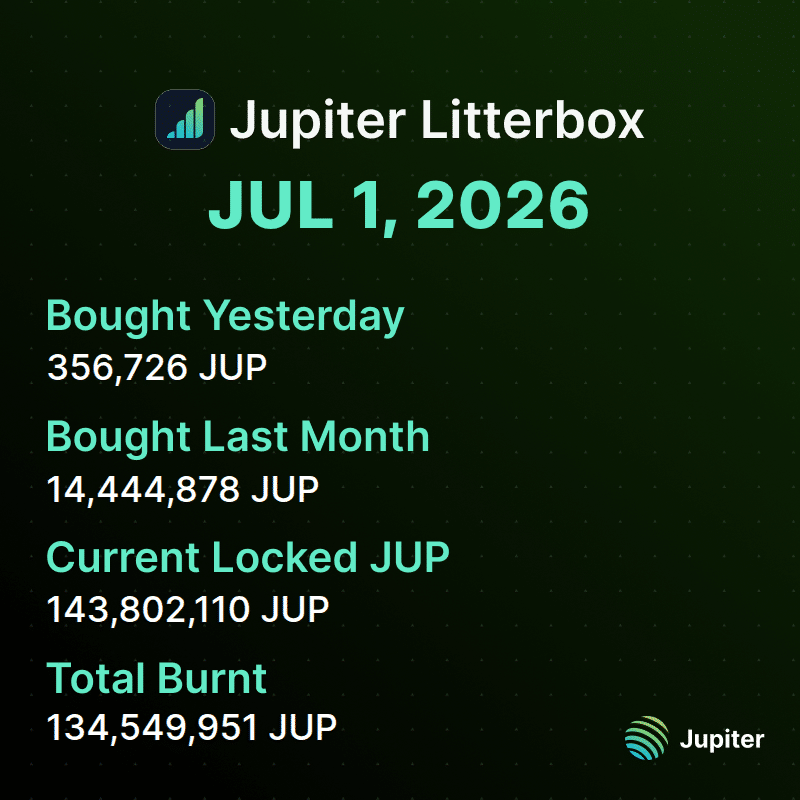
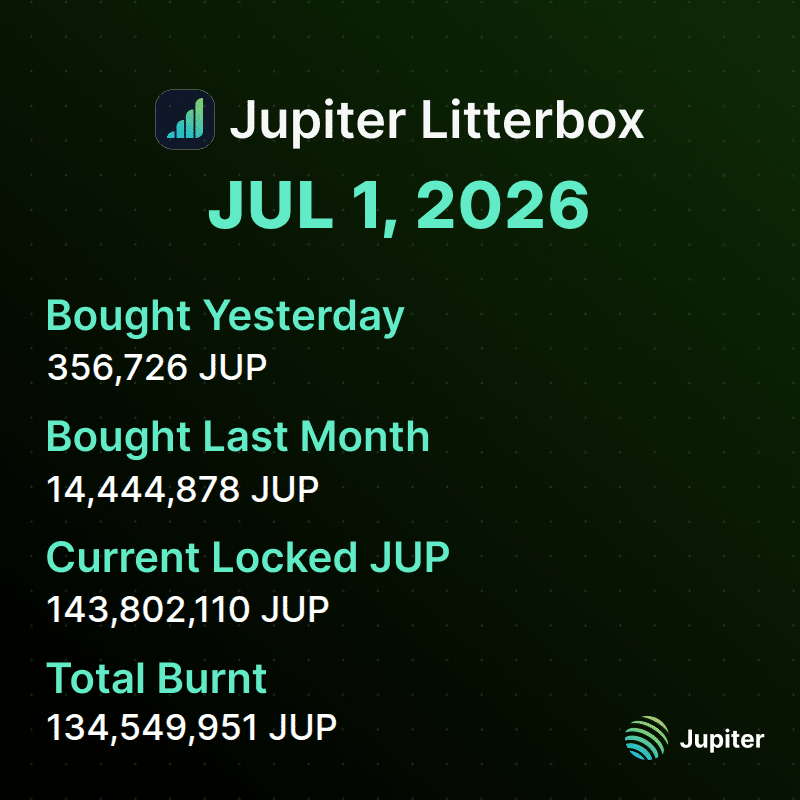
That is not all there is though. Jupiter Strategic Reserve, Litterbox Trust, is creating buying pressure in the market as well as shrinking supply.

Over the last 24 hours alone, the strategic reserve added 356,726 JUP. This, on top of 14.44 million JUP bought last month, taking the total locked JUP tokens to 143.8 million.
Source: X

On the supply tokenomics side, a total of about 134.55 JUP have been burned from the reserve’s effort.

This is a big step towards reducing total supply of the token after 3 billion tokens were burned in January 2025. The altcoin’s total supply is now below 7 billion, down from 10 billion.

Has JUP reclaimed the lost trendline support level?

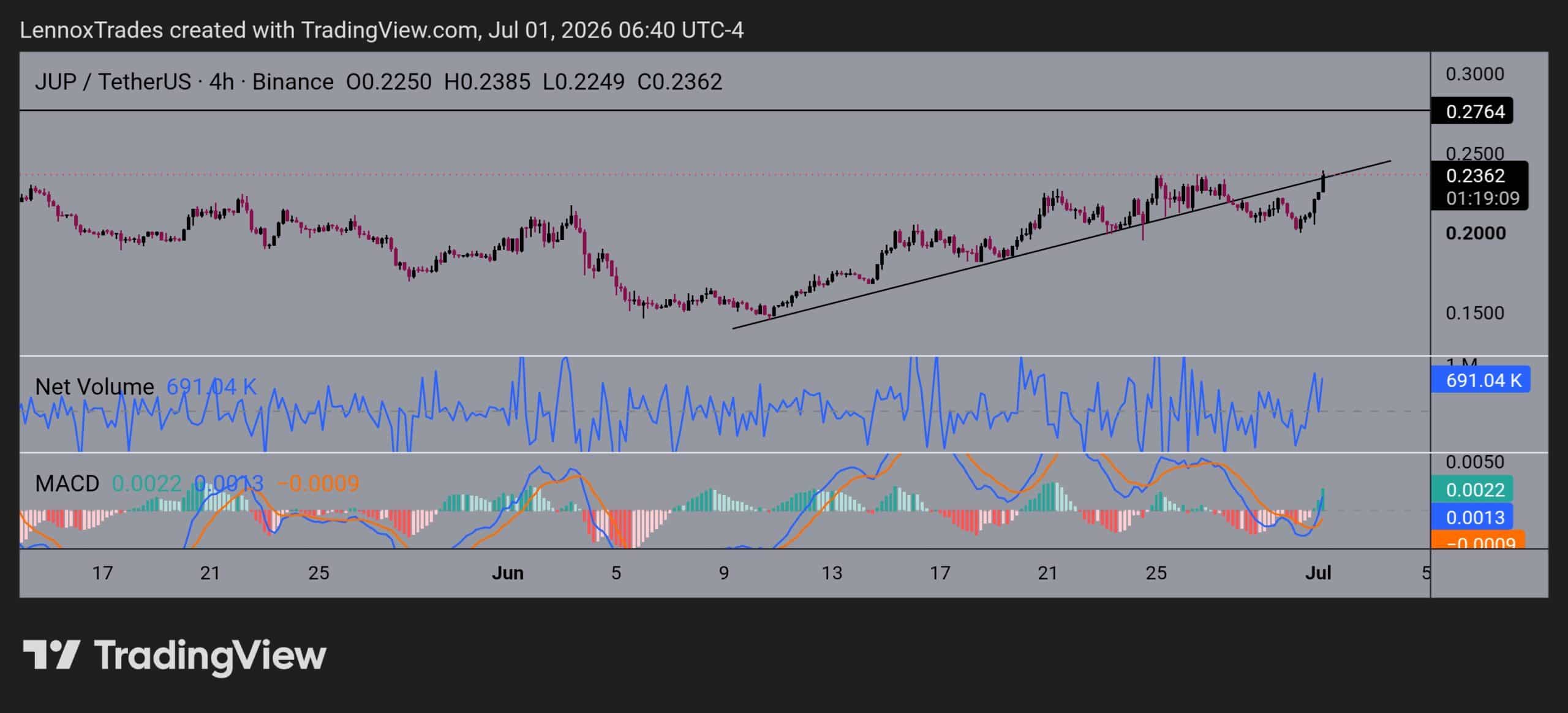
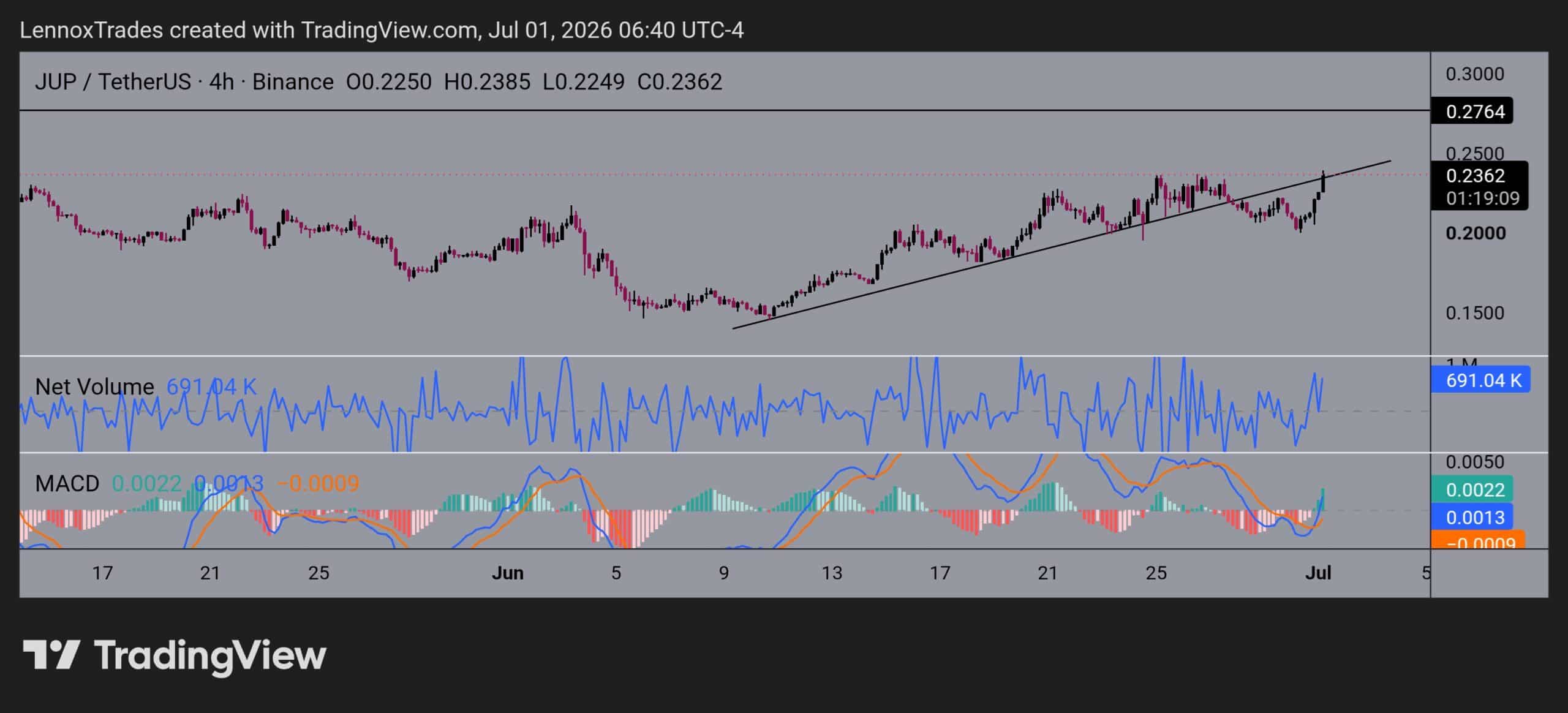
JUP showed similar strength on the 4-hour chart, as it attempted to reclaim the lost trendline support level. The altcoin has traded above the trendline for the better part of June, but it was lost in the last five days of the month.

At press time, JUP’s price was above this level. However, it was yet to create a base above it to ascertain a true shift. If the price stays above the minor resistance at $0.24, it may mean that the altcoin could push to $0.28.

This scenario can probably be supported by the market’s buying pressure too. In fact, Net Volume revealed that more than 800K JUP were bought on the day as bulls reclaimed market momentum.
Source: JUP/USDT on TradingView

All in all, turning the resistance into support would mean a trend shift in the short term. Otherwise, failure would extend the bear structure that had started to form.


Final Summary

  • Jupiter rallied by more than 15% after JupUSD’s integration into JLP, talks of its own Omnichain Ledger, and its strategic reserve accumulation.
  • JUP’s price action reclaimed its lost trendline support, but was yet to form a base level at press time.


Trending Cryptos

Related Questions

QWhat are the three main catalysts behind Jupiter's (JUP) recent double-digit price rally?

AThe three main catalysts are: 1) The addition of its own stablecoin, JupUSD, to Jupiter Liquidity Provider (JLP) as a custody asset, facilitating a planned $500 million USDC-to-JupUSD transition. 2) Reignited talks of Jupiter building its own Omnichain Ledger. 3) The Jupiter Strategic Reserve (Litterbox Trust) creating buying pressure and shrinking supply by accumulating JUP tokens, with 356,726 JUP added in the last 24 hours and a total of 143.8 million JUP now locked.

QWhat is the potential next price target for JUP mentioned in the article, and what condition must be met?

AThe article states that JUP's price may push to $0.28. For this to happen, the price must stay above the minor resistance level at $0.24 to confirm a true shift and turn that resistance into support.

QWhat significant change has occurred to JUP's total token supply according to the article?

AJUP's total token supply is now below 7 billion, down from the original 10 billion. This reduction follows the burning of 3 billion tokens in January 2025 and ongoing burns from the strategic reserve's efforts, with about 134.55 JUP burned recently.

QWhat does Net Volume data indicate about market activity for JUP?

AThe Net Volume data reveals that more than 800,000 JUP were bought on the day, indicating strong buying pressure and that bulls have reclaimed market momentum.

QWhat role does Jupiter play in the Solana ecosystem based on the information provided?

AJupiter drives more than 80% of the total retail liquidity movement on Solana. It has grown from a swap aggregator in 2021 into a full on-chain finance system.

Related Reads

After Snagging a Nobel Laureate, Anthropic Poaches Berkeley CS Department Head, Recruiting Four Top Talents in Two Weeks

In a stunning move, Anthropic has recruited Jelani Nelson, the chair of UC Berkeley's prestigious EECS Computer Science Division and a leading theoretical computer scientist, on a leave of absence. This follows a two-week hiring spree where Anthropic also secured Nobel laureate John Jumper and two key Gemini researchers from Google. Nelson's expertise in streaming algorithms, dimensionality reduction, and randomized algorithms—fundamentally about processing vast data with minimal resources—directly addresses core challenges in large language models: training efficiency, data compression, and computational complexity. His work on the Johnson-Lindenstrauss lemma underpins modern vector search and embedding compression. Anthropic's recruitment signals a strategic shift in the AI race from merely scaling models to optimizing foundational algorithms for efficiency. This "leave of absence" model, exemplified by figures like Fei-Fei Li, is becoming a mainstream talent pipeline, allowing scholars to retain academic positions while gaining industry access to unprecedented compute and real-world problems. The recent talent war has escalated from poaching between AI firms to raiding top university departments, with Berkeley being a prime target. As OpenAI and Anthropic near potential IPOs, offering pre-IPO equity, they are effectively becoming parallel research institutions. The competition's focus is now descending to the theoretical bedrock of algorithms.

marsbit1m ago

After Snagging a Nobel Laureate, Anthropic Poaches Berkeley CS Department Head, Recruiting Four Top Talents in Two Weeks

marsbit1m ago

A Year Consumes a Solid-State Drive: Codex Log Bug Slammed as 'Slopware'

OpenAI's flagship AI coding tool, Codex, was found to have a critical bug causing its feedback logging system to silently and rapidly wear out users' SSDs. A developer reported that Codex was writing approximately 640 TB of data per year to a local SQLite database (`logs_2.sqlite`) through a constant cycle of inserting and immediately deleting log entries, primarily at the verbose TRACE level. While the database file itself remained around 1 GB, the underlying write-amplification from SQLite's WAL mechanism meant the physical SSD endured the full write load. This was enough to exceed the typical 600 TBW endurance rating of a consumer SSD within a year. The root cause was a hardcoded default logging level (`Level::TRACE`) in the configuration, which overrode any user attempts to reduce logging via environment variables. Analysis showed that over 96% of the logged data—including noisy WebSocket packet dumps and repeated system file events—was useless debug information. The issue, which had at least nine related bug reports in the Codex repository, remained latent because it didn't visibly consume disk space, only silently accumulated write cycles. After the report gained traction on Hacker News, OpenAI merged fixes estimated to reduce writes by about 85%. However, even post-fix, the tool would still write an estimated 96 TB annually. The incident sparked broader criticism of "slopware" in AI-assisted development tools, highlighting a lack of resource budgeting for disk, CPU, and memory in always-on agent software, and a reliance on modern hardware to mask inefficient code. Competing tools like Claude Code were noted to have similar issues.

marsbit13m ago

A Year Consumes a Solid-State Drive: Codex Log Bug Slammed as 'Slopware'

marsbit13m ago

Robinhood Chain Mainnet Launch Ignites Industry Shockwaves: Rally of Top Protocols, but Leaves dYdX in a Deep Pit

Robinhood's launch of its Layer 2 blockchain, Robinhood Chain, and a suite of new crypto products has significantly impacted the market. The announcement, made ahead of its Q2 earnings, caused the company's stock to rise 8.35%. The chain, built on Arbitrum Orbit, aims to be an institutional-grade, AI-native infrastructure optimized for Real World Assets (RWA). Key product launches include tokenized stocks available globally via various DEXs, perpetual contracts with fee incentives, and a decentralized lending product called Robinhood Earn offering yields on USDG stablecoin. The company is also expanding its AI trading tools to crypto. The move has attracted major protocols like Uniswap and Chainlink to its ecosystem. However, a partnership with dYdX to launch a new DEX called Arcus on Robinhood Chain sparked controversy. The dYdX community expressed concerns that the core team's focus on this new, independent platform could divert resources and liquidity away from the existing dYdX Chain, potentially diluting the value of the DYDX token. Despite assurances from dYdX's founder about shared interests and potential future token allocations for the dYdX community, the DYDX token price dropped roughly 40.7% following the news. Amidst slowing crypto revenue growth, Robinhood is leveraging its large user base and financial expertise to expand globally and transform from an internet broker into a broader financial gateway through its new blockchain initiative.

链捕手14m ago

Robinhood Chain Mainnet Launch Ignites Industry Shockwaves: Rally of Top Protocols, but Leaves dYdX in a Deep Pit

链捕手14m ago

The Trillion-Dollar Credit Market Leveraged by Stablecoins, Stuck in Off-Chain Risk Control

**Stablecoins Fueling Trillion-Dollar Private Credit Market, Hampered by Off-Chain Risk Management** This article examines how interest-bearing stablecoins are replicating the business model of money market funds to democratize access to the $2 trillion private credit market, while highlighting the significant risks posed by inadequate off-chain risk controls. Historically, private credit investments had high minimums (e.g., $1 million+) due to costly due diligence and loan servicing. Stablecoins like Apollo's ACRED and Figure's YLDS are bridging this gap. They tokenize institutional credit funds, allowing small investors to gain exposure and enabling new functionalities like using these tokens as collateral in DeFi for leveraged yield. The on-chain private credit market has grown 15x in a year to $5.87 billion, yet remains a tiny fraction of the global total. However, the core challenge is not blockchain technology but managing the inherent risks of lending, which occur off-chain. The failure of Goldfinch, a pioneer in on-chain private credit, serves as a stark warning. It raised funds in crypto (USDC) to lend to small businesses in markets like Kenya and Nigeria. While smart contracts handled fund distribution, critical functions—local due diligence, monitoring loan use, and debt collection—relied on off-chain partners. A major breach, where a local partner misappropriated nearly 40% of funds, went undetected for months. When borrowers defaulted, crypto depositors had no effective legal recourse or means to seize assets, leaving $56 million trapped in non-performing loans with a projected 8-15 year recovery timeline. The article concludes that tokenization addresses only 10% of the credit business—the distribution. The remaining 90%—rigorous risk assessment and collection infrastructure—is expensive and localization-dependent. Without solving these fundamental off-chain challenges, the sector risks repeating Goldfinch's collapse.

Foresight News58m ago

The Trillion-Dollar Credit Market Leveraged by Stablecoins, Stuck in Off-Chain Risk Control

Foresight News58m ago

Trading

Spot

Hot Articles

How to Buy JUP

Welcome to HTX.com! We've made purchasing Jupiter (JUP) simple and convenient. Follow our step-by-step guide to embark on your crypto journey.Step 1: Create Your HTX AccountUse your email or phone number to sign up for a free account on HTX. Experience a hassle-free registration journey and unlock all features.Get My AccountStep 2: Go to Buy Crypto and Choose Your Payment MethodCredit/Debit Card: Use your Visa or Mastercard to buy Jupiter (JUP) instantly.Balance: Use funds from your HTX account balance to trade seamlessly.Third Parties: We've added popular payment methods such as Google Pay and Apple Pay to enhance convenience.P2P: Trade directly with other users on HTX.Over-the-Counter (OTC): We offer tailor-made services and competitive exchange rates for traders.Step 3: Store Your Jupiter (JUP)After purchasing your Jupiter (JUP), store it in your HTX account. Alternatively, you can send it elsewhere via blockchain transfer or use it to trade other cryptocurrencies.Step 4: Trade Jupiter (JUP)Easily trade Jupiter (JUP) on HTX's spot market. Simply access your account, select your trading pair, execute your trades, and monitor in real-time. We offer a user-friendly experience for both beginners and seasoned traders.

3.3k Total ViewsPublished 2024.03.29Updated 2026.06.02

How to Buy JUP

Discussions

Welcome to the HTX Community. Here, you can stay informed about the latest platform developments and gain access to professional market insights. Users' opinions on the price of JUP (JUP) are presented below.

活动图片