Why I Am Not Bullish on Ethereum at Its Current State?

marsbitPublished on 2026-01-19Last updated on 2026-01-19

Abstract

Why I'm Not Bullish on Ethereum at Current Prices The author expresses skepticism about Ethereum's current valuation, not its long-term business growth potential (user base and transaction volume are expected to increase). The author believes the price is too high relative to its fundamentals, based on the following analysis: - Active users and transaction counts have reached new highs but are growing slower than some leading e-commerce platforms. - Monthly transaction fees are only 0.6% of the previous cycle's peak, and average fees per transaction are 0.5% of previous highs. This slow growth comes at the cost of drastically reduced service prices, which is unfavorable in any industry. - If Ethereum is viewed as a company selling block space, its price-to-fee (PF) ratio exceeds 2,000x and its price-to-sales (PS) ratio exceeds 10,000x. It has negative net profit, so no P/E ratio exists. In comparison, traditional cloud service companies have P/E ratios of 20-30 and single-digit PS ratios. - If considered a commodity (like digital oil), Ethereum faces competition from other chains and rollups offering similar services. Its value proposition may not justify such a high premium, especially as its narrative as a store of value (like Bitcoin) has faded. - There is a lack of new, product-market-fit crypto native applications this cycle, leading to oversupply of block space and stagnant growth in the public chain sector. - Grand visions of Ethereum becoming a decentralized "Wall S...

Author: Alex Xu

Not being bullish doesn't mean I am pessimistic about Ethereum's business development (referring to long-term growth in user scale and transaction volume, which I believe will continue), but rather that I am unwilling to buy at the current price because it is too expensive relative to its fundamentals.

From a few charts, we can paint a picture of Ethereum's current state:
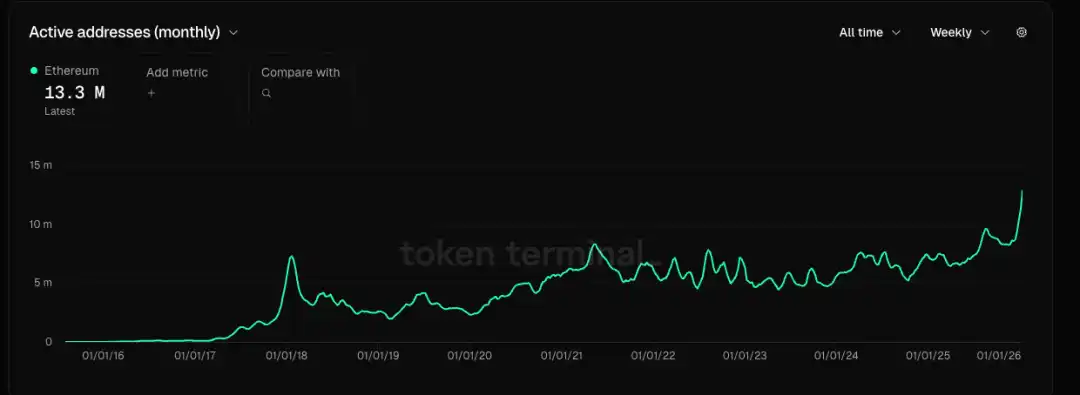
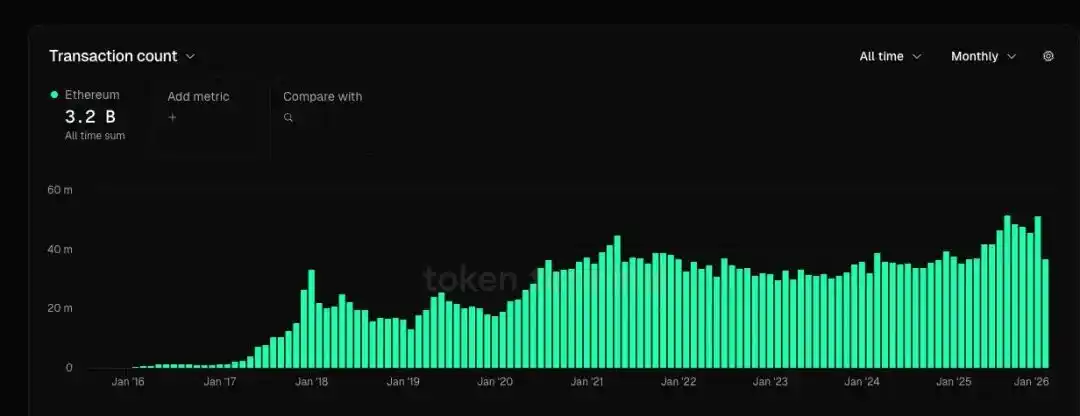
1. The number of active users has risen in waves to new highs (44% higher than the peak of the last cycle), and the number of transactions has also reached new highs (13% higher than the peak of the last cycle). However, the growth rate of these two metrics is still slower than the GMV growth of some leading e-commerce platforms.
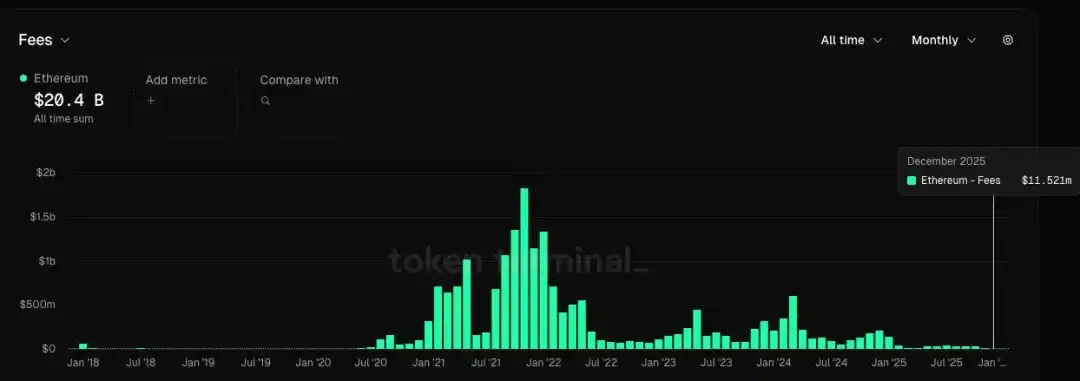
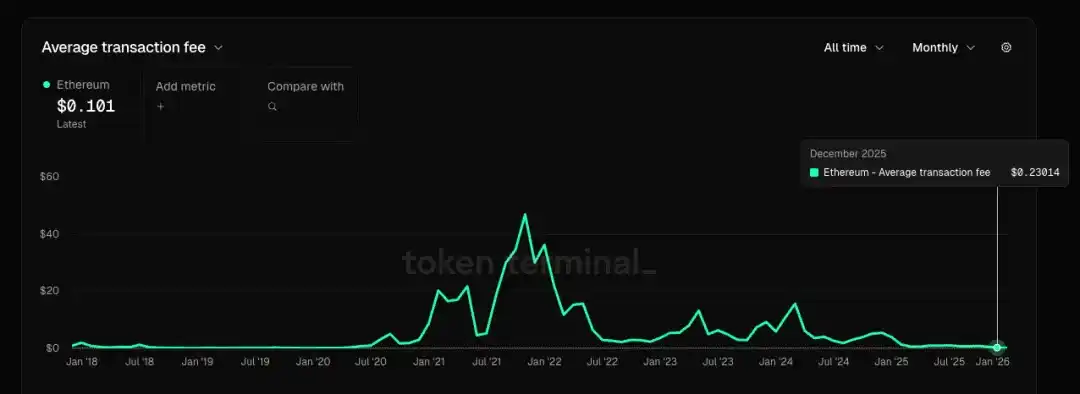
2. The current monthly transaction fees are only 0.6% of the peak of the last cycle, and the average transaction fee per transaction is only 0.5% of the peak of the last cycle. This means that the slow growth in users and transaction volume has been achieved at the cost of a sharp decline in service prices. When growth comes at the expense of drastic price reductions for products and services, it is not a good sign for any company in any industry.
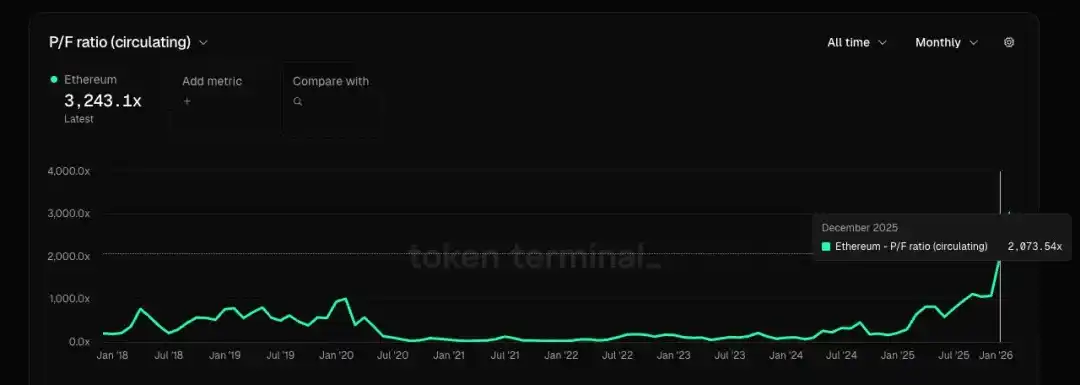
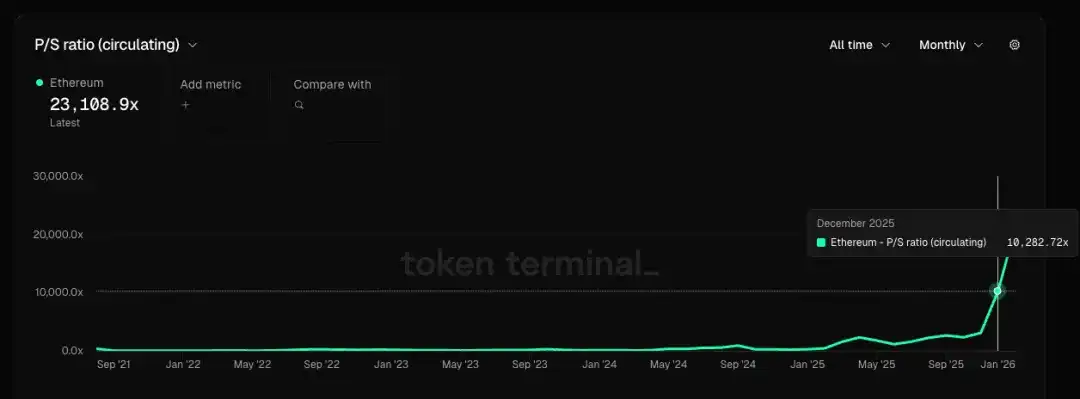
3. If we view Ethereum as a company providing block space services, based on December data, its P/F (Price-to-Fee ratio) exceeds 2,000x, and its P/S (Price-to-Sales ratio) exceeds 10,000x. Its net profit is negative, so there is no P/E ratio. In comparison, traditional cloud service companies typically have P/E ratios between 20-30 and P/S ratios in the single digits.

4. If Ethereum is considered not a company but a commodity (similar to digital oil), its challenge lies in the fact that other public chains and rollups can provide similar block space services (akin to substitutable oil). Some may argue that Ethereum's decentralization and censorship-resistant properties make it more valuable as a commodity resource, but is it really worth that much more? The previous narrative that ETH could replace BTC as a store of value has largely disappeared, as consensus has shifted: compared to BTC's status as digital gold, ETH is more like a tech company + specialized cloud service provider, and its commodity positioning is also highly substitutable.

5. Crypto-native applications with product-market fit (PMF) have almost disappeared in this cycle, with almost no high-value applications emerging. Insufficient demand and increased supply (the continued growth of rollups and public chains) have led to a severe oversupply of block space, and the public chain sector itself is experiencing sluggish growth or even contraction.

6. The grand vision painted by Tom Lee and some domestic VCs—"Ethereum is the Wall Street on-chain, and everything will eventually be on Ethereum"—lacks sufficient data and factual evidence to support this story. There is no concrete logical derivation, and it seems more like a promotional pitch. Our investment decisions should be based on rationality, not faith. I am not ready to buy into their narrative yet. If future data and facts gradually support this story, it will be time to reconsider.


Related Questions

QWhat is the author's main reason for not being optimistic about Ethereum at its current price?

AThe author believes the current price is too expensive relative to its fundamentals, such as its high valuation multiples and declining fee revenue, despite some growth in user base and transaction count.

QHow does the author compare Ethereum's current performance to the previous cycle's peak in terms of transaction fees?

AThe author states that the current monthly transaction fees are only 0.6% of the previous cycle's peak, and the average fee per transaction is only 0.5% of the previous high.

QWhat valuation multiples does the author use to argue that Ethereum is overvalued, and how do they compare to traditional cloud service companies?

AThe author uses a Price-to-Fees (PF) ratio of over 2000x and a Price-to-Sales (PS) ratio of over 10,000x for Ethereum, while noting that traditional cloud service companies typically have a PS ratio in the single digits and a PE ratio between 20-30.

QAccording to the author, what is a key challenge to Ethereum's 'digital oil' commodity narrative?

AThe author argues that other blockchains and rollups can provide similar block space services, making Ethereum's commodity-like resource highly substitutable and questioning if its premium valuation is justified.

QWhy does the author express skepticism about the narrative that Ethereum will become the 'Wall Street of on-chain' activities?

AThe author finds this narrative lacks supporting data and concrete logical derivation, viewing it more as promotional 'shilling' rather than a rational investment thesis based on current evidence.

Related Reads

Vitalik's Vision for the Next Evolution of On-Chain Finance: How to Reconstruct DeFi with an 'Options Mindset'?

Vitalik Buterin recently proposed a conceptual shift for DeFi: replacing traditional Collateralized Debt Positions (CDPs) and forced liquidations with an options-based mechanism. This aims to address key vulnerabilities in current DeFi lending. The traditional CDP model, foundational to protocols like MakerDAO and Aave, allows users to borrow against collateral but relies on real-time oracles and triggers sudden, mandatory liquidations during price volatility. This can cause cascading sell-offs, oracle manipulation risks, and significant MEV extraction, exacerbating market stress. Vitalik's alternative envisions splitting an asset like 1 ETH into two complementary components: one offering stable/index-like exposure and the other absorbing the opposite risk/reward. Instead of a hard liquidation threshold, a user's exposure to the target asset would gradually and smoothly deviate (following a near-quadratic curve) as the collateral price moves. The system would primarily depend on "slow oracles" for periodic settlement rather than instant price feeds. Key potential benefits include: the elimination of abrupt, forced liquidations; drastically reduced reliance on vulnerable real-time oracles; and inherent resistance to certain MEV exploits centered on liquidation auctions. The article posits that for Ethereum DeFi to maintain its relevance amid competition from faster, cheaper chains, it must compete on sophisticated financial engineering and robustness—not just transaction speed or yields. The core value proposition should shift towards offering users clearer, more manageable risk structures, greater autonomy, and resilience in extreme scenarios, moving DeFi from high-risk experimentation towards becoming reliable financial infrastructure.

marsbit16m ago

Vitalik's Vision for the Next Evolution of On-Chain Finance: How to Reconstruct DeFi with an 'Options Mindset'?

marsbit16m ago

AI Agent Completely Transforms Web3 Gaming: From the Rugpull Bakery Bot Controversy to the New 2026 Agent Paradigm

This article explores how the AI Agent paradigm is fundamentally transforming Web3 gaming, moving from a disruptive force to a core, legitimized element. It begins with the controversy in the competitive baking game Rugpull Bakery, where automated scripts caused fairness issues. Instead of banning them, the developers integrated AI Agents into the official gameplay by providing technical documentation (skill.md, agent.json), marking a shift towards "Agentic Gaming." The piece outlines three primary implementation models for AI Agents in Web3 games by 2026: 1. **Autonomous Competitors & Economic Entities:** AI Agents act as independent players with unique strategies. Examples include TEN Protocol's poker agents, AI Arena's trainable NFT fighters, and Satoshi Strike Force's "Digital Athletes" trained on player data. The Somnia blockchain is highlighted as a dedicated "Agentic L1" infrastructure supporting this model at scale. 2. **Modular Infrastructure & Programmable Environments:** This model, exemplified by EVE Frontier, allows AI Agents to program game world logic itself. Using "Smart Assemblies" (e.g., Smart Turrets, Smart Gates), Agents can modify shared economic and physical rules on-chain, creating dynamic, player/AI-built worlds. The ERC-8183 standard further enables these automated entities to hire other AI services for complex tasks. 3. **Hybrid Companions & Dynamic Adaptation:** Here, AI serves as a collaborative partner. In Parallel Colony, highly autonomous AI Avatars work alongside human players who provide high-level guidance. Illuvium plans to use AI to make NPCs dynamic and responsive, creating personalized, emergent narratives for each player. The conclusion posits that Web3 gaming has reached a "post-human" inflection point. Blockchains' transparency and programmability, combined with new standards and infrastructure like Somnia, make integrating and governing AI Agents not just viable but essential. The future lies in a symbiotic digital order where players transition from manual laborers to commanders and partners of algorithmic intelligence.

marsbit1h ago

AI Agent Completely Transforms Web3 Gaming: From the Rugpull Bakery Bot Controversy to the New 2026 Agent Paradigm

marsbit1h ago

Trading

Spot
Futures

Hot Articles

Discussions

Welcome to the HTX Community. Here, you can stay informed about the latest platform developments and gain access to professional market insights. Users' opinions on the price of ETH (ETH) are presented below.

活动图片