Why Ethereum is rethinking its ‘rollup-first’ strategy in 2026

ambcryptoPublished on 2026-02-09Last updated on 2026-02-09

Abstract

Ethereum is rethinking its 'rollup-first' strategy by 2026 as its original scaling vision no longer aligns with ecosystem evolution. Key factors driving this shift include Ethereum’s improved on-chain scalability through higher gas limits and upgrades, reducing L2s' role in affordability. Many Layer 2s have slowed decentralization due to regulatory and business pressures, creating a spectrum of trust models rather than uniform extensions of Ethereum. L2s are now evolving into independent platforms with distinct use cases, not just scaling tools. As mainnet regains appeal for security-sensitive applications, the declining capital secured on L2s highlights their shift toward execution-focused roles rather than value hubs. This redefines the L1-L2 relationship and prioritizes product-market fit over pure throughput.

For years, Ethereum [ETH] prioritized security on mainnet while Layer 2 handled speed and scalability, and the ecosystem viewed L2s as “branded shards” and direct extensions of the network.

However, by 2026, this vision no longer reflected how the ecosystem evolved, as Vitalik Buterin acknowledged that Layer 2s no longer serve purely as scaling tools.

Rising gas limits and ongoing upgrades improved mainnet performance faster than expected, while many L2 projects slowed or abandoned decentralization due to regulatory and business pressures.

Together, these shifts created uncertainty and redefined the relationship between Layer 1 and Layer 2.

That said, three major changes explain this shift in Ethereum’s Layer 2 landscape.

The identity crisis of Layer 2

In a recent episode of Unchained, Austin Griffith and Karl Floersch joined the discussion to examine the future of Layer 2s, as Buterin questioned whether Ethereum’s original scaling vision still makes sense today.

First, Ethereum now scales more effectively on its own through higher gas limits and continuous technical upgrades.

These improvements increase network capacity and reduce reliance on Layer 2s for basic affordability. As a result, L2s no longer play an essential role in keeping transaction costs low.

Second, many Layer 2 networks have slowed their progress toward decentralization in recent years.

Regulatory and business pressures have pushed several projects away from full decentralization. This shift weakens the original idea that L2s closely reflect Ethereum’s trust and governance.

Third, Layer 2s now operate with different levels of trust across the ecosystem. Instead of remaining uniformly pure Ethereum, they exist on a broad spectrum.

Some networks stay tightly secured by Ethereum, while others function more independently and carry higher risks.

Together, these changes show that Layer 2s no longer act as simple extensions of Ethereum. They now form a diverse ecosystem with distinct roles and priorities, reshaping how the community understands scaling on Ethereum.

As Ethereum scales more efficiently and many Layer 2 networks remain only partially decentralized, a key question is emerging...

What are L2s really becoming?

According to Karl Floersch, it depends on whether Ethereum is seen as just a network or a shared culture. Projects like Optimism began as extensions of Ethereum but have grown into independent platforms.

Floersch added,

“Optimism was built to scale Ethereum and you know make progress on the frontier.”

Thus, being faster and cheaper is no longer enough; L2s now need clear use cases and strong value to stay relevant. At the same time, Ethereum’s mainnet is regaining importance.

The ultimate goal

As fees fall and security remains unmatched, developers are increasingly returning to Layer 1.

Lower costs, stronger guarantees, and growing AI-driven activity are making the mainnet more attractive, especially for serious applications where security matters more than speed.

Meanwhile, even as Layer 2 networks see strong growth in usage, the amount of capital they secure continues to decline.

This coincided with Buterin recently highlighting that Ethereum’s original rollup-first strategy no longer reflects current realities.

Data from L2Beat shows that users increasingly rely on rollups for fast and low-cost transactions, while fewer assets remain protected under Ethereum-level security.

This widening gap shows that L2s are shifting toward execution-focused platforms rather than major value hubs, pushing Ethereum to rethink the long-term role of Layer 2s in its ecosystem.


Final Thoughts

  • Partial decentralization has become a structural weakness for many rollups, limiting long-term trust and institutional adoption.
  • L2 networks are increasingly being judged by product-market fit rather than technical throughput.


Trending Cryptos

Related Questions

QWhy is Ethereum rethinking its 'rollup-first' strategy by 2026?

AEthereum is rethinking its rollup-first strategy because mainnet performance has improved faster than expected through higher gas limits and upgrades, reducing reliance on L2s for scaling. Additionally, many Layer 2 projects have slowed decentralization due to regulatory pressures and now operate with varying levels of trust, no longer serving as simple extensions of Ethereum.

QWhat are the three major changes driving the shift in Ethereum's Layer 2 landscape?

AThe three major changes are: 1) Ethereum scaling more effectively on its own through technical upgrades and higher gas limits, 2) Many L2 networks slowing progress toward decentralization due to regulatory and business pressures, and 3) Layer 2s operating with different levels of trust across the ecosystem rather than uniformly reflecting Ethereum's security model.

QHow has the role of Layer 2 networks evolved beyond just scaling Ethereum?

ALayer 2 networks have evolved from being pure scaling tools to becoming independent platforms with distinct roles and priorities. They now need clear use cases and strong value propositions beyond just being faster and cheaper, as many have grown into their own ecosystems rather than remaining as direct extensions of Ethereum.

QWhy are developers increasingly returning to Ethereum's Layer 1 mainnet?

ADevelopers are returning to Layer 1 because of falling fees, unmatched security guarantees, and growing AI-driven activity. The mainnet is becoming more attractive for serious applications where security matters more than speed, especially as Ethereum's own scaling improvements have reduced transaction costs.

QWhat does the declining amount of capital secured by Layer 2 networks indicate about their changing role?

AThe declining capital secured by Layer 2 networks indicates they are shifting toward execution-focused platforms rather than major value hubs. While users rely on them for fast, low-cost transactions, fewer assets remain protected under Ethereum-level security, showing L2s are becoming less about value storage and more about transaction processing.

Related Reads

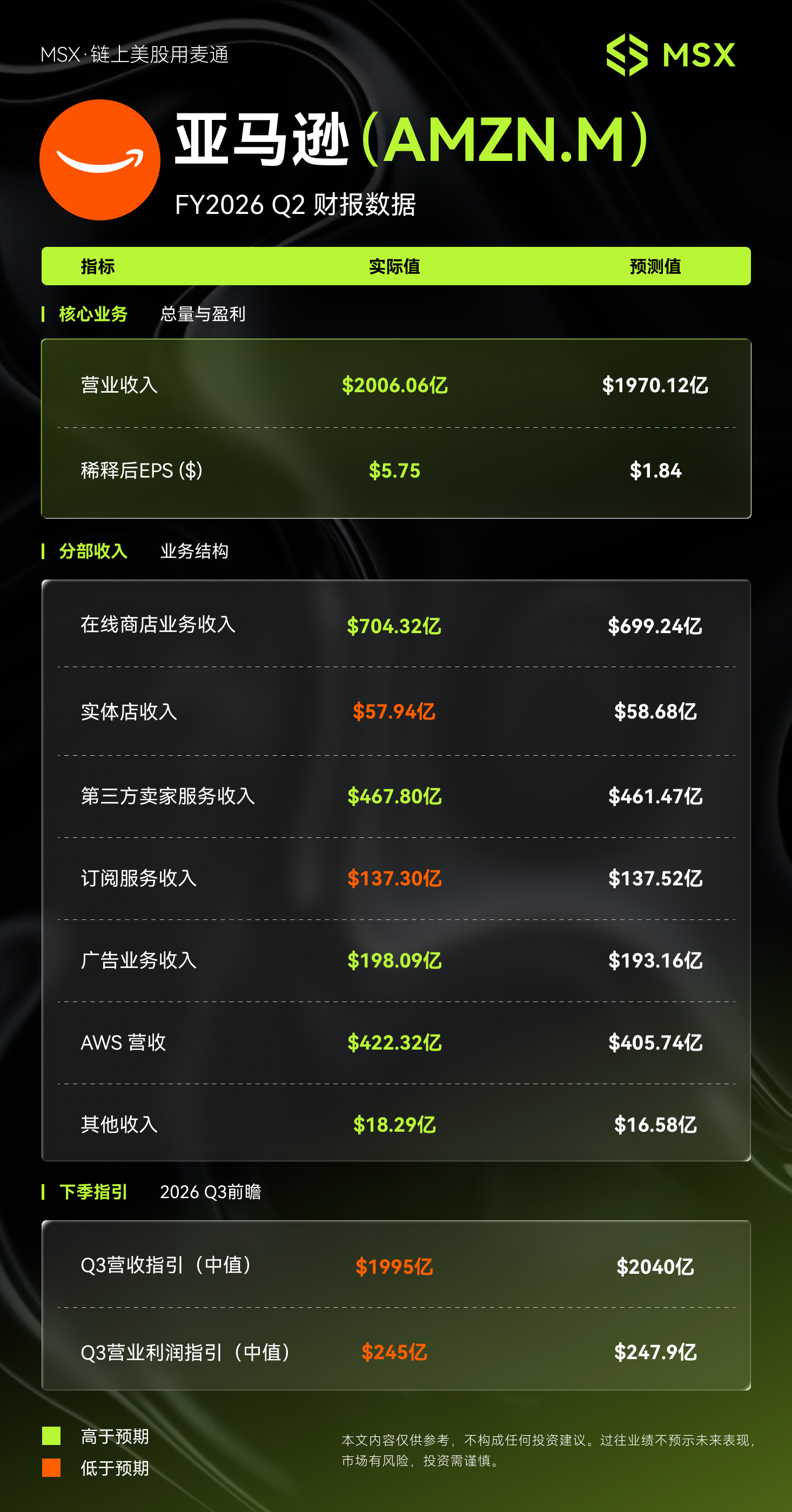
MSX US Stock Daily Insight: Amazon 2026 Q2 Earnings: AWS Records Fastest Growth in Five Years

**MSX Daily US Stock Observation: Amazon's Q2 2026 Earnings: AWS Achieves Fastest Growth in Five Years** Amazon's latest quarterly results exceeded expectations, driven by a strong performance from its cloud computing unit. The company reported revenue of $200.66 billion, surpassing estimates of approximately $197 billion. The key highlight was Amazon Web Services (AWS), which generated $42.232 billion in revenue, surging 37% year-over-year. This marked the segment's fastest growth pace in 18 quarters, indicating robust demand for cloud services. Reported Earnings Per Share (EPS) of $5.75 significantly exceeded the $1.84 forecast. However, this figure included a substantial one-time, non-operating gain of $53.4 billion, primarily from the revaluation of Amazon's investment in AI company Anthropic. Excluding this item, core operating profit was $27.461 billion, a strong increase of 43% compared to the same period last year. Despite the positive results, Amazon provided guidance for the upcoming third quarter that fell short of market expectations. The company's revenue guidance midpoint is $199.5 billion, below the consensus estimate of around $204 billion. Operating profit guidance of $24.5 billion also slightly missed expectations of approximately $247.9 billion. Furthermore, Amazon raised its forecast for full-year capital expenditures to $220 billion, citing rising memory chip costs, which weighed on investor sentiment regarding future profitability. In summary, Amazon's quarter showcased accelerating momentum in its core AWS business. The underlying operational profit growth remains solid. However, cautious forward guidance and increased investment spending present key areas for monitoring in the coming quarters, as the market assesses whether the current growth phase will translate into sustained profit margin expansion.

Odaily星球日报10m ago

MSX US Stock Daily Insight: Amazon 2026 Q2 Earnings: AWS Records Fastest Growth in Five Years

Odaily星球日报10m ago

Cyclical Stock or Growth Stock? Coinbase's Q2 Earnings Report Reveals 'Valuation Disagreement'

Coinbase's Q2 2026 financial results revealed a mixed performance, reigniting debate over whether the company should be valued as a cyclical stock tied to crypto markets or a growth stock with future potential. Total revenue missed expectations at $1.22 billion, down 19% year-over-year. Transaction revenue fell to $599 million, with retail crypto spot trading revenue dropping 30% to $452 million, back to 2023 levels. The company reported a net loss of $359 million, marking its third consecutive quarterly loss. Despite CEO Brian Armstrong's positive commentary on metrics like a 10.3% overall crypto trading market share and 106% growth in prediction markets, the market reacted negatively, with shares dropping over 5% after-hours. A key issue is the decline in core retail trading. While Coinbase touted record market share, this figure includes derivatives and new products. Its traditional crypto spot trading share is likely shrinking. New ventures like prediction markets, while growing, contributed less than $30 million, insufficient to offset the core revenue decline. The valuation debate hinges on perspective. As a cyclical stock, Coinbase remains deeply tied to the crypto bear market, with user attrition and competitive pressures justifying a lower valuation. The company's strategy appears focused on surviving until the next bull cycle. Viewed as a growth stock, however, Coinbase shows promising diversification. Subscription and service revenue reached $555 million, nearly matching transaction revenue. Stablecoin revenue, its second-largest source at $292 million, remains strong through its partnership with Circle. Critically, Coinbase is positioning itself as a leader in the emerging on-chain "agent economy." Over 90% of agent-based stablecoin transactions occur on its Base network, which it believes could handle trillions in future agent transactions. The recent acquisition of Deribit also aims to boost its international derivatives offering. In summary, Coinbase's present struggles are clear, but its future hinges on whether its investments in revenue diversification, stablecoins, and the agent economy can ultimately transform its business model and justify a growth premium.

Odaily星球日报30m ago

Cyclical Stock or Growth Stock? Coinbase's Q2 Earnings Report Reveals 'Valuation Disagreement'

Odaily星球日报30m ago

Global Market Share Survey: Japanese Firms Lead in Semiconductor Materials

Global Market Share Survey: Japanese Firms Lead in Semiconductor Materials According to the 2025 "Major Goods and Services Market Share Survey" by Nikkei, Japanese companies maintain strong positions in semiconductor-related materials. In silicon wafers, Shin-Etsu Chemical ranks first with a 26.3% share, followed by SUMCO at 17.8%. Together, they hold 44.1% of the market, widening their lead over competitors from Taiwan, Germany, and South Korea. In photoresists, Tokyo Ohka Kogyo, JSR, and Shin-Etsu Chemical occupy the top three spots, with a combined share of 60.5%. Despite their strength in materials, Japanese firms have a weaker presence in core semiconductor segments like DRAM and NAND flash memory, where South Korean and U.S. companies dominate. For instance, SK Hynix and Samsung lead in DRAM, while China’s CXMT doubled its share to 6% in 2025. The semiconductor market is projected to grow rapidly, with WSTS forecasting a 90% increase to $1.5112 trillion by 2026. Major players like Samsung, SK Hynix, and Micron are making massive investments to expand capacity. To maintain their edge in materials, Japanese companies must similarly commit to large-scale, risk-taking investments. In contrast, Japan’s automotive sector shows stagnation. Toyota remains the global leader but with only a slight share increase to 12.3%, while Japanese brands are absent from the top five in the EV market. In shipbuilding, Imabari Shipbuilding rose to third place globally with a 7.2% share, benefiting from large container ship deliveries. However, Chinese and South Korean firms dominate the sector, holding the top two positions. Japan aims to revitalize its shipbuilding industry through government and corporate efforts, targeting a near doubling of output by 2035. Addressing labor shortages and adopting advanced technologies like physical AI will be critical for competitiveness.

marsbit54m ago

Global Market Share Survey: Japanese Firms Lead in Semiconductor Materials

marsbit54m ago

Trading

Spot

Hot Articles

Discussions

Welcome to the HTX Community. Here, you can stay informed about the latest platform developments and gain access to professional market insights. Users' opinions on the price of ETH (ETH) are presented below.

活动图片