White Whale: A 'Doomed' Meme Coin's 500x Comeback in 30 Days?

Odaily星球日报Published on 2025-12-29Last updated on 2025-12-29

Abstract

White Whale, a meme coin initially destined to fail, staged a dramatic 500x rally in under a month, surging from a sub-$100K market cap to over $57 million. Launched on Pump.fun on October 13, 2025, as an unauthorized fan-made token using the image of crypto KOL @TheWhiteWhaleV2, it began as a satirical “People’s Whale” meme critiquing market manipulation. It quickly faded into obscurity with near-zero activity. The turning point came on December 7, 2025, when @TheWhiteWhaleV2 unexpectedly announced he was taking over the project’s treasury and control to protect his reputation. He committed to reinvesting all creator fees back into the community, locked his own purchased tokens until 2063, and personally funded liquidity and incentives. On-chain analysts noted early signals of a rebound, including a sharp drop in top-holder supply and increased "smart money" inflow days before the announcement. The real price explosion occurred in late December, fueled by community trust in the KOL’s transparent and responsible management. White Whale’s revival is seen as a rare “anti-rug” narrative in a high-risk meme coin ecosystem, turning a potential scam into a story of redemption and community-led growth.

Original | Odaily Planet Daily (@OdailyChina)

Author | Ding Dang (@XiaMiPP)

This is the story of a meme coin that "should have died," but unexpectedly revived from the bottom after being nearly forgotten by the market.

White Whale surged nearly 500 times in less than a month, climbing from a market cap of less than $100,000 to a current temporary market cap of $57 million. The community is now calling for the next target: $100 million.

A Familiar Meme Coin Pattern: From Start to End

White Whale was launched on Pump.fun on October 13, 2025. It was originally created by a fan as a joke, "borrowing" the avatar and image of crypto KOL @TheWhiteWhaleV2. @TheWhiteWhaleV2 is a crypto OG on X with 828,000 followers. His avatar is a whale clad in armor with a stern and cold expression, in a serious and restrained style. He often shares trading philosophies and market insights. Perhaps because of this, fans see him as a positive "whale" symbol.
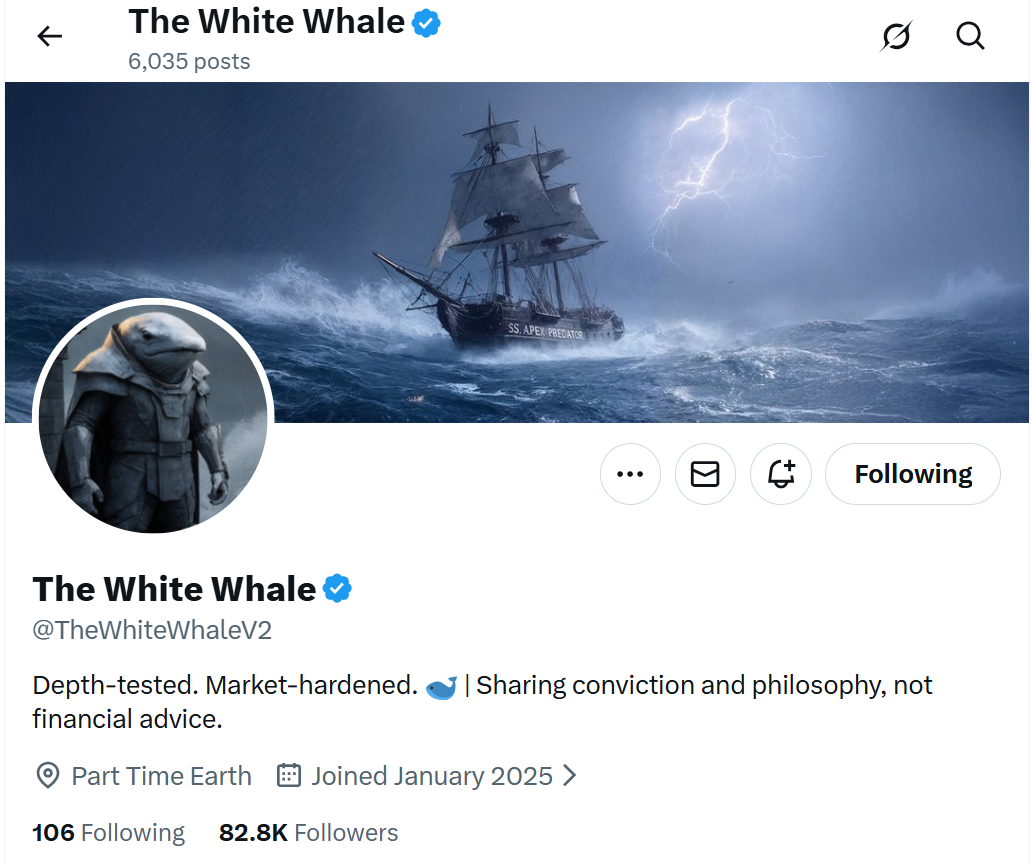
The initial narrative of the project was "The People's Whale," intended to satirize and resist manipulation by big whales or institutions in the crypto market, positioning itself as a tool for community counterattacks. But this was purely a fan's prank-like creation, without authorization or permission from @TheWhiteWhaleV2 himself. He even later tweeted that "this thing will die in 48 hours." And similar incidents of "borrowing avatars to issue coins" were not the first time for him.

This is exactly why it was originally "supposed" to be a dead meme coin. On Pump.fun, thousands of meme coins are born every day, and 99.9% of them die quickly; this coin was no exception. Shortly after its launch, the market cap briefly surged to around $100,000 after the curve binding, then quickly cooled off. From mid-October to early December, the price basically moved sideways, with trading volume near zero, almost forgotten. This is an ending the market has seen countless times.

A Dramatic Turnaround: The Whale's "Redemption" and Community Takeover

The turning point came on December 7, 2025.

@TheWhiteWhaleV2 himself suddenly posted an announcement: He officially took over the Treasury and control of this meme coin. The reason was simple: fans used his image and reputation without permission. He initially ignored it, but seeing that the coin had gained some (albeit small) popularity, he was worried that if a Rug Pull happened in the future, it would damage his reputation. So he decided to "step in personally" to protect the brand.

He emphasized that this was not a coin he created and that he initially even advised people not to buy it. But to control his own image and portrait rights, he had to take over.

Of course, that's not important.
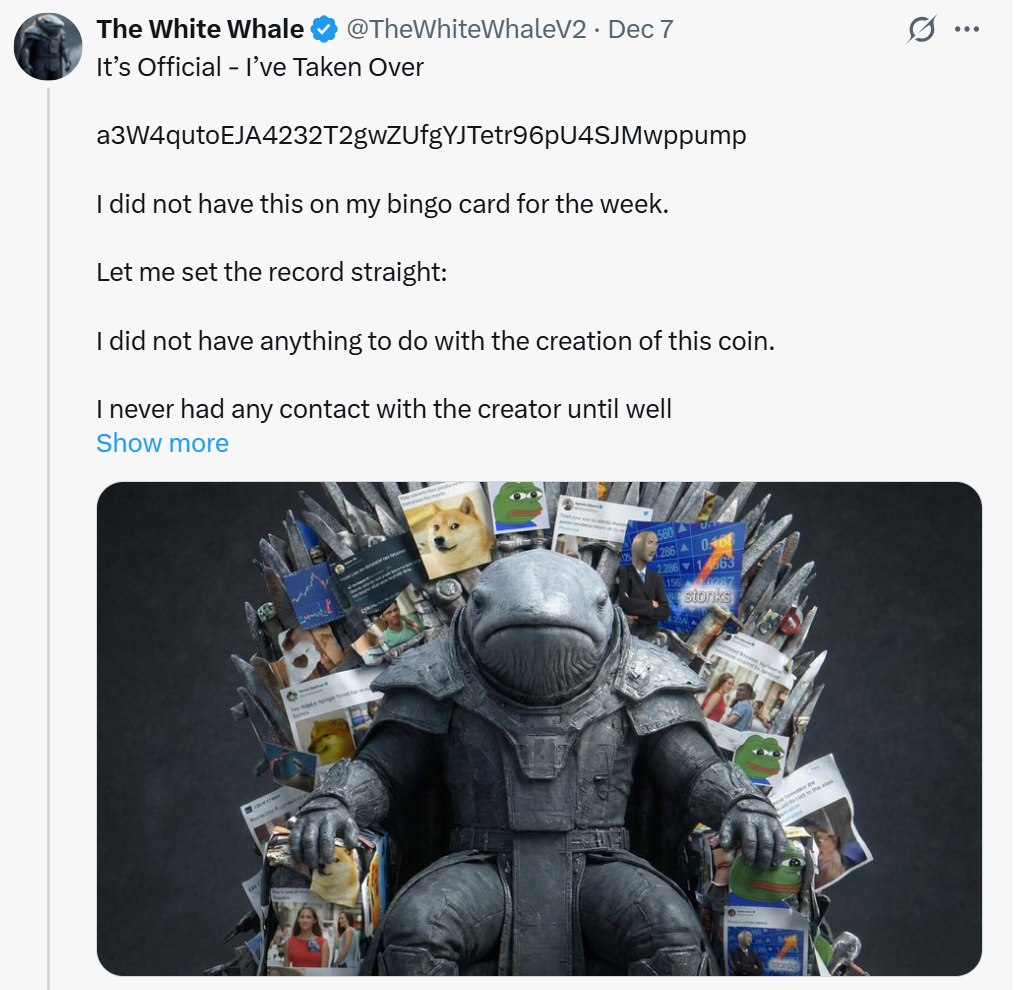
What is important is his promise: 100% of the creator revenue will be returned to the community, and he also bought some tokens as a memento, with the portion he bought never to be sold.

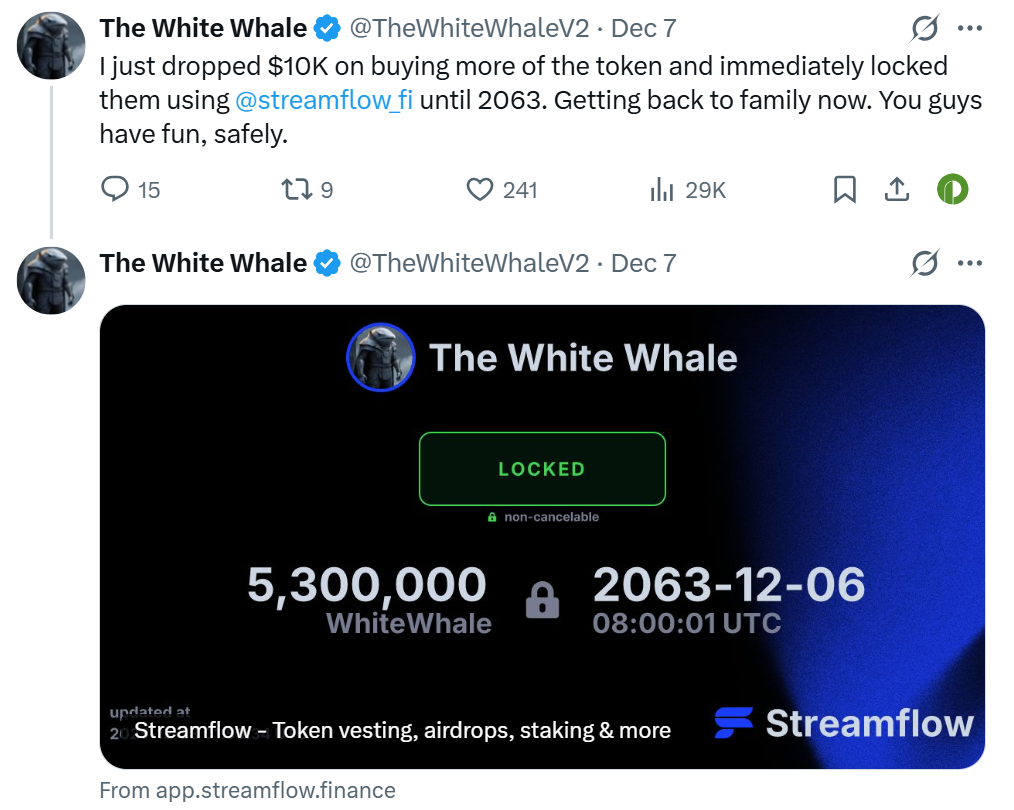
And he proved his sincerity with actions. On the day he announced the takeover, he spent $10,000 to buy 5.3 million tokens and locked them via the Streamflow protocol, with an unlock date set for 2063.
After that, he disclosed that he had already spent $130,000 to support the community, building a pool on Wasabi and adjusting the LP bandwidth to reduce volatility for holders, and using personal funds to incentivize community contributors.

It was these operations that gradually transformed what was originally a "fan prank" into a narrative sample about "good management" as understood by the community.

What Story Do the On-Chain Data Tell?

After White Whale surged 100 times, on-chain analyst @cryptorinweb3 revisited the token's indicator signals. According to the investigation, on December 2, @nansen_ai data showed that the token supply held by the top 100 holders suddenly dropped from 870 million to 140 million tokens. After checking the exchange labels, he found that this drop was mainly due to a significant amount of funds flowing back to the main liquidity pool (LP). He reminded that when you see such a change in the top 100 holdings, it is always a signal worth further investigation.

Then, on December 4, the "smart money inflow" indicator he set up in Discord was triggered, accompanied by an increase in trading volume.

On December 7, @TheWhiteWhaleV2 himself announced the official takeover. And starting from December 8, after excluding CEX/DEX wallets, the real top 100 holders increased their holdings by over 80%, while exchange supply remained stable.

Let's revisit White Whale's token performance: from the "smart money anomaly" on December 4 to the official takeover on December 7, White Whale's increase was only about 6 times, and it subsequently experienced a correction; the real explosion occurred in late December.

This, of course, is inseparable from sentiment and capital driving, but on the other hand, the responsible attitude and transparent on-chain operations demonstrated by @TheWhiteWhaleV2 himself form the foundation of the project.
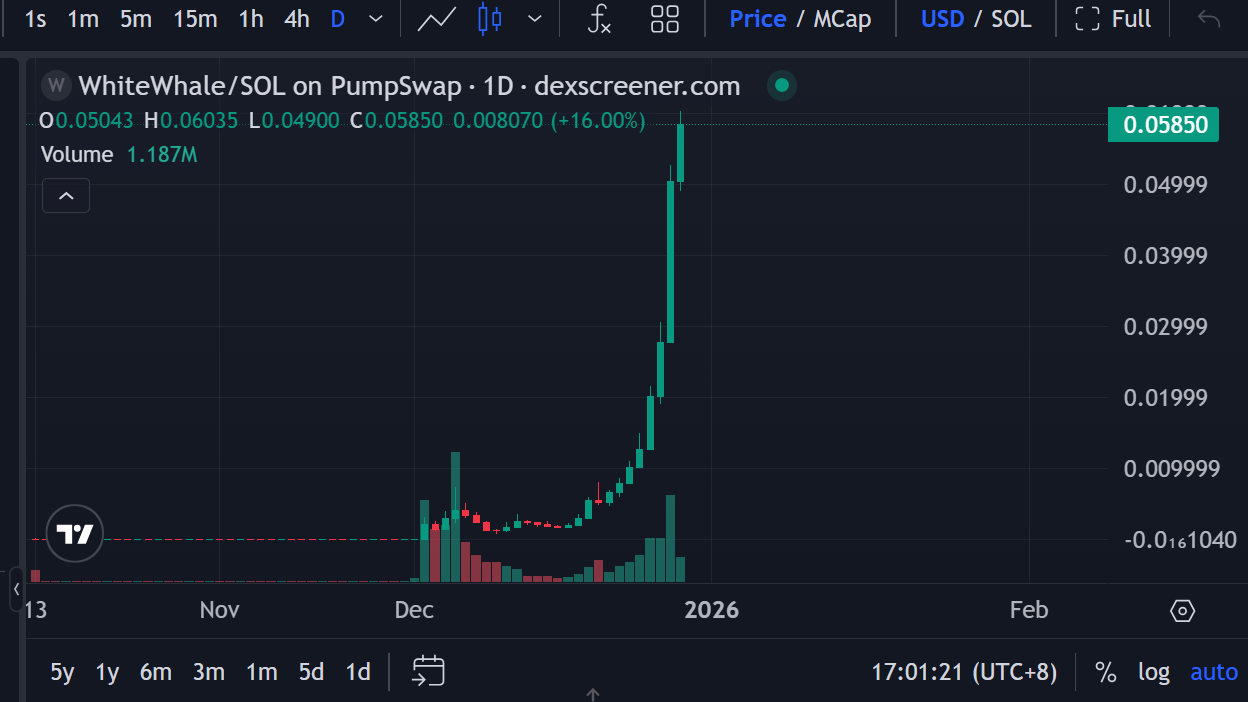
White Whale is essentially a microcosm of the Solana meme coin ecosystem: random, chaotic, high-risk. But the reason it survived and became popular is due to an unexpected positive turn: a nearly dead joke coin was taken over by the original figure in a "responsible, well-managed" manner, rebuilding trust and creating the most inspiring "anti-Rug" case at the end of 2025. Although we don't know how far it can go, in such a market known for short-term gambling, this in itself is rare enough.


Related Questions

QWhat is White Whale and why was it initially considered a 'should-be-dead' meme coin?

AWhite Whale is a meme coin launched on Pump.fun on October 13, 2025, created by a fan using the image and persona of crypto KOL @TheWhiteWhaleV2 without authorization. It was considered 'should-be-dead' because it followed the typical meme coin pattern of rapid initial interest followed by near-zero trading volume and obscurity, with 99.9% of such coins dying quickly.

QWhat was the key turning point that led to White Whale's dramatic price surge?

AThe key turning point occurred on December 7, 2025, when @TheWhiteWhaleV2 announced he was taking over control of the meme coin's treasury and management to protect his reputation, promising to reinvest all creator earnings back into the community and locking his own purchased tokens until 2063.

QHow did @TheWhiteWhaleV2 demonstrate his commitment to the White Whale community after taking over?

AHe spent $13,000 of his own money to support the community, including purchasing tokens, building liquidity pools on Wasabi, adjusting LP bandwidth to reduce volatility, and incentivizing community contributors. He also locked his personal token purchase until 2063 via Streamflow protocol.

QWhat on-chain data signals indicated early smart money movement into White Whale before the major price surge?

AOn December 2, the top 100 holders' token supply dropped significantly from 870 million to 140 million tokens due to funds flowing back to the liquidity pool. On December 4, 'smart money inflow' indicators were triggered along with increased trading volume, and after December 8, the real top 100 holders (excluding CEX/DEX wallets) increased their holdings by over 80%.

QWhat makes White Whale's story unique in the context of Solana's meme coin ecosystem?

AWhite Whale represents a rare 'anti-rug' case where a nearly dead meme coin was revitalized through responsible management and transparency when the original persona took control to protect his reputation, transforming a random joke coin into a narrative about good governance in a typically high-risk environment.

Related Reads

MoneyGram: Why Did We Launch Our Own Stablecoin?

MoneyGram, a global leader in cross-border remittances for over 80 years, has launched its own stablecoin, MGUSD. The initiative aims to evolve from single-transaction services to becoming a more integral part of users' financial lives. By allowing customers to hold a stable US dollar balance within the MoneyGram app, MGUSD enables not only remittances but also everyday spending, currency exchange, cash access, and future financial services. Targeting the billions globally who face challenges like currency volatility or lack of bank accounts, MGUSD leverages Stellar blockchain technology with a self-custody wallet architecture. This gives users control over their assets while providing a secure, compliant experience through a trusted brand. The approach focuses on solving existing customer pain points within MoneyGram's established network, rather than competing for broad crypto market liquidity. A key advantage is MoneyGram's hybrid model, combining digital services with the world's largest physical network for crypto-to-cash conversions. The stablecoin also modernizes the company's internal infrastructure, streamlining treasury management and partner settlements, with annual forex volume via stablecoins already reaching $2 billion. The project was delivered in about a year, driven by a reorganization into agile, cross-functional teams that operate with startup-like speed while leveraging decades of institutional expertise. Partners include Stablecoin (issuance), Crossmint (wallet APIs), Fireblocks (enterprise treasury), m0 (smart contracts), and the Stellar network. MoneyGram emphasizes that enhancing direct consumer offerings strengthens its partner ecosystem. The future direction is clear: to provide users worldwide with stable value storage, better financial tools, and greater control over their funds through a trusted, existing network.

Foresight News35m ago

MoneyGram: Why Did We Launch Our Own Stablecoin?

Foresight News35m ago

BIP-110 Controversy Intensifies: Bitcoin May Face Its Most Divisive Hard Fork Battle in Years

Bitcoin is approaching a critical block height of 961,632, which could activate the controversial BIP-110 proposal. This proposal aims to restrict the amount of non-financial data, such as inscriptions and other large data payloads, within Bitcoin transactions. Supporters, including some node operators and Bitcoin purists, argue that BIP-110 is necessary to preserve Bitcoin's core function as a monetary settlement layer by reducing network congestion and node operational burdens caused by non-essential data. They frame it as a correction to keep the network true to its original purpose. However, critics, including prominent figures like Blockstream's Adam Back and developer Jameson Lopp, warn that the proposal's implementation mechanism is dangerously flawed. They highlight that its low 55% miner signaling threshold, coupled with a contentious enforcement mechanism allowing nodes to unilaterally reject non-compliant blocks, significantly increases the risk of a chain split. Opponents argue this sets a dangerous precedent for transaction censorship, undermines Bitcoin's protocol neutrality, and creates excessive uncertainty for developers and businesses, especially since the rule is proposed as a temporary one-year measure. Market analysts, such as those from Bitfinex, suggest a full-scale network split is unlikely due to a lack of broad economic consensus. Major mining pools remain neutral, and adoption of the new rules is minimal. They view the situation more as a governance stress test. The primary risk is operational disruption: if a minority chain persists, major exchanges and custodians may need to temporarily suspend Bitcoin deposits and withdrawals to manage security and liquidity, potentially unsettling newer institutional investors. While BIP-110 is not expected to succeed in overtaking the main chain, its approach has ignited a significant debate about Bitcoin's governance, core values, and resilience.

Foresight News1h ago

BIP-110 Controversy Intensifies: Bitcoin May Face Its Most Divisive Hard Fork Battle in Years

Foresight News1h ago

Crypto Market Makers Are Collectively Seeking Change as Money Becomes Harder to Earn

**Summary: Crypto Market Makers Adapt as Margins Shrink** Leading crypto market maker GSR exemplifies a broader industry shift, moving beyond traditional market-making to become a full-service "Web3 investment bank." Its recent strategic acquisitions—including an SEC-registered broker-dealer, rebranded as GSR Securities—and purchases of token advisory firms aim to create an integrated platform covering token design, fundraising, listing, liquidity provision, and asset management. This includes launching an ETF and investing in tokenization platforms like Libeara, backed by a strategic investment from Standard Chartered's SC Ventures. This transformation is not unique to GSR. Other major players like Keyrock, B2C2, Wintermute, and DWF Labs are also expanding geographically, pursuing regulatory licenses (especially under frameworks like MiCA in the EU), and diversifying into over-the-counter (OTC) trading, asset management, and real-world asset tokenization. The driving force behind this collective pivot is a rapidly changing market. Profits from traditional altcoin market-making are declining due to fewer viable projects, reduced client budgets, increased competition, and smarter, more demanding clients. Simultaneously, regulatory pressures are mounting, making compliance a baseline cost. Extreme market events further expose teams lacking robust risk controls. Consequently, the crypto market-making business model is evolving from one reliant on information asymmetry and volatility to a more institutionalized, regulated, and service-diverse industry. Survival now depends on building systemic capabilities beyond mere liquidity provision.

marsbit2h ago

Crypto Market Makers Are Collectively Seeking Change as Money Becomes Harder to Earn

marsbit2h ago

Trading

Spot
Futures

Hot Articles

Discussions

Welcome to the HTX Community. Here, you can stay informed about the latest platform developments and gain access to professional market insights. Users' opinions on the price of MEME (MEME) are presented below.

活动图片