Original author: ChandlerZ, Foresight News
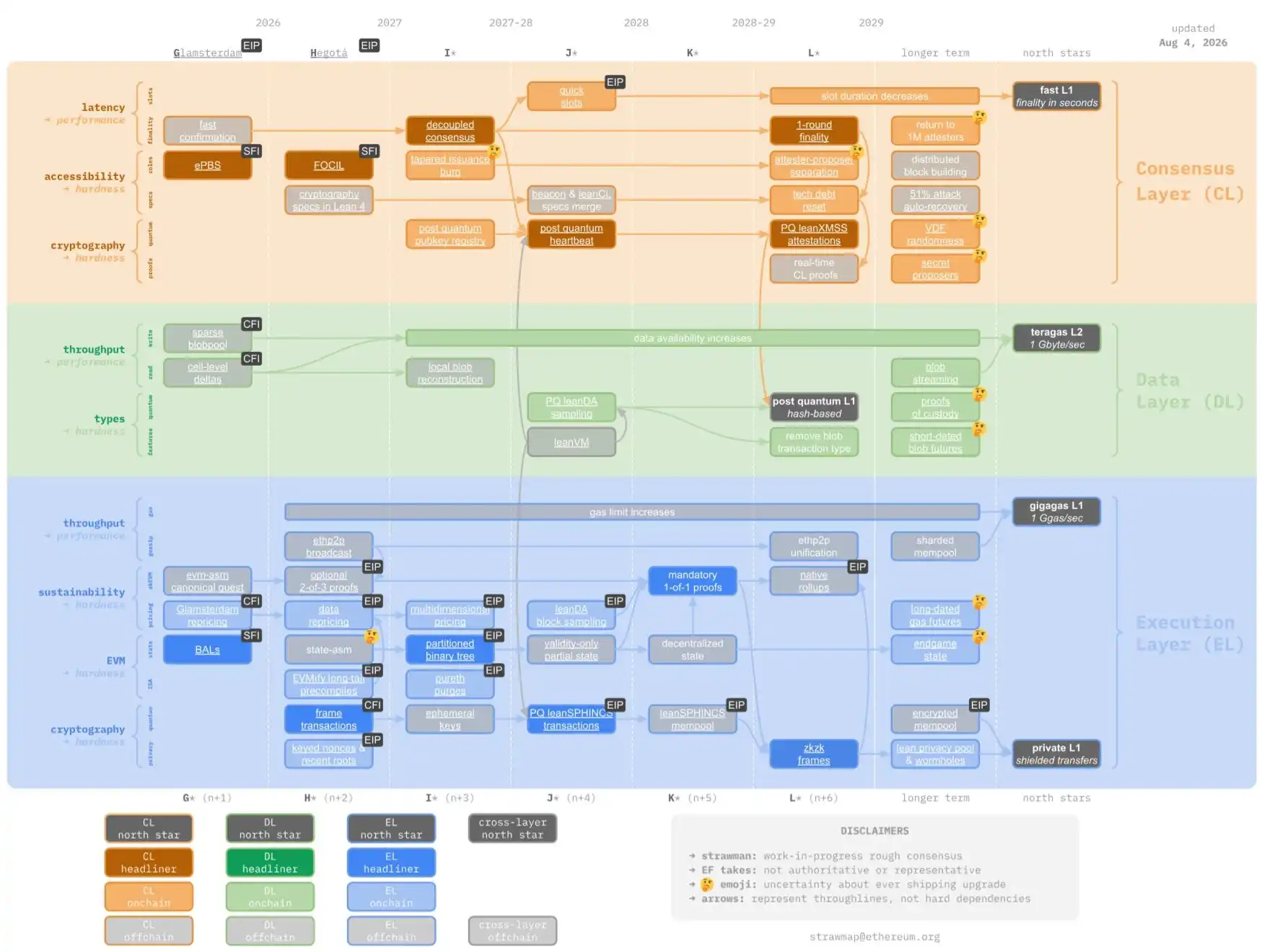
On August 10th, Ethereum co-founder Vitalik Buterin published a comparison overlay of his 2023 technical roadmap with the current Strawmap. He noted that the overall alignment is high, but the priority of some items has been increased (e.g., quantum security), some have been lowered (e.g., VDF, multiple EVM improvements), and some proposals have been replaced by better constructions (e.g., Verkle trees were first replaced by unified binary trees, then by PBT; the state expiry solution was replaced by a new state type).
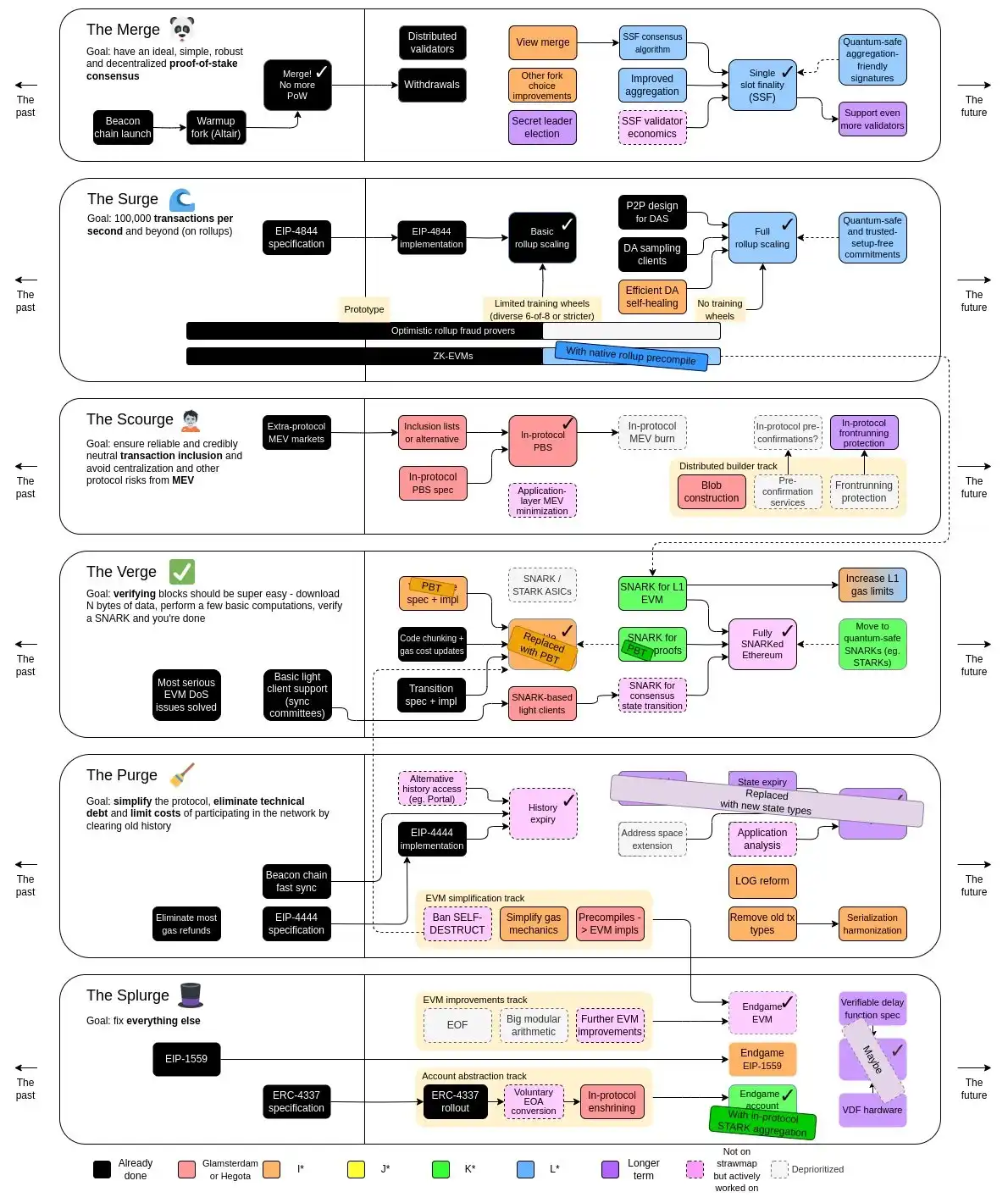
The current roadmap features several entirely new directions not covered at all in 2023, reflecting priority shifts. These include strong privacy protection being listed as a first-class concern for the first time; pursuing aggressive scaling in a post-quantum context; simplifying protocol specifications to assist formal verification (he stated AI has made full formal verification of the entire protocol possible); introducing concepts like block and gas futures; introducing native Rollup (previously SNARK technology was not mature enough); and opening more design space for "the future of EVM," where the protocol may in the future offer users non-EVM instruction set architectures.
Three Proposals to Complete Protocol Capabilities for Private Transfers
Strong privacy protection shows the most significant change. The 2023 roadmap did not cover this group of protocol-level designs, while the current Strawmap elevates privacy L1 to a protocol-level topic. Vitalik mentioned keyed nonces, recent roots, simplified privacy pools, and wormholes as addressing the concurrency, proof verification, shared anonymity set, and fund linking issues of private transactions, respectively.
The EIP-8250 submitted in April allows a shared sending address to use multiple independent nonces, preventing a user's pending transaction from blocking other users in the same privacy protocol. The EIP-8272 submitted in May allows private spending proofs to reference recent commitment tree roots, eliminating the need to read the constantly changing application state during verification. EIP-8182 proposes establishing a protocol-internal privacy pool for ETH and ERC-20 through a system contract, a shared shielding pool, and a separated proof architecture. EIP-8250 and EIP-8272 are currently in Draft, and EIP-8182 is in Review. None have a confirmed activation fork yet.
Currently, privacy applications maintain separate fund pools. Once users and liquidity are split, the anonymity set of a single pool tends to become too small. EIP-8182 aims to concentrate multiple assets into the same set of protocol-internal anonymity sets and add new verification methods through an extensible authorization verification mechanism, reducing the need to split users again during upgrades.
Wormholes correspond to the zero-knowledge burn proof in EIP-7503, where users first transfer ETH to an address that is cryptographically impossible to spend, then use a zero-knowledge proof to re-mint an equivalent amount of ETH, making it difficult for the public chain to link the original transfer to the new address. This proposal is currently Stagnant; its specification and reference implementation need improvement, and there are risks of implementation errors and duplicate minting. Privacy entering the roadmap as a primary goal means Ethereum has begun simultaneously modifying accounts, transaction verification, and base-layer transfers, with several protocol and wallet tasks remaining before default private accounts are realized.
Quantum Migration Covers Four Areas of Cryptography
Vitalik raised the priority of quantum security and proposed continuing scaling under post-quantum conditions. Risks are distributed across the ECDSA signatures used by ordinary accounts, the BLS signatures used by validators, the KZG commitments used for Blob data availability, and the zero-knowledge proof systems adopted by some Rollups and privacy applications. Current quantum computers are not yet capable of breaking this cryptography, but replacing account and validator keys across a global network requires years of preparation.
The latest roadmap lists directions such as leanSPHINCS signature aggregation and zkzk frames, and places recursive STARKs for use across the execution layer, consensus layer, and data layer. STARKs primarily rely on hash functions, which can avoid some quantum risks associated with elliptic curve cryptography and also compress large amounts of computation into proofs that are easier to verify. The Ethereum Foundation has established a dedicated post-quantum team. The current timeline suggests the L1 protocol upgrade could be completed by 2029, while full migration of the execution layer may take several more years, with no fixed completion date.
STARKs are also linked to protocol simplification and formal verification. The Extremely Lean Chain concept proposed by Vitalik in July envisions compressing a single validator's state in the first phase to 6 bytes, further reducing it to 1 byte in the second phase, and having validators update balances and rotate public keys daily via zero-knowledge proofs. Vitalik believes modern AI tools make full-protocol formal verification feasible. Here, AI is used to write and check machine-verifiable mathematical proofs, not to participate in block production, voting, or consensus decisions.
Native Rollup Allows L2 to Reuse Mainnet Validation, Timeline Remains Adjustable
The draft for native Rollup was provided in EIP-8079 submitted in November 2025. Ethereum would expose the mainnet state transition function to the execution layer via an EXECUTE precompile, enabling EVM-equivalent Rollups to reuse L1's validation infrastructure. Rollups currently need to maintain their own proof systems, bridge contracts, and upgrade mechanisms. Nativization could reduce custom verification code and provide conditions for removing security councils. Elements like proof-carrying transactions, ZK verification, and some security designs in EIP-8079 are still marked as pending and have not been included in confirmed mainnet upgrades.
In March, the Ethereum Foundation further clarified the division of labor between L1 and L2, suggesting that L2s wishing to inherit the maximum security of the mainnet could transition to native Rollup, Stage 2, and synchronous composability; L2s providing privacy, application-specific efficiency, or other differentiated features would continue to exist. The roadmap adjustment for native Rollup changes the validation relationship between L2 and the mainnet but does not cancel the multi-chain scaling structure.
The state design is also changing. Vitalik stated that Verkle trees were first replaced by unified binary trees and then shifted to partitioned binary trees (PBT), while state expiry has given way to a new state type. EIP-8347 submitted in July proposes an offline migration to PBT, but the activation fork and anchoring block remain undetermined. Blob and Gas Futures, leanISA or RISC-V and other non-EVM instruction sets have also entered long-term discussions, with deeper EVM modifications not yet mature enough to be written into the Strawmap.
The Strawmap tentatively outlines seven potential upgrades until 2029, arranged in a roughly semi-annual fork rhythm. In May, the Ethereum Foundation disclosed that core developers already consider the year-by-fork annotations post-2026 to be overly deterministic and may tone them down subsequently.
Summary
This update by Vitalik centrally presents the changes in Ethereum's technical priorities. Privacy, post-quantum security, and formal verification have entered the base protocol design, while native Rollup and new state types push the scaling discussion forward into validation mechanisms and state structures. Many proposals are still in Draft, Review, or early research stages. The Strawmap provides dependency relationships and long-term direction and cannot be directly viewed as a launch commitment.
Key questions remain, such as whether the related EIPs can enter specific hard forks, whether complete specifications for post-quantum account and validator migration can be formed, and whether the proof-carrying transaction and ZK verification designs for native Rollup can be completed. Near-term observation points are still the Glamsterdam upgrade in Q4 2026 and the Hegotá upgrade in 2027, whose proposal scope is still being determined.