Wells Fargo and JPMorgan Chase Snap Up Over 10,000 BTC Each in a Single Quarter: Who's Quietly Accumulating in the Bear Market?

marsbitPublished on 2026-08-17Last updated on 2026-08-17

Abstract

Institutional Bitcoin Accumulation Defies Market Downturn in Q2 2026 Despite a 14.2% decline in Bitcoin's price in Q2 2026, institutional holdings in Bitcoin ETFs increased by 7.5%, indicating a significant bullish divergence. While total ETF holdings fell by 6.6%, institutional allocation grew to a record 44.2% of the total. Key players driving this trend include Wells Fargo and JPMorgan, each adding over 10,000 BTC during the quarter. The Abu Dhabi sovereign wealth fund also increased its position. Notably, Ameriprise Financial, a major US wealth manager, entered the market with a new position, signaling Bitcoin's integration into traditional wealth management channels. The total number of institutions reporting Bitcoin holdings via 13F filings decreased slightly by 6.8%, reflecting ongoing market pressures. However, the substantial growth in total institutional BTC held suggests that major players view current price levels as an attractive entry point. This accumulation during a bear market phase is seen as a strong positive signal for a potential market recovery.

Author: Bitcoin Strategy

Translation: TechFlow

TechFlow Insight: Bitcoin fell 14% in Q2, yet institutional 13F holdings increased by 7.5%. Smart money continued to accumulate at the bottom. Wells Fargo and JPMorgan Chase each added over 10,000 BTC in a single quarter, with Abu Dhabi's sovereign fund also following suit. This indicates institutions view current prices as an entry point, providing an important reference for judging the market bottom.

Dear Bitcoin holders,

In this week's Roxom "State of the Bitcoin Market" program, I discussed price action. I categorize this cycle as the institutional adoption and maturity cycle, with the primary catalyst being ETF approval.

We have repeatedly discussed that the main entry points for institutional adoption are ETFs and vault companies.

This is why Bitcoin Strategy publishes a quarterly institutional adoption report based on the latest institutional ETF holdings. The data comes from SEC 13F filings, which are required for institutions managing over $100 million in assets—the so-called "smart money."

Yesterday was the deadline, and the latest data for institutional ETF holdings in the second quarter of 2026 has been released.

In today's briefing, we will discuss the latest insights from these filings, which serve as a proxy indicator for institutional Bitcoin adoption. Let's dive right in!


Institutional Adoption Report: Q2 2026
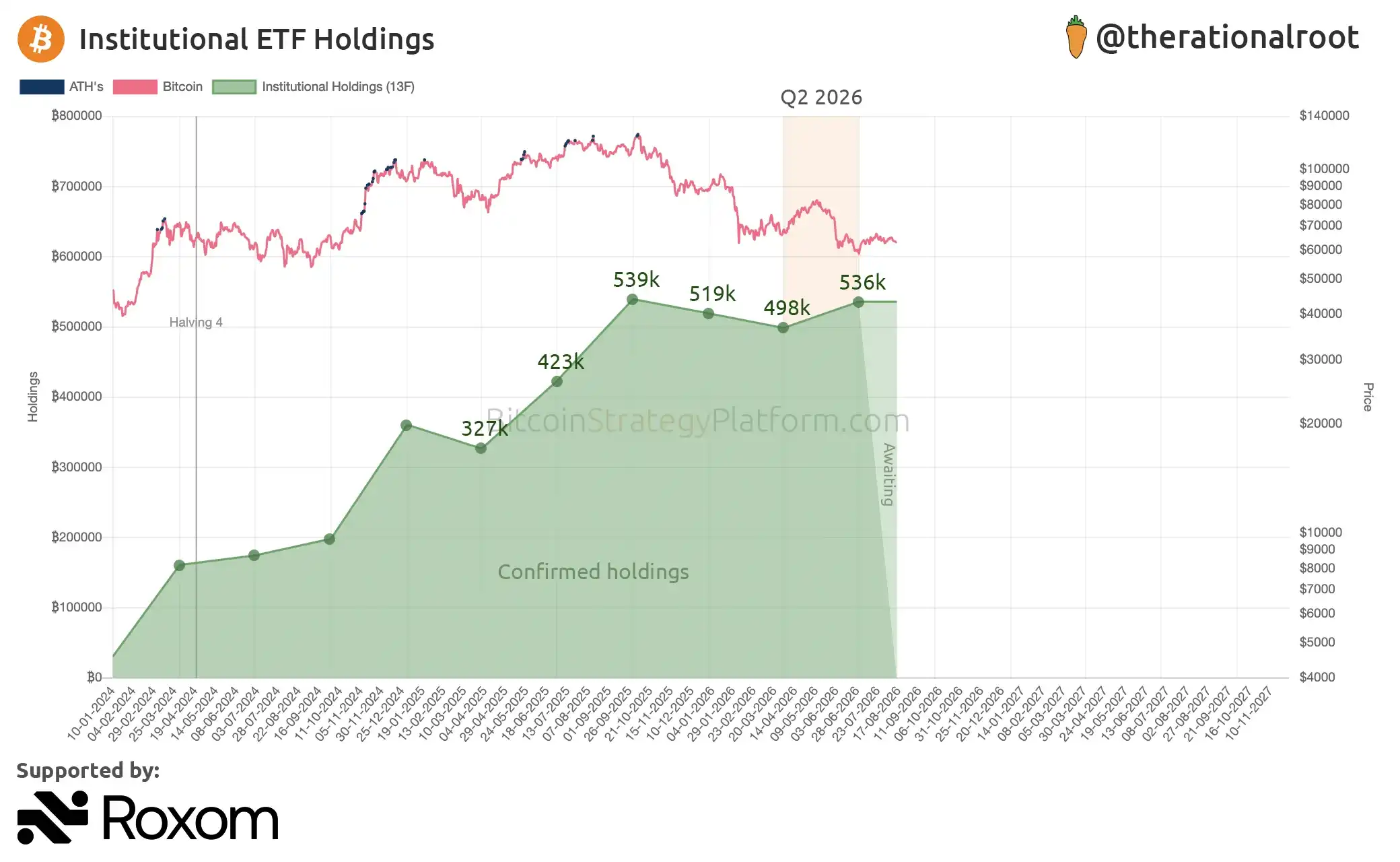
👉 Key Insight: In Q2, the Bitcoin price fell 14.2%, while institutional holdings increased 7.5%. This bullish divergence indicates that institutions continued to accumulate during Bitcoin's bottom formation.


Institutional Share of ETF Holdings
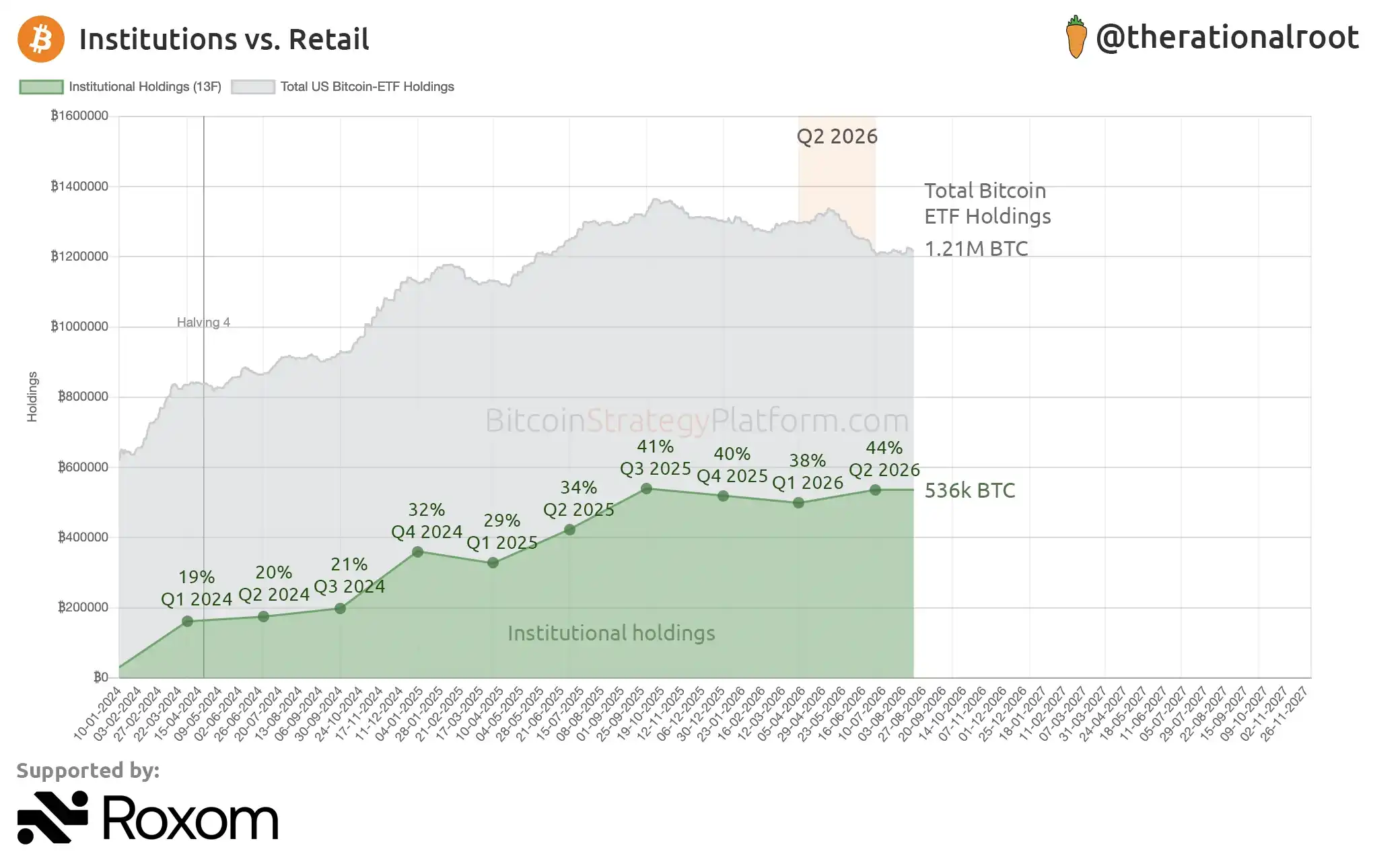
Total ETF holdings decreased from 1,297,010 BTC to 1,211,322 BTC, down 6.6%; while institutional holdings increased from 498,389 BTC to 535,723 BTC, up 7.5%.

👉 Key Insight: Despite the decline in total ETF holdings, institutions increased their positions. The institutional share rose from 38.4% to 44.2%, reaching a new all-time high!


Top 25 ETF Holders

Below are the top 25 institutional Bitcoin ETF holders.
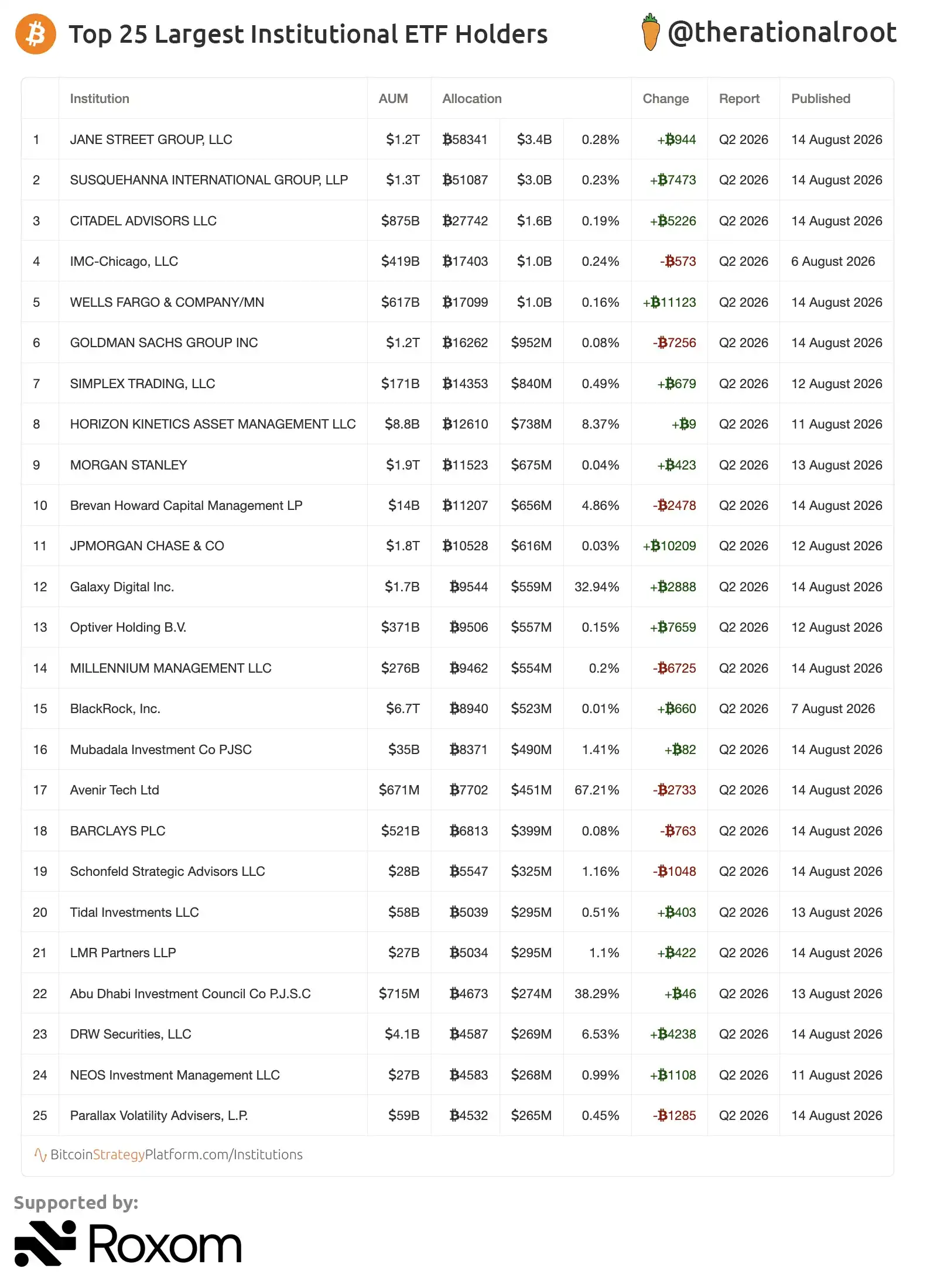
👇 Key Insights:

Seventeen of them increased their positions this quarter.

Both Wells Fargo and JPMorgan Chase added over 10,000 BTC each.

Abu Dhabi's sovereign wealth fund increased its position.


New Entrants

Below is a list of new entrants who initiated positions of 100 BTC or more for the first time.
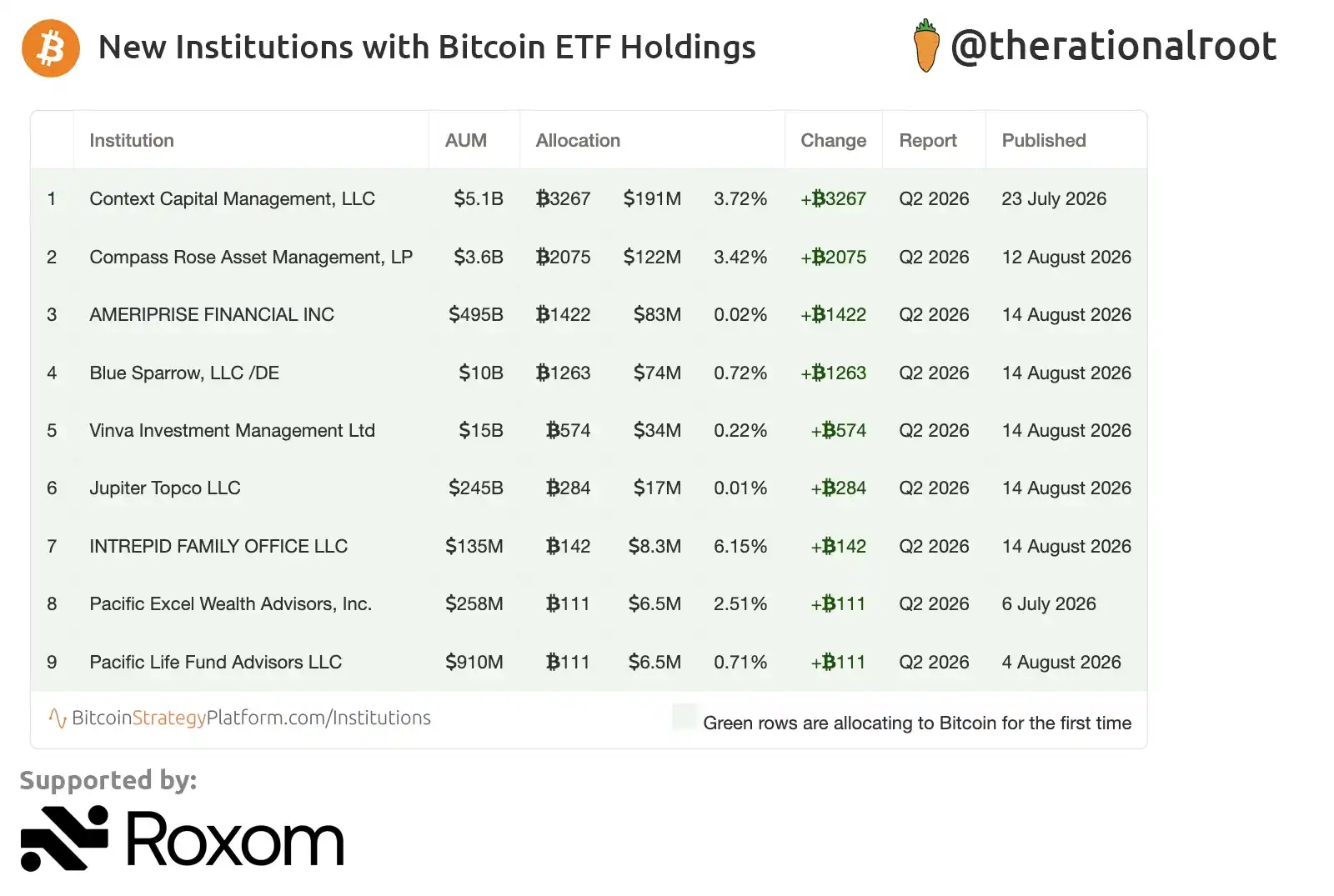
The most notable is Ameriprise, a mainstream U.S. wealth management and financial services firm with over 10,000 financial advisors and approximately $1.7 trillion in assets under management.

This reaffirms that Bitcoin has become a mature institutional-grade asset and is gradually being integrated into traditional wealth management through financial advisors. This is a very positive development.

Other new entrants are primarily hedge funds and investment management firms, with Context Capital Management and Compass Rose Asset Management making the largest new allocations at $191 million and $122 million, respectively. While the names may not be as prominent, these are still substantial new positions and a positive sign of continued institutional adoption growth.


Number of Institutions
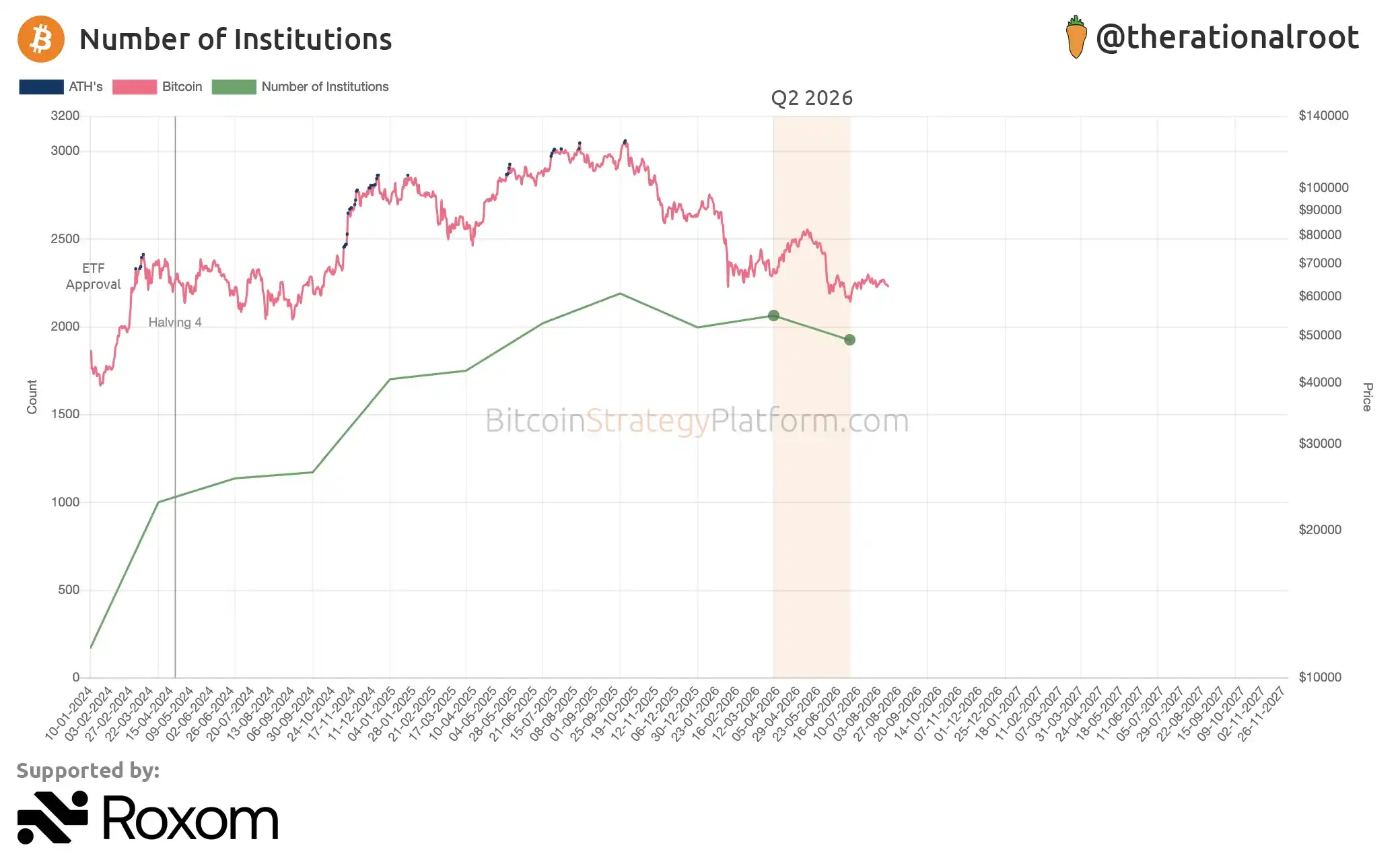
The number of institutions reporting Bitcoin holdings via 13F filings decreased from approximately 2,000 in Q1 to nearly 1,900 in Q2, a decline of 6.8%.

This indicates the bear market is still quite brutal. Despite the overall increase in institutional holdings, some institutions were still forced out or became fearful.


Conclusion

This institutional data truly exceeded my expectations. Given the bear market phase and price action, I did not anticipate seeing such significant growth. Total institutional holdings have nearly surpassed the numbers we saw at the cycle peak.

This confirms that institutions view current prices as an attractive entry point. Combined with the recovery following recent digital credit stress tests, the possibility of a rebound has increased.

I hope you can appreciate this bullish divergence! As always, I strive to provide you with the best data and insights. I would love to see your comments and thoughts. 👊 🧡

See you next week, 🫡

Trending Cryptos

Related Questions

QAccording to the article, what key divergence signals that institutions are accumulating Bitcoin during a perceived bottom?

AThe article highlights a bullish divergence where the Bitcoin price fell by 14.2% in Q2, while institutional holdings in ETFs increased by 7.5%. This indicates institutions are accumulating during price weakness.

QWhich two major financial institutions added over 10,000 BTC each in a single quarter, as per the Q2 2026 data?

AWells Fargo and JPMorgan Chase each added over 10,000 BTC to their holdings in the second quarter of 2026.

QWhat significant development does the entry of Ameriprise into Bitcoin ETFs represent, according to the author's analysis?

AAmeriprise's entry signifies Bitcoin's maturation into an institutional-grade asset and its gradual integration into traditional wealth management portfolios through financial advisors.

QDespite an increase in total institutional BTC holdings, what metric decreased in Q2 2026, and what does the author suggest this indicates about the market?

AThe number of institutions reporting Bitcoin holdings via 13F filings decreased by 6.8%, from about 2,000 to nearly 1,900. The author suggests this shows the bear market remains brutal, forcing or frightening some institutions to exit.

QWhat overall conclusion does the author draw about institutional sentiment from the Q2 2026 data on Bitcoin ETF holdings?

AThe author concludes that institutions view the current price levels as an attractive entry point. The strong growth in holdings during a bear market confirms their positive long-term sentiment and increases the likelihood of a market recovery.

Related Reads

Report on the State of the Crypto Industry by 2026, Featuring Sumsub Vice President for North America, Danielle LaBarbera

The cryptocurrency industry is entering an era of regulated maturity, driven by frameworks like the CLARITY Act and the $GENIUS Act in the US. These provide clearer rules but also raise operational standards, requiring platforms to effectively demonstrate compliance. Simultaneously, fraud is evolving into sophisticated, AI-powered, lifecycle-based attacks, moving beyond simple onboarding scams. According to Daniel LaBarbera, VP of Sumsub for North America, companies must shift from one-time KYC checks to continuous, risk-based verification. This involves integrating identity, behavioral, device, and transaction data into a unified risk view. The 2026 State of Crypto Industry report highlights that while 55% of crypto firms faced fraud last year, effective strategies now combine AI-driven detection, continuous monitoring, and behavioral analytics. Key compliance challenges persist, particularly with the Travel Rule. Only 23% of companies are fully compliant, with high implementation costs, data security concerns, and regulatory fragmentation being major hurdles. Meanwhile, stablecoins are gaining traction, accounting for 36% of all crypto transactions in 2025, and evolving from trading tools into financial infrastructure for payments and settlements. The path forward lies in risk-based approaches that balance security, speed, and user experience. This includes adopting documentless verification, reusable KYC, and breaking down silos between compliance functions to create a holistic, lifecycle view of customer risk and trust.

cryptonews.ru12m ago

Report on the State of the Crypto Industry by 2026, Featuring Sumsub Vice President for North America, Danielle LaBarbera

cryptonews.ru12m ago

U.S. National Debt Approaches $40 Trillion in 5 Months, Bitcoin Debate Gains Momentum

The US national debt has surged to nearly $40 trillion in just five months, the fastest trillion-dollar increase on record. The debt's growth has accelerated dramatically over time, from taking 192 years to reach the first $1 trillion in 1981 to adding the latest $1 trillion in only five months. The federal budget deficit for the fiscal year is already over $1.8 trillion, exceeding last year's total, and net interest payments on the debt have surpassed $1 trillion, now exceeding defense or Medicare spending. This rapid debt accumulation is fueling arguments within the cryptocurrency industry that Bitcoin serves as a hedge against government-backed currencies and fiscal irresponsibility. Proponents, including some lawmakers and industry leaders, argue Bitcoin could act as a "hard currency" fiscal control mechanism. Legislation has even been proposed for the Treasury to acquire Bitcoin to help reduce the national debt. The International Monetary Fund has warned that global public debt could hit 100% of world GDP by 2029 if current trends continue, with the US and China as primary drivers. Some analyses suggest a sovereign debt crisis could drive capital into alternative assets like Bitcoin, similar to past regional banking crises. However, skeptics point out that both Bitcoin and gold have fallen in price at times during 2026 despite record debt, indicating the depreciation hedge theory may operate over a much longer timeframe than short-term price action.

cryptonews.ru21m ago

U.S. National Debt Approaches $40 Trillion in 5 Months, Bitcoin Debate Gains Momentum

cryptonews.ru21m ago

Technological Self-Reliance in China: A War from Lithography Machines to ABF Films

"China's Tech Independence: A Battle from Lithography Machines to ABF Film" In August 2026, Japan's Ajinomoto announced a 30% supply cut of ABF film to Chinese mainland clients, causing industry-wide shock and fears of price hikes and shortages in the semiconductor supply chain. That same year, Chinese company Lotus Holdings, known for its MSG business, acquired a small domestic ABF film startup for 103 million yuan, aiming to change this passive situation. ABF film is a core insulating material for advanced CPU, GPU, and AI chip packages. Ajinomoto, originally a food flavoring company, has monopolized over 95% of the global ABF film market for nearly 30 years, deriving its technology from byproducts of monosodium glutamate production. With AI chips consuming 5-10 times more ABF film than traditional chips, the supply-demand gap is widening. Ajinomoto's supply cut to China, where domestic ABF film production accounts for less than 5%, directly threatens the production of domestic high-end AI chips and their substrates. This incident highlights a crucial but often overlooked truth: the vulnerabilities in China's quest for technological self-reliance extend beyond headline areas like lithography machines to critical but seemingly minor components—insulating films, photoresists, electronic specialty gases, etc. The article frames China's tech independence as a multi-front war. While major breakthroughs have been achieved in chip design (e.g., Huawei's HiSilicon), foundry (e.g., SMIC), and memory chips (e.g., YMTC), countless smaller "Ajinomoto-style" chokepoints remain. Lotus Holdings' acquisition represents a significant shift: the battle is no longer fought only by tech giants but has become a collective, industry-wide effort involving companies from diverse backgrounds. Historically, external blockades have often spurred China's technological breakthroughs, as seen with Huawei's Kirin chips and YMTC's 3D NAND flash memory. Ajinomoto's supply cut, while a short-term challenge, may similarly catalyze domestic innovation in ABF film and other critical materials. The path to technological sovereignty is long and arduous, requiring sustained patience and investment to fill every gap in the complex supply chain. Lotus's move is not an immediate solution but a step towards that future, symbolizing a broader, relentless march toward independence.

marsbit41m ago

Technological Self-Reliance in China: A War from Lithography Machines to ABF Films

marsbit41m ago

Trading

Spot

Hot Articles

What is $BITCOIN

DIGITAL GOLD ($BITCOIN): A Comprehensive Analysis Introduction to DIGITAL GOLD ($BITCOIN) DIGITAL GOLD ($BITCOIN) is a blockchain-based project operating on the Solana network, which aims to combine the characteristics of traditional precious metals with the innovation of decentralized technologies. While it shares a name with Bitcoin, often referred to as “digital gold” due to its perception as a store of value, DIGITAL GOLD is a separate token designed to create a unique ecosystem within the Web3 landscape. Its goal is to position itself as a viable alternative digital asset, although specifics regarding its applications and functionalities are still developing. What is DIGITAL GOLD ($BITCOIN)? DIGITAL GOLD ($BITCOIN) is a cryptocurrency token explicitly designed for use on the Solana blockchain. In contrast to Bitcoin, which provides a widely recognized value storage role, this token appears to focus on broader applications and characteristics. Notable aspects include: Blockchain Infrastructure: The token is built on the Solana blockchain, known for its capacity to handle high-speed and low-cost transactions. Supply Dynamics: DIGITAL GOLD has a maximum supply capped at 100 quadrillion tokens (100P $BITCOIN), although details regarding its circulating supply are currently undisclosed. Utility: While precise functionalities are not explicitly outlined, there are indications that the token could be utilized for various applications, potentially involving decentralized applications (dApps) or asset tokenization strategies. Who is the Creator of DIGITAL GOLD ($BITCOIN)? At present, the identity of the creators and development team behind DIGITAL GOLD ($BITCOIN) remains unknown. This situation is typical among many innovative projects within the blockchain space, particularly those aligning with decentralized finance and meme coin phenomena. While such anonymity may foster a community-driven culture, it intensifies concerns about governance and accountability. Who are the Investors of DIGITAL GOLD ($BITCOIN)? The available information indicates that DIGITAL GOLD ($BITCOIN) does not have any known institutional backers or prominent venture capital investments. The project seems to operate on a peer-to-peer model focused on community support and adoption rather than traditional funding routes. Its activity and liquidity are primarily situated on decentralized exchanges (DEXs), such as PumpSwap, rather than established centralized trading platforms, further highlighting its grassroots approach. How DIGITAL GOLD ($BITCOIN) Works The operational mechanics of DIGITAL GOLD ($BITCOIN) can be elaborated on based on its blockchain design and network attributes: Consensus Mechanism: By leveraging Solana’s unique proof-of-history (PoH) combined with a proof-of-stake (PoS) model, the project ensures efficient transaction validation contributing to the network's high performance. Tokenomics: While specific deflationary mechanisms have not been extensively detailed, the vast maximum token supply implies that it may cater to microtransactions or niche use cases that are still to be defined. Interoperability: There exists the potential for integration with Solana’s broader ecosystem, including various decentralized finance (DeFi) platforms. However, the details regarding specific integrations remain unspecified. Timeline of Key Events Here is a timeline that highlights significant milestones concerning DIGITAL GOLD ($BITCOIN): 2023: The initial deployment of the token occurs on the Solana blockchain, marked by its contract address. 2024: DIGITAL GOLD gains visibility as it becomes available for trading on decentralized exchanges like PumpSwap, allowing users to trade it against SOL. 2025: The project witnesses sporadic trading activity and potential interest in community-led engagements, although no noteworthy partnerships or technical advancements have been documented as of yet. Critical Analysis Strengths Scalability: The underlying Solana infrastructure supports high transaction volumes, which could enhance the utility of $BITCOIN in various transaction scenarios. Accessibility: The potential low trading price per token could attract retail investors, facilitating wider participation due to fractional ownership opportunities. Risks Lack of Transparency: The absence of publicly known backers, developers, or an audit process may yield skepticism regarding the project's sustainability and trustworthiness. Market Volatility: The trading activity is heavily reliant on speculative behavior, which can result in significant price volatility and uncertainty for investors. Conclusion DIGITAL GOLD ($BITCOIN) emerges as an intriguing yet ambiguous project within the rapidly evolving Solana ecosystem. While it attempts to leverage the “digital gold” narrative, its departure from Bitcoin's established role as a store of value underscores the need for a clearer differentiation of its intended utility and governance structure. Future acceptance and adoption will likely depend on addressing the current opacity and defining its operational and economic strategies more explicitly. Note: This report encompasses synthesised information available as of October 2023, and developments may have transpired beyond the research period.

1.9k Total ViewsPublished 2025.05.13Updated 2025.05.13

What is $BITCOIN

Discussions

Welcome to the HTX Community. Here, you can stay informed about the latest platform developments and gain access to professional market insights. Users' opinions on the price of BTC (BTC) are presented below.

活动图片