Wall Street Morning News: S&P and Dow Hit New Highs, Philadelphia Semiconductor Index and Chip Stocks Rise for 4th Straight Day, SanDisk and Intel Surge Over 10%, Micron's Market Cap Returns to $1 Trillion

marsbitPublished on 2026-08-05Last updated on 2026-08-05

Abstract

U.S. stocks surged to record highs driven by strong earnings and easing Middle East tensions. The Dow Jones and S&P 500 both hit closing records, with the Nasdaq jumping 2.59%. The Philadelphia Semiconductor Index soared 6.55%, marking four straight days of gains, fueled by a broad AI rally spanning chips, software, and infrastructure. SanDisk and Intel surged over 10%, while Micron's market cap returned to the $1 trillion level. Geopolitical optimism weighed on oil, with WTI crude falling over 5%. Reports indicated the U.S., Iran, and Oman are nearing a temporary deal to reopen the Strait of Hormuz, alleviating supply disruption fears and lowering September Fed rate hike probabilities. Key stock movers included Palantir, up 29.45% on explosive revenue growth; Caterpillar, hitting a record high on raised guidance linked to data center demand; and AMD, rising 7% despite a post-earnings dip. Nvidia gained 2.56% after announcing new open-source models and securing an exclusive AI partnership with SpaceX. However, Oracle faces heightened credit risk due to heavy AI-related borrowing. Markets now focus on upcoming earnings from Uber and Eli Lilly, and a major SpaceX share lockup expiry on August 6th.

Published every Monday to Friday morning, focusing on macroeconomics, U.S. stocks, AI, precious metals, crude oil, and other directions. We review the market with data and seize opportunities with trends, produced by PANews.
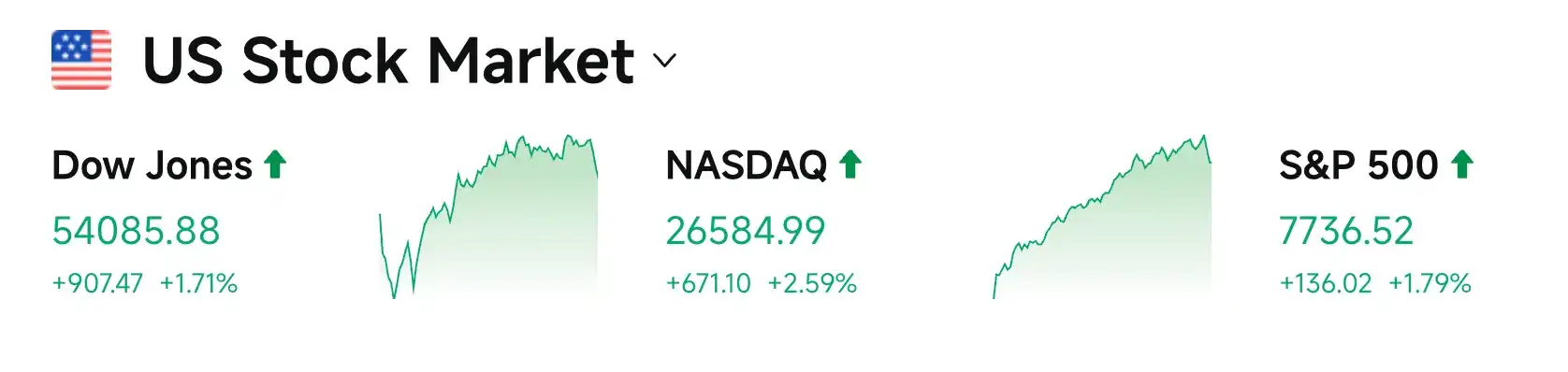
U.S. stocks soared across the board last night, driven by robust corporate earnings and geopolitical optimism. The Dow Jones Industrial Average surged 1.71%, breaking above 54,000 points for the first time and hitting a record closing high. The S&P 500 index rose 1.79%, also setting a new record. The Nasdaq Composite jumped 2.59%, led by the tech sector. Market sentiment swiftly shifted from recent volatility to a chase for gains, rallying from a near one-month low to new highs in just a few trading sessions.

Strait of Hormuz Agreement Nears Finalization, Oil Prices Fall for 3rd Straight Day

The most watched macroeconomic event is signs of easing tensions in the Strait of Hormuz. According to Axios, the U.S., Iran, and Oman are close to reaching an interim agreement, aiming for a formal announcement on Wednesday local time. The agreement aims to reopen the Strait of Hormuz, restore the U.S.-Iran ceasefire, and create conditions for subsequent nuclear talks. Influenced by this geopolitical positive development, concerns about energy supply disruptions eased, and international oil prices plunged sharply. WTI crude fell 5.58% yesterday, down 13.27% in August, currently fluctuating around $73.5; Brent crude broke below $80, hitting a low of $77.7, down about 12% this month.

The arrangement is tentatively set for 60 days and may be extended in the future. According to the currently discussed plan, all inbound vessels will use the northern shipping lane near the Iranian coast, and outbound vessels will use the southern lane near the Omani coast, coordinated jointly by Oman and Iran.

The agreement also includes a crucial component: parties plan to complete mine-clearing operations in the central channel of the Strait of Hormuz within 30 days. According to Bloomberg, Iran's stance has softened, now for the first time considering allowing European countries to participate in mine-clearing, in exchange for trust from shipping companies and insurers. No passage fees or related charges will be levied during the 60-day interim arrangement. In the long term, Oman proposes referencing the Strait of Malacca model, establishing a "voluntary fund" jointly financed by Gulf states and European member states of the International Maritime Organization (IMO) for channel maintenance, search and rescue, and security. Besides Oman, Qatar, Pakistan, and Saudi Arabia have also participated in mediation.

Despite rapid progress, the agreement still faces multiple uncertainties. Hardliners within Iran's Revolutionary Guards still have disagreements over foreign participation in mine-clearing and channel control rights, and there are precedents of agreements collapsing leading to escalated military conflict.

Falling Oil Prices Ease Inflation Concerns, September Rate Hike Probability Declines

The sharp drop in oil prices significantly eased inflation concerns. The 10-year U.S. Treasury yield fell about 6 basis points to near 4.6%, providing additional support for risk assets. Institutions like Wells Fargo noted that lower oil prices help moderate energy price pressures, but overall price stickiness persists, and inflation is unlikely to normalize overnight.
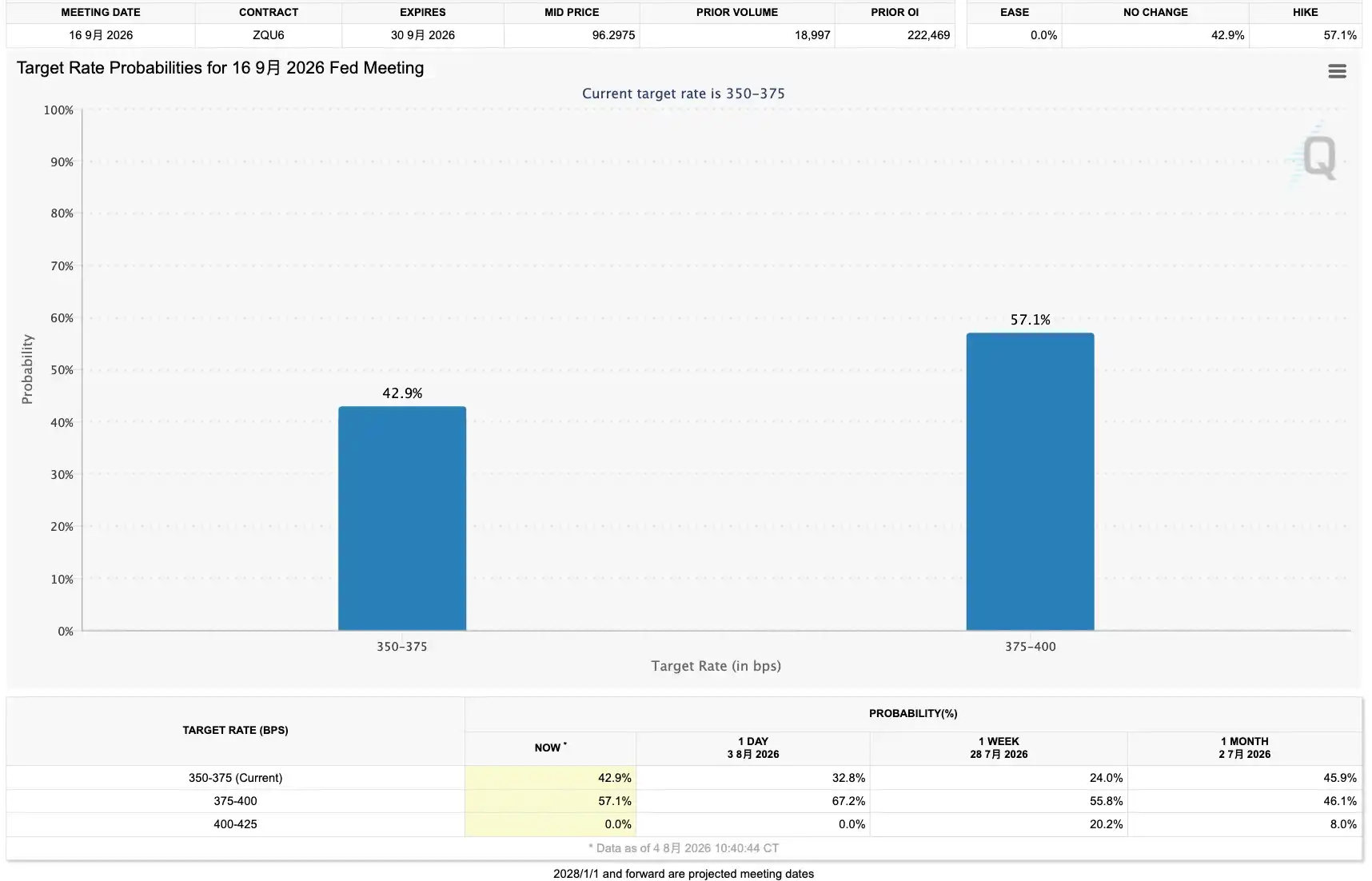
The U.S. dollar weakened slightly, and the yen's rally stalled. Regarding interest rates and institutional views, the CME FedWatch Tool shows that the probability of a 25 basis point rate hike in September is about 57.1%, down sharply from 67.2% the previous day, while the probability of holding steady is 42.9%. The market is closely watching this Friday's non-farm payrolls report. Strong data could reinforce rate hike expectations, while weak data could increase room for inaction. Institutions like JPMorgan believe that in a context where oil prices dominate Treasury movements, employment data will become a key short-term pricing node.

AI Trading Makes a Comeback, Funds Believe in the 'Computing Power-Application-Infrastructure' Loop Again

The strongest sector in U.S. stocks last night was still AI. Unlike previous rallies solely reliant on chip stocks, this AI market move is more comprehensive: Palantir used strong earnings to prove AI applications can drive revenue growth; semiconductor, memory, and optical communication sectors reflect rising computing power demand; Caterpillar shows data center construction demand is trickling down to traditional industrial equipment.

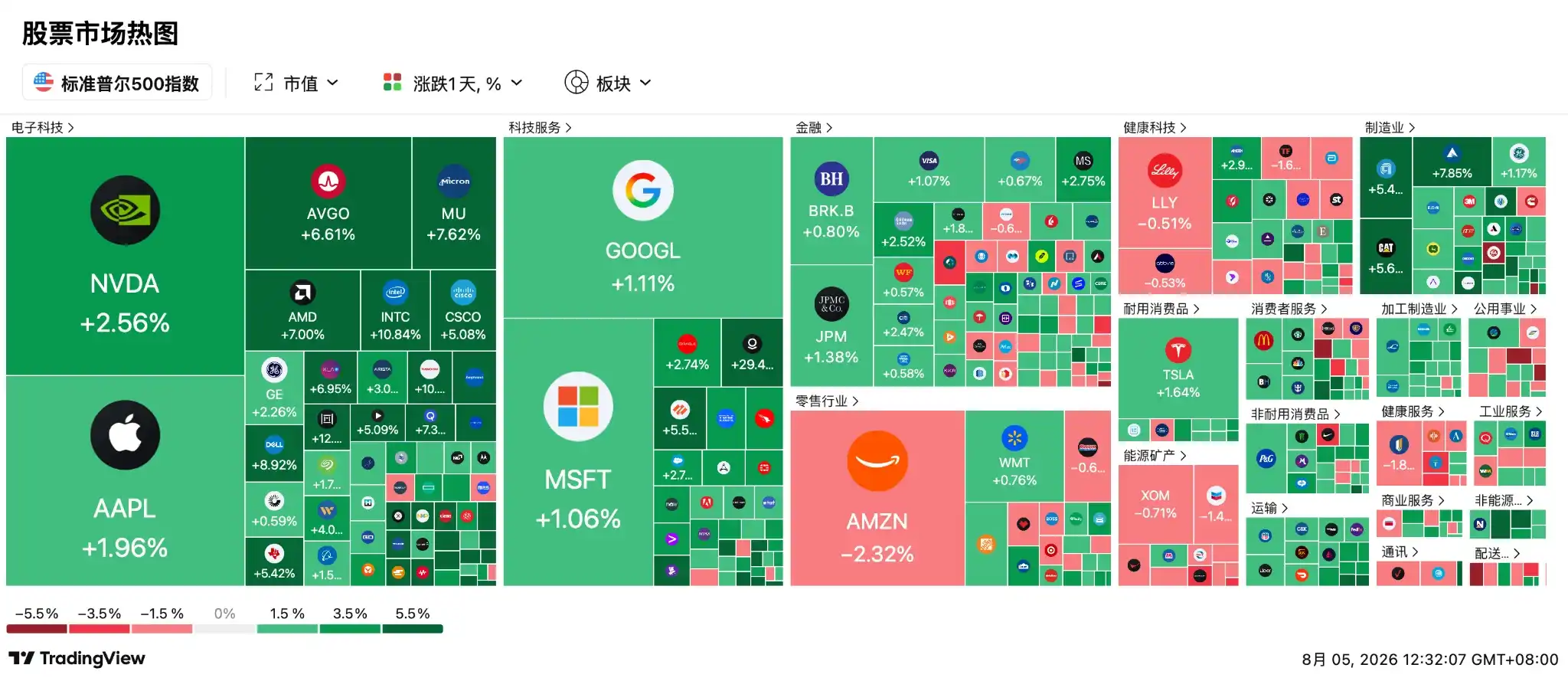
The Philadelphia Semiconductor Index surged 6.55%, rising for the fourth consecutive day, with 30 component stocks broadly higher. Memory chips, optical communication, AI software, data center infrastructure, and industrial equipment sectors performed notably well. The Nasdaq 100 index rose about 3.3% in a single day, its largest single-day gain since May 2025.

Major tech stocks were also generally stronger. Nvidia rose over 2%, Apple, Microsoft, and Tesla rose over 1%, Google rose 1.11%, but Amazon fell over 2%. Over the past four trading days, the "Magnificent Seven" tech giants have collectively risen nearly 10%, indicating funds are flowing back into large-cap growth stocks.

Peter Callahan, Goldman Sachs' chief tech trader, believes this rally stems from four factors: the market has already undergone a round of de-risking earlier, leaving cleaner positioning; technicals have improved; the Nasdaq 100 valuation is still at about a 10% discount to its five-year average; the earnings season has improved investor confidence in profits.

However, Goldman's trading desk also cautioned that market trading volume is about 7% below the 5-day average, indicating not exceptionally high activity. This means that while the index rally is strong, not all funds have fully returned yet. Future moves still depend on whether earnings and macro data can continue to support the uptrend.

Specific Company Actions and Stock Price Movements:
  • Palantir closed up 29.45%, strongly breaking above its 200-day moving average: The company's Q2 revenue soared 93% year-over-year to $1.935 billion, with U.S. commercial revenue surging 149%. CEO Alex Karp called this a "supernatural" quarter and stated that demand for AI sovereignty is being unleashed. Related AI software stocks also rose, Datadog and Shopify rose over 5%, ServiceNow and Applovin rose over 3%, Adobe and Salesforce rose over 2%.

  • Caterpillar surged over 5%, hitting a record high: This heavy equipment giant's Q2 sales broke the $20 billion mark for the first time (up 24% year-over-year) and it comprehensively raised its full-year guidance. Wells Fargo strategist Ohsung Kwon pointed out that Caterpillar is "the most traditional stock close to the AI concept," and the spillover benefits from data center construction have just begun. The industrial sector has performed strongly this year, rising about 20%.

  • SpaceX closed up 9.43%, after-hours fell nearly 9% due to high capex concerns: Yesterday, Musk confirmed AI services will exclusively adopt Nvidia architecture and set sights on the U.S. telecom market. Space-related stocks rose broadly, Rocket Lab rose nearly 6% (won a $397 million contract from the U.S. Space Force), AST SpaceMobile rose nearly 11%. The after-hours Q2 earnings report showed revenue of $7.8 billion, up 92% year-over-year, EBITDA surged, but AI-related capital expenditures reached $15.8 billion, expected to remain high in subsequent quarters.

  • AMD closed up 7%, after-hours fell nearly 8%: CEO Lisa Su expects data center sales to double by 2027 and announced collaborations with Anthropic and others. Semiconductor sector surged, ARM surged 17.36%, Marvell Technology rose nearly 13%, Intel rose nearly 11%, Qualcomm rose 7.23%, Broadcom rose nearly 7%, TSMC rose over 2%. After-hours Q2 earnings showed revenue of $11.54 billion, up 50% year-over-year, beating expectations, but Q3 revenue guidance didn't completely "wow" the market.

  • Nvidia closed up 2.56%: Nvidia CEO Jensen Huang announced the official open-source commercial release of Alpamayo 2 Super, Nvidia's open-source inference model for autonomous driving, aiming to advance applications like robotaxis, robots, and logistics vehicles. Concurrently, SpaceX stated future AI services will be "exclusively" based on Nvidia systems and plans to deploy Nvidia Vera Rubin NVL72 rack-scale systems on the ground and in space.

  • Micron Technology closed up 7.62%, market cap returned to the $1 trillion club: Bank of America reiterated a Buy rating and a $1,550 target price, viewing the recent pullback as an "excellent buying opportunity," and expects memory chip prices to normalize in 2027-2028. Memory sector rose across the board, SanDisk rose 10.84% (jointly released the first standard specification for High Bandwidth Flash HBF with SK Hynix), Rambus rose over 9%, SK Hynix rose over 8%, Western Digital rose over 4%.

  • Intel closed up 10.84%: Media reports indicated Intel's EMIB-T advanced packaging technology has made progress, with packaging yields nearing 90% and costs about 50% lower than TSMC's CoWoS solution. Intel expects to offer this packaging service at scale by 2027, while continuing to advance construction of its large Ohio wafer fab campus, targeting full operation by 2031.

  • Oracle closed up 2.74%: However, its stock price has been halved since June, its five-year credit default swap spread has surged to a historical high exceeding the peak of the 2008 financial crisis. Due to aggressive borrowing to fund AI data center construction, its current debt stands at $129.5 billion. S&P Global has downgraded its credit rating to BBB-, just one notch above "junk" grade. Moody's warned its leverage ratio may approach 5x, and the market is deeply concerned about the mismatch risk between its 15-year long-term leases and short-term AI contracts.

  • Bitdeer surged 23% intraday before closing up 0.09%: Bitdeer signed a 16-year data center hosting and services agreement with Norwegian cloud startup Volta Infra for deploying Nvidia GPUs and serving leading AI labs. Concurrently, Anthropic was reported to have reached a $100 billion, six-year computing power agreement with Volta.

  • Arista Networks (ANET) closed up 3.04%, after-hours surged 12.5%: Supported by AI networking demand, Q2 revenue slightly exceeded $3 billion, up 37.7% year-over-year, and the company raised its 2026 guidance for the third time, expecting full-year revenue of $12.6 billion, an annual growth rate of about 40%.

  • Apple rose nearly 2%: Apple has begun preparations for its September launch event, with U.S. retail employees able to apply for on-site work. The event is expected in the first half of September. Separately, Apple reportedly requested a judge to immediately ban OpenAI from using its trade secrets and demanded OpenAI return all confidential information.

Upcoming Focus:

August 5th Major Earnings: Circle, Uber, Eli Lilly, BeiGene, etc.

August 6th (Thursday)

  • SpaceX Lock-up Expiration: Up to 911.5 million restricted shares of SpaceX will be unlocked, with a potential value nearing $100 billion based on the latest stock price, representing the week's biggest liquidity pressure test. If selling pressure is limited post-expiration, it will boost market confidence in the capacity to absorb high-valuation tech assets; if concentrated selling emerges, it could dampen sentiment for the Nasdaq and Musk-related assets.

  • 05:00 SanDisk, Western Digital After-Hours Earnings: Will directly influence sentiment in the memory sector. Following recent consecutive pullbacks in Micron, SanDisk, and SK Hynix, the market will closely focus on enterprise SSD, NAND prices, AI data center storage demand, inventory cycles, and H2 guidance.

Trending Cryptos

Related Questions

QWhat were the main reasons for the sharp rise in US stock markets last night?

AThe primary drivers for the sharp rise in US stock markets last night were strong corporate earnings and optimism surrounding a potential geopolitical agreement regarding the Strait of Hormuz.

QWhat was the projected probability of a Fed rate hike in September according to the CME FedWatch Tool, and how did it change?

AAccording to the CME FedWatch Tool, the probability of a 25-basis-point Fed rate hike in September was approximately 57.1%, which was a significant decrease from 67.2% the previous day.

QWhich company reported a 93% year-over-year revenue surge and saw its stock price jump nearly 30%?

APalantir reported a 93% year-over-year revenue surge to $1.935 billion for Q2, and its stock price closed up 29.45%.

QWhat key development was reported regarding the EMIB-T advanced packaging technology?

AIntel's EMIB-T advanced packaging technology has reportedly made progress, nearing 90% packaging yield with costs approximately 50% lower than TSMC's CoWoS solution. Intel expects to offer this packaging service on a large scale by 2027.

QWhat major liquidity event for SpaceX is scheduled for August 6th (Thursday)?

AOn August 6th, up to 911.5 million restricted shares of SpaceX are scheduled to be unlocked, potentially representing nearly $100 billion in value. This event is considered a significant liquidity stress test for the week.

Related Reads

Arthur Hayes' 10,000-Word New Article: When Will the AI Wave Peak? Will the Bubble Burst? Why Am I Fiercely Buying ETH?

In his latest essay, "When Will the AI Wave Peak? Will the Bubble Burst? Why Am I Loading Up on ETH?", crypto veteran Arthur Hayes presents a contrarian thesis on the AI investment boom, framing it as an impending credit bubble rather than a tech growth story. Hayes argues that massive AI infrastructure spending (AI CAPEX) is fundamentally a real estate play—building data centers—disguised as high-growth technology. This misclassification leads to dangerous capital misallocation. He predicts the bubble is a credit bubble akin to the 2008 financial crisis, not an earnings bubble like the 2000 dot-com bust. The turning point will not be AI companies failing to profit, but a slowdown in the growth rate of data center construction, which will cause over-leveraged players to falter. He anticipates AI CAPEX growth will slow by mid-to-late 2027, entering a "slowdown phase" in 2028. However, credit will continue flowing due to profitable lending, government pressure, and implicit bailout guarantees. This creates a period of misallocation where credit exceeds valuable projects. Hayes draws parallels to the 2006-2007 housing market "no man's land." Governments, particularly the US, will inevitably print money to bail out the system, possibly through direct equity purchases via SPVs—a form of "Equity QE." This massive future liquidity injection, exceeding the 2008 crisis response, will ultimately flow into crypto, specifically Bitcoin, potentially driving it past $1 million. Regarding the current crypto market, Hayes believes the AI boom has sucked away liquidity, contributing to Bitcoin's correction. He expects Bitcoin to bottom as AI capital misallocation accelerates, with the excess fiat liquidity eventually fueling its next bull run. Finally, Hayes reveals a major personal trade: aggressively accumulating ETH. He targets $5,000 by end-2026, betting on a new narrative where Ethereum becomes the settlement layer for TradFi RWA tokenization, citing projects like Robinhood using Arbitrum L2s as a catalyst. He views ETH as a hated, high-Lindy asset with strong liquidity, presenting an asymmetric opportunity.

Odaily星球日报57m ago

Arthur Hayes' 10,000-Word New Article: When Will the AI Wave Peak? Will the Bubble Burst? Why Am I Fiercely Buying ETH?

Odaily星球日报57m ago

Stunning, Musk Joins Forces with Huang Jen-hsun to Deploy the Stellar Brain! AI Computing Center Launched into Space

SpaceX, in its first public earnings report, has announced a partnership with NVIDIA to launch Starmind, an orbital AI computing network. This initiative aims to move AI's computational foundation into space to solve the critical challenges of energy consumption and heat dissipation faced by terrestrial data centers. The core concept involves deploying data centers equipped with NVIDIA's advanced GPUs (like the upcoming Rubin) into sun-synchronous orbit. Key advantages include near-continuous solar power for energy, the vacuum of space for highly efficient radiative cooling, and the absence of terrestrial constraints like land use and grid capacity. The first computational node, the Starmind AI1 satellite, is described as a massive vehicle with a 75-meter wingspan, generating 210 kW of solar power to run a 150 kW computing payload—equivalent to a full NVIDIA GB300 supercomputer rack. These "compute satellites" will connect to users via SpaceX's existing Starlink constellation using high-speed laser links, promising low-latency access from anywhere on Earth. SpaceX's ability to realize this vision is underpinned by its Starship rocket, designed for low-cost, high-frequency launches to transport thousands of satellites, and massive planned manufacturing facilities like the Gigasat factory and the Terafab chip plant. Elon Musk framed the project within the context of the Kardashev Scale, proposing Starmind as humanity's first substantive step toward becoming a Type II civilization capable of harnessing a star's energy. The ultimate goal is to deploy one terawatt of computational power in space, with even more ambitious plans involving lunar-based manufacturing and launch systems. The report positions Starmind not merely as a commercial AI service, but as a foundational infrastructure project to expand human intelligence and capability beyond Earth, leveraging SpaceX's integrated strengths in rockets, satellites, and global connectivity.

marsbit1h ago

Stunning, Musk Joins Forces with Huang Jen-hsun to Deploy the Stellar Brain! AI Computing Center Launched into Space

marsbit1h ago

Trading

Spot

Hot Articles

What is SONIC

Sonic: Pioneering the Future of Gaming in Web3 Introduction to Sonic In the ever-evolving landscape of Web3, the gaming industry stands out as one of the most dynamic and promising sectors. At the forefront of this revolution is Sonic, a project designed to amplify the gaming ecosystem on the Solana blockchain. Leveraging cutting-edge technology, Sonic aims to deliver an unparalleled gaming experience by efficiently processing millions of requests per second, ensuring that players enjoy seamless gameplay while maintaining low transaction costs. This article delves into the intricate details of Sonic, exploring its creators, funding sources, operational mechanics, and the timeline of significant events that have shaped its journey. What is Sonic? Sonic is an innovative layer-2 network that operates atop the Solana blockchain, specifically tailored to enhance the existing Solana gaming ecosystem. It accomplishes this through a customised, VM-agnostic game engine paired with a HyperGrid interpreter, facilitating sovereign game economies that roll up back to the Solana platform. The primary goals of Sonic include: Enhanced Gaming Experiences: Sonic is committed to offering lightning-fast on-chain gameplay, allowing players and developers to engage with games at previously unattainable speeds. Atomic Interoperability: This feature enables transactions to be executed within Sonic without the need to redeploy Solana programmes and accounts. This makes the process more efficient and directly benefits from Solana Layer1 services and liquidity. Seamless Deployment: Sonic allows developers to write for Ethereum Virtual Machine (EVM) based systems and execute them on Solana’s SVM infrastructure. This interoperability is crucial for attracting a broader range of dApps and decentralised applications to the platform. Support for Developers: By offering native composable gaming primitives and extensible data types - dining within the Entity-Component-System (ECS) framework - game creators can craft intricate business logic with ease. Overall, Sonic's unique approach not only caters to players but also provides an accessible and low-cost environment for developers to innovate and thrive. Creator of Sonic The information regarding the creator of Sonic is somewhat ambiguous. However, it is known that Sonic's SVM is owned by the company Mirror World. The absence of detailed information about the individuals behind Sonic reflects a common trend in several Web3 projects, where collective efforts and partnerships often overshadow individual contributions. Investors of Sonic Sonic has garnered considerable attention and support from various investors within the crypto and gaming sectors. Notably, the project raised an impressive $12 million during its Series A funding round. The round was led by BITKRAFT Ventures, with other notable investors including Galaxy, Okx Ventures, Interactive, Big Brain Holdings, and Mirana. This financial backing signifies the confidence that investment foundations have in Sonic’s potential to revolutionise the Web3 gaming landscape, further validating its innovative approaches and technologies. How Does Sonic Work? Sonic utilises the HyperGrid framework, a sophisticated parallel processing mechanism that enhances its scalability and customisability. Here are the core features that set Sonic apart: Lightning Speed at Low Costs: Sonic offers one of the fastest on-chain gaming experiences compared to other Layer-1 solutions, powered by the scalability of Solana’s virtual machine (SVM). Atomic Interoperability: Sonic enables transaction execution without redeployment of Solana programmes and accounts, effectively streamlining the interaction between users and the blockchain. EVM Compatibility: Developers can effortlessly migrate decentralised applications from EVM chains to the Solana environment using Sonic’s HyperGrid interpreter, increasing the accessibility and integration of various dApps. Ecosystem Support for Developers: By exposing native composable gaming primitives, Sonic facilitates a sandbox-like environment where developers can experiment and implement business logic, greatly enhancing the overall development experience. Monetisation Infrastructure: Sonic natively supports growth and monetisation efforts, providing frameworks for traffic generation, payments, and settlements, thereby ensuring that gaming projects are not only viable but also sustainable financially. Timeline of Sonic The evolution of Sonic has been marked by several key milestones. Below is a brief timeline highlighting critical events in the project's history: 2022: The Sonic cryptocurrency was officially launched, marking the beginning of its journey in the Web3 gaming arena. 2024: June: Sonic SVM successfully raised $12 million in a Series A funding round. This investment allowed Sonic to further develop its platform and expand its offerings. August: The launch of the Sonic Odyssey testnet provided users with the first opportunity to engage with the platform, offering interactive activities such as collecting rings—a nod to gaming nostalgia. October: SonicX, an innovative crypto game integrated with Solana, made its debut on TikTok, capturing the attention of over 120,000 users within a short span. This integration illustrated Sonic’s commitment to reaching a broader, global audience and showcased the potential of blockchain gaming. Key Points Sonic SVM is a revolutionary layer-2 network on Solana explicitly designed to enhance the GameFi landscape, demonstrating great potential for future development. HyperGrid Framework empowers Sonic by introducing horizontal scaling capabilities, ensuring that the network can handle the demands of Web3 gaming. Integration with Social Platforms: The successful launch of SonicX on TikTok displays Sonic’s strategy to leverage social media platforms to engage users, exponentially increasing the exposure and reach of its projects. Investment Confidence: The substantial funding from BITKRAFT Ventures, among others, emphasizes the robust backing Sonic has, paving the way for its ambitious future. In conclusion, Sonic encapsulates the essence of Web3 gaming innovation, striking a balance between cutting-edge technology, developer-centric tools, and community engagement. As the project continues to evolve, it is poised to redefine the gaming landscape, making it a notable entity for gamers and developers alike. As Sonic moves forward, it will undoubtedly attract greater interest and participation, solidifying its place within the broader narrative of blockchain gaming.

2.2k Total ViewsPublished 2024.04.04Updated 2024.12.03

What is SONIC

What is $S$

Understanding SPERO: A Comprehensive Overview Introduction to SPERO As the landscape of innovation continues to evolve, the emergence of web3 technologies and cryptocurrency projects plays a pivotal role in shaping the digital future. One project that has garnered attention in this dynamic field is SPERO, denoted as SPERO,$$s$. This article aims to gather and present detailed information about SPERO, to help enthusiasts and investors understand its foundations, objectives, and innovations within the web3 and crypto domains. What is SPERO,$$s$? SPERO,$$s$ is a unique project within the crypto space that seeks to leverage the principles of decentralisation and blockchain technology to create an ecosystem that promotes engagement, utility, and financial inclusion. The project is tailored to facilitate peer-to-peer interactions in new ways, providing users with innovative financial solutions and services. At its core, SPERO,$$s$ aims to empower individuals by providing tools and platforms that enhance user experience in the cryptocurrency space. This includes enabling more flexible transaction methods, fostering community-driven initiatives, and creating pathways for financial opportunities through decentralised applications (dApps). The underlying vision of SPERO,$$s$ revolves around inclusiveness, aiming to bridge gaps within traditional finance while harnessing the benefits of blockchain technology. Who is the Creator of SPERO,$$s$? The identity of the creator of SPERO,$$s$ remains somewhat obscure, as there are limited publicly available resources providing detailed background information on its founder(s). This lack of transparency can stem from the project's commitment to decentralisation—an ethos that many web3 projects share, prioritising collective contributions over individual recognition. By centring discussions around the community and its collective goals, SPERO,$$s$ embodies the essence of empowerment without singling out specific individuals. As such, understanding the ethos and mission of SPERO remains more important than identifying a singular creator. Who are the Investors of SPERO,$$s$? SPERO,$$s$ is supported by a diverse array of investors ranging from venture capitalists to angel investors dedicated to fostering innovation in the crypto sector. The focus of these investors generally aligns with SPERO's mission—prioritising projects that promise societal technological advancement, financial inclusivity, and decentralised governance. These investor foundations are typically interested in projects that not only offer innovative products but also contribute positively to the blockchain community and its ecosystems. The backing from these investors reinforces SPERO,$$s$ as a noteworthy contender in the rapidly evolving domain of crypto projects. How Does SPERO,$$s$ Work? SPERO,$$s$ employs a multi-faceted framework that distinguishes it from conventional cryptocurrency projects. Here are some of the key features that underline its uniqueness and innovation: Decentralised Governance: SPERO,$$s$ integrates decentralised governance models, empowering users to participate actively in decision-making processes regarding the project’s future. This approach fosters a sense of ownership and accountability among community members. Token Utility: SPERO,$$s$ utilises its own cryptocurrency token, designed to serve various functions within the ecosystem. These tokens enable transactions, rewards, and the facilitation of services offered on the platform, enhancing overall engagement and utility. Layered Architecture: The technical architecture of SPERO,$$s$ supports modularity and scalability, allowing for seamless integration of additional features and applications as the project evolves. This adaptability is paramount for sustaining relevance in the ever-changing crypto landscape. Community Engagement: The project emphasises community-driven initiatives, employing mechanisms that incentivise collaboration and feedback. By nurturing a strong community, SPERO,$$s$ can better address user needs and adapt to market trends. Focus on Inclusion: By offering low transaction fees and user-friendly interfaces, SPERO,$$s$ aims to attract a diverse user base, including individuals who may not previously have engaged in the crypto space. This commitment to inclusion aligns with its overarching mission of empowerment through accessibility. Timeline of SPERO,$$s$ Understanding a project's history provides crucial insights into its development trajectory and milestones. Below is a suggested timeline mapping significant events in the evolution of SPERO,$$s$: Conceptualisation and Ideation Phase: The initial ideas forming the basis of SPERO,$$s$ were conceived, aligning closely with the principles of decentralisation and community focus within the blockchain industry. Launch of Project Whitepaper: Following the conceptual phase, a comprehensive whitepaper detailing the vision, goals, and technological infrastructure of SPERO,$$s$ was released to garner community interest and feedback. Community Building and Early Engagements: Active outreach efforts were made to build a community of early adopters and potential investors, facilitating discussions around the project’s goals and garnering support. Token Generation Event: SPERO,$$s$ conducted a token generation event (TGE) to distribute its native tokens to early supporters and establish initial liquidity within the ecosystem. Launch of Initial dApp: The first decentralised application (dApp) associated with SPERO,$$s$ went live, allowing users to engage with the platform's core functionalities. Ongoing Development and Partnerships: Continuous updates and enhancements to the project's offerings, including strategic partnerships with other players in the blockchain space, have shaped SPERO,$$s$ into a competitive and evolving player in the crypto market. Conclusion SPERO,$$s$ stands as a testament to the potential of web3 and cryptocurrency to revolutionise financial systems and empower individuals. With a commitment to decentralised governance, community engagement, and innovatively designed functionalities, it paves the way toward a more inclusive financial landscape. As with any investment in the rapidly evolving crypto space, potential investors and users are encouraged to research thoroughly and engage thoughtfully with the ongoing developments within SPERO,$$s$. The project showcases the innovative spirit of the crypto industry, inviting further exploration into its myriad possibilities. While the journey of SPERO,$$s$ is still unfolding, its foundational principles may indeed influence the future of how we interact with technology, finance, and each other in interconnected digital ecosystems.

305 Total ViewsPublished 2024.12.17Updated 2024.12.17

What is $S$

What is AGENT S

Agent S: The Future of Autonomous Interaction in Web3 Introduction In the ever-evolving landscape of Web3 and cryptocurrency, innovations are constantly redefining how individuals interact with digital platforms. One such pioneering project, Agent S, promises to revolutionise human-computer interaction through its open agentic framework. By paving the way for autonomous interactions, Agent S aims to simplify complex tasks, offering transformative applications in artificial intelligence (AI). This detailed exploration will delve into the project's intricacies, its unique features, and the implications for the cryptocurrency domain. What is Agent S? Agent S stands as a groundbreaking open agentic framework, specifically designed to tackle three fundamental challenges in the automation of computer tasks: Acquiring Domain-Specific Knowledge: The framework intelligently learns from various external knowledge sources and internal experiences. This dual approach empowers it to build a rich repository of domain-specific knowledge, enhancing its performance in task execution. Planning Over Long Task Horizons: Agent S employs experience-augmented hierarchical planning, a strategic approach that facilitates efficient breakdown and execution of intricate tasks. This feature significantly enhances its ability to manage multiple subtasks efficiently and effectively. Handling Dynamic, Non-Uniform Interfaces: The project introduces the Agent-Computer Interface (ACI), an innovative solution that enhances the interaction between agents and users. Utilizing Multimodal Large Language Models (MLLMs), Agent S can navigate and manipulate diverse graphical user interfaces seamlessly. Through these pioneering features, Agent S provides a robust framework that addresses the complexities involved in automating human interaction with machines, setting the stage for myriad applications in AI and beyond. Who is the Creator of Agent S? While the concept of Agent S is fundamentally innovative, specific information about its creator remains elusive. The creator is currently unknown, which highlights either the nascent stage of the project or the strategic choice to keep founding members under wraps. Regardless of anonymity, the focus remains on the framework's capabilities and potential. Who are the Investors of Agent S? As Agent S is relatively new in the cryptographic ecosystem, detailed information regarding its investors and financial backers is not explicitly documented. The lack of publicly available insights into the investment foundations or organisations supporting the project raises questions about its funding structure and development roadmap. Understanding the backing is crucial for gauging the project's sustainability and potential market impact. How Does Agent S Work? At the core of Agent S lies cutting-edge technology that enables it to function effectively in diverse settings. Its operational model is built around several key features: Human-like Computer Interaction: The framework offers advanced AI planning, striving to make interactions with computers more intuitive. By mimicking human behaviour in tasks execution, it promises to elevate user experiences. Narrative Memory: Employed to leverage high-level experiences, Agent S utilises narrative memory to keep track of task histories, thereby enhancing its decision-making processes. Episodic Memory: This feature provides users with step-by-step guidance, allowing the framework to offer contextual support as tasks unfold. Support for OpenACI: With the ability to run locally, Agent S allows users to maintain control over their interactions and workflows, aligning with the decentralised ethos of Web3. Easy Integration with External APIs: Its versatility and compatibility with various AI platforms ensure that Agent S can fit seamlessly into existing technological ecosystems, making it an appealing choice for developers and organisations. These functionalities collectively contribute to Agent S's unique position within the crypto space, as it automates complex, multi-step tasks with minimal human intervention. As the project evolves, its potential applications in Web3 could redefine how digital interactions unfold. Timeline of Agent S The development and milestones of Agent S can be encapsulated in a timeline that highlights its significant events: September 27, 2024: The concept of Agent S was launched in a comprehensive research paper titled “An Open Agentic Framework that Uses Computers Like a Human,” showcasing the groundwork for the project. October 10, 2024: The research paper was made publicly available on arXiv, offering an in-depth exploration of the framework and its performance evaluation based on the OSWorld benchmark. October 12, 2024: A video presentation was released, providing a visual insight into the capabilities and features of Agent S, further engaging potential users and investors. These markers in the timeline not only illustrate the progress of Agent S but also indicate its commitment to transparency and community engagement. Key Points About Agent S As the Agent S framework continues to evolve, several key attributes stand out, underscoring its innovative nature and potential: Innovative Framework: Designed to provide an intuitive use of computers akin to human interaction, Agent S brings a novel approach to task automation. Autonomous Interaction: The ability to interact autonomously with computers through GUI signifies a leap towards more intelligent and efficient computing solutions. Complex Task Automation: With its robust methodology, it can automate complex, multi-step tasks, making processes faster and less error-prone. Continuous Improvement: The learning mechanisms enable Agent S to improve from past experiences, continually enhancing its performance and efficacy. Versatility: Its adaptability across different operating environments like OSWorld and WindowsAgentArena ensures that it can serve a broad range of applications. As Agent S positions itself in the Web3 and crypto landscape, its potential to enhance interaction capabilities and automate processes signifies a significant advancement in AI technologies. Through its innovative framework, Agent S exemplifies the future of digital interactions, promising a more seamless and efficient experience for users across various industries. Conclusion Agent S represents a bold leap forward in the marriage of AI and Web3, with the capacity to redefine how we interact with technology. While still in its early stages, the possibilities for its application are vast and compelling. Through its comprehensive framework addressing critical challenges, Agent S aims to bring autonomous interactions to the forefront of the digital experience. As we move deeper into the realms of cryptocurrency and decentralisation, projects like Agent S will undoubtedly play a crucial role in shaping the future of technology and human-computer collaboration.

971 Total ViewsPublished 2025.01.14Updated 2025.01.14

What is AGENT S

Discussions

Welcome to the HTX Community. Here, you can stay informed about the latest platform developments and gain access to professional market insights. Users' opinions on the price of S (S) are presented below.

活动图片