Virtuals Launches Hyperboost: Extends 14 Days of Rewards for Each Graduated Token to Combat 'Peak on Day One' Curse

marsbitPublished on 2026-07-29Last updated on 2026-07-29

Abstract

Virtuals Protocol launched "Hyperboost" on July 27, 2026, to combat the "first-day peak" trend where over 75% of its AI Agent tokens see trading volume peak within 24 hours of graduation (launch to Uniswap). The mechanism automatically allocates a fraction of each token's previously idle graduation supply into a 14-day reward pool. Rewards are distributed daily, split between users based on trading volume share and creators for content posted about the token on platforms like X. Claims are immediate with no vesting. Early data from the first ~48 hours shows newly graduated tokens like AMARA and MAGE still experiencing significant post-graduation price declines (-78% and -55% in 24h respectively), indicating it's too early to judge effectiveness. Community concerns focus on potential wash trading due to volume-based rewards and a lack of transparency around content reward criteria. Hyperboost is part of Virtuals' broader ecosystem, which has over 18,000 AI Agent tokens and $750M+ in protocol revenue. While the feature could theoretically boost activity for its native VIRTUAL token by increasing trading volume in its paired pools, VIRTUAL's price remains influenced by broader market trends, down 7.4% over the past week. Observers note that several weeks of data will be needed to properly assess the mechanism's impact on sustaining post-graduation trading activity.

Author: Claude, Shenchao TechFlow

Shenchao TL;DR: Virtuals Protocol launched the "Hyperboost" mechanism on July 27th, which converts a portion of the idle token supply at graduation into 14 days of daily released trading and content rewards, automatically covering all newly graduated tokens.

Official data shows that over 75% of tokens on the platform reach their trading volume peak within 24 hours after graduation launch, followed by a rapid decline. Hyperboost aims to extend this price discovery window, but the mechanism has only been live for two days. Early graduated projects still show the typical 'post-graduation plunge' trend, and its effectiveness remains to be seen.
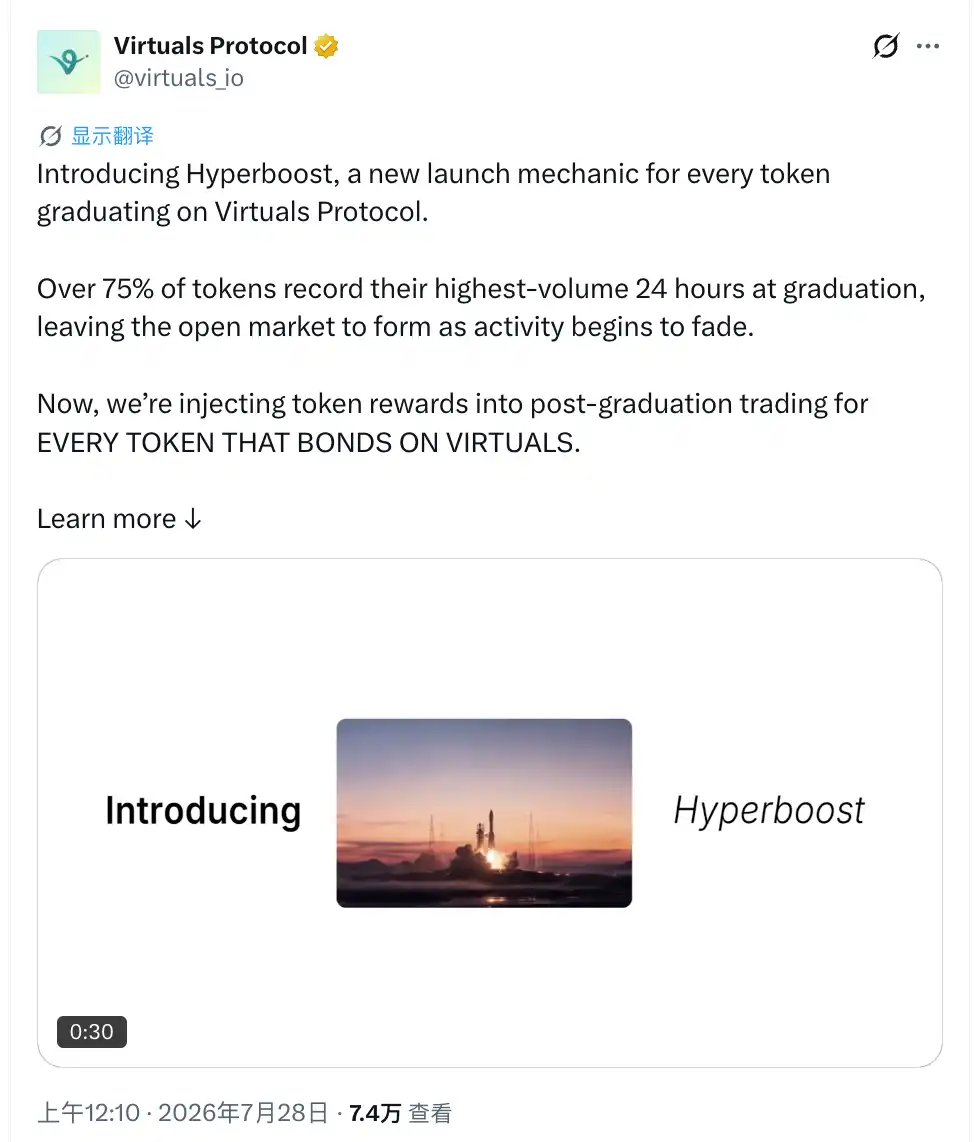
The AI Agent token launch platform Virtuals Protocol has long faced a persistent issue:

The day a token "graduates" from the bonding curve and launches, its trading volume typically peaks and then declines steadily. Platform data indicates that over 75% of tokens record their highest trading volume within 24 hours after graduation, with public market activity quickly fading thereafter.

On July 27th, Virtuals introduced the Hyperboost mechanism, attempting to use economic incentives to prolong post-graduation market interest.

Mechanism Breakdown: Idle Supply Converted to Trading Rewards, Released Daily for 14 Days

The core logic of Hyperboost is to activate a portion of token supply that was previously idle.

In the past, when a token graduated from the bonding curve and entered public trading on Uniswap, a portion of the supply was reserved for smoothing the transition, essentially remaining idle.

Hyperboost reallocates this portion, converting it into a reward pool released daily over the 14 days following graduation.

Rewards are distributed along two tracks: trading rewards are allocated based on a wallet's proportion of the day's trading volume; content rewards are directed at creators publishing content about the token on platforms like X. A total of 1/14th of the total rewards are released each day, with no lock-up or vesting restrictions upon claiming. Rewards are claimable upon arrival.

This mechanism activates automatically, requiring no founder configuration or manual activation. All tokens completing graduation after 16:00 UTC on July 27th will automatically enter the Hyperboost window.

The official whitepaper does not disclose the specific idle supply ratio or reward allocation percentage, only describing it as "a fraction of token supply".

Details regarding the content reward evaluation criteria are also limited. The community has raised questions about the transparency of anti-sybil mechanisms and content scoring rules.

Virtuals Ecosystem Status: 18k+ Agents, Market Cap ~$400M

Hyperboost is not an isolated product; it is embedded within Virtuals' broader AI Agent tokenization ecosystem.

As of H1 2026, the Virtuals Protocol platform has launched over 18,000 AI Agent tokens, with cumulative protocol revenue exceeding $75 million.

Amidst overall crypto market shifts and AI Agent development, Virtuals has undertaken intensive ecosystem and product expansion efforts since the beginning of the year. In March, it launched the ERC-8183 standard (in collaboration with the Ethereum Foundation) for on-chain AI Agent identity.

In early July, it completed the migration of cross-chain infrastructure from LayerZero to Chainlink CCIP, involving over $700 million in VIRTUAL liquidity. Robinhood Chain also announced plans to integrate Virtuals' AI Agent infrastructure on its new chain.

The above developments align more with long-term considerations and updates to the product foundation. Hyperboost appears more like an innovative play in token trading and rules.

Two Days Post-Launch, Some Graduated Projects Still 'Plummeting as Usual'

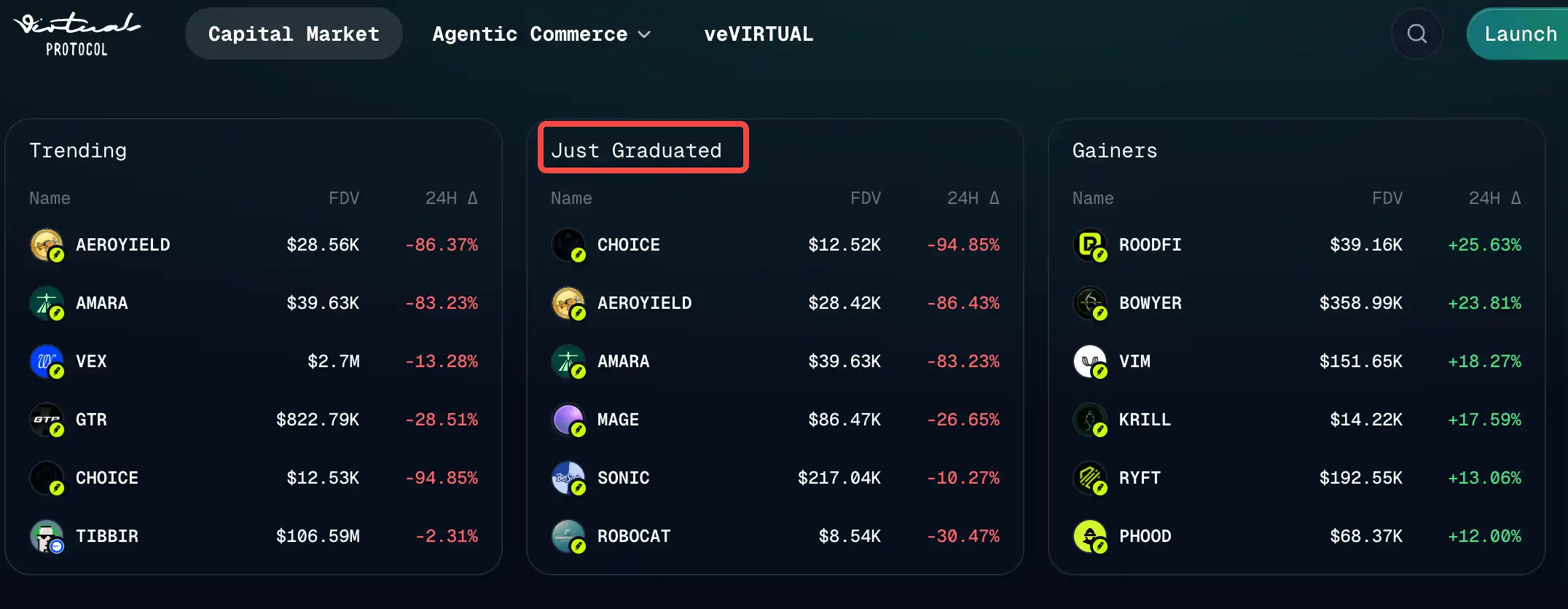
Hyperboost has been live for only about two days. The "Just Graduated" section on app.virtuals.io shows some early examples.

AMARA (Amara Exchange) graduated about 9 hours ago, FDV ~$51k, 24-hour decline ~78%, trading volume ~$358k, holders ~185.

MAGE is associated with the Mage Trading AI Agent, 24-hour decline ~55%. GTR (gtr.trade) launched ~4 days ago, FDV ~$700k, 24-hour decline ~44%, holders ~1700, liquidity ~$110k.

The data from these examples still presents the typical "peak post-graduation followed by decay" pattern, precisely what Hyperboost aims to mitigate. However, given the mechanism has been active for less than 48 hours and the first 14-day reward cycle is not yet complete, the current sample size and time span are insufficient to judge effectiveness.
Core Questions: Could Trading Volume Rewards Become a Farmer's ATM?

Currently, community discussions around this new product focus on several key points.

First, if trading rewards are allocated based on trading volume share, this design inherently attracts wash trading. If a wallet contributes 50% of the day's trading volume, it claims 50% of that day's trading rewards. For tokens with an FDV of only tens of thousands of dollars, the cost of wash trading could be lower than the reward revenue, creating a clear arbitrage opportunity.

The official response is that the daily reward pool is fixed. Even if someone wash trades, they merely take a larger slice of a fixed pie, not infinitely inflating it. However, this argument holds only if the reward pool itself is relatively small (undisclosed by the official). If the reward scale is significant, wash trading incentives remain.

Second, the evaluation criteria for content rewards are also vague. Current rules state "parameters are set by the protocol and may be adjusted to maintain distribution integrity" but do not disclose specifics like the content scoring mechanism, whether account verification is needed, or how to prevent bulk spamming.

For a mechanism publicly stated to incentivize content creation on platform X, the absence of these rules casts doubt on its practical effectiveness.

Limited Impact on VIRTUAL Token

In narrative terms, Hyperboost provides VIRTUAL with a new growth story. If the mechanism genuinely extends the active trading period of graduated tokens, it implies more trading volume flows through VIRTUAL-paired liquidity pools, indirectly increasing demand for VIRTUAL.

According to TronWeekly, the VIRTUAL price showed short-term technical bullish signals following the Hyperboost launch, with some analysts setting a short-term target of $0.70.

However, simultaneously, VIRTUAL has declined about 7.4% over the past 7 days, still generally weighed down by the broader market downturn. BTC recently turned negative, and overall crypto market sentiment is weak.

A breakout star token might be more effective in reversing this trend. Follow-up metrics to watch include the trading volume retention rate of graduated tokens during the 14-day window, whether the number of newly graduated tokens increases due to the incentives, and the actual consumption of VIRTUAL as a pairing asset.

Accumulating sufficient data for these points will likely take at least 2 to 4 weeks. Nevertheless, in a climate where many crypto projects are shutting down or pivoting, it is encouraging to see Virtuals continuously iterate and update its playbook.

Trending Cryptos

Related Questions

QWhat is the Hyperboost mechanism launched by Virtuals Protocol and what problem does it aim to solve?

AVirtuals Protocol launched the Hyperboost mechanism on July 27th. It aims to combat the 'first-day peak curse,' where over 75% of tokens on the platform see their highest trading volume within 24 hours of graduation before rapidly declining. Hyperboost automatically converts a portion of a graduating token's initially idle supply into a 14-day reward pool, released daily to incentivize trading and content creation, thereby attempting to extend the price discovery window.

QHow does the Hyperboost mechanism distribute its rewards?

AThe Hyperboost reward pool is distributed across two tracks over 14 days: 1) Trading Rewards: Distributed to wallets based on their daily trading volume share for that specific token. 2) Content Rewards: Awarded to creators who publish content about the token on platforms like X (formerly Twitter). Each day, 1/14th of the total reward pool is released. Users can claim their rewards with no lock-up or vesting period.

QAccording to the article, what are the main concerns within the community regarding the Hyperboost mechanism?

AThe community's main concerns focus on potential exploitation: 1) Trading rewards based on volume share could incentivize wash trading, especially for low-FDV tokens where the reward might outweigh the cost of fake trading. 2) The criteria and anti-spam mechanisms for content rewards are vague and lack transparency, raising questions about how content quality is judged and how 'farming' with bot accounts will be prevented.

QWhat was the performance of some early token samples after the Hyperboost launch, and what does this indicate?

AEarly samples like AMARA, MAGE, and GTR, which graduated shortly after Hyperboost went live, still showed significant price declines (~44% to ~78% in 24 hours). This indicates the typical 'post-graduation slump' pattern that Hyperboost is designed to mitigate. However, the article notes that with the mechanism being active for less than 48 hours and the full 14-day cycle not yet complete, it's too early to judge its effectiveness based on this limited data.

QWhat is the potential impact of Hyperboost on the VIRTUAL token itself, and what factors will determine its success?

AHyperboost could indirectly benefit the VIRTUAL token by potentially increasing trading activity and volume across its paired liquidity pools, thus boosting demand for VIRTUAL as the pairing asset. However, its direct impact is considered limited, as VIRTUAL's price remains influenced by broader market trends. The mechanism's success should be measured by observing metrics over 2-4 weeks, such as the retention of trading volume for graduated tokens during the 14-day window, an increase in new token graduations, and the actual consumption/utility of VIRTUAL in these pools.

Related Reads

What's New in Ethereum's Roadmap: Privacy, Quantum Security, Native Rollup?

On August 10, 2024, Ethereum co-founder Vitalik Buterin revealed an updated technical roadmap, highlighting significant changes in priorities and new focus areas. Key new additions include: - **Strong Privacy Protection**: Elevated to a top-tier protocol concern. Proposals like EIP-8250 (keyed nonces for concurrency), EIP-8272 (recent roots for verification), and EIP-8182 (shared protocol-level privacy pools) aim to enable private transfers of ETH and ERC-20s, moving toward default private accounts. - **Quantum Resilience**: Priority increased. The plan addresses risks to ECDSA/BLS signatures, KZG commitments, and ZK systems, exploring solutions like leanSPHINCS signatures, STARK proofs (considered quantum-resistant), and streamlined verification processes. A full L1 upgrade is tentatively targeted for ~2029. - **Native Rollups**: A novel concept where rollups could reuse Ethereum's core validation infrastructure via a new EXECUTE precompile (EIP-8079 draft). This aims to reduce custom code and enhance security for certain L2s, while specialized chains will continue to exist. - **Protocol Simplification & Formal Verification**: Leveraging AI tools to make full-protocol formal verification feasible, aiming for more rigorous and machine-verifiable specifications. Other notable shifts: - State storage is evolving from Verkle trees to a Partitioned Binary Tree (PBT, EIP-8347 draft). - Some 2023 items like VDFs and certain EVM improvements were deprioritized. - Long-term discussions include blob/gas futures and non-EVM instruction sets (e.g., RISC-V). The "Strawmap" outlines potential upgrades through ~2029 but is a directional guide, not a firm timeline. Key milestones to watch include the Glamsterdam (Q4 2026) and Hegotá (2027) forks. Many proposals remain in draft or research phases.

marsbit10m ago

What's New in Ethereum's Roadmap: Privacy, Quantum Security, Native Rollup?

marsbit10m ago

Hyperliquid Trading Volume Soars, So Why Are Profits Falling?

Hyperliquid, a leading decentralized perpetuals trading platform, has seen its open interest surge to a record high above $11 billion, capturing roughly 9% of the global market share. Trading volume remains robust, nearing $178 billion over 30 days, driven largely by the explosive growth of third-party markets offering tokenized real-world assets (RWAs) like stocks and commodities. Despite this growth, the platform's protocol revenue has declined for four consecutive quarters, falling 43% from its Q3 2025 peak of $357 million to approximately $202 million in Q2 2026. This divergence is primarily attributed to the HIP-3 governance proposal, which allows external developers to launch their own markets and keep up to half of the generated fees. These third-party markets now account for nearly 50% of total volume. Consequently, the share of revenue redistributed to developers, market makers, and the treasury has tripled from 6% to 18% in a year. This directly reduces the funds allocated to the platform's buyback-and-burn mechanism for its native HYPE token, weakening a key price support. HYPE's price has fallen 28% from its all-time high. The platform's growth is also heavily concentrated, with a single entity, Trade.xyz, responsible for over 90% of HIP-3 open interest, introducing systemic risk. Additionally, the ecosystem lacks diversity beyond HYPE, faces ongoing token unlocks adding sell pressure, and is encountering increased regulatory scrutiny and new competition from platforms like Robinhood Chain. While still a major revenue generator in crypto, Hyperliquid's model of sharing fees to fuel expansion is currently compressing its own earnings and token economics.

marsbit10m ago

Hyperliquid Trading Volume Soars, So Why Are Profits Falling?

marsbit10m ago

Citi Research Report Analysis: U.S. Proposed Ban on Chinese Optical Modules Has No Substantial Progress, Short-term Enforcement Faces Supply Constraints

Citi Report Analysis: U.S. Proposed Ban on Chinese Optical Modules Lacks Substantive Progress, Faces Supply Bottlenecks in Short Term. Reuters reported on August 4th that the U.S. government and FCC are considering a ban on Chinese optical modules. Citi's August 9th report clarifies that optical modules are not listed on any effective FCC ban. The FCC's Order 26-50 established two restricted list mechanisms (based on manufacturer and production location), but optical modules were only mentioned once, as an example in a disclosure requirement, not as a restricted product. The reported ban remains at a proposal stage. Citi estimates Chinese suppliers provide 60-70% of high-speed optical modules for U.S. hyperscalers. Non-Chinese suppliers cannot fill this gap in the short term, making the immediate implementation of a genuine ban unlikely. Future regulatory paths could be manufacturer-based (least likely), location-based covering all offshore production (strictest), or location-based covering only China (more feasible but with unresolved definitions). A ban would pressure U.S. AI infrastructure, conflicting with stated policy goals. Citi sees low near-term implementation probability, with the issue potentially becoming a negotiation chip in bilateral talks. U.S. domestic capacity build-out is a key long-term variable. Among Chinese companies, XSENS and Dongshan Precision have the highest U.S. exposure, while Tianfu Communication, as a passive component supplier, is relatively insulated. Citi maintains Buy ratings on all three with respective price targets. The conclusion is that Chinese modules are currently irreplaceable in the U.S. AI supply chain, creating a longer timeline for potential restrictions than the market may expect.

marsbit1h ago

Citi Research Report Analysis: U.S. Proposed Ban on Chinese Optical Modules Has No Substantial Progress, Short-term Enforcement Faces Supply Constraints

marsbit1h ago

Trading

Spot

Hot Articles

How to Buy ONE

Welcome to HTX.com! We've made purchasing Harmony (ONE) simple and convenient. Follow our step-by-step guide to embark on your crypto journey.Step 1: Create Your HTX AccountUse your email or phone number to sign up for a free account on HTX. Experience a hassle-free registration journey and unlock all features.Get My AccountStep 2: Go to Buy Crypto and Choose Your Payment MethodCredit/Debit Card: Use your Visa or Mastercard to buy Harmony (ONE) instantly.Balance: Use funds from your HTX account balance to trade seamlessly.Third Parties: We've added popular payment methods such as Google Pay and Apple Pay to enhance convenience.P2P: Trade directly with other users on HTX.Over-the-Counter (OTC): We offer tailor-made services and competitive exchange rates for traders.Step 3: Store Your Harmony (ONE)After purchasing your Harmony (ONE), store it in your HTX account. Alternatively, you can send it elsewhere via blockchain transfer or use it to trade other cryptocurrencies.Step 4: Trade Harmony (ONE)Easily trade Harmony (ONE) on HTX's spot market. Simply access your account, select your trading pair, execute your trades, and monitor in real-time. We offer a user-friendly experience for both beginners and seasoned traders.

4.8k Total ViewsPublished 2024.03.29Updated 2026.06.02

How to Buy ONE

Discussions

Welcome to the HTX Community. Here, you can stay informed about the latest platform developments and gain access to professional market insights. Users' opinions on the price of ONE (ONE) are presented below.

活动图片