Top 5 Most Profitable and Unprofitable Cryptocurrencies in July 2026

cryptonews.ruPublished on 2026-08-13Last updated on 2026-08-13

Abstract

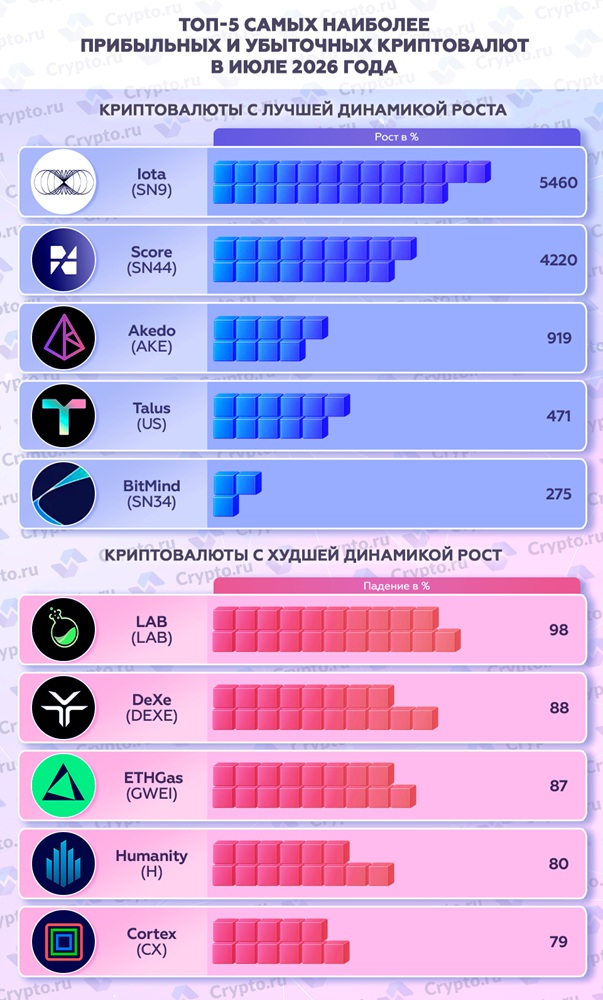
The article summarizes the performance of cryptocurrencies in July 2026. The market had a successful month, with Bitcoin recovering from below $60,000, though a sustained bull trend wasn't established. The US Federal Reserve signaled no immediate monetary policy easing. **Top Performers:** 1. **Iota (SN9):** +5460%. Linked to the Bittensor ecosystem for decentralized AI model training. 2. **Score (SN44):** +4220%. Also on Bittensor, focused on football match video analysis via computer vision. 3. **Akedo (AKE):** +919%. Utility token for an AI-powered game creation platform. Other notable gainers included Talus (+471%) and EfficientFrontier (+275%). **Worst Performers:** 1. **$LAB:** -98%. Utility token for a multi-chain trading platform. 2. **DeXe (DEXE):** -88%. Governance token for a no-code DAO creation protocol. 3. **ETHGas (GWEI):** -87%. Token for reserving Ethereum blockchain space and governance. Other notable decliners were Solstice (-80%) and Cortex (-79%).

July 2026 turned out to be quite successful for the crypto market. While Bitcoin was trading below $60,000 at the beginning of the month, by August its quotes were consistently holding above this level. However, it is worth understanding that conditions for forming a sustained bullish trend are currently absent.

Although on July 29th, the Fed left its key rate unchanged for the 5th consecutive time, the rhetoric of the agency's representatives made it clear that the American regulator does not intend to rush with easing monetary policy. Be that as it may, it is time to sum up the month. This article discusses the cryptocurrencies that demonstrated the best and worst market dynamics in July.

The undisputed leader in terms of growth dynamics was the cryptocurrency Iota (SN9), which increased in value by 5460%. This coin is closely tied to the Bittensor ecosystem. It was created for the decentralized training of large artificial intelligence models. SN9 is used as an economic asset. The token supports the incentive system and allows investors to participate in the project's development.

Next is Score (SN44), which added 4220% during the reporting period. This is another token associated with the Bittensor network. The project is focused on football competitions and develops a decentralized computer vision system. The point is that the project processes video recordings of football matches, recognizes players and the ball, tracks movements, and records data about events on the field. However, this ecosystem can be used in various fields, from analytics to scouting.

Third place was taken by the coin Akedo (AKE), which appreciated by 919%. This is the utility cryptocurrency of the eponymous platform for creating games using artificial intelligence. A user describes an idea in text, and specialized AI agents design the virtual world, rules, balance, and plot without manual programming. Subsequently, a network participant can monetize their content. From the perspective of growth dynamics, it also makes sense to note the following cryptocurrencies:

  • Talus (US): +471%.
  • EfficientFrontier (SN53): +275%.

As for the anti-leaders, first of all, it's worth highlighting $LAB ($LAB), which lost 98% during the reporting period. This is the utility token of the eponymous platform. It combines a browser terminal, a mobile application, and a Telegram bot, allowing users to conduct spot and perpetual deals across different blockchains through a single interface. The token is used in the reward system and referral program.

Next is the coin DeXe (DEXE), whose decline during the reporting period amounted to 88%. This is the utility cryptocurrency of a protocol for creating and managing various DAOs. The platform allows launching communities without programming knowledge, configuring voting parameters, and distributing roles among participants.

Closing the list of anti-leaders is the coin ETHGas (GWEI), which became cheaper by 87% over the month. This is the utility token of a platform that allows purchasing and reserving blockchain space on the Ethereum network. Holders of the cryptocurrency can participate in voting for protocol updates and resource distribution within the ecosystem. From the perspective of decline dynamics, it is also worth noting such crypto coins:

  • Solstice (SLX): –80%.
  • Cortex (CX): –79%.

Earlier, the editorial board published an infographic dedicated to the largest crypto exchanges with a MiCA license.
end-content

Trending Cryptos

Related Questions

QAccording to the article, which cryptocurrency showed the highest growth in July 2026 and what was its percentage increase?

AAccording to the article, the cryptocurrency with the highest growth in July 2026 was Iota (SN9), with an increase of 5460%.

QWhat network or ecosystem are the top two gainers, Iota (SN9) and Score (SN44), closely associated with?

ABoth Iota (SN9) and Score (SN44) are closely associated with the Bittensor ecosystem.

QWhat is the main focus of the Akedo (AKE) platform, the third-best performer in July 2026?

AThe Akedo (AKE) platform is focused on creating games using artificial intelligence, where users describe an idea in text and specialized AI agents design the virtual world.

QWhich cryptocurrency experienced the largest loss in value in July 2026, and what was the percentage of that loss?

AThe cryptocurrency with the largest loss in July 2026 was $LAB, which lost 98% of its value.

QWhat is the primary purpose of the DeXe (DEXE) protocol, the second-worst performer in July?

AThe primary purpose of the DeXe (DEXE) protocol is for creating and managing various DAOs (Decentralized Autonomous Organizations) without requiring programming knowledge.

Related Reads

Cryptocurrency Companies Urge AI Labs to 'Arm' Bitcoin Defenders with the Most Powerful Models

Over thirty Bitcoin and cryptocurrency companies have called on leading AI labs to provide open-source developers with early access to the most powerful cybersecurity models. In an open letter organized by the Bitcoin Policy Institute, signatories including Coinbase, Block, BitGo, Blockstream, ARK Invest, and Foundry argue that developers of critical financial infrastructure like Bitcoin Core are at a disadvantage, using less capable AI tools than potential attackers. They contend that the safety restrictions of public AI models can hinder legitimate vulnerability research. The letter requests that AI labs establish trusted access programs offering early model access, sufficient computing resources for audits, secure environments for private code analysis, and inclusion for small teams and independent developers. The signatories warn that the Bitcoin network secures over $1 trillion in assets, and infrastructure vulnerabilities pose significant risks. They cite recent incidents like the exploitation of a critical vulnerability in BTCPay Server and a major attack on Coldcard wallets, where a configuration error led to the theft of approximately 1,719 BTC ($111 million). The call comes amid a series of high-value crypto infrastructure attacks in 2026, including multimillion-dollar losses from protocols like Ostium, AFX, Summer.fi, and Bonzo Lend due to logic flaws and oracle manipulation. The companies believe advanced AI could strengthen defenses by analyzing large codebases, detecting atypical exploit scenarios, and helping developers identify issues before malicious actors can exploit them.

cryptonews.ru40m ago

Cryptocurrency Companies Urge AI Labs to 'Arm' Bitcoin Defenders with the Most Powerful Models

cryptonews.ru40m ago

Trading

Spot

Hot Articles

What is $BITCOIN

DIGITAL GOLD ($BITCOIN): A Comprehensive Analysis Introduction to DIGITAL GOLD ($BITCOIN) DIGITAL GOLD ($BITCOIN) is a blockchain-based project operating on the Solana network, which aims to combine the characteristics of traditional precious metals with the innovation of decentralized technologies. While it shares a name with Bitcoin, often referred to as “digital gold” due to its perception as a store of value, DIGITAL GOLD is a separate token designed to create a unique ecosystem within the Web3 landscape. Its goal is to position itself as a viable alternative digital asset, although specifics regarding its applications and functionalities are still developing. What is DIGITAL GOLD ($BITCOIN)? DIGITAL GOLD ($BITCOIN) is a cryptocurrency token explicitly designed for use on the Solana blockchain. In contrast to Bitcoin, which provides a widely recognized value storage role, this token appears to focus on broader applications and characteristics. Notable aspects include: Blockchain Infrastructure: The token is built on the Solana blockchain, known for its capacity to handle high-speed and low-cost transactions. Supply Dynamics: DIGITAL GOLD has a maximum supply capped at 100 quadrillion tokens (100P $BITCOIN), although details regarding its circulating supply are currently undisclosed. Utility: While precise functionalities are not explicitly outlined, there are indications that the token could be utilized for various applications, potentially involving decentralized applications (dApps) or asset tokenization strategies. Who is the Creator of DIGITAL GOLD ($BITCOIN)? At present, the identity of the creators and development team behind DIGITAL GOLD ($BITCOIN) remains unknown. This situation is typical among many innovative projects within the blockchain space, particularly those aligning with decentralized finance and meme coin phenomena. While such anonymity may foster a community-driven culture, it intensifies concerns about governance and accountability. Who are the Investors of DIGITAL GOLD ($BITCOIN)? The available information indicates that DIGITAL GOLD ($BITCOIN) does not have any known institutional backers or prominent venture capital investments. The project seems to operate on a peer-to-peer model focused on community support and adoption rather than traditional funding routes. Its activity and liquidity are primarily situated on decentralized exchanges (DEXs), such as PumpSwap, rather than established centralized trading platforms, further highlighting its grassroots approach. How DIGITAL GOLD ($BITCOIN) Works The operational mechanics of DIGITAL GOLD ($BITCOIN) can be elaborated on based on its blockchain design and network attributes: Consensus Mechanism: By leveraging Solana’s unique proof-of-history (PoH) combined with a proof-of-stake (PoS) model, the project ensures efficient transaction validation contributing to the network's high performance. Tokenomics: While specific deflationary mechanisms have not been extensively detailed, the vast maximum token supply implies that it may cater to microtransactions or niche use cases that are still to be defined. Interoperability: There exists the potential for integration with Solana’s broader ecosystem, including various decentralized finance (DeFi) platforms. However, the details regarding specific integrations remain unspecified. Timeline of Key Events Here is a timeline that highlights significant milestones concerning DIGITAL GOLD ($BITCOIN): 2023: The initial deployment of the token occurs on the Solana blockchain, marked by its contract address. 2024: DIGITAL GOLD gains visibility as it becomes available for trading on decentralized exchanges like PumpSwap, allowing users to trade it against SOL. 2025: The project witnesses sporadic trading activity and potential interest in community-led engagements, although no noteworthy partnerships or technical advancements have been documented as of yet. Critical Analysis Strengths Scalability: The underlying Solana infrastructure supports high transaction volumes, which could enhance the utility of $BITCOIN in various transaction scenarios. Accessibility: The potential low trading price per token could attract retail investors, facilitating wider participation due to fractional ownership opportunities. Risks Lack of Transparency: The absence of publicly known backers, developers, or an audit process may yield skepticism regarding the project's sustainability and trustworthiness. Market Volatility: The trading activity is heavily reliant on speculative behavior, which can result in significant price volatility and uncertainty for investors. Conclusion DIGITAL GOLD ($BITCOIN) emerges as an intriguing yet ambiguous project within the rapidly evolving Solana ecosystem. While it attempts to leverage the “digital gold” narrative, its departure from Bitcoin's established role as a store of value underscores the need for a clearer differentiation of its intended utility and governance structure. Future acceptance and adoption will likely depend on addressing the current opacity and defining its operational and economic strategies more explicitly. Note: This report encompasses synthesised information available as of October 2023, and developments may have transpired beyond the research period.

1.8k Total ViewsPublished 2025.05.13Updated 2025.05.13

What is $BITCOIN

Discussions

Welcome to the HTX Community. Here, you can stay informed about the latest platform developments and gain access to professional market insights. Users' opinions on the price of BTC (BTC) are presented below.

活动图片