Tools for Humanity expands World app toward super-app model

cointelegraphPublished on 2025-12-12Last updated on 2025-12-12

Abstract

Tools for Humanity, co-founded by OpenAI CEO Sam Altman, is expanding its World app into a super-app model by adding encrypted messaging, financial services, and third-party mini-apps. The update includes end-to-end encrypted messaging with verified accounts, support for stablecoins like USDC and EURC, and yield products offering up to 18% returns. Users in Argentina can make QR code payments at over a million merchants, and virtual US dollar accounts are available in 18 countries. This move aligns with a broader trend in the U.S., where companies like Elon Musk’s X and Coinbase are also developing super-apps that integrate social, financial, and payment features.

Tools for Humanity is broadening its World platform beyond digital identity and crypto payments, adding encrypted messaging and financial services to its app as part of a push toward a super-app model.

The company, co-founded by OpenAI CEO Sam Altman, introduced an in-app messaging feature with end-to-end encryption that distinguishes between verified and unverified World ID accounts and enables users to send or request digital assets within chats.

According to an announcement, the application now supports third-party mini-apps, including prediction markets, games and financial tools, that run inside conversations. Tools for Humanity said it plans to add optional profile photo verification to help reduce impersonation and misuse.

The changes were released in San Francisco on Thursday by co-founders Altman and Alex Blania.
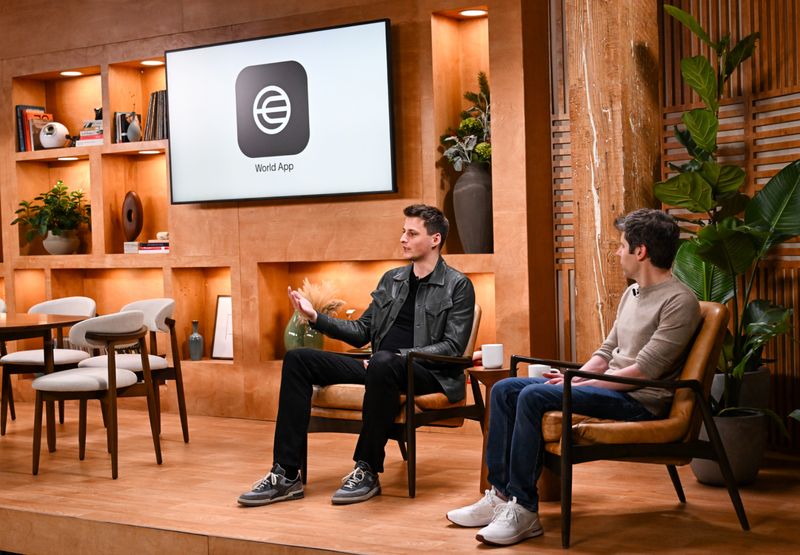
Alex Blania, left, and Sam Altman. Source: Tools for Humanity

World App has also expanded stablecoin support to include USDC (USDC), EURC (EURC) and several Latin American peso-linked tokens. The release introduces yield products offering rates of up to 18% on Worldcoin (WLD) holdings and up to 15% on USDC, powered by the DeFi protocol Morpho, according to the company.

On the payments side, users in Argentina will be able to pay at more than one million merchants using QR codes.

The update also adds US dollar virtual accounts powered by Bridge in 18 countries, including the United States, Japan and several markets across Latin America, allowing users to receive wages, fund accounts from banks and spend USDC inside the app.

Tools for Humanity is a technology company that led the development of World Network and operates World App. World, formerly known as Worldcoin, is the digital identity and financial infrastructure project developed and operated by Tools for Humanity.

Related: Thai regulators raid alleged World iris scanning site, arrest multiple suspects

The evolution of super apps in the US

Tools for Humanity is joining a growing group of companies trying to build super-app ecosystems in Western countries. After buying Twitter in October 2022, Elon Musk posted that “buying Twitter” was the “accelerant to creating X, the everything app.”
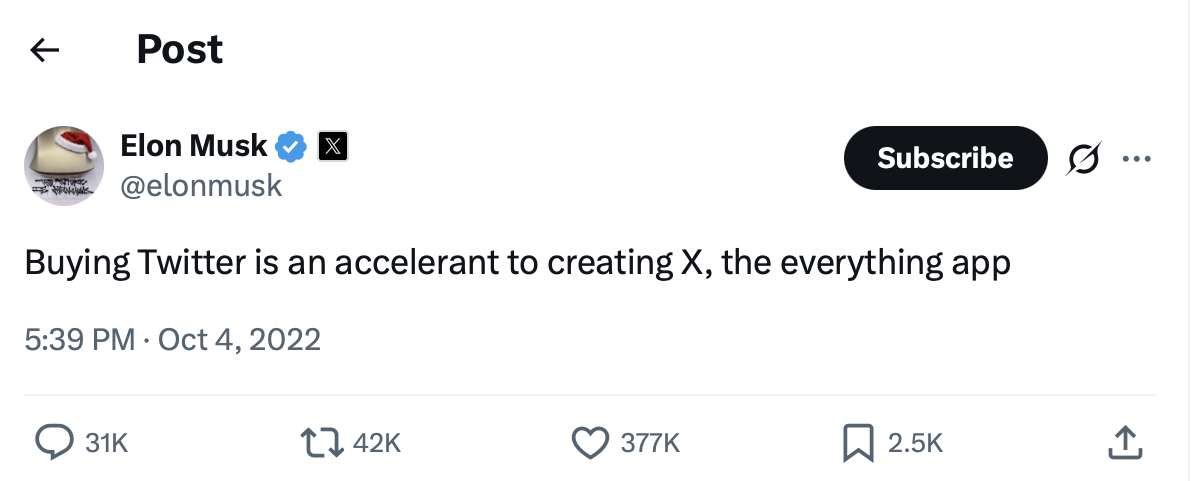
Source: Elon Musk

A super app is a single platform that combines social interaction, payments, commerce and financial services, a model popularized in Asia by services like WeChat. Today, several US companies are expanding crypto, payments and financial tools as they inch toward becoming their own versions of everything apps.

In October, Musk said X has rebuilt its messaging infrastructure into a standalone product called “X Chat,” describing it as a peer-to-peer, encrypted messaging service designed to compete with Telegram and WhatsApp.

Musk, who co-founded OpenAI with Sam Altman in 2015 and has had an ongoing feud with the OpenAI CEO since Musk left the organization in 2018, said in December on the People by WTF podcast that he likes the idea of having a “unified app or website where you can do anything you want” and that he sees China’s WeChat as a model for X.

“There’s no real WeChat outside of China,” he added.

Cryptocurrency exchange Coinbase also signaled a push toward a super app by rebranding Coinbase Wallet as the “Base app,” combining trading, payments, social features, messaging and mini-apps.

In addition, the banking app owned by Walmart OnePay is expected to roll out cryptocurrency trading and custody later this year, beginning with support for Bitcoin (BTC) and Ether (ETH). The app already offers banking, credit, loans and wireless plans and has positioned itself as a US-style super-app.

Magazine: Quantum attacking Bitcoin would be a waste of time: Kevin O’Leary

Related Reads

Anthropic Cries Wolf: Is the AGI Threat Real, or Just an IPO Story?

Anthropic has published an article titled "When AI builds itself," discussing the emerging concept of "recursive self-improvement," where AI begins to actively participate in designing, training, testing, and optimizing its own subsequent versions. The company presents internal data showing that by May 2026, over 80% of code merged into its codebase was written by Claude, its AI model. Claude's capabilities have expanded to handling complex, open-ended engineering tasks, achieving a 76% success rate in such areas, and even contributing to research processes, such as optimizing code performance and conducting AI safety experiments. Anthropic outlines an evolution from human-driven development to AI-assisted workflows, culminating in the current stage where AI agents can autonomously write, run, and delegate code. The company cautions that the path toward a "closed loop," where AI continuously improves itself, is becoming visible. It calls for coordinated global mechanisms to potentially slow or pause frontier AI development to allow safety research and societal structures to catch up. However, the timing of this warning coincides with Anthropic's preparations for an IPO, framing the narrative not just as a safety concern but also as a demonstration of Claude's advanced capabilities and its integral role in accelerating Anthropic's own R&D—creating a potential "flywheel" effect for competitive advantage. This contrasts with OpenAI's recent, more policy-oriented discussion of the same risks, highlighting the competitive dynamics in the AI industry as companies position themselves in both the technological and regulatory landscape.

marsbit36m ago

Anthropic Cries Wolf: Is the AGI Threat Real, or Just an IPO Story?

marsbit36m ago

BIT Research: ETF Purchases Have Slowed, Strategy (MicroStrategy) Has Slowed, What Else Can Drive Bitcoin's Rise?

Market Refocus on Inflation and Rate Expectations Weighs on Bitcoin Currently, the market is in a phase of macro-repricing dominated by inflation and interest rate expectations. Bitcoin, which previously benefited from easy liquidity and low inflation, is seeing its core bullish drivers weaken. These drivers were market expectations for interest rate cuts and strong inflows from Bitcoin ETFs and institutions like MicroStrategy (referred to as "Strategy" in the text). The logic has shifted. Recent high inflation data (e.g., CPI hitting 3.8% in a May 2026 report) has caused the market to sharply reduce its rate cut expectations for 2025 and even price in potential hikes. This is a key constraint for Bitcoin, as it lacks cash flows and is highly sensitive to rate expectations. Concurrently, institutional capital flows have slowed significantly. Following the hot CPI data, Bitcoin ETFs saw accelerated outflows, with around $4.3 billion leaving over a period. MicroStrategy's ability to keep adding substantial Bitcoin to its balance sheet is also diminishing. Together, ETF and MicroStrategy holdings total roughly $110 billion, but their momentum as growth engines is cooling. In summary, Bitcoin's current pressure stems not from its own fundamentals but from a changing macro environment. As long as inflation stays elevated, Bitcoin is likely to remain in a consolidating phase. However, historically, inflation eventually peaks. Once it recedes and rate cut expectations rebuild, institutional capital could return, potentially fueling a new and more robust recovery phase for Bitcoin.

marsbit44m ago

BIT Research: ETF Purchases Have Slowed, Strategy (MicroStrategy) Has Slowed, What Else Can Drive Bitcoin's Rise?

marsbit44m ago

Earning 1000 Trillion in Half a Year, 'Pocketing' 20 Million per Capita: This Round of Wealth Creation in the Korean Stock Market is Unprecedented in Scale

The South Korean stock market is experiencing an unprecedented wealth surge in 2026, with household equity and fund asset values soaring by over 1,000 trillion KRW (~$730bn) year-to-date. This translates to an average per capita wealth increase of roughly 20 million KRW, fueled by a historic 109% rally in the KOSPI index. The boom is driven by three converging forces: an AI-driven semiconductor supercycle boosting giants like Samsung and SK Hynix; the government's "Value-Up" market reforms addressing long-standing corporate governance issues; and aggressive real estate regulations that have locked capital within financial markets, preventing profits from flowing back into property. This has triggered a wealth effect, boosting high-end consumption significantly. However, the gains are highly concentrated. The two semiconductor behemoths account for over half the index's value, but retail investors own relatively low stakes in them, systematically missing the biggest rallies. Wealth and consumption benefits are skewed towards luxury goods and imported cars, bypassing mainstream retail. Further risks stem from excessive leverage, with high trading volume in leveraged ETFs, and a market sentiment heavily reliant on the AI sector's fortunes and speculative rumors. While this cycle marks a potential shift from real estate to equities as a primary wealth generator for Koreans, its sustainability, amid structural imbalances and leverage, remains a critical test.

marsbit49m ago

Earning 1000 Trillion in Half a Year, 'Pocketing' 20 Million per Capita: This Round of Wealth Creation in the Korean Stock Market is Unprecedented in Scale

marsbit49m ago

Trading

Spot
Futures

Hot Articles

How to Buy SUPER

Welcome to HTX.com! We've made purchasing SuperFarm (SUPER) simple and convenient. Follow our step-by-step guide to embark on your crypto journey.Step 1: Create Your HTX AccountUse your email or phone number to sign up for a free account on HTX. Experience a hassle-free registration journey and unlock all features.Get My AccountStep 2: Go to Buy Crypto and Choose Your Payment MethodCredit/Debit Card: Use your Visa or Mastercard to buy SuperFarm (SUPER) instantly.Balance: Use funds from your HTX account balance to trade seamlessly.Third Parties: We've added popular payment methods such as Google Pay and Apple Pay to enhance convenience.P2P: Trade directly with other users on HTX.Over-the-Counter (OTC): We offer tailor-made services and competitive exchange rates for traders.Step 3: Store Your SuperFarm (SUPER)After purchasing your SuperFarm (SUPER), store it in your HTX account. Alternatively, you can send it elsewhere via blockchain transfer or use it to trade other cryptocurrencies.Step 4: Trade SuperFarm (SUPER)Easily trade SuperFarm (SUPER) on HTX's spot market. Simply access your account, select your trading pair, execute your trades, and monitor in real-time. We offer a user-friendly experience for both beginners and seasoned traders.

5.2k Total ViewsPublished 2024.03.29Updated 2026.06.02

How to Buy SUPER

Discussions

Welcome to the HTX Community. Here, you can stay informed about the latest platform developments and gain access to professional market insights. Users' opinions on the price of SUPER (SUPER) are presented below.

活动图片