Is Bitcoin undervalued? Why $66K may not tell BTC’s full story

ambcryptoPublished on 2026-07-21Last updated on 2026-07-21

Abstract

Bitcoin has surpassed $66,000, yet data suggests it may be undervalued. The MVRV percentile sits at the 5th, indicating Bitcoin is trading lower than 95% of its historical valuations—a level that has previously preceded rallies. However, spot market activity tells a more cautious story. Key metrics like the Spot Taker CVD show a neutral balance between buyers and sellers, with no clear dominance since mid-June. While spot netflow indicates accumulation over recent days and weeks, the volume is considered too soft to provide strong bullish conviction. For the current rally to sustain and advance, a significant increase in spot buying pressure is needed.

Bitcoin [BTC] surged past the $66,000 mark for the first time since the 17th of June.

The move tracks a broader market recovery playing out across altcoins, with the total crypto market capitalization crossing $2.25 trillion on the back of the rally.

Yet the data shows Bitcoin may still be undervalued at its current price, and the question is whether investors will treat that discount as a reason to accumulate the asset.

An undervalued Bitcoin

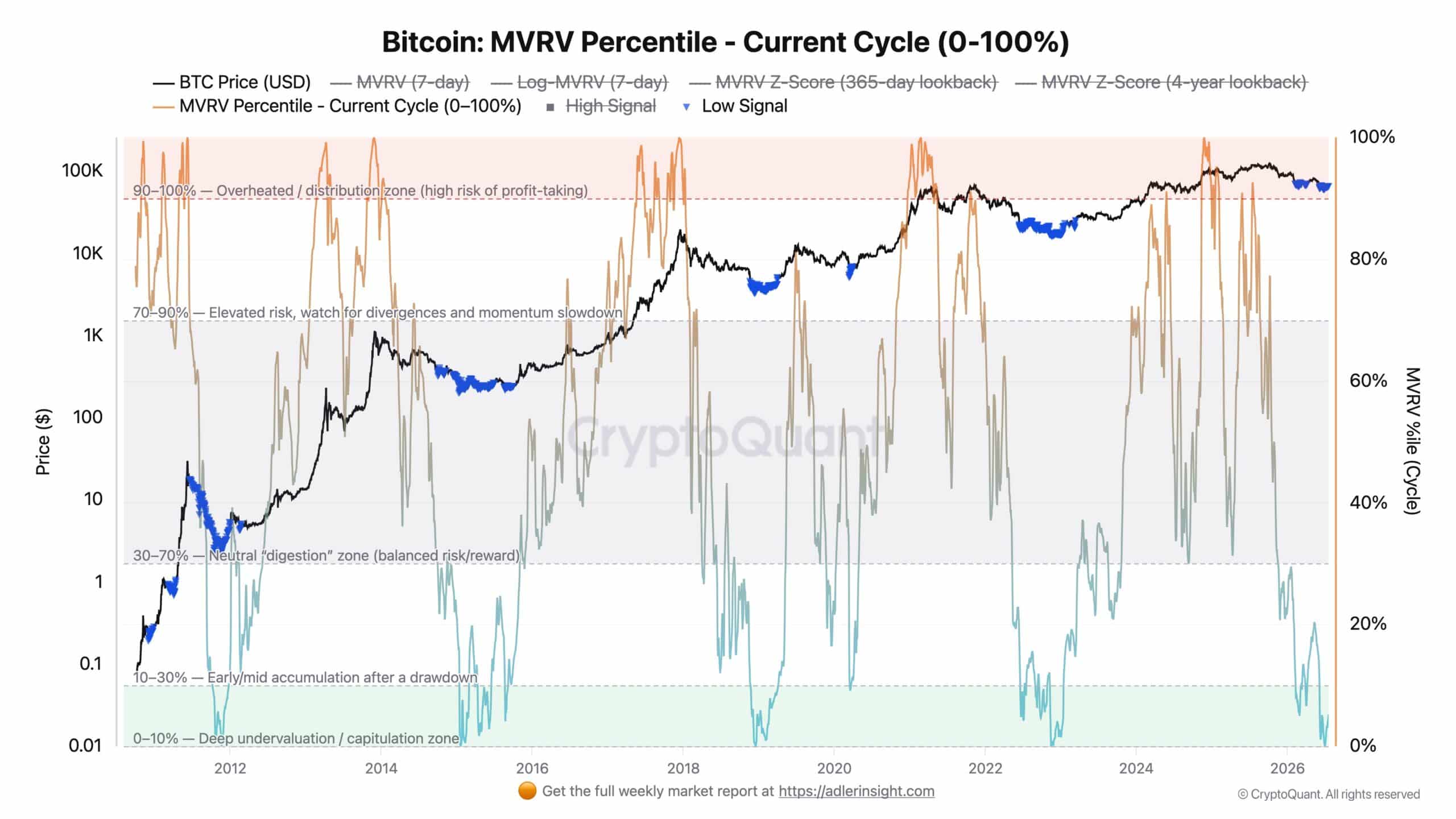
A recent CryptoQuant report, analyzing the Market Value to Realized Value (MVRV) percentile, places Bitcoin at an undervalued level.

The MVRV percentile measures where Bitcoin trades at any given moment against its performance over time, framing the asset’s current standing relative to its history in the market.

At press time, the metric sat at the 5th percentile, meaning Bitcoin traded lower than 95% of its historical readings. In plain terms, the asset was significantly undervalued at its present price level.
Source: CryptoQuant/X

This zone has historically acted as a catalyst, as the 2023 case showed when it preceded a sustained rally over the following months.

On shorter timeframes, the percentile slipped to the 10th as the price fell toward the $60,000 region, and a rebound followed that carried Bitcoin to a local high of $82,850. A similar setup could repeat, though whether it produces another local high or a longer-term run remains unclear as market dynamics shift.

The market still holds a neutral stance

Spot market activity, where traders hold and exchange actual Bitcoin without leverage, points to neutrality, with neither bulls nor bears taking control.

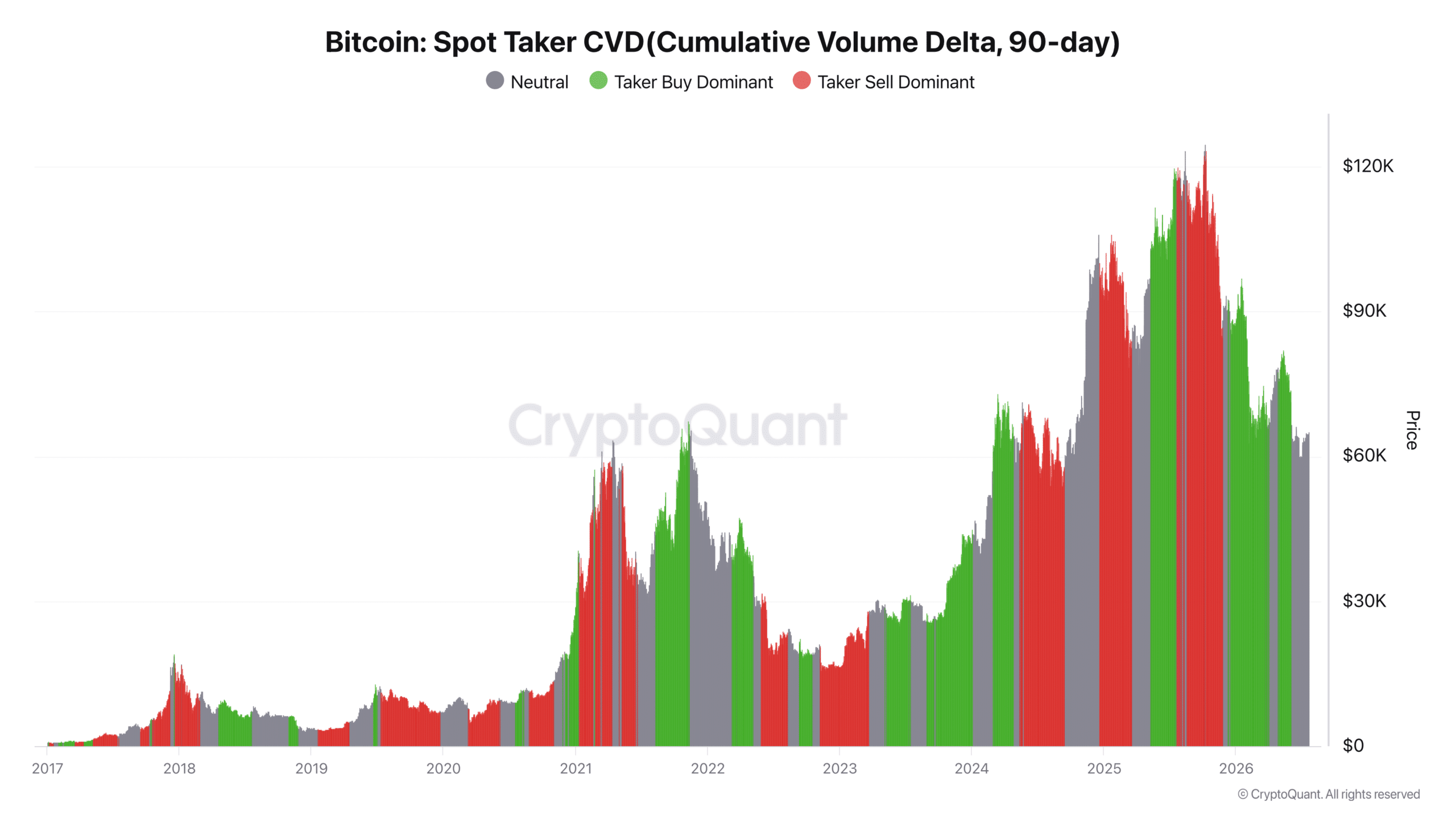
The Spot Taker Cumulative Volume Delta (CVD), which tracks the gap between buyer and seller volume to show where the spot market leans, confirms that balance.
Source: CryptoQuant

Despite the turbulent price swings of recent weeks, the CVD has held its equilibrium as far back as the 14th of June, keeping buying and selling evenly matched. The market needs to commit to a definite side before price can extend a directional run.

Reinforcing that read, spot trading activity measured through the 365-day Moving Average shows retail traders sitting on the fence. The total trade reading came in at negative 3.994 million, just 0.04% in relative terms, which keeps the activity firmly in neutral territory.

What’s going on in BTC’s spot market?

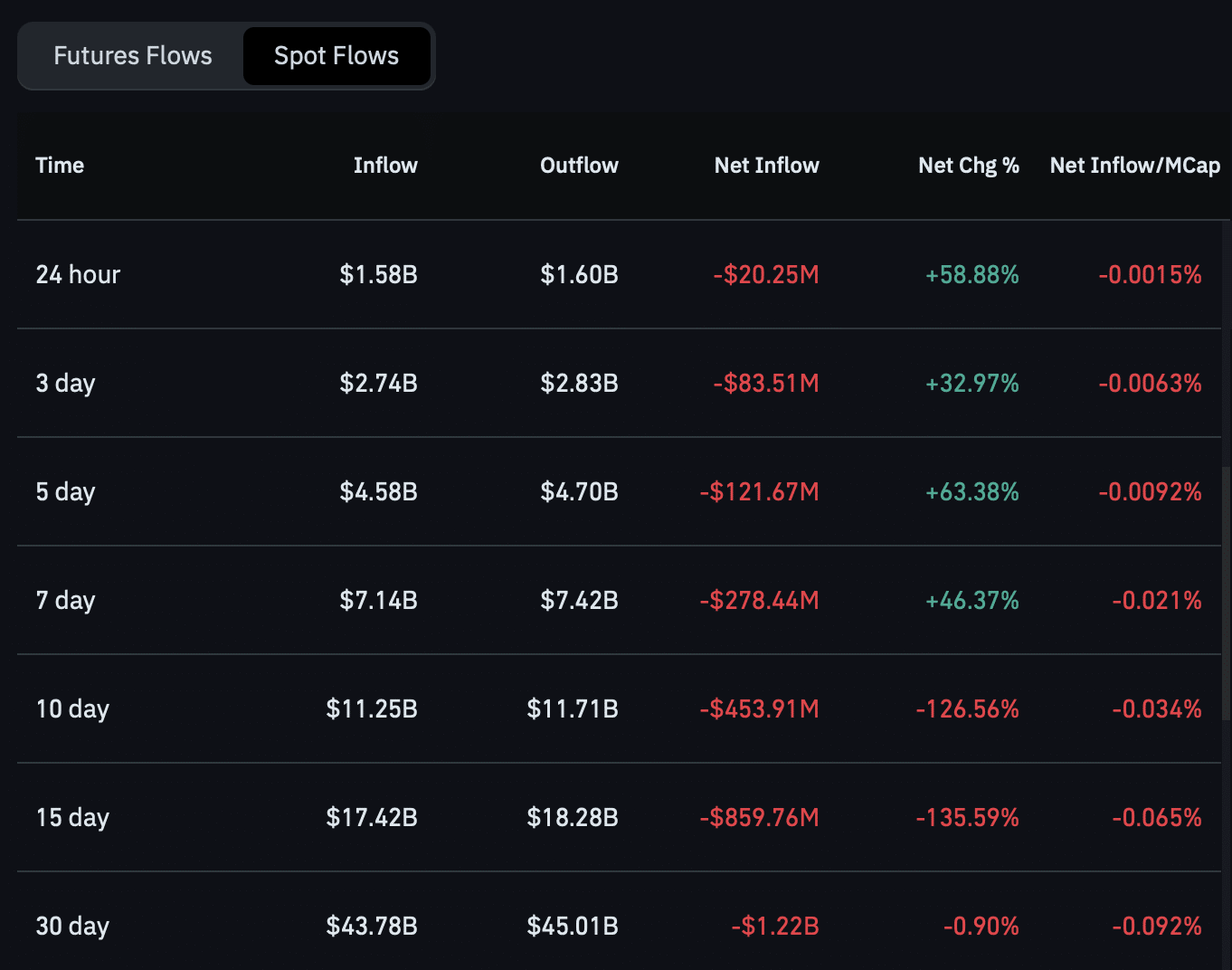
Spot market capital flow reflects how traders engage with the asset, and it shows mostly accumulation—though a weakened one rather than a strengthening drive.

Spot Netflow points to roughly $34.66 million accumulated over the past 24 hours, about $277.03 million across the past seven days, and close to $1.22 billion over the last 30 days.
Source: CoinGlass

The accumulation stays minimal for a move that needs more fuel to push higher, and stronger buy volume would be required to drive the rally further.

Whether Bitcoin sustains its recent $66,000 surge hinges on a meaningful pickup in spot Netflow, which for now stays too soft to call the market decisively bullish.


Final Summary

  • Bitcoin’s move past $66,000 coincides with an MVRV percentile reading at the 5th percentile, a zone that historically marks undervaluation and has preceded rallies.

  • Spot metrics tell a more cautious story, with the CVD holding neutral since the 14th of June and Netflow accumulation staying thin, leaving the rally without the buy-side conviction needed to confirm a durable trend.


Trending Cryptos

Related Questions

QWhat does the Market Value to Realized Value (MVRV) percentile of 5 indicate about Bitcoin's current valuation?

AA Market Value to Realized Value (MVRV) percentile reading at the 5th percentile indicates that Bitcoin is trading lower than 95% of its historical readings, which according to the article signifies that the asset is currently significantly undervalued.

QAccording to the Spot Taker Cumulative Volume Delta (CVD) data, what is the current sentiment in the Bitcoin spot market?

AAccording to the Spot Taker Cumulative Volume Delta (CVD) data, the Bitcoin spot market holds a neutral stance. The CVD has maintained an equilibrium since June 14th, showing that buying and selling volumes are evenly matched, with neither bulls nor bears taking control.

QHow much Bitcoin has been accumulated in the spot market over the past 30 days, and what does this suggest about market conviction?

AApproximately $1.22 billion worth of Bitcoin has been accumulated in the spot market over the past 30 days. However, the article suggests this level of accumulation is minimal and represents a weakened drive rather than a strengthening one, indicating a lack of strong buy-side conviction needed to decisively fuel a sustained rally.

QWhat historical precedent does the article mention for Bitcoin's current MVRV percentile level?

AThe article mentions that in 2023, when Bitcoin's MVRV percentile was in a similarly low zone, it acted as a catalyst and preceded a sustained rally over the following months.

QWhat condition does the article state is necessary for Bitcoin to sustain its rally above $66,000?

AThe article states that for Bitcoin to sustain its rally above $66,000, it requires a meaningful pickup in spot Netflow (accumulation). Currently, the spot Netflow is described as too soft, lacking the stronger buy volume needed to drive the rally further and confirm a durable bullish trend.

Related Reads

Trading

Spot

Hot Articles

What is $BITCOIN

DIGITAL GOLD ($BITCOIN): A Comprehensive Analysis Introduction to DIGITAL GOLD ($BITCOIN) DIGITAL GOLD ($BITCOIN) is a blockchain-based project operating on the Solana network, which aims to combine the characteristics of traditional precious metals with the innovation of decentralized technologies. While it shares a name with Bitcoin, often referred to as “digital gold” due to its perception as a store of value, DIGITAL GOLD is a separate token designed to create a unique ecosystem within the Web3 landscape. Its goal is to position itself as a viable alternative digital asset, although specifics regarding its applications and functionalities are still developing. What is DIGITAL GOLD ($BITCOIN)? DIGITAL GOLD ($BITCOIN) is a cryptocurrency token explicitly designed for use on the Solana blockchain. In contrast to Bitcoin, which provides a widely recognized value storage role, this token appears to focus on broader applications and characteristics. Notable aspects include: Blockchain Infrastructure: The token is built on the Solana blockchain, known for its capacity to handle high-speed and low-cost transactions. Supply Dynamics: DIGITAL GOLD has a maximum supply capped at 100 quadrillion tokens (100P $BITCOIN), although details regarding its circulating supply are currently undisclosed. Utility: While precise functionalities are not explicitly outlined, there are indications that the token could be utilized for various applications, potentially involving decentralized applications (dApps) or asset tokenization strategies. Who is the Creator of DIGITAL GOLD ($BITCOIN)? At present, the identity of the creators and development team behind DIGITAL GOLD ($BITCOIN) remains unknown. This situation is typical among many innovative projects within the blockchain space, particularly those aligning with decentralized finance and meme coin phenomena. While such anonymity may foster a community-driven culture, it intensifies concerns about governance and accountability. Who are the Investors of DIGITAL GOLD ($BITCOIN)? The available information indicates that DIGITAL GOLD ($BITCOIN) does not have any known institutional backers or prominent venture capital investments. The project seems to operate on a peer-to-peer model focused on community support and adoption rather than traditional funding routes. Its activity and liquidity are primarily situated on decentralized exchanges (DEXs), such as PumpSwap, rather than established centralized trading platforms, further highlighting its grassroots approach. How DIGITAL GOLD ($BITCOIN) Works The operational mechanics of DIGITAL GOLD ($BITCOIN) can be elaborated on based on its blockchain design and network attributes: Consensus Mechanism: By leveraging Solana’s unique proof-of-history (PoH) combined with a proof-of-stake (PoS) model, the project ensures efficient transaction validation contributing to the network's high performance. Tokenomics: While specific deflationary mechanisms have not been extensively detailed, the vast maximum token supply implies that it may cater to microtransactions or niche use cases that are still to be defined. Interoperability: There exists the potential for integration with Solana’s broader ecosystem, including various decentralized finance (DeFi) platforms. However, the details regarding specific integrations remain unspecified. Timeline of Key Events Here is a timeline that highlights significant milestones concerning DIGITAL GOLD ($BITCOIN): 2023: The initial deployment of the token occurs on the Solana blockchain, marked by its contract address. 2024: DIGITAL GOLD gains visibility as it becomes available for trading on decentralized exchanges like PumpSwap, allowing users to trade it against SOL. 2025: The project witnesses sporadic trading activity and potential interest in community-led engagements, although no noteworthy partnerships or technical advancements have been documented as of yet. Critical Analysis Strengths Scalability: The underlying Solana infrastructure supports high transaction volumes, which could enhance the utility of $BITCOIN in various transaction scenarios. Accessibility: The potential low trading price per token could attract retail investors, facilitating wider participation due to fractional ownership opportunities. Risks Lack of Transparency: The absence of publicly known backers, developers, or an audit process may yield skepticism regarding the project's sustainability and trustworthiness. Market Volatility: The trading activity is heavily reliant on speculative behavior, which can result in significant price volatility and uncertainty for investors. Conclusion DIGITAL GOLD ($BITCOIN) emerges as an intriguing yet ambiguous project within the rapidly evolving Solana ecosystem. While it attempts to leverage the “digital gold” narrative, its departure from Bitcoin's established role as a store of value underscores the need for a clearer differentiation of its intended utility and governance structure. Future acceptance and adoption will likely depend on addressing the current opacity and defining its operational and economic strategies more explicitly. Note: This report encompasses synthesised information available as of October 2023, and developments may have transpired beyond the research period.

964 Total ViewsPublished 2025.05.13Updated 2025.05.13

What is $BITCOIN

Discussions

Welcome to the HTX Community. Here, you can stay informed about the latest platform developments and gain access to professional market insights. Users' opinions on the price of BTC (BTC) are presented below.

活动图片