Tokenized US Treasurys surge 50x since 2024, marking shift toward on-chain finance

cointelegraphPublished on 2025-12-22Last updated on 2025-12-22

Abstract

Tokenized US Treasurys have experienced explosive growth, surging 50x from under $200 million in January 2024 to nearly $7 billion by late 2025. This rapid expansion is driven by rising institutional demand for on-chain yield and marks a significant shift toward blockchain-based finance. BlackRock's USD Institutional Digital Liquidity Fund (BUIDL) leads this market with almost $2 billion in assets, offering daily yield accrual and on-chain settlement. Other key products include offerings from Circle, Superstate, and Ondo Finance. Tokenized Treasury bills are becoming a crucial gateway for institutional DeFi adoption, combining the safety of US government debt with the efficiency of blockchain settlement. They are increasingly used for collateral management, margining, and improving capital efficiency.

Tokenized US Treasurys have emerged as one of the fastest-growing segments of the real-world asset (RWA) market, with data pointing to 50x growth in less than two years amid rising institutional demand for on-chain yield.

Data from Token Terminal shows that the combined market capitalization of tokenized US Treasury products has exploded from well under $200 million in January 2024 to almost $7 billion in late 2025. The growth underscores the rapid acceleration of onchain adoption for government-backed debt instruments.
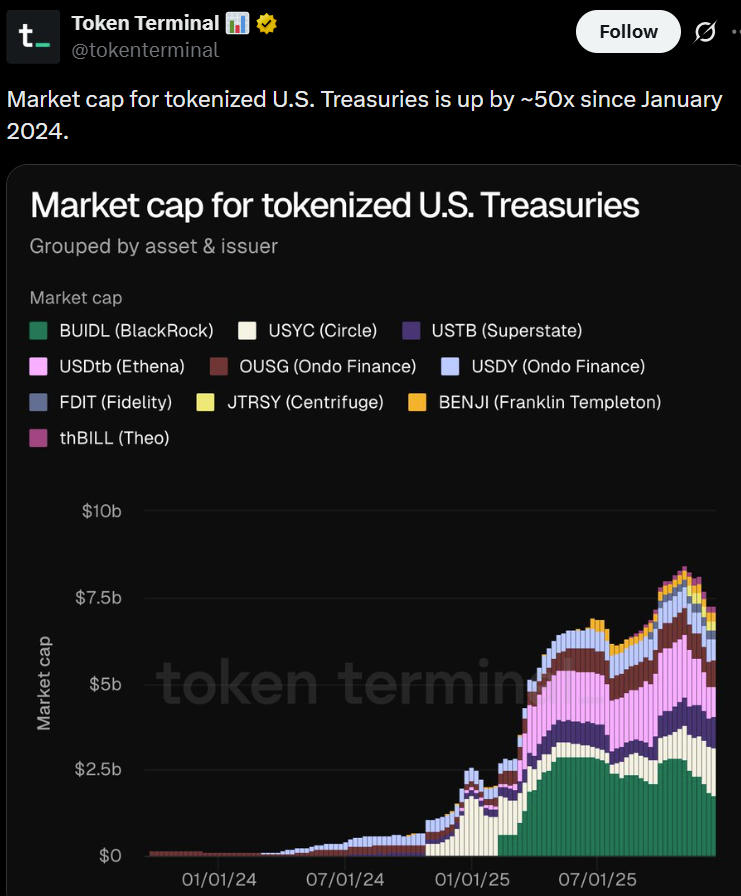
Source: Token Terminal

At the center of this expansion is BlackRock’s USD Institutional Digital Liquidity Fund (BUIDL), which is widely regarded as the flagship product of the tokenized Treasury market.

The blockchain-based fund provides investors with exposure to short-term US Treasurys while offering daily yield accrual and onchain settlement. Industry data shows that BUIDL has amassed close to $2 billion in assets under management.

Other prominent offerings include USD Coin Yield (USYC) from Circle, US Treasury Bill Token (USTB) from Superstate and Ondo Short-Term US Government Bond Fund (OUSG) from Ondo Finance.

Each product offers tokenized access to US government debt through regulated fund structures, reflecting a broader push to bring traditional fixed-income instruments onto blockchain rails.

Related: Goldman Sachs, BNY to offer tokenized money market funds for clients

Tokenized Treasury bills emerge as a key gateway to institutional DeFi

US Treasury bills are particularly well-suited for tokenization, as they combine the safety of US government backing with the efficiency of blockchain-based settlement, creating a regulated gateway into decentralized finance (DeFi) markets.

As Cointelegraph has reported, institutional adoption of tokenized Treasury bills is gaining traction, particularly for use in settlement and margining. Traditional financial institutions are using tokenized government debt to improve capital efficiency while maintaining exposure to low-risk assets.

DBS, Southeast Asia’s largest financial institution by assets, was among the first major lenders to test tokenized funds, including blockchain-based Treasury products. The bank has piloted tokenized money market funds and government securities as part of broader efforts to use onchain assets for collateral management and settlement.

Tokenized Treasury bills have grown in tandem with other onchain assets, contributing to the rapid evolution of the tokenization market. RedStone data shows that private credit has been the fastest-growing segment, buoyed by yields that exceed those of traditional investment vehicles.


Related: New protocol targets redemption delays in $20B tokenized market

Trending Cryptos

Related Questions

QWhat is the reported growth rate of the tokenized US Treasurys market since January 2024, according to Token Terminal?

AThe market has experienced 50x growth, surging from well under $200 million in January 2024 to almost $7 billion in late 2025.

QWhich fund is considered the flagship product of the tokenized Treasury market and how much in assets has it amassed?

ABlackRock’s USD Institutional Digital Liquidity Fund (BUIDL) is the flagship product, and it has amassed close to $2 billion in assets under management.

QName three other prominent tokenized US Treasury products mentioned besides BlackRock's BUIDL.

AThe other prominent products are USD Coin Yield (USYC) from Circle, US Treasury Bill Token (USTB) from Superstate, and Ondo Short-Term US Government Bond Fund (OUSG) from Ondo Finance.

QWhy are US Treasury bills described as being particularly well-suited for tokenization?

AThey combine the safety of US government backing with the efficiency of blockchain-based settlement, creating a regulated gateway into decentralized finance (DeFi) markets.

QWhich major Southeast Asian financial institution was mentioned as an early tester of tokenized funds, including Treasury products?

ADBS, Southeast Asia’s largest financial institution by assets, was among the first major lenders to test tokenized funds.

Related Reads

Bitcoin Withdrawals Continue: 8 Years of Storage in a Coldcard Cold Wallet Ended in Zero

Coldcard Hardware Wallet Hacked: Losses Mount Due to Vulnerable Seed Generation A critical vulnerability in Coldcard hardware wallets has led to a continued wave of fund thefts. According to Galaxy Research, the total stolen has reached 1,367.05 BTC (approx. $88.6 million) from 4,585 addresses, a significant increase from the initial 594.5 BTC reported on July 30, 2026. Most of the stolen funds remain on the attackers' addresses. The issue is not with the current firmware, which Coinkite has updated, but with seed phrases generated on vulnerable devices between March 2021 and the release of fixed firmware versions. Due to a programmer error, devices switched from using a hardware random number generator to the software-based Yasmarang generator, which was initialized with publicly accessible data like the chip's serial number. This made the seed phrases predictable through offline brute-force attacks, meaning wallets remain at risk until funds are moved to a new wallet generated with the patched firmware. Affected devices include Mk2/Mk3 with firmware 4.0.1–4.1.9 (and up to 5.0.3), Mk4/Mk5 up to version 5.6.0, and Q models up to 1.5.0Q. The only exceptions are seeds created with a high-entropy method like at least 50 independent dice rolls or a strong unique BIP-39 passphrase. All other owners must generate a new seed on the fixed firmware and transfer their assets. A case highlighting the human impact involves a 39-year-old long-term investor who lost 2 BTC (approx. $130,000) in minutes. He had accumulated the Bitcoin over eight years through physical labor, viewing it as a financial lifeline and a retirement plan in a country suffering from hyperinflation. His story underscores that even conservative "buy and hold in cold storage" strategies can be compromised by such underlying technical flaws. From a technical perspective, this incident echoes historical failures where weak random number generators undermined cryptographic security, challenging the assumption that offline storage is automatically foolproof.

cryptonews.ru2h ago

Bitcoin Withdrawals Continue: 8 Years of Storage in a Coldcard Cold Wallet Ended in Zero

cryptonews.ru2h ago

Trading

Spot

Hot Articles

How to Buy US

Welcome to HTX.com! We've made purchasing Talus Network (US) simple and convenient. Follow our step-by-step guide to embark on your crypto journey.Step 1: Create Your HTX AccountUse your email or phone number to sign up for a free account on HTX. Experience a hassle-free registration journey and unlock all features.Get My AccountStep 2: Go to Buy Crypto and Choose Your Payment MethodCredit/Debit Card: Use your Visa or Mastercard to buy Talus Network (US) instantly.Balance: Use funds from your HTX account balance to trade seamlessly.Third Parties: We've added popular payment methods such as Google Pay and Apple Pay to enhance convenience.P2P: Trade directly with other users on HTX.Over-the-Counter (OTC): We offer tailor-made services and competitive exchange rates for traders.Step 3: Store Your Talus Network (US)After purchasing your Talus Network (US), store it in your HTX account. Alternatively, you can send it elsewhere via blockchain transfer or use it to trade other cryptocurrencies.Step 4: Trade Talus Network (US)Easily trade Talus Network (US) on HTX's spot market. Simply access your account, select your trading pair, execute your trades, and monitor in real-time. We offer a user-friendly experience for both beginners and seasoned traders.

5.6k Total ViewsPublished 2025.12.11Updated 2026.06.02

How to Buy US

Discussions

Welcome to the HTX Community. Here, you can stay informed about the latest platform developments and gain access to professional market insights. Users' opinions on the price of US (US) are presented below.

活动图片