Tiger Research: U.S. Strategic Bitcoin Reserve - Should the Market Be Happy or Disappointed?

marsbitPublished on 2026-06-16Last updated on 2026-06-16

Abstract

Tiger Research analyzes the evolution of U.S. legislative efforts regarding a strategic Bitcoin reserve, concluding the market impact is limited in the short term but potentially positive long-term. The core event was a March 2025 executive order by former President Trump, which designated confiscated Bitcoin as a strategic reserve and promised not to sell existing holdings (approx. 190k BTC). As it contained no mandate to purchase new Bitcoin, the market reacted negatively, with prices dropping 5.7%. Legislative history shows a significant retreat from initial ambitions. The 2024 "BITCOIN Act" proposed mandatory purchases of 1 million BTC over five years. Reintroduced in 2025, it stalled due to high fiscal costs, concerns over dollar hegemony, and opposition from the Treasury Secretary. The current frontrunner, the 2026 "American Retirement and Monetary Advancement (ARMA) Act," is a compromise. It lacks any purchase requirement, instead focusing on consolidating existing government-held Bitcoin and legally prohibiting its sale for at least 20 years. While ARMA has higher passage odds due to bipartisan support and no purchase mandate, its immediate market effect is neutral. It eliminates potential government selling pressure but creates no new demand. The long-term significance is that formally establishing Bitcoin as a national reserve asset in law could later reignite debates on mandatory purchases. Therefore, the path to a government buyer is longer than initially price...

This article is written by Tiger Research. News about a U.S. strategic Bitcoin reserve has circulated for nearly two years. The core of the initial BITCOIN Act (introduced in 2024) was active government purchases of Bitcoin, whereas the ARMA Act contains no such provisions. Whether the market should view this as positive remains an open question.

Key Points

The executive order signed by Trump in March 2025 committed to not selling the Bitcoin already held by the federal government but did not require the purchase of new coins. The market had anticipated more; when the order's content became clear, the Bitcoin price immediately dropped by 5.7%.

Legislative efforts beginning in 2024 have significantly retreated over the past two years: from a bill requiring the purchase of 1 million BTC to a bill containing only custodial obligations and no purchase requirements whatsoever.

The most likely to pass currently, the American Retirement and Monetary Advancement Act (ARMA), is not a purchase bill. It prohibits the government from selling its existing Bitcoin holdings for at least 20 years.

ARMA has limited short-term impact on the Bitcoin market. In the long term, establishing the legal status of Bitcoin as a national reserve asset could reopen the discussion on mandatory purchases, which would be positive for the market.

Background: What the U.S. Has and Has Not Done

During the 2024 presidential campaign, Trump repeatedly promised to establish a strategic Bitcoin reserve, which the market interpreted as the federal government becoming a direct buyer.

After the election, on March 6, 2025, Trump signed an executive order designating Bitcoin obtained through criminal investigations and civil forfeiture as a strategic reserve and directing its permanent holding. The order did not instruct the acquisition of new Bitcoin; it only committed to not selling the Bitcoin the government already owns. When the order's content became clear, the Bitcoin price fell from about $92,000 to below $85,000.

At the time of signing, the federal government held approximately 190,000 BTC, about 0.9% of the total 21 million supply. This Bitcoin came entirely from criminal and civil proceedings; not a single coin was purchased.

The situation remains unchanged. Nothing beyond the executive order has been enacted into law.

Legislative History
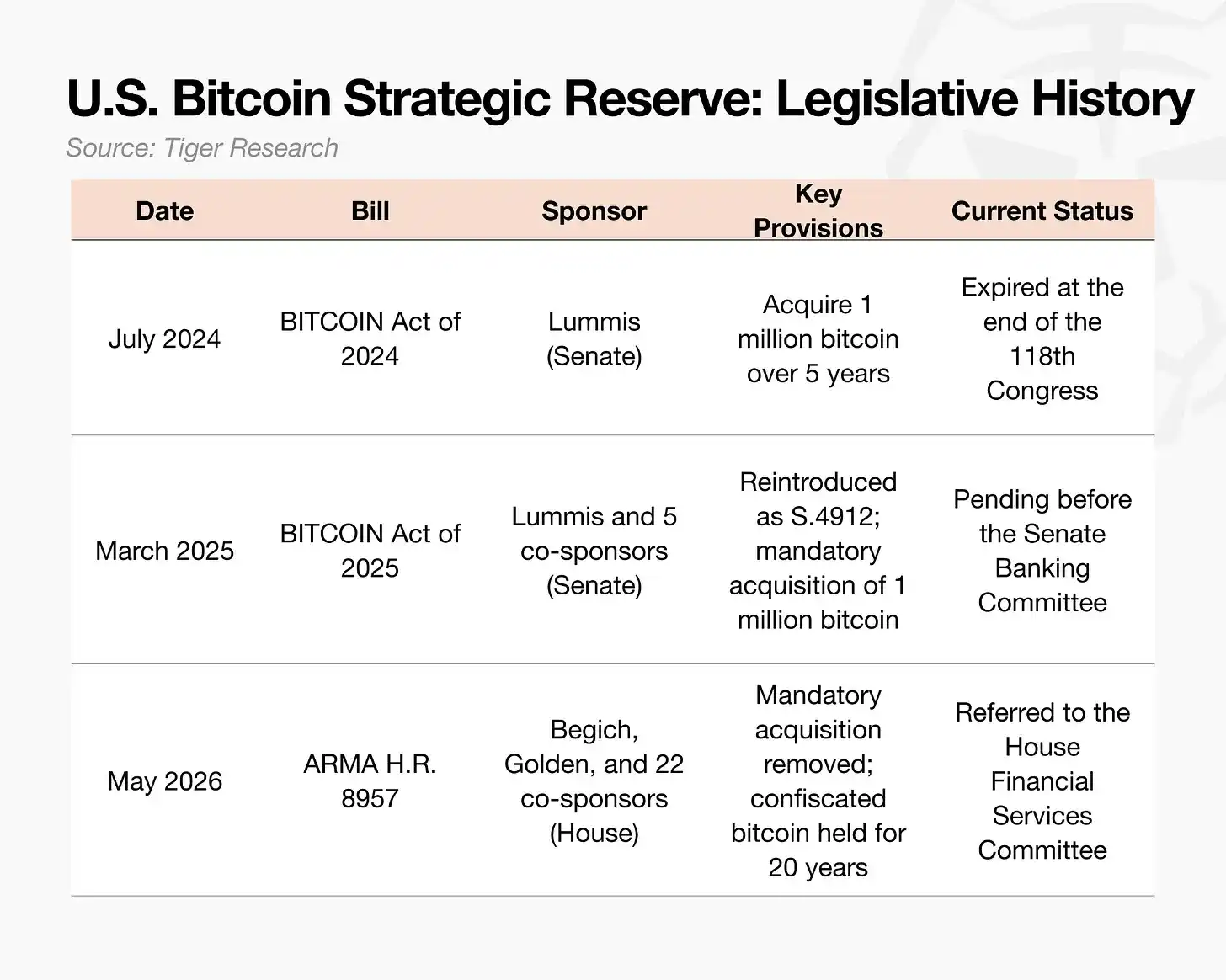
Discussions starting in 2021 produced the first concrete bill in 2024, reintroduced in 2025, and reframed as ARMA in 2026. The main theme of this evolution has been constant compromise with political reality: mandatory purchase quantities went from being present to being absent. Each revision made passage more feasible but simultaneously reduced market impact.

2024: The Original Bill

Since entering the Senate in 2021, Senator Lummis has publicly called for incorporating Bitcoin into the federal reserve. There was no consensus within Congress at the time, and the crypto winter of 2022-2023 coupled with the FTX collapse made the environment even more unfavorable.

The situation shifted in 2024 with Bitcoin surpassing $100,000 and spot ETFs receiving regulatory approval. In July of that year, Lummis introduced the first concrete legislation: requiring the purchase of 1 million Bitcoin over five years, to be held for at least 20 years, funded by the Federal Reserve's surplus account.

1 million BTC represents 4.76% of the total supply, exceeding the approximately 840,000 reportedly held by Strategy. The bill automatically expired at the end of that Congress.

2025: Reintroduction and Stalled Progress

In March 2025, the same month as the executive order, Lummis reintroduced the BITCOIN Act as Senate Bill 954. The core structure remained unchanged: annual purchases of 200,000 BTC, accumulating to 1 million over five years, held for 20 years. The revised version canceled certain exemptions from the disposal ban, tightened holding obligations, and added four cosponsors.

The market reaction was generally positive, but the bill faced substantive resistance on three fronts:

  • Fiscal Cost: Valued at trillions of won at the time, 1 million Bitcoin. Fiscal conservatives within the Republican party viewed gold as a stable store of value and Bitcoin as a speculative asset, opposing any mandatory purchase structure.
  • Dollar Hegemony: Democratic critics, led by Representative Maxine Waters, argued that treating Bitcoin as a reserve asset would weaken the dollar's status as the global reserve currency.
  • Treasury Secretary's Stance: In August 2025, Treasury Secretary Bessent publicly stated the government would not pursue additional Bitcoin purchases. As the official responsible for executing the law, he had clearly voiced opposition.

The bill has remained in the Senate Banking Committee since.

2026: ARMA as Legislative Compromise

In May 2026, Representative Nick Begich introduced the American Retirement and Monetary Advancement Act (ARMA), with Democratic Representative Jared Golden joining as a cosponsor. The name change itself is strategic: aimed at distancing the bill from the associations of previous, difficult-to-advance legislation and broadening its coalition of supporters.

ARMA does two things: consolidates all Bitcoin currently held or forfeited by the federal government into a single reserve managed by the Treasury, and prohibits the sale of this Bitcoin for at least 20 years. The sole exception to the disposal ban is using it to pay down the national debt.

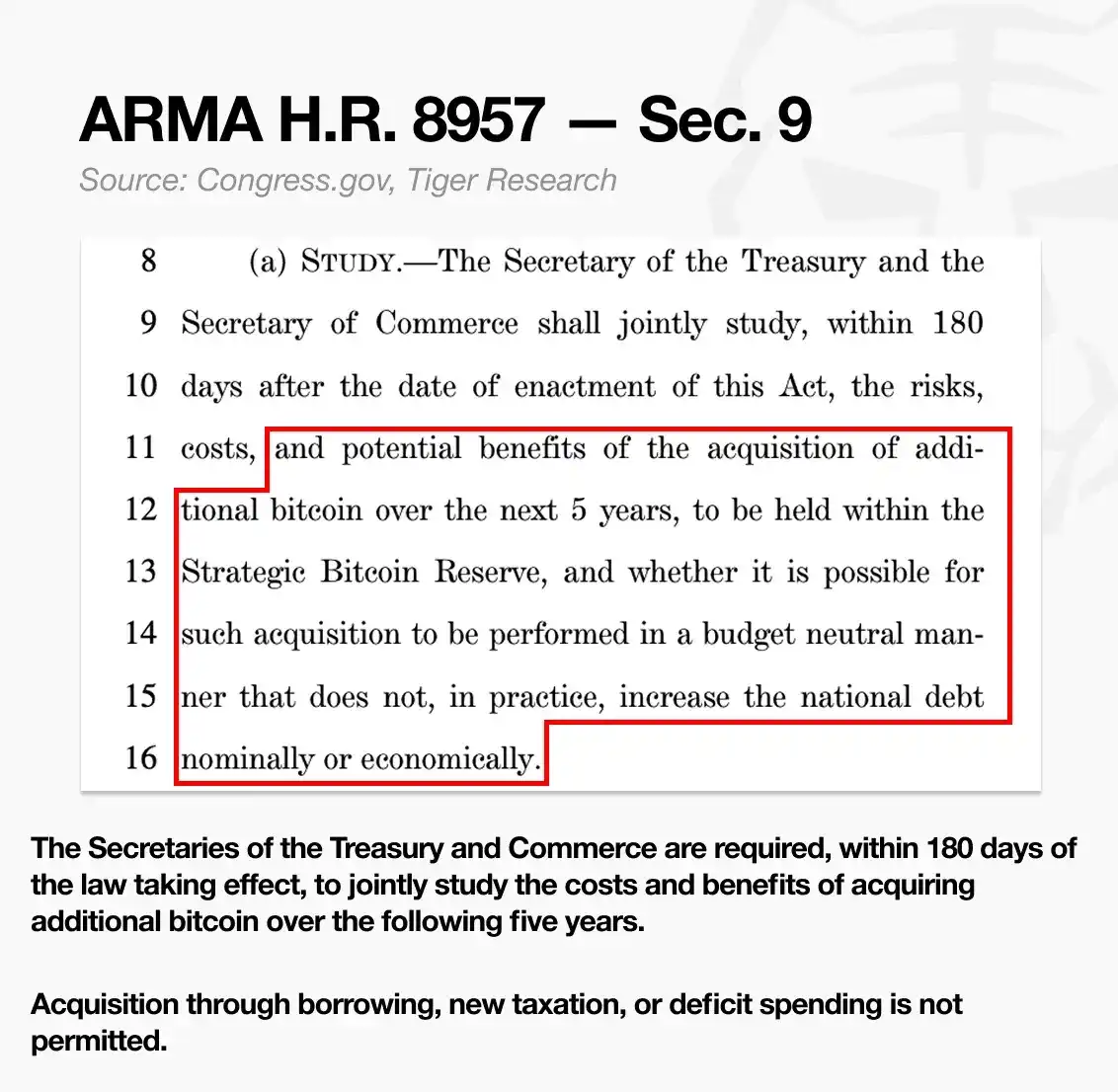
The decisive difference from its predecessor is what ARMA does not contain. The BITCOIN Act mandated annual purchases of 200,000 BTC, whereas ARMA completely removes this obligation. Instead, it directs the Treasury and Commerce Departments to study and report within 180 days on whether additional purchases can be achieved in a budget-neutral manner. A study mandate, not a purchase mandate.

ARMA is essentially a custody and holding bill, not an acquisition bill. Its goal is passage, and it is structured accordingly.

Short-Term Outlook: Limited Market Impact

Currently, two bills are moving through Congress in parallel. The BITCOIN Act (S.954) is in the Senate Banking Committee; ARMA is in the House. Their goals differ: BITCOIN Act is an acquisition bill, ARMA is a custody bill.

ARMA has a higher probability of passage. The BITCOIN Act has been stalled in committee for over a year, weighed down by fiscal cost and purely Republican support. ARMA has Democratic support and imposes no purchase obligations, removing the most common objections.

Even so, the passage of ARMA itself would not constitute a short-term positive for the Bitcoin market. If ARMA were enacted, the approximately 320,000 BTC currently held by the federal government would be legally barred from entering the market for at least 20 years. The pressure of potential government selling would disappear. But the issue is that without any purchase obligation, there is no new demand. The market wants direct government purchases of Bitcoin, and ARMA does not provide that. Its practical effect is closer to elevating the March 2025 executive order to statutory status.
The key lies in what might happen after ARMA. Nick Begich, a Bitcoin holder since 2013, was a House cosponsor of the March 2025 BITCOIN Act. He publicly supports Bitcoin as a strategic asset. The structure of ARMA suggests a phased approach rather than an immediate solution: first, establish the legal framework, then build the acquisition mandate upon it.

If ARMA passes and Bitcoin gains formal legal status as a national reserve asset, then the debate on mandatory purchases is likely to reopen on a firmer foundation. The path to this outcome is longer than the market initially priced in during Trump's campaign promises, but the direction has not changed.

In short, the passage of ARMA would have limited short-term impact on price. In the long term, it remains a constructive factor for the market; if ARMA passes, the probability of eventual purchase legislation becomes more visible.


Trending Cryptos

Related Questions

QWhat is the key difference between the original BITCOIN Act (2024/S.954) and the ARMA bill (2026) regarding government involvement with Bitcoin?

AThe key difference is the absence of a mandatory purchase requirement. The original BITCOIN Act mandated the U.S. government to purchase 1 million Bitcoin over five years. In contrast, the ARMA bill is a custody bill, not an acquisition bill. It only requires the government to consolidate its existing seized Bitcoin holdings into a single reserve and legally prohibits selling them for at least 20 years, with no provisions for buying new Bitcoin.

QAccording to the article, why did the price of Bitcoin drop following President Trump's 2025 executive order on a strategic Bitcoin reserve?

AThe price dropped because the market's expectations were higher than the actual content of the order. The market had interpreted Trump's campaign promises as the federal government becoming a direct buyer. However, the executive order only designated confiscated Bitcoin as a strategic reserve and instructed permanent holding (no selling), with no directive to acquire new Bitcoin. This disappointment led to an immediate price drop from around $92,000 to below $85,000.

QWhat are the three main obstacles that prevented the BITCOIN Act (S.954) from progressing in Congress, as outlined in the article?

AThe three main obstacles are: 1) Fiscal Cost: Republican fiscal conservatives objected to spending trillions on Bitcoin, viewing it as a speculative asset compared to gold. 2) Dollar Hegemony: Democratic critics, led by figures like Maxine Waters, argued that recognizing Bitcoin as a reserve asset would weaken the U.S. dollar's global dominance. 3) Treasury Secretary's Stance: In August 2025, Treasury Secretary Bessent publicly stated the government would not pursue additional Bitcoin purchases, signaling executive branch opposition.

QWhat is the short-term market impact expected if the ARMA bill is passed into law, and why?

AThe short-term market impact is expected to be limited. While ARMA would legally lock up the government's existing ~320,000 Bitcoin, preventing potential future sales pressure, it creates no new, direct demand from the government because it contains no mandatory purchase provisions. The market had priced in the expectation of a major government buyer, which ARMA does not provide. Its effect is closer to codifying the 2025 executive order into law.

QWhat long-term strategic purpose does the ARMA bill serve for Bitcoin proponents, according to the article's analysis?

AThe long-term strategic purpose of ARMA is to establish a foundational legal framework. By giving Bitcoin the formal legal status of a national reserve asset, it creates a more solid basis for future legislative debates about mandatory government purchases. The article describes it as a phased approach: first secure the legal status and custody structure, then potentially build acquisition mandates on top of it. This makes the path to a future 'purchase bill' more visible and plausible, even if it takes longer than initially hoped.

Related Reads

Trends in US Stocks (June 22): Strait of Hormuz Agreement Changes Course, Thursday's PCE and Micron to Determine Chip Sector Direction

U.S. Stock Market Outlook (June 22): Strait of Hormuz Deal Falters, Thursday's PCE & Micron to Set Chip Sector Direction. Geopolitical tensions resurged over the weekend as Iran's IRGC announced the closure of the Strait of Hormuz, and its negotiation team walked out after threats from Trump, pausing U.S.-Iran talks. This renewed risk premium is weighing on U.S. equity futures ahead of the open. Last week's market was driven by chip stocks, with the Philly Semiconductor Index hitting a record high. While the Fed's hawkish tone was overshadowed by initial deal optimism, the S&P 500 gained 0.9% for the week. SpaceX debuted strongly but ended with two down days. Key events this week: The status of U.S.-Iran negotiations remains the immediate variable for oil and energy stocks. Monday sees Marvell and Flex added to the S&P 500. Tuesday's MSCI reclassification could benefit South Korean semiconductors and memory stocks. **Thursday, June 25th, is the critical day**, featuring the May Core PCE report and Micron's earnings. Hotter PCE data could solidify expectations for two 2024 rate hikes, while softer data would rapidly reprice rate cut bets. Micron's report is a key test for the AI narrative; the market will scrutinize its 2027 HBM supply visibility, HBM4 progress, and its position in Nvidia's Vera Rubin supply chain. Nvidia's AGM and a potential OpenAI GPT-5.6 release will make Thursday a pivotal 24 hours for AI. Friday concludes with the Russell reconstitution, elevating small-cap volatility. In summary, last week's gains face a true test. The path hinges on two concurrent threads: geopolitical developments with Iran and the AI narrative defined by Micron's guidance and Nvidia's updates. The chip sector's record highs are vulnerable if Thursday brings hot PCE data and conservative guidance from Micron. Conversely, positive outcomes could reaffirm the AI bull case, making this week's volatility a potential entry window.

marsbit40m ago

Trends in US Stocks (June 22): Strait of Hormuz Agreement Changes Course, Thursday's PCE and Micron to Determine Chip Sector Direction

marsbit40m ago

OpenAI's "Most Open" Move: Codex No Longer Exclusively Favors GPT

OpenAI has significantly opened up its Codex programming agent by introducing a "model provider" configuration layer that allows users to connect it with various open-source models, not just its proprietary GPT. Through a configuration file or a simple `--oss` command-line flag, Codex can now route requests to local services like Ollama or LM Studio, or to third-party APIs such as Mistral or DeepSeek. This move is seen as one of OpenAI's most "open" steps, potentially lowering costs and enhancing privacy for developers who can run code generation offline. However, integration isn't seamless for all models. Codex primarily uses OpenAI's newer Responses API, while many open-source models rely on the older Chat Completions interface. This creates compatibility issues, especially for advanced features like function calling. The developer community is already building "routing" or adapter layers (e.g., CC Switch, LiteLLM) to translate between these protocols, enabling hybrid setups where GPT handles planning and open-source models handle execution. Analysts interpret this as a strategic shift for OpenAI: from competing solely on model superiority to controlling the platform and interface standards. By making Codex a flexible, pluggable entry point for AI-assisted programming, OpenAI aims to become the central hub in the developer toolchain ecosystem, even as users gain the freedom to switch underlying models.

marsbit1h ago

OpenAI's "Most Open" Move: Codex No Longer Exclusively Favors GPT

marsbit1h ago

When 500 Million People Abandon ChatGPT

ChatGPT's Global AI Assistant Market Share Drops Below 50% Three and a half years after its groundbreaking launch, ChatGPT faces a pivotal moment. While it remains the largest AI assistant globally, its market share has fallen below 50% for the first time, reaching 46.4% as of May, according to Sensor Tower's 2026 AI landscape report. Google's Gemini (27.7%) and Anthropic's Claude (10.3%) are now its main competitors, with Grok, Perplexity, and others also gaining ground. The market has evolved from awe and initial adoption into a phase of product comparison, ecosystem integration, and commercialization. User behavior has matured significantly. Loyalty is low; users readily switch between assistants for specific tasks. Gemini benefits from deep integration within Google's ecosystem (Search, Gmail, Android), while Claude has carved a niche among productivity-focused users with strong retention, nearly matching ChatGPT's. User choice is now influenced by a complex mix of capability, ecosystem, price, use case, and even brand trust. Commercialization is accelerating. AI app downloads continue but growth is slowing, while user spending is rising. Over $4.2 billion was spent in-app during H1 2026. Claude leads in premium subscription conversion rates (13%). OpenAI is expanding its revenue streams, testing ads shown to 17% of ChatGPT users daily by May. This shift highlights the immense financial pressure of model training and inference costs. Despite revenue growth, OpenAI's cash burn is intense, reaching $3.7 billion in Q1 2026. The company projects this could rise to $25-57 billion in the coming years, underscoring the industry-wide challenge of scaling profitably. The symbolism is clear: ChatGPT no longer defines the AI assistant market alone. The era of a single dominant product is over. Gemini, Claude, and specialized tools are collectively shaping user habits and business models. As AI assistants move from novelty to utility—judged on accuracy, efficiency, and value—they are becoming embedded in everyday digital life. ChatGPT may have lost its majority, but AI as a whole is winning, entering a mature, competitive, and diverse new phase.

marsbit1h ago

When 500 Million People Abandon ChatGPT

marsbit1h ago

Trading

Spot
Futures

Hot Articles

What is $BITCOIN

DIGITAL GOLD ($BITCOIN): A Comprehensive Analysis Introduction to DIGITAL GOLD ($BITCOIN) DIGITAL GOLD ($BITCOIN) is a blockchain-based project operating on the Solana network, which aims to combine the characteristics of traditional precious metals with the innovation of decentralized technologies. While it shares a name with Bitcoin, often referred to as “digital gold” due to its perception as a store of value, DIGITAL GOLD is a separate token designed to create a unique ecosystem within the Web3 landscape. Its goal is to position itself as a viable alternative digital asset, although specifics regarding its applications and functionalities are still developing. What is DIGITAL GOLD ($BITCOIN)? DIGITAL GOLD ($BITCOIN) is a cryptocurrency token explicitly designed for use on the Solana blockchain. In contrast to Bitcoin, which provides a widely recognized value storage role, this token appears to focus on broader applications and characteristics. Notable aspects include: Blockchain Infrastructure: The token is built on the Solana blockchain, known for its capacity to handle high-speed and low-cost transactions. Supply Dynamics: DIGITAL GOLD has a maximum supply capped at 100 quadrillion tokens (100P $BITCOIN), although details regarding its circulating supply are currently undisclosed. Utility: While precise functionalities are not explicitly outlined, there are indications that the token could be utilized for various applications, potentially involving decentralized applications (dApps) or asset tokenization strategies. Who is the Creator of DIGITAL GOLD ($BITCOIN)? At present, the identity of the creators and development team behind DIGITAL GOLD ($BITCOIN) remains unknown. This situation is typical among many innovative projects within the blockchain space, particularly those aligning with decentralized finance and meme coin phenomena. While such anonymity may foster a community-driven culture, it intensifies concerns about governance and accountability. Who are the Investors of DIGITAL GOLD ($BITCOIN)? The available information indicates that DIGITAL GOLD ($BITCOIN) does not have any known institutional backers or prominent venture capital investments. The project seems to operate on a peer-to-peer model focused on community support and adoption rather than traditional funding routes. Its activity and liquidity are primarily situated on decentralized exchanges (DEXs), such as PumpSwap, rather than established centralized trading platforms, further highlighting its grassroots approach. How DIGITAL GOLD ($BITCOIN) Works The operational mechanics of DIGITAL GOLD ($BITCOIN) can be elaborated on based on its blockchain design and network attributes: Consensus Mechanism: By leveraging Solana’s unique proof-of-history (PoH) combined with a proof-of-stake (PoS) model, the project ensures efficient transaction validation contributing to the network's high performance. Tokenomics: While specific deflationary mechanisms have not been extensively detailed, the vast maximum token supply implies that it may cater to microtransactions or niche use cases that are still to be defined. Interoperability: There exists the potential for integration with Solana’s broader ecosystem, including various decentralized finance (DeFi) platforms. However, the details regarding specific integrations remain unspecified. Timeline of Key Events Here is a timeline that highlights significant milestones concerning DIGITAL GOLD ($BITCOIN): 2023: The initial deployment of the token occurs on the Solana blockchain, marked by its contract address. 2024: DIGITAL GOLD gains visibility as it becomes available for trading on decentralized exchanges like PumpSwap, allowing users to trade it against SOL. 2025: The project witnesses sporadic trading activity and potential interest in community-led engagements, although no noteworthy partnerships or technical advancements have been documented as of yet. Critical Analysis Strengths Scalability: The underlying Solana infrastructure supports high transaction volumes, which could enhance the utility of $BITCOIN in various transaction scenarios. Accessibility: The potential low trading price per token could attract retail investors, facilitating wider participation due to fractional ownership opportunities. Risks Lack of Transparency: The absence of publicly known backers, developers, or an audit process may yield skepticism regarding the project's sustainability and trustworthiness. Market Volatility: The trading activity is heavily reliant on speculative behavior, which can result in significant price volatility and uncertainty for investors. Conclusion DIGITAL GOLD ($BITCOIN) emerges as an intriguing yet ambiguous project within the rapidly evolving Solana ecosystem. While it attempts to leverage the “digital gold” narrative, its departure from Bitcoin's established role as a store of value underscores the need for a clearer differentiation of its intended utility and governance structure. Future acceptance and adoption will likely depend on addressing the current opacity and defining its operational and economic strategies more explicitly. Note: This report encompasses synthesised information available as of October 2023, and developments may have transpired beyond the research period.

415 Total ViewsPublished 2025.05.13Updated 2025.05.13

What is $BITCOIN

Discussions

Welcome to the HTX Community. Here, you can stay informed about the latest platform developments and gain access to professional market insights. Users' opinions on the price of BTC (BTC) are presented below.

活动图片