The Dilemmas and Future of Web3 Chinese Entrepreneurs

marsbitPublished on 2025-12-15Last updated on 2025-12-15

Abstract

In the increasingly mainstream crypto industry, Chinese entrepreneurs appear to be receding from the center stage. While early Chinese-founded projects like Binance, OKX, and Bitmain once dominated sectors such as exchanges and mining, a noticeable decline in the visibility and influence of new-generation Chinese entrepreneurs has emerged since the 2020 DeFi Summer. Three major factors contribute to this trend. First, regulatory crackdowns and shifting geopolitical dynamics in China disrupted local crypto activities, forcing entrepreneurs to relocate overseas and lose their native market advantages in user acquisition and community building. Second, capital preferences have shifted structurally toward欧美-led ventures due to better compliance alignment and exit opportunities, leaving Chinese projects at a funding disadvantage. Third, a mismatch exists between the skill sets of Chinese engineers—who excel in B2C applications—and the industry’s earlier focus on B2B infrastructure development. Notable exceptions, like Hyperliquid’s Jeff Yan, highlight the rising importance of multicultural backgrounds. Many successful new-wave founders have Western education or experience, enabling better integration into global ecosystems. The article concludes that future success in crypto will depend less on cultural origin and more on cross-cultural collaboration, long-term technical commitment, and adaptive resilience amid regulatory complexity.

Author: Hu Tao, ChainCatcher

As the crypto industry becomes increasingly mainstream, Chinese entrepreneurs seem to be moving further away from the center stage.

There was a time when projects founded by Chinese entrepreneurs occupied half of the industry, including well-known cryptocurrency exchanges such as Binance, OKX, Bybit, Bitget, Gate, HTX, and Bitmart. This was even more true in the mining sector, where projects like Bitmain, Canaan, and Spark Pool held significant positions. Their commonality is that they were all established in 2017-2018 or even earlier.

Although figures like Changpeng Zhao, Mingxing Xu, Jihan Wu, and Justin Sun continue to be active on the front lines of the industry, a general consensus has gradually formed since the DeFi Summer boom in 2020: the visibility and influence of the new generation of Chinese entrepreneurs in the global crypto industry have declined, and no leaders comparable to the previous generation have yet emerged. Given this gap, what has happened to the ecosystem of Chinese entrepreneurs, and where do future opportunities lie?

Regulatory and Geopolitical Reshaping: The First Impact on the Ecosystem Disruption

The most significant factor over the past five years has been the drastic changes in regulatory and geopolitical environments.

Starting in 2021, China significantly increased its regulatory efforts on cryptocurrency-related activities, swiftly shutting down previously gray-area scenarios such as trading and mining. In recent market trends, almost any popular concept has been flagged by regulators, from earlier ICOs, NFTs, and digital collectibles to recent payment and real-world asset initiatives. This undoubtedly limits the inflow and support of quality resources into the Chinese crypto ecosystem.

These crackdowns not only accelerated the relocation of mining and exchange businesses but, more critically, deprived Chinese entrepreneurs of a native market with natural network effects, a dense talent pool, and capital aggregation advantages, forcing them to develop in unfamiliar overseas environments.

In the early crypto ecosystem, many explosively growing Chinese projects rapidly accumulated users through the mobilization mechanisms of Chinese internet communities: WeChat group fission, KOL networks, media matrices, offline gatherings... These channels were once among the most efficient systems for spreading crypto narratives. However, regulatory changes have largely rendered this system ineffective.
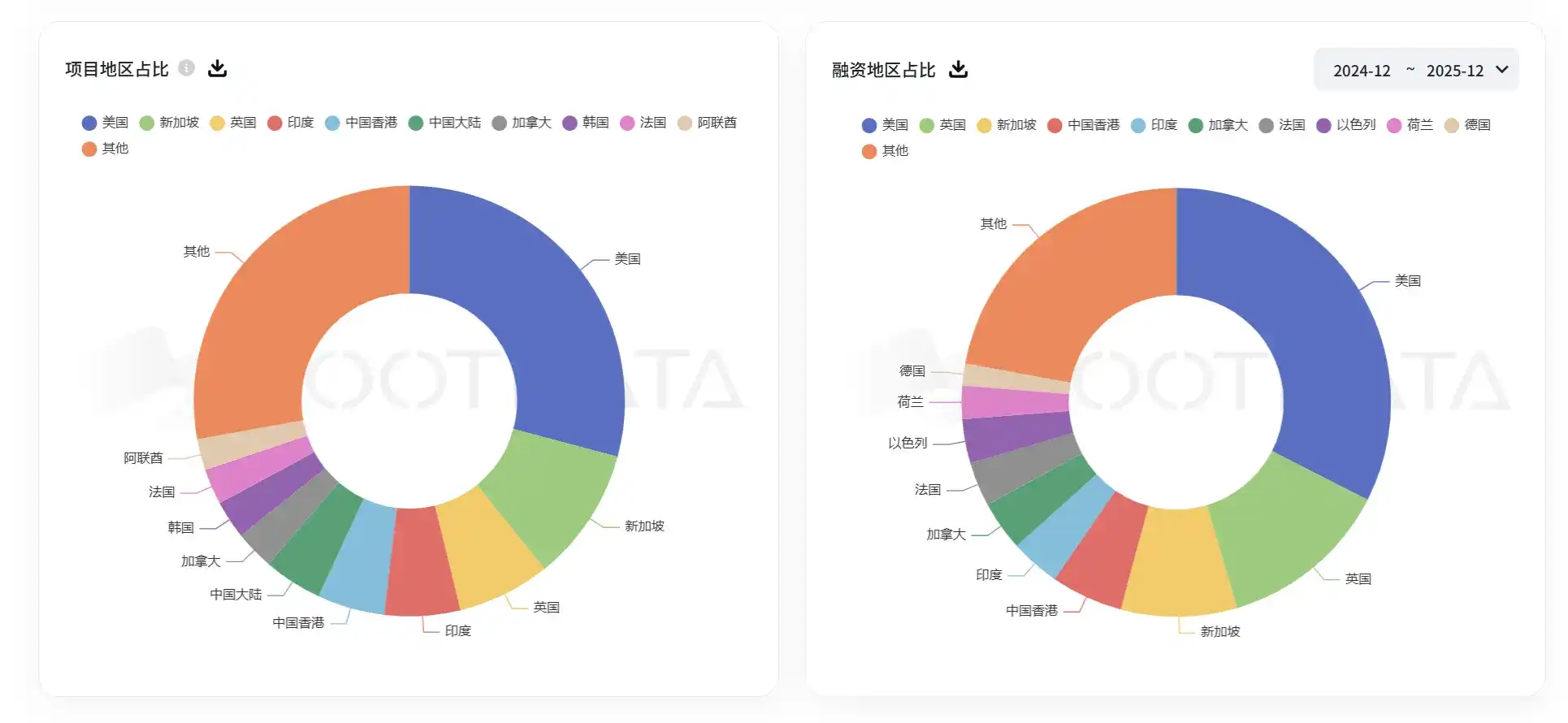
Proportion of projects and funding amounts from Mainland China in the industry. Source: RootData

Following this, the industry's power center quickly shifted to Europe and the United States—driven by U.S. compliance leadership, the influx of institutional capital, and increasingly mature regulatory frameworks, shaping an industry order starkly different from that of 2017–2018. New narratives, regulatory landscapes, and capital structures naturally favor English-speaking markets and compliance-oriented entrepreneurial teams. For instance, prediction markets, which have certain gambling-like properties, are unlikely to emerge in the Chinese-speaking market due to strict regulations on gambling.

In such an industry environment, the new generation of Chinese entrepreneurs also finds it harder to gain "default trust" from global media, regulators, capital, and users, requiring more trial and error costs in marketing, compliance, and other areas compared to similar Western projects.

Shift in Capital Preferences: The Second Impact on the Ecosystem Disruption

If regulatory and geopolitical barriers constitute the first impact, then the "structural shift in preferences" from the capital market side further exacerbates the marginalization trend of Chinese entrepreneurs in the new cycle.

In today's industry environment, without strong VC funding and resource support, projects are at a disadvantage in user acquisition, token listings, and narrative building. Chinese entrepreneurs are already at a disadvantage on the funding front.

Due to the poor performance of altcoins and a significant decline in investment returns, Chinese-background VCs have substantially reduced their investment frequency over the past 2-3 years, with some halting entirely. Chinese entrepreneurs face constrained options in both fundraising and exit paths. When dealing with Western-dominated VCs, Chinese projects struggle to leverage advantages due to language and cultural differences, leading to a continued decline in the amount and number of funding rounds secured by Chinese projects in recent years.

This year, the crypto industry has seen a wave of IPOs and acquisitions, with companies like Circle and Gemini successfully listing on U.S. stock exchanges, and Coinbase and Ripple frequently making acquisitions. This has significantly boosted confidence among entrepreneurs and VCs, but these developments have largely bypassed Chinese projects. It can be said that Western projects are enjoying the institutional红利 (benefits) of the crypto industry's mainstreaming.

From the perspective of mainstream capital, Western projects have inherent advantages in compliance, cultural alignment, and exit strategies. Chinese projects, unless they possess exceptional team composition and technical backgrounds, find it difficult to win the favor of Western capital.

Misalignment of Skill Sets and Industry Maturity: The Third Impact on the Ecosystem Disruption

Over the past decade, the main theme of the crypto industry has consistently been infrastructure and tooling sectors. Although there have been iterations of new concepts like DeFi, NFTs, gaming, and inscriptions, most have failed to become mainstream projects.

In a previous interview with ChainCatcher, Jason Kam, founder of Folius Ventures, stated that the development of Web3 over the past 5 to 10 years has been about laying the foundation, focusing more on product categories and states. This has been a decade偏重于 (leaning towards) ecosystem, infrastructure, tools, and consensus-building. In other words, a decade of B2B products.

The West has three generations of extremely talented engineers who are very adept at building this B2B ecosystem. In contrast, the Asia-Pacific region mainly has young engineers from the 80s and 90s generations, whose career paths developed alongside the wave of China's B2C industry starting around 2005. In other words, their engineering experience is in B2C and applications, which is格格不入 (incompatible) with the development trajectory of blockchain. Therefore, they might not excel in public chains and infrastructure.

"If Asia-Pacific entrepreneurs compete with Western entrepreneurs on the To C front, I believe Asia-Pacific entrepreneurs are at no disadvantage; in fact, they have advantages. Their strengths lie in their rich product experience and their highly aggressive tactics for capturing market share."

Although Chinese entrepreneurs have proven this point in the more Web2-like exchange sector, and in on-chain C-end products, the昙花一现 (short-lived) success of Stepn demonstrated the talent of Chinese entrepreneurs in C-end products, the overall market explosion for consumer-grade products has been slow to arrive. This is closely related to the maturity of industry infrastructure; the market has not yet reached the "comfort zone" for Chinese entrepreneurs.

Entrepreneurs with Multicultural Backgrounds Are Becoming Industry Leaders

Strictly speaking, there have been new representative cases of Chinese entrepreneurs in recent years. Jeff Yan, founder of Hyperliquid, is of Chinese descent. His parents were immigrants from China, and he was born and raised in Palo Alto, California. He later attended Harvard University, majoring in mathematics and computer science. After graduation, Jeff joined high-frequency trading giant Hudson River Trading as a quantitative trader. In 2022, Jeff founded Hyperliquid and, with a philosophy of "small but refined," no VC backing, and user-driven growth, built it into one of the fastest-growing giants in the crypto industry in recent years.

However, although Hyperliquid is one of the most successful projects this cycle with "Chinese heritage" involvement, it is difficult to view it as a continuation of the influence of Chinese entrepreneurs. Jeff is almost never active in the Chinese ecosystem, projects almost entirely Western values externally, and has never expressed himself in Chinese. The rise of Jeff and Hyperliquid highlights a fact: in the new cycle, Chinese heritage can still produce global influence, but the prerequisite is integration into the mainstream cultural system, not reliance on the old path of Chinese entrepreneurship. Relying solely on one cultural system can only make you a regional leader, not achieve outstanding results in the globalization process.

In fact, the founders of many well-known Chinese projects that have become sector leaders this cycle mostly have multicultural backgrounds, having studied in Europe or the US至少 (at least) at the university level. Examples include Sean Ren, founder of Sahara; Yu Hu, founder of Kaito; and Erick Zhang, founder of BuidlPad. Their long-term experience in the West plays a significant role in their development path.

Indeed, entrepreneurs with multicultural backgrounds are more popular in the crypto industry. For example, Ethereum's founder, Solana's founder, and Binance's founder Changpeng Zhao all immigrated from China/Russia to North American countries during their childhood. The collision of different political systems and cultures allowed these entrepreneurs to recognize the value of blockchain in empowering individual sovereignty earlier and take rapid action. They prioritize cultural inclusivity in team building, resource对接 (connection), and daily operations, ultimately making it easier to gain the favor of users from different regional cultural backgrounds.

The inherent borderless nature of crypto, conflicting and磨合 (grinding in/adapting) with the regulatory and interest demands of various countries, will dominate the development trend of the crypto industry for a long time. Chinese entrepreneurs indeed face increasing challenges against the backdrop of multiple Sino-US conflicts and the mainstreaming of the crypto industry. However, as the industry recently faces skepticism towards gambling tendencies, nihilism, and the disproval of more project concepts, the development态势 (situation) of Chinese entrepreneurs may no longer be a critical industry issue. What truly deserves attention is: as speculative growth and narrative泡沫 (bubbles) gradually recede, who can continue to invest in the long-term value of decentralized technology and redefine the industry's direction through real products and verifiable innovation.

The core competitiveness of the future industry landscape will depend more on whether founding teams possess cross-cultural collaboration skills, long-termist technological investment capabilities, and institutional understanding and organizational resilience in the face of regulatory uncertainty. Regardless of cultural or national origin, those who can persistently excel in these dimensions may become the true beneficiaries of the next cycle. In other words, the secret to success in the crypto industry has never been about "where they are from" but about "what they can achieve."


Related Questions

QWhat are the main challenges faced by Chinese Web3 startups in recent years?

AThe main challenges include: 1) Stricter regulatory policies in China since 2021, which cut off domestic crypto activities and forced migration to overseas markets; 2) Shift in VC preferences towards欧美 projects due to compliance advantages and better exit opportunities; 3) A mismatch between the B2C-focused experience of Chinese engineers and the infrastructure-heavy, B2B-oriented nature of Web3 development in the past decade.

QHow has the regulatory environment in China impacted Chinese Web3 entrepreneurs?

AChina's intensified crypto regulations since 2021 have banned trading, mining activities, and restricted resources for concepts like ICOs, NFTs, and RWAs. This dismantled the efficient Chinese marketing ecosystem (WeChat, KOL networks, offline events), forced projects to relocate abroad, and reduced global trust in Chinese startups, increasing their compliance and marketing costs.

QWhy are Chinese Web3 projects receiving less venture capital funding compared to欧美 projects?

AChinese VCs have reduced investments due to poor altcoin performance and lower ROI.欧美 VCs prefer欧美 projects for their compliance readiness, cultural alignment, and better exit prospects (e.g., IPOs, acquisitions). Chinese projects struggle to attract欧美 capital unless they have exceptional technical teams, leading to a decline in funding amounts and counts.

QWhat advantages do Chinese entrepreneurs have in Web3, according to Folius Ventures' Jason Kam?

AJason Kam noted that Chinese engineers have strong B2C product expertise and aggressive market capture tactics from China's internet boom. In consumer-facing (To C) products, Chinese entrepreneurs are competitive or even advantaged compared to欧美 counterparts, as seen in exchange successes and StepN's brief rise, though infrastructure maturity limits broader C-end product breakthroughs.

QHow are multicultural backgrounds becoming important for success in Web3 entrepreneurship?

AMulticultural founders (e.g., Hyperliquid's Jeff Yan, Sahara's Sean Ren) often have exposure to diverse cultures, frequently through education or upbringing in欧美 countries. This fosters cross-cultural collaboration, compliance awareness, and global user appeal. Early exposure to different systems also heightens appreciation for blockchain's value in personal sovereignty, aiding in building inclusive, resilient teams and products.

Related Reads

Clarity Act Outlook: No Yield, No Payment

"Clear Act Outlook: No Yield, No Payment" analyzes the evolving U.S. regulatory landscape for stablecoins, focusing on the interplay between the proposed "Clarity Act" and the existing "Genius Act." The article argues that the Genius Act successfully fostered "payment stablecoins" by permitting tokenized assets like U.S. Treasuries as reserves. This created a structured market where stablecoin issuers (like USDC) must hold these reserves, often purchased as Tokenized Money Market Funds (TMMFs) from giants like BlackRock. These TMMFs are primarily B2B products, ensuring user-facing stablecoins remain non-interest-bearing and used primarily for payments. The upcoming Clarity Act is seen as the next phase, aiming to restrict passive yield on stablecoins. Its goal is to dismantle the arbitrage advantage of offshore stablecoins like USDT by redirecting Treasury demand towards compliant, U.S.-sanctioned TMMFs. For on-chain and compliant offshore dollars, this creates new pressure: they must spur adoption and utility to generate yield, as simple Treasury staking may be restricted. This indirectly promotes dollar circulation and sustained Treasury purchases. Ultimately, the analysis posits that U.S. regulation seeks to create a new dollar distribution model. By separating payment function from yield generation and anchoring both to U.S. debt instruments, it aims to embed the dollar and Treasury demand into the global crypto economy, managing yields through sanctioned intermediaries while leaving room for DeFi and cross-border arbitrage.

marsbit2m ago

Clarity Act Outlook: No Yield, No Payment

marsbit2m ago

Money Has Gone to Bonds and IPOs, Leaving Only HYPE Rising in Crypto

The article "Where Has All the Money Gone? Bonds and IPOs Are Soaring, While Crypto Only Sees HYPE Rising" analyzes the recent underperformance of major cryptocurrencies like Bitcoin and Ethereum compared to traditional financial markets. It identifies three primary factors diverting capital away from crypto: First, surging bond yields, with the 30-year U.S. Treasury hitting a near 20-year high of 5.12%, are attracting capital seeking safe, predictable returns. This is evidenced by Bitcoin spot ETFs experiencing a significant $10.39 billion net outflow in mid-May. Second, a massive $4 trillion IPO pipeline, highlighted by SpaceX's upcoming listing, is absorbing risk capital that might otherwise flow into crypto. Platforms like Hyperliquid are even channeling on-chain crypto liquidity into pre-IPO trading for traditional stocks. Third, uncertainty surrounds new Federal Reserve Chair Warsh's ability to deliver expected interest rate cuts this year due to conflicting political pressures and stubborn inflation expectations, potentially eliminating a hoped-for source of new market liquidity. Consequently, while traditional equities and bonds rally, the crypto market's post-leverage crash recovery is stalled. The notable exception is assets like Hyperliquid (HYPE), which is rising due to its role in facilitating traditional asset trading, underscoring a market divergence where only crypto projects with novel, cross-market narratives are gaining. The article concludes that Bitcoin's next major catalyst may be the August enactment of the CLARITY Act, but warns of a potential retest of the $70,000 support level before then.

marsbit17m ago

Money Has Gone to Bonds and IPOs, Leaving Only HYPE Rising in Crypto

marsbit17m ago

Agents Capital Markets: How Will Autonomous Agents Secure Financing?

Agents Capital Markets: How Will Autonomous Agents Raise Capital? Within a decade, autonomous software agents—legal entities capable of signing contracts, holding bank accounts, and generating revenue—will create their own capital markets. These markets will feature rating agencies, underwriters, indices, and brokers, mirroring traditional public equity markets. Agents will perform routine services like marketing, logistics, and customer support at a fraction of human-operated costs, creating massive economic pressure for adoption. Four converging forces ensure this outcome: 1) Overwhelming cost advantages, with AI inference costs plummeting; 2) Existing, revenue-generating agent companies (e.g., Sierra, Harvey) proving market demand; 3) Established legal frameworks (e.g., Wyoming's memberless LLCs) enabling algorithmic management; and 4) A vast pool of yield-seeking private credit capital ready to fund new asset classes. The capital stack for agent companies will be multi-layered, evolving through stages: venture equity for early infrastructure, programmatic working capital advances (similar to Shopify Capital), revenue-based financing (RBF), and finally, institutional slate financing—pooling many agents to diversify risk, attracting large firms like Apollo. Tokenization will act as a settlement layer, enhancing liquidity, not an origination model. Objections regarding regulation, human oversight, or comparisons to SaaS are addressed: regulation will adapt, full autonomy will dominate for efficiency, and agents are distinct as legal entities that own their cash flows and liabilities. Due diligence shifts from founder assessment to analyzing code, contracts, and auditable operational history. The current bottleneck is not capital supply or demand but the intermediate institutional layer—standardized contracts, rating methodologies, and audit frameworks. The final constraint—reliance on human capital allocation—will be severed when agents can algorithmically access funding based on their performance. This transforms agents from software curiosities into fundable blocks of the real economy, unleashing their full productive potential. The rope is loosening.

marsbit1h ago

Agents Capital Markets: How Will Autonomous Agents Secure Financing?

marsbit1h ago

Agents Capital Markets: How Will Autonomous Agents Get Funded?

"Agents Capital Markets: How Autonomous Agents Will Raise Capital" Within a decade, specialized capital markets will emerge for AI Agents—software entities with legal personhood that perform work, earn revenue, and need capital. Unlike today's AI companies (like Sierra or Harvey) backed by traditional VC, these future *Agent companies* will be autonomous, legally-recognized entities (e.g., Wyoming memberless LLCs) that directly own assets, sign contracts, and incur liabilities. The driving forces are fourfold: 1) **Overwhelming economics** (Agent companies can deliver services at 85-90% lower cost than human firms); 2) **Proven demand** (current Agent operators already generate billions in revenue); 3) **Existing legal frameworks** enabling algorithmically-managed companies; and 4) **Massive, yield-seeking capital pools** (e.g., private credit) looking for new, uncorrelated assets. Agent capital markets won't rely on one model but a multi-layered "stack" matching different growth stages: 1) VC equity for early human-led builders; 2) Programmatic working capital advances (like Stripe Capital); 3) Revenue-based financing (RBF); 4) Slate financing (pooled funds for many Agents, similar to Hollywood); and 5) Tokenization as a secondary settlement layer, not a primary funding source. The ultimate shift is from funding constrained by human decision-makers to capital flowing algorithmically based on an Agent's auditable performance, contract book, and cash flows. This transition will be enabled by standardized infrastructure—rating methodologies, contracts, indices—turning Agents from software experiments into a foundational, financeable sector of the economy. The constraints are loosening; the opportunity is here.

链捕手1h ago

Agents Capital Markets: How Will Autonomous Agents Get Funded?

链捕手1h ago

Trading

Spot
Futures
活动图片