Money Has Gone to Bonds and IPOs, Leaving Only HYPE Rising in Crypto

marsbitPublished on 2026-05-19Last updated on 2026-05-19

Abstract

The article "Where Has All the Money Gone? Bonds and IPOs Are Soaring, While Crypto Only Sees HYPE Rising" analyzes the recent underperformance of major cryptocurrencies like Bitcoin and Ethereum compared to traditional financial markets. It identifies three primary factors diverting capital away from crypto: First, surging bond yields, with the 30-year U.S. Treasury hitting a near 20-year high of 5.12%, are attracting capital seeking safe, predictable returns. This is evidenced by Bitcoin spot ETFs experiencing a significant $10.39 billion net outflow in mid-May. Second, a massive $4 trillion IPO pipeline, highlighted by SpaceX's upcoming listing, is absorbing risk capital that might otherwise flow into crypto. Platforms like Hyperliquid are even channeling on-chain crypto liquidity into pre-IPO trading for traditional stocks. Third, uncertainty surrounds new Federal Reserve Chair Warsh's ability to deliver expected interest rate cuts this year due to conflicting political pressures and stubborn inflation expectations, potentially eliminating a hoped-for source of new market liquidity. Consequently, while traditional equities and bonds rally, the crypto market's post-leverage crash recovery is stalled. The notable exception is assets like Hyperliquid (HYPE), which is rising due to its role in facilitating traditional asset trading, underscoring a market divergence where only crypto projects with novel, cross-market narratives are gaining. The article concludes that Bitcoin...

Where has all the money gone?

The S&P 500 hit new all-time highs last week, and the Nasdaq completed a nearly seven-week winning streak. The 30-year US Treasury yield surged to 5.12%, the highest since 2007. SpaceX's Pre-IPO contracts on Hyperliquid saw $40 million in turnover on the first day.

Money is pouring in everywhere—except into crypto. BTC, which had just climbed above $82,000 on May 14th, has since tumbled below $77,000 in recent days. ETH fared no better, dropping nearly 10% over the week from the $2,300 range down to $2,110. Solana completely erased its recent gains, falling from a high near $100 back to $84. It seems nothing in the major crypto space is holding strong, except for HYPE.

Why is crypto, as a risk asset, falling behind alone?

30-Year Bond Yields Hit Nearly 20-Year High

The bond market is once again becoming the gravitational center for global capital.

The yield on the 30-year US Treasury bond has reached its highest level since June 2007, rising from 4.63% at the end of February to 5.12%. Meanwhile, the 10-year yield touched 4.6%, and the two-year yield climbed to 4.08%.
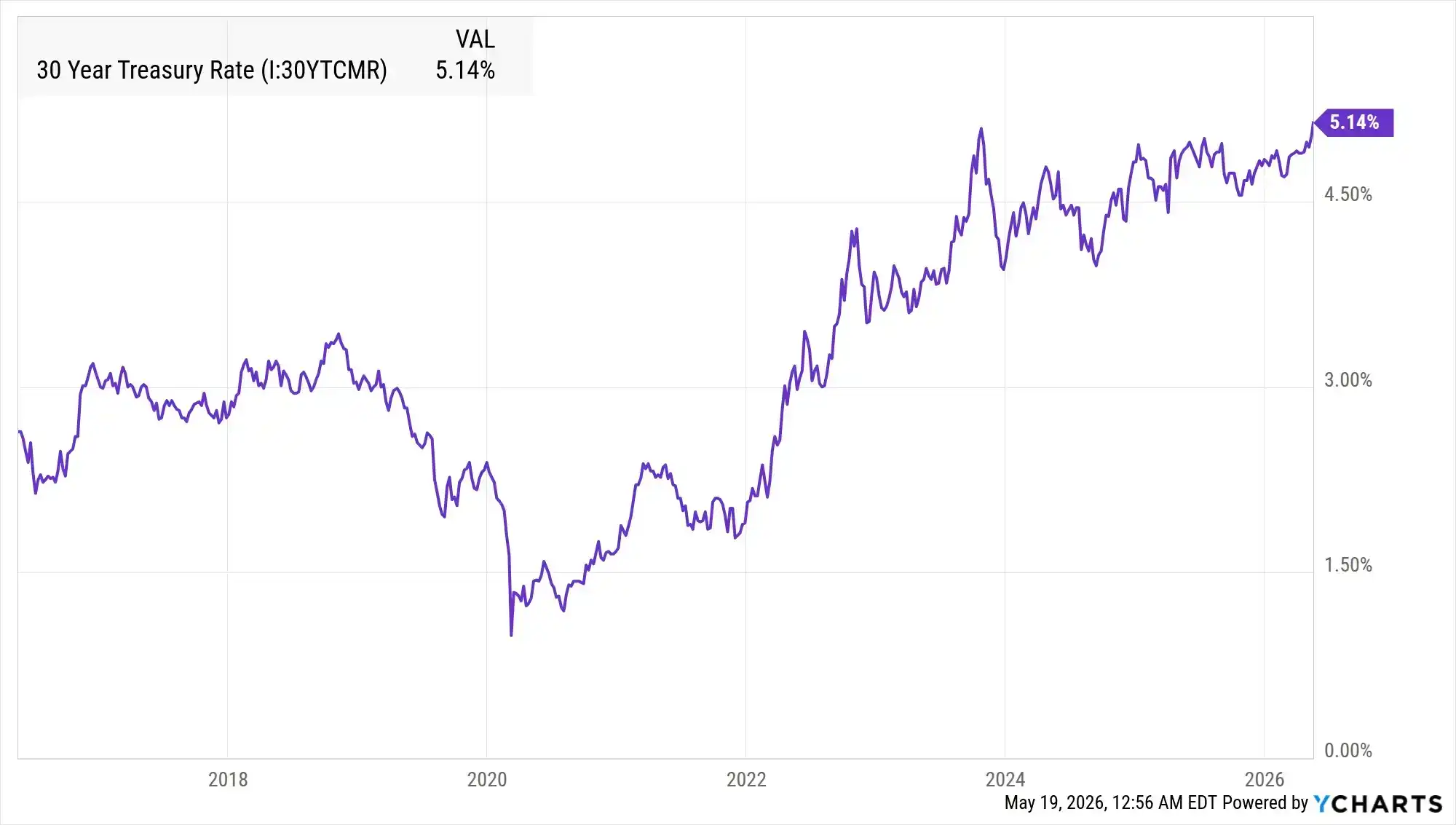
It's not just the United States. In a report on Sunday, May 17th, Apollo Global Management chief economist Torsten Slok stated that the yields on government bonds with maturities of 10 years or longer across G7 nations have collectively reached their highest levels since 2004, all approaching 5%.

Government fiscal deficits are expanding worldwide, necessitating more borrowing and bond issuance. The US fiscal deficit remains around 6% of GDP. Rising borrowing costs make it harder for governments to spend their way out of crises, precisely at a time when many countries face crises due to war.

In a report on May 18th, Deutsche Bank's Jim Reid noted that bond issues are likely to be on the agenda for the two-day G7 finance ministers' meeting opening that day in Paris. However, the structural problems in the bond market cannot be solved by any single ministerial meeting.

At a time of heightened geopolitical tension, global capital favors assets with more certain returns.

The outflow data from Bitcoin ETFs also corroborates this point.
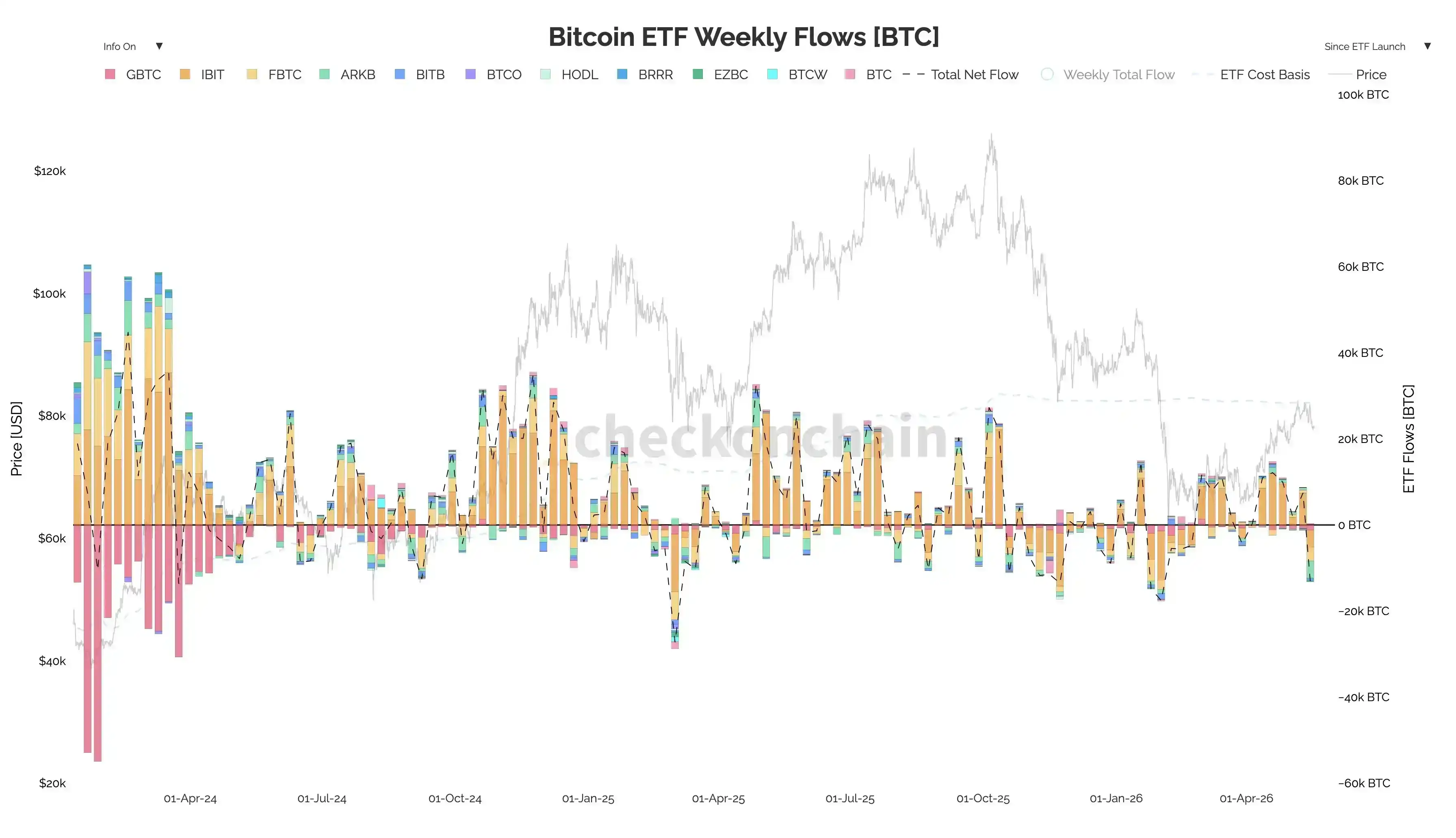
According to SoSoValue data, Bitcoin spot ETFs saw a net outflow of $1.039 billion for the week of May 11th to May 15th, ending six consecutive weeks of net inflows. This was also the largest weekly outflow since the end of January.

Drilling down to specific products, ARKB had a weekly net outflow of $324 million, and IBIT saw a net outflow of $317 million, with both leading products bleeding simultaneously. The intraday data paints an even sharper picture. There was a net outflow of $233 million on May 12th, a single-day withdrawal of $635 million on May 13th, and on Friday, May 15th, the 11 Bitcoin ETFs collectively experienced another outflow of $290 million. This indicates institutional funds are exiting in an orderly fashion.

Comparing with data from previous weeks highlights the force of this reversal. The week of April 17th saw nearly $1 billion in net inflows, the week of April 24th had $824 million in net inflows, and the week of May 8th still recorded $623 million in net inflows. The funding situation reversed from "sustained inflows" to "a $1 billion weekly outflow" within a single week.

Concurrently, Ethereum ETFs also saw a net outflow of $255 million, marking five consecutive days of negative outflows. The funding landscape for the entire crypto ETF asset class collectively turned downward in mid-May.

As the bond market's attractiveness grows, crypto's relative appeal naturally diminishes passively.

$4 Trillion in IPOs: How Can Crypto Compete?

Bonds are siphoning off funds with little risk appetite. IPOs are capturing risk capital, which constitutes the most direct liquidity drain for crypto.

There are $4 trillion worth of IPOs queued up for 2026, waiting to compete for capital. This is a figure substantial enough to reshape the map of global capital allocation.

SpaceX has become the next concentrated market focus. In this environment, Pre-IPO and new listing strategies offer an attraction that bonds cannot provide—non-linear wealth effects.

Meanwhile, the AI narrative remains the dominant theme of 2026. In a report on May 15th, Evercore analysts pointed out that US economic data shows demand remains strong, especially with a surge in AI-related capital expenditures. The flip side of this AI capital spending boom is the life-changing wealth effects created by AI leaders in the secondary market.

The return efficiency of names like Nvidia and Cerebras makes any crypto narrative seem less appealing by comparison.

More glaringly, even on-chain activity is helping traditional markets pull in money.

On the night SpaceX debuted on Trade.xyz, the Pre-IPO contracts on Hyperliquid saw $40 million in turnover on the first day. The HIP-3 platform is using perpetuals to facilitate price discovery for traditional stocks. Hyperliquid itself rose 10% to $45 for the week, becoming the only major crypto asset to buck the downtrend. Related reading: The Biggest Winner of the SpaceX IPO Might Be Trade.xyz.

In the short term, this is not exactly good news for crypto-native assets.

On-chain liquidity is being directed to price discovery for traditional stock targets like SpaceX, rather than flowing back to Bitcoin, ETH, or Solana. Even Hyperliquid's gains are not fundamentally driven by crypto narratives, but rather by the dividends of traditional asset narratives.

Warsh Takes Over, But Rate Cuts May Be Off the Table

While the bond and IPO markets are draining liquidity from the crypto space, looking at the Federal Reserve, the anticipated new liquidity injection might not materialize either.

Powell's term ended on May 15th. Warsh was confirmed by the Senate as the new Federal Reserve Chair last week and is currently awaiting formal appointment committee approval from the President and completion of asset clearance to comply with ethics regulations.

And even before officially taking the oath, Warsh already faces some tough problems.

Trump nominated Warsh partly because he hoped Warsh would be more cooperative than Powell with the White House's cost-cutting agenda. Treasury Secretary Bessent has consistently included lowering the government's borrowing costs as a core part of the White House's cost-cutting promises over the past few months. He laid it out clearly in his speech at the New York Fed last autumn: lowering government borrowing costs means lower corporate borrowing costs, lower mortgage rates, lower car loan payments—improving affordability for all Americans.

But as mentioned earlier, today's reality is that the bond market has pushed five-year inflation expectations to 2.7%, the highest since 2023. Yardeni Research directly pointed out in a report on May 17th that a two-year Treasury yield of 4.08% is the market using price to signal to the Fed that the current target range of 3.50%-3.75% is set too low.

By Warsh's own logic, he should continue raising rates, or at least not cut them. But the White House, especially Trump himself, has made its political desire for rate cuts almost public.

On the other hand, those who heard Warsh's pre-confirmation hearing remarks know he spent considerable time discussing AI. He believes AI will boost productivity, suppress inflation, and thus supports rate cuts. The problem is, short-term data shows no signs of this happening.

The view of José Torres, a senior economist at Interactive Brokers, already represents a large segment of opinion. In a report on May 15th, he wrote the assessment that, due to lack of progress in geopolitical conflicts, the market has abandoned bets on room for further rate hikes.

If Warsh chooses to succumb to Trump's political pressure and forces a rate cut, the bond market will respond with even higher long-end yields, making all duration-sensitive assets even more uncomfortable. If Warsh chooses a hawkish stance, then rate cut expectations for this year are directly off the table, and the market's bets on liquidity easing all need to be repriced.

This means the bets placed over the past few months on Warsh cutting rates upon taking office may be completely overturned.

HYPE Leads Crypto Gains

After October 10th, the recovery period following the crypto market's deleveraging should have been fueled by the return of new capital.

With $4 trillion in IPOs queued for 2026 and AI names continuing to generate wealth effects, the appeal of altcoin trades is being persistently diluted in this environment. Even Bitcoin, the most institutionally-favored crypto asset, is beginning to cede ground to traditional markets. The $1 billion weekly outflow from ETFs is the most direct evidence.

High bond yields, Bitcoin ETF outflows. The recovery period is being drawn out indefinitely, and crypto consistently fails to catch up with the overall upward pace of risk assets.

However, it's worth noting that some differentiation trends are already emerging within the broader crypto market.
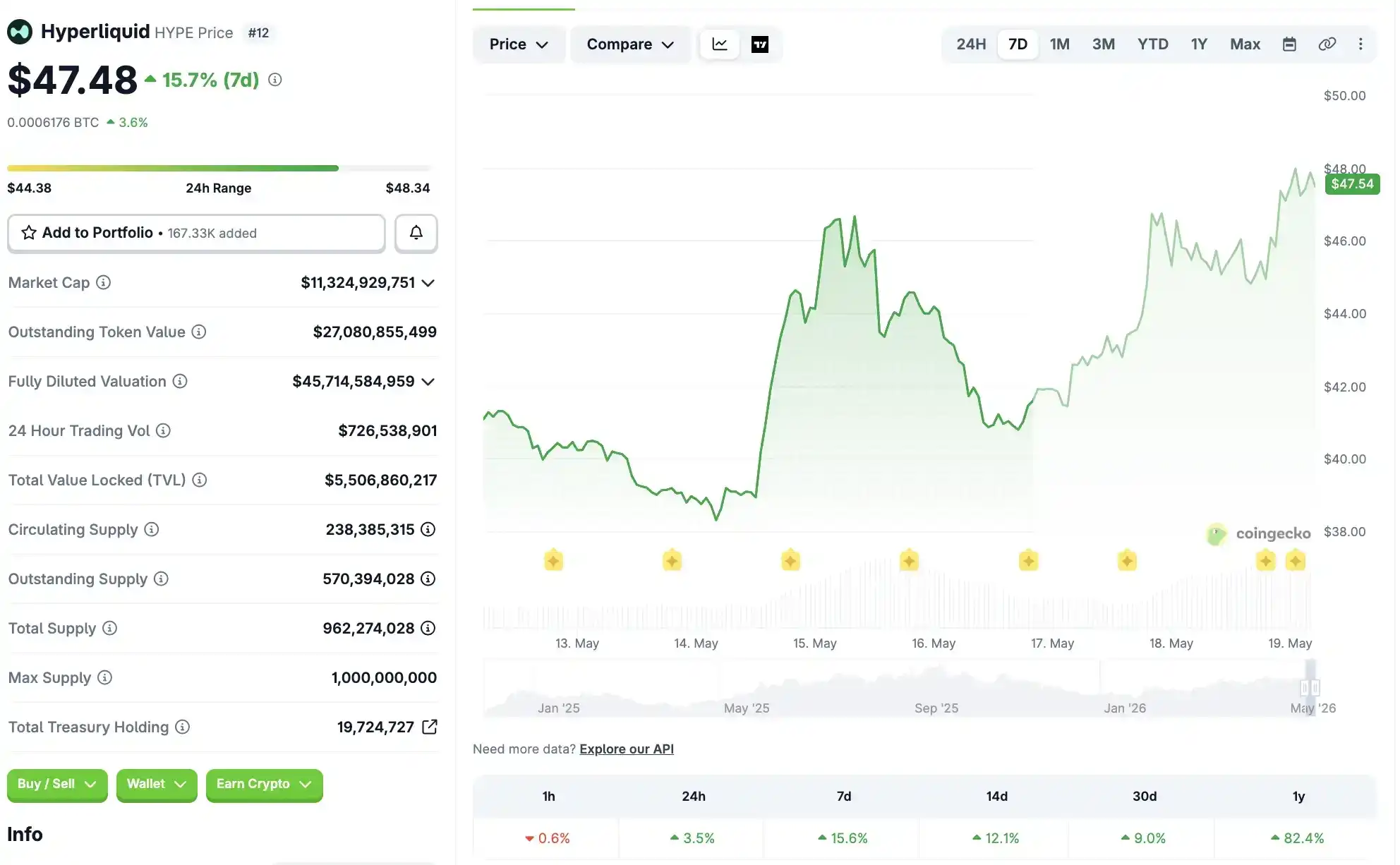
Hyperliquid rose 15% weekly to $48, with a year-to-date gain of 69%, precisely riding on the Pre-IPO price discovery narrative enabled by HIP-3. Assets that can tell new stories and capture entry points into traditional markets are still rising, while assets relying purely on beta are being compressed in pricing. Even Bitcoin has to take a back seat.

Zooming out to view the broader financial market reveals three forces simultaneously draining liquidity from the crypto space over the past few weeks. The bond market is pulling risk-averse money back with 5% yields, IPOs are capturing incremental risk budgets with a $4 trillion queue, and the new Fed Chair Warsh, upon taking office, may be unable to deliver on this year's rate cut expectations.

However, there are still potential catalysts for Bitcoin's next phase.

The upside catalyst is the enactment of the CLARITY Act in August. This is the biggest policy tailwind window for crypto this year, and increased regulatory certainty could directly release some pent-up institutional demand.

The downside risk is that before this catalyst materializes, we may need to retest the $70,000 level. If the current $77,000 level fails to hold, the next effective support is likely around $70,000.


Trending Cryptos

Related Questions

QWhat is the main point of the article regarding the current state of the crypto market?

AThe main point is that capital is being diverted away from the crypto market towards traditional assets. Specifically, it highlights that money is flowing into high-yield bonds (like the 30-year US Treasury) and into traditional IPOs (with a $4 trillion pipeline), leaving the crypto market behind and causing major assets like Bitcoin and Ethereum to decline. The only crypto asset seeing gains is HYPE, which benefits from a narrative tied to traditional finance.

QAccording to the article, what are the three forces currently draining liquidity from the cryptocurrency circle?

AThe three forces draining liquidity from the crypto market are: 1) The bond market, offering high yields (e.g., 5.12% for 30-year US Treasuries), pulling away risk-averse capital. 2) The traditional IPO market, with a $4 trillion pipeline of upcoming listings, competing for and absorbing risk capital. 3) The uncertainty around the Federal Reserve's future interest rate policy under the new Chairman Warsh, which threatens the expected liquidity injection from potential rate cuts.

QWhat does the article say about the performance of Bitcoin ETFs and what does this indicate?

AThe article states that Bitcoin spot ETFs experienced a net outflow of $1.039 billion for the week of May 11-15. This ended six consecutive weeks of inflows and was the largest weekly outflow since late January. It indicates that institutional money is making an organized retreat from the crypto market, likely due to the increased attractiveness of yields in traditional bonds.

QHow does the article describe the situation with the new Federal Reserve Chairman, Kevin Warsh?

AThe article describes a dilemma for the new Fed Chairman, Kevin Warsh. On one hand, there is significant political pressure from the Trump administration for him to cut interest rates to lower government borrowing costs. On the other hand, the bond market's high yields signal that inflation expectations are elevated, suggesting that current rates might be too low and that a rate hike or hold would be more appropriate. The article suggests his earlier dovish stance based on AI productivity gains may be challenged by short-term data, and markets may have to revise their expectations for rate cuts in 2026.

QWhat is one potential upcoming positive catalyst for Bitcoin mentioned in the article, and what is a key downside risk?

AOne potential positive catalyst for Bitcoin is the August enactment of the 'CLARITY Act', which is described as the biggest policy tailwind for crypto this year, as it would provide greater regulatory clarity and potentially unlock institutional demand. A key downside risk mentioned is that Bitcoin may need to retest the $70,000 support level if it fails to hold above $77,000 before that catalyst materializes.

Related Reads

Just Now, The World's First Ultra-High-Frame World Model Was Born, Nvidia Content 0, Racing to 50 FPS

Just Now, Global First Ultra-High-Frame World Model Born, 0% NVIDIA, Speeds to 50 FPS A Chinese team has developed MoWorld, the world's first Flash World Model, achieving real-time interactive inference exceeding 50 FPS. Crucially, it is entirely built on domestic NPUs (National Processing Units), bypassing NVIDIA GPUs. Developed by Moxin Technology in collaboration with Zhejiang University's Pan Yunhe academician team, MoWorld represents a complete, closed-loop system from training and distillation to deployment on domestic computing power. The model tackles the critical industry bottleneck of real-time performance, essential for applications like robotics, gaming, and digital worlds. MoWorld achieves this through a full-stack redesign for NPUs, including a proprietary 3D-annotated data pipeline, system-level optimizations for long-sequence training (up to 2000 frames), and inference optimizations like dynamic mixed-precision quantization. On a Huawei Ascend 910C platform, a 14B MoE parameter model achieves over 50 FPS, reducing typical inference costs by 70% compared to equivalent GPU solutions. This breakthrough lowers the deployment barrier, potentially accelerating the industrialization of world models. Key application areas include gaming/entertainment (offering 6-DoF camera control for immersive exploration), embodied AI/autonomous driving (providing a high-fidelity digital training ground), film pre-visualization, and 3D reconstruction/digital twins due to its strong geometric consistency. MoWorld demonstrates that a full-stack domestic compute ecosystem can support cutting-edge, real-time world models, positioning China at a competitive starting line in defining next-generation spatial intelligence standards. The project underscores a shift in competition from model scale to real-world usability and cost-effective deployment.

marsbit1m ago

Just Now, The World's First Ultra-High-Frame World Model Was Born, Nvidia Content 0, Racing to 50 FPS

marsbit1m ago

Pacific 'Fever': How Extreme Weather Becomes Wall Street's Cash Machine?

"Pacific Fever": How Extreme Weather Becomes Wall Street's ATM? The summer of 2026 sees unusually fierce weather across China and globally. The common driver behind this global pattern is a powerful El Niño event, potentially the strongest since 1950, as declared by NOAA. This phenomenon, characterized by warming central/eastern Pacific waters, disrupts global atmospheric circulation, raising risks of floods, droughts, and heatwaves, further intensified by climate change. For financial markets, especially commodities, El Niño is not just weather but a major trading theme. History shows its price impact is profound. In the 1970s, El Niño-driven anchovy collapse in Peru fueled a soybean boom, giving Richard Dennis his first million. Anthony Ward's cocoa empire was built on superior weather intelligence. Most recently in 2024, West African droughts caused cocoa prices to soar over 400%, delivering huge gains for trend-following hedge funds. In 2026, markets are again pricing in future El Niño-induced supply shocks. Despite high current inventories, prices for palm oil, rubber, and sugar have rallied on anticipation of upcoming Southeast Asian droughts and weak Indian monsoons. Analysts identify key indicators to watch: the Niño3.4 index, Indian monsoon rainfall, Malaysian palm oil stocks, and the fundraising scale of specialized weather funds like Moreton Capital. Beyond trading opportunities, a concerning narrative is gaining traction online, linking El Niño with fertilizer shortages and energy supply disruptions to warn of potential global food crises within months. While alarmist, it highlights a deeper truth: the cascading effects of climate-driven weather extremes ultimately translate into higher costs of living for everyone, far beyond the trading floor.

marsbit5m ago

Pacific 'Fever': How Extreme Weather Becomes Wall Street's Cash Machine?

marsbit5m ago

Pacific 'Fever': How Extreme Weather Becomes Wall Street's ATM?

"Pacific 'Fever': How Extreme Weather Becomes Wall Street's Piggy Bank" The article examines how the 2026-2027 El Niño, potentially the strongest since 1950, is not only disrupting global weather but also creating major financial opportunities. It links recent extreme events in China and worldwide to this climate phenomenon, which alters atmospheric patterns, increasing risks of floods, droughts, and heatwaves. The core narrative explores how financial markets capitalize on these disruptions. A hedge fund is raising $500 million specifically to bet on El Niño-affected crops like South African corn and Malaysian palm oil. Historically, such strategies have yielded massive profits. Examples include Richard Dennis ("Turtle Trader") making his first fortune in the 1970s soy boom triggered by El Niño's impact on Peruvian anchovies (a key fishmeal source), and Anthony Ward's cocoa empire built on superior weather intelligence. The 2024 cocoa price surge, driven by West African drought, enriched quantitative trend-following funds. Currently, markets are preemptively bidding up palm oil, rubber, and sugar futures based on anticipated future supply shocks, despite high current inventories. The article details El Niño's asymmetric global impacts: causing drought in Southeast Asia (hurting palm oil/rubber) and India (affecting sugar/cotton), but bringing beneficial rains to South American soy and sugarcane. Key metrics to watch include the Niño3.4 index, Indian monsoon data, and Malaysian palm oil stocks. The true price effects often materialize *after* the El Niño peaks, suggesting 2027 may see the real volatility. The conclusion warns that beyond trading gains, the convergence of El Niño, energy shortages, and fertilizer scarcity poses a systemic risk, potentially raising the cost of living for everyone, turning a climate event into a global economic story.

链捕手14m ago

Pacific 'Fever': How Extreme Weather Becomes Wall Street's ATM?

链捕手14m ago

Just Now, OpenAI's Chief Futurist Departed, Once Called a Jackass by Musk

Just now, OpenAI's Chief Futurist, Joshua Achiam, announced his departure from the company via X. Having joined as a 25-year-old intern in 2017, he spent nine years at OpenAI, evolving from an AI safety research scientist to leading the Mission Alignment team. Earlier this year, that team was dissolved, and Achiam transitioned to the newly created role of Chief Futurist, positioned at the intersection of AI safety and policy to study AGI's long-term risks and opportunities. In his departure statement, Achiam called his time a "graduation," reflecting on the immense progress from AI that couldn't converse to systems solving scientific problems. He expressed optimism about a future of peace, prosperity, and possibility, closing with "To safe AGI." His tenure was notably marked by a 2018 incident where he publicly challenged Elon Musk—then still with OpenAI—on safety compromises if Musk pursued AGI at Tesla, leading Musk to call him a "jackass." This became an internal legend, with colleagues later giving him a trophy inscribed, "To safety, never stop being that jackass." Achiam's exit follows a pattern of prominent safety and alignment experts leaving OpenAI, including Jan Leike and others who joined rivals like Anthropic or started non-profits. His departure coincides with OpenAI's internal efforts to more tightly integrate its research and policy teams, and the recent hiring of former White House AI advisor Dean Ball. Achiam did not cite a specific reason for leaving but indicated it was a long-considered decision, stating the mission to ensure AGI benefits humanity can now be advanced beyond the "frontier lab's" walls.

marsbit16m ago

Just Now, OpenAI's Chief Futurist Departed, Once Called a Jackass by Musk

marsbit16m ago

Anthropic Drops $19 Billion to 'Sponsor' a Bitcoin Miner

On July 6, 2026, Bitcoin mining company TeraWulf (NASDAQ: WULF) saw its stock surge 15% pre-market following the announcement of a landmark 20-year agreement with AI giant Anthropic. The deal grants Anthropic 401 MW of IT load capacity at TeraWulf's "Justified Data" campus in Kentucky and is projected to generate approximately $19 billion in contracted revenue for the miner over its duration. On the same day, TeraWulf also sold its 50.1% stake in a Texas joint venture for about $530 million. This dual move signals a strategic pivot: divesting non-core assets to fund its fully-owned Kentucky project and shifting focus from cryptocurrency mining to becoming a specialized infrastructure provider for AI. The agreement highlights a key advantage for Bitcoin miners transitioning to AI: their pre-existing access to land and critical power grid capacity, which is becoming a major bottleneck for data center expansion. Unlike peers who operate AI clouds, TeraWulf is adopting a "landlord" model, leasing only the physical space and power for clients' own servers. However, a significant gap exists between the deal's announcement and revenue generation, with the first phase of the Kentucky site not operational until late 2027. The $19 billion figure represents a long-term bet on both TeraWulf's execution and Anthropic's financial durability in the capital-intensive AI race. The market's positive reaction reflects the growing value of fundamental infrastructure—secured land and reliable electricity—in the era of AI compute scarcity.

marsbit19m ago

Anthropic Drops $19 Billion to 'Sponsor' a Bitcoin Miner

marsbit19m ago

Trading

Spot

Hot Articles

What is SONIC

Sonic: Pioneering the Future of Gaming in Web3 Introduction to Sonic In the ever-evolving landscape of Web3, the gaming industry stands out as one of the most dynamic and promising sectors. At the forefront of this revolution is Sonic, a project designed to amplify the gaming ecosystem on the Solana blockchain. Leveraging cutting-edge technology, Sonic aims to deliver an unparalleled gaming experience by efficiently processing millions of requests per second, ensuring that players enjoy seamless gameplay while maintaining low transaction costs. This article delves into the intricate details of Sonic, exploring its creators, funding sources, operational mechanics, and the timeline of significant events that have shaped its journey. What is Sonic? Sonic is an innovative layer-2 network that operates atop the Solana blockchain, specifically tailored to enhance the existing Solana gaming ecosystem. It accomplishes this through a customised, VM-agnostic game engine paired with a HyperGrid interpreter, facilitating sovereign game economies that roll up back to the Solana platform. The primary goals of Sonic include: Enhanced Gaming Experiences: Sonic is committed to offering lightning-fast on-chain gameplay, allowing players and developers to engage with games at previously unattainable speeds. Atomic Interoperability: This feature enables transactions to be executed within Sonic without the need to redeploy Solana programmes and accounts. This makes the process more efficient and directly benefits from Solana Layer1 services and liquidity. Seamless Deployment: Sonic allows developers to write for Ethereum Virtual Machine (EVM) based systems and execute them on Solana’s SVM infrastructure. This interoperability is crucial for attracting a broader range of dApps and decentralised applications to the platform. Support for Developers: By offering native composable gaming primitives and extensible data types - dining within the Entity-Component-System (ECS) framework - game creators can craft intricate business logic with ease. Overall, Sonic's unique approach not only caters to players but also provides an accessible and low-cost environment for developers to innovate and thrive. Creator of Sonic The information regarding the creator of Sonic is somewhat ambiguous. However, it is known that Sonic's SVM is owned by the company Mirror World. The absence of detailed information about the individuals behind Sonic reflects a common trend in several Web3 projects, where collective efforts and partnerships often overshadow individual contributions. Investors of Sonic Sonic has garnered considerable attention and support from various investors within the crypto and gaming sectors. Notably, the project raised an impressive $12 million during its Series A funding round. The round was led by BITKRAFT Ventures, with other notable investors including Galaxy, Okx Ventures, Interactive, Big Brain Holdings, and Mirana. This financial backing signifies the confidence that investment foundations have in Sonic’s potential to revolutionise the Web3 gaming landscape, further validating its innovative approaches and technologies. How Does Sonic Work? Sonic utilises the HyperGrid framework, a sophisticated parallel processing mechanism that enhances its scalability and customisability. Here are the core features that set Sonic apart: Lightning Speed at Low Costs: Sonic offers one of the fastest on-chain gaming experiences compared to other Layer-1 solutions, powered by the scalability of Solana’s virtual machine (SVM). Atomic Interoperability: Sonic enables transaction execution without redeployment of Solana programmes and accounts, effectively streamlining the interaction between users and the blockchain. EVM Compatibility: Developers can effortlessly migrate decentralised applications from EVM chains to the Solana environment using Sonic’s HyperGrid interpreter, increasing the accessibility and integration of various dApps. Ecosystem Support for Developers: By exposing native composable gaming primitives, Sonic facilitates a sandbox-like environment where developers can experiment and implement business logic, greatly enhancing the overall development experience. Monetisation Infrastructure: Sonic natively supports growth and monetisation efforts, providing frameworks for traffic generation, payments, and settlements, thereby ensuring that gaming projects are not only viable but also sustainable financially. Timeline of Sonic The evolution of Sonic has been marked by several key milestones. Below is a brief timeline highlighting critical events in the project's history: 2022: The Sonic cryptocurrency was officially launched, marking the beginning of its journey in the Web3 gaming arena. 2024: June: Sonic SVM successfully raised $12 million in a Series A funding round. This investment allowed Sonic to further develop its platform and expand its offerings. August: The launch of the Sonic Odyssey testnet provided users with the first opportunity to engage with the platform, offering interactive activities such as collecting rings—a nod to gaming nostalgia. October: SonicX, an innovative crypto game integrated with Solana, made its debut on TikTok, capturing the attention of over 120,000 users within a short span. This integration illustrated Sonic’s commitment to reaching a broader, global audience and showcased the potential of blockchain gaming. Key Points Sonic SVM is a revolutionary layer-2 network on Solana explicitly designed to enhance the GameFi landscape, demonstrating great potential for future development. HyperGrid Framework empowers Sonic by introducing horizontal scaling capabilities, ensuring that the network can handle the demands of Web3 gaming. Integration with Social Platforms: The successful launch of SonicX on TikTok displays Sonic’s strategy to leverage social media platforms to engage users, exponentially increasing the exposure and reach of its projects. Investment Confidence: The substantial funding from BITKRAFT Ventures, among others, emphasizes the robust backing Sonic has, paving the way for its ambitious future. In conclusion, Sonic encapsulates the essence of Web3 gaming innovation, striking a balance between cutting-edge technology, developer-centric tools, and community engagement. As the project continues to evolve, it is poised to redefine the gaming landscape, making it a notable entity for gamers and developers alike. As Sonic moves forward, it will undoubtedly attract greater interest and participation, solidifying its place within the broader narrative of blockchain gaming.

1.8k Total ViewsPublished 2024.04.04Updated 2024.12.03

What is SONIC

What is $S$

Understanding SPERO: A Comprehensive Overview Introduction to SPERO As the landscape of innovation continues to evolve, the emergence of web3 technologies and cryptocurrency projects plays a pivotal role in shaping the digital future. One project that has garnered attention in this dynamic field is SPERO, denoted as SPERO,$$s$. This article aims to gather and present detailed information about SPERO, to help enthusiasts and investors understand its foundations, objectives, and innovations within the web3 and crypto domains. What is SPERO,$$s$? SPERO,$$s$ is a unique project within the crypto space that seeks to leverage the principles of decentralisation and blockchain technology to create an ecosystem that promotes engagement, utility, and financial inclusion. The project is tailored to facilitate peer-to-peer interactions in new ways, providing users with innovative financial solutions and services. At its core, SPERO,$$s$ aims to empower individuals by providing tools and platforms that enhance user experience in the cryptocurrency space. This includes enabling more flexible transaction methods, fostering community-driven initiatives, and creating pathways for financial opportunities through decentralised applications (dApps). The underlying vision of SPERO,$$s$ revolves around inclusiveness, aiming to bridge gaps within traditional finance while harnessing the benefits of blockchain technology. Who is the Creator of SPERO,$$s$? The identity of the creator of SPERO,$$s$ remains somewhat obscure, as there are limited publicly available resources providing detailed background information on its founder(s). This lack of transparency can stem from the project's commitment to decentralisation—an ethos that many web3 projects share, prioritising collective contributions over individual recognition. By centring discussions around the community and its collective goals, SPERO,$$s$ embodies the essence of empowerment without singling out specific individuals. As such, understanding the ethos and mission of SPERO remains more important than identifying a singular creator. Who are the Investors of SPERO,$$s$? SPERO,$$s$ is supported by a diverse array of investors ranging from venture capitalists to angel investors dedicated to fostering innovation in the crypto sector. The focus of these investors generally aligns with SPERO's mission—prioritising projects that promise societal technological advancement, financial inclusivity, and decentralised governance. These investor foundations are typically interested in projects that not only offer innovative products but also contribute positively to the blockchain community and its ecosystems. The backing from these investors reinforces SPERO,$$s$ as a noteworthy contender in the rapidly evolving domain of crypto projects. How Does SPERO,$$s$ Work? SPERO,$$s$ employs a multi-faceted framework that distinguishes it from conventional cryptocurrency projects. Here are some of the key features that underline its uniqueness and innovation: Decentralised Governance: SPERO,$$s$ integrates decentralised governance models, empowering users to participate actively in decision-making processes regarding the project’s future. This approach fosters a sense of ownership and accountability among community members. Token Utility: SPERO,$$s$ utilises its own cryptocurrency token, designed to serve various functions within the ecosystem. These tokens enable transactions, rewards, and the facilitation of services offered on the platform, enhancing overall engagement and utility. Layered Architecture: The technical architecture of SPERO,$$s$ supports modularity and scalability, allowing for seamless integration of additional features and applications as the project evolves. This adaptability is paramount for sustaining relevance in the ever-changing crypto landscape. Community Engagement: The project emphasises community-driven initiatives, employing mechanisms that incentivise collaboration and feedback. By nurturing a strong community, SPERO,$$s$ can better address user needs and adapt to market trends. Focus on Inclusion: By offering low transaction fees and user-friendly interfaces, SPERO,$$s$ aims to attract a diverse user base, including individuals who may not previously have engaged in the crypto space. This commitment to inclusion aligns with its overarching mission of empowerment through accessibility. Timeline of SPERO,$$s$ Understanding a project's history provides crucial insights into its development trajectory and milestones. Below is a suggested timeline mapping significant events in the evolution of SPERO,$$s$: Conceptualisation and Ideation Phase: The initial ideas forming the basis of SPERO,$$s$ were conceived, aligning closely with the principles of decentralisation and community focus within the blockchain industry. Launch of Project Whitepaper: Following the conceptual phase, a comprehensive whitepaper detailing the vision, goals, and technological infrastructure of SPERO,$$s$ was released to garner community interest and feedback. Community Building and Early Engagements: Active outreach efforts were made to build a community of early adopters and potential investors, facilitating discussions around the project’s goals and garnering support. Token Generation Event: SPERO,$$s$ conducted a token generation event (TGE) to distribute its native tokens to early supporters and establish initial liquidity within the ecosystem. Launch of Initial dApp: The first decentralised application (dApp) associated with SPERO,$$s$ went live, allowing users to engage with the platform's core functionalities. Ongoing Development and Partnerships: Continuous updates and enhancements to the project's offerings, including strategic partnerships with other players in the blockchain space, have shaped SPERO,$$s$ into a competitive and evolving player in the crypto market. Conclusion SPERO,$$s$ stands as a testament to the potential of web3 and cryptocurrency to revolutionise financial systems and empower individuals. With a commitment to decentralised governance, community engagement, and innovatively designed functionalities, it paves the way toward a more inclusive financial landscape. As with any investment in the rapidly evolving crypto space, potential investors and users are encouraged to research thoroughly and engage thoughtfully with the ongoing developments within SPERO,$$s$. The project showcases the innovative spirit of the crypto industry, inviting further exploration into its myriad possibilities. While the journey of SPERO,$$s$ is still unfolding, its foundational principles may indeed influence the future of how we interact with technology, finance, and each other in interconnected digital ecosystems.

100 Total ViewsPublished 2024.12.17Updated 2024.12.17

What is $S$

What is AGENT S

Agent S: The Future of Autonomous Interaction in Web3 Introduction In the ever-evolving landscape of Web3 and cryptocurrency, innovations are constantly redefining how individuals interact with digital platforms. One such pioneering project, Agent S, promises to revolutionise human-computer interaction through its open agentic framework. By paving the way for autonomous interactions, Agent S aims to simplify complex tasks, offering transformative applications in artificial intelligence (AI). This detailed exploration will delve into the project's intricacies, its unique features, and the implications for the cryptocurrency domain. What is Agent S? Agent S stands as a groundbreaking open agentic framework, specifically designed to tackle three fundamental challenges in the automation of computer tasks: Acquiring Domain-Specific Knowledge: The framework intelligently learns from various external knowledge sources and internal experiences. This dual approach empowers it to build a rich repository of domain-specific knowledge, enhancing its performance in task execution. Planning Over Long Task Horizons: Agent S employs experience-augmented hierarchical planning, a strategic approach that facilitates efficient breakdown and execution of intricate tasks. This feature significantly enhances its ability to manage multiple subtasks efficiently and effectively. Handling Dynamic, Non-Uniform Interfaces: The project introduces the Agent-Computer Interface (ACI), an innovative solution that enhances the interaction between agents and users. Utilizing Multimodal Large Language Models (MLLMs), Agent S can navigate and manipulate diverse graphical user interfaces seamlessly. Through these pioneering features, Agent S provides a robust framework that addresses the complexities involved in automating human interaction with machines, setting the stage for myriad applications in AI and beyond. Who is the Creator of Agent S? While the concept of Agent S is fundamentally innovative, specific information about its creator remains elusive. The creator is currently unknown, which highlights either the nascent stage of the project or the strategic choice to keep founding members under wraps. Regardless of anonymity, the focus remains on the framework's capabilities and potential. Who are the Investors of Agent S? As Agent S is relatively new in the cryptographic ecosystem, detailed information regarding its investors and financial backers is not explicitly documented. The lack of publicly available insights into the investment foundations or organisations supporting the project raises questions about its funding structure and development roadmap. Understanding the backing is crucial for gauging the project's sustainability and potential market impact. How Does Agent S Work? At the core of Agent S lies cutting-edge technology that enables it to function effectively in diverse settings. Its operational model is built around several key features: Human-like Computer Interaction: The framework offers advanced AI planning, striving to make interactions with computers more intuitive. By mimicking human behaviour in tasks execution, it promises to elevate user experiences. Narrative Memory: Employed to leverage high-level experiences, Agent S utilises narrative memory to keep track of task histories, thereby enhancing its decision-making processes. Episodic Memory: This feature provides users with step-by-step guidance, allowing the framework to offer contextual support as tasks unfold. Support for OpenACI: With the ability to run locally, Agent S allows users to maintain control over their interactions and workflows, aligning with the decentralised ethos of Web3. Easy Integration with External APIs: Its versatility and compatibility with various AI platforms ensure that Agent S can fit seamlessly into existing technological ecosystems, making it an appealing choice for developers and organisations. These functionalities collectively contribute to Agent S's unique position within the crypto space, as it automates complex, multi-step tasks with minimal human intervention. As the project evolves, its potential applications in Web3 could redefine how digital interactions unfold. Timeline of Agent S The development and milestones of Agent S can be encapsulated in a timeline that highlights its significant events: September 27, 2024: The concept of Agent S was launched in a comprehensive research paper titled “An Open Agentic Framework that Uses Computers Like a Human,” showcasing the groundwork for the project. October 10, 2024: The research paper was made publicly available on arXiv, offering an in-depth exploration of the framework and its performance evaluation based on the OSWorld benchmark. October 12, 2024: A video presentation was released, providing a visual insight into the capabilities and features of Agent S, further engaging potential users and investors. These markers in the timeline not only illustrate the progress of Agent S but also indicate its commitment to transparency and community engagement. Key Points About Agent S As the Agent S framework continues to evolve, several key attributes stand out, underscoring its innovative nature and potential: Innovative Framework: Designed to provide an intuitive use of computers akin to human interaction, Agent S brings a novel approach to task automation. Autonomous Interaction: The ability to interact autonomously with computers through GUI signifies a leap towards more intelligent and efficient computing solutions. Complex Task Automation: With its robust methodology, it can automate complex, multi-step tasks, making processes faster and less error-prone. Continuous Improvement: The learning mechanisms enable Agent S to improve from past experiences, continually enhancing its performance and efficacy. Versatility: Its adaptability across different operating environments like OSWorld and WindowsAgentArena ensures that it can serve a broad range of applications. As Agent S positions itself in the Web3 and crypto landscape, its potential to enhance interaction capabilities and automate processes signifies a significant advancement in AI technologies. Through its innovative framework, Agent S exemplifies the future of digital interactions, promising a more seamless and efficient experience for users across various industries. Conclusion Agent S represents a bold leap forward in the marriage of AI and Web3, with the capacity to redefine how we interact with technology. While still in its early stages, the possibilities for its application are vast and compelling. Through its comprehensive framework addressing critical challenges, Agent S aims to bring autonomous interactions to the forefront of the digital experience. As we move deeper into the realms of cryptocurrency and decentralisation, projects like Agent S will undoubtedly play a crucial role in shaping the future of technology and human-computer collaboration.

768 Total ViewsPublished 2025.01.14Updated 2025.01.14

What is AGENT S

Discussions

Welcome to the HTX Community. Here, you can stay informed about the latest platform developments and gain access to professional market insights. Users' opinions on the price of S (S) are presented below.

活动图片