The Day CZ Missed the Best Investment of His Life, Crypto Missed AI

marsbitPublished on 2026-02-09Last updated on 2026-02-09

Abstract

In 2014, CZ sold his Shanghai apartment to buy 1,500 BTC—a legendary investment in crypto history. But years later, he missed an even bigger opportunity: acquiring FTX in 2021. During FTX liquidity crisis negotiations, Binance signed a non-binding LOI to acquire the exchange but backed out within a day, citing issues “beyond control.” Unbeknownst to many, FTX held a hidden gem: a $500 million investment in AI startup Anthropic, acquired in 2021 for a 13.56% stake (later diluted to 7.84%). Post-ChatGPT, Anthropic’s valuation soared. It’s nearing a new funding round at a potential $350 billion valuation. FTX’s stake would now be worth ~$27.4 billion—enough to cover its collapse losses multiple times. Instead, FTX’s bankruptcy estate sold the shares for over $1.3 billion to traditional investors like Jane Street and Fidelity—not crypto firms. This missed chance represents what could have been a powerful intersection of Crypto and AI, with potential innovations lost as the opportunity moved entirely into traditional finance hands.

Original | Odaily Planet Daily (@OdailyChina)

Author | Azuma (@azuma_eth)

In 2014, just one year after being introduced to the concept of cryptocurrency, CZ made the most daring investment of his life — he sold his apartment in Shanghai and "all-in" bought about 1,500 BTC at a three-digit price. 12 years later, if CZ had never sold, this investment could have yielded hundreds of millions of dollars in profits (peak return about $189 million).

Compared to his subsequent achievements of founding Binance and becoming an industry leader, the returns from this investment are insignificant to CZ. But from an external perspective, this idealistic "all-in" move remains CZ's most talked-about operation.

Yet, it is lamentable that even someone as resolute and decisive as CZ once missed an investment with potential profits a hundred times greater than "selling a house to buy coins" in a highly dramatic way.

Rewind 1555 Days: That Aborted Acquisition

November 9, 2021, was a sleepless night for the cryptocurrency industry.

Just the day before, the then high-flying FTX suspended withdrawals due to a liquidity crisis, causing panic to spread rapidly through the community. The musty smell before a storm was already permeating the market... The rest of the story is well-known: FTX collapsed, triggering a domino effect that plunged the market into a prolonged winter lasting years.

In a parallel universe, the story could have taken a different turn. In the early hours of November 9, SBF and CZ had issued statements indicating that FTX had preliminarily reached an acquisition agreement with Binance.
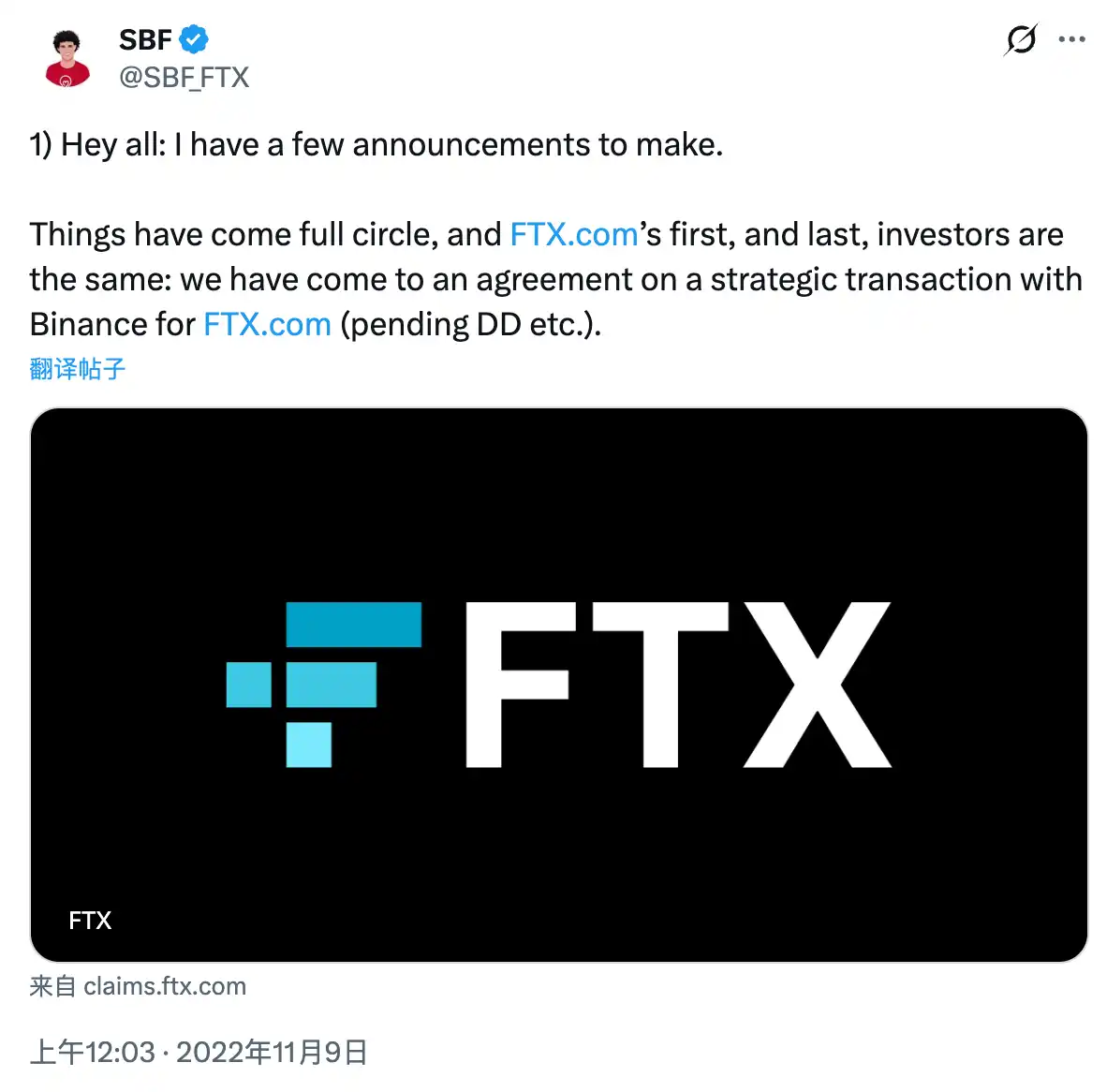
SBF: Hey everyone, I have an announcement. Things have come full circle. FTX's first and last investors are the same — we have reached a strategic transaction agreement with Binance (pending due diligence).
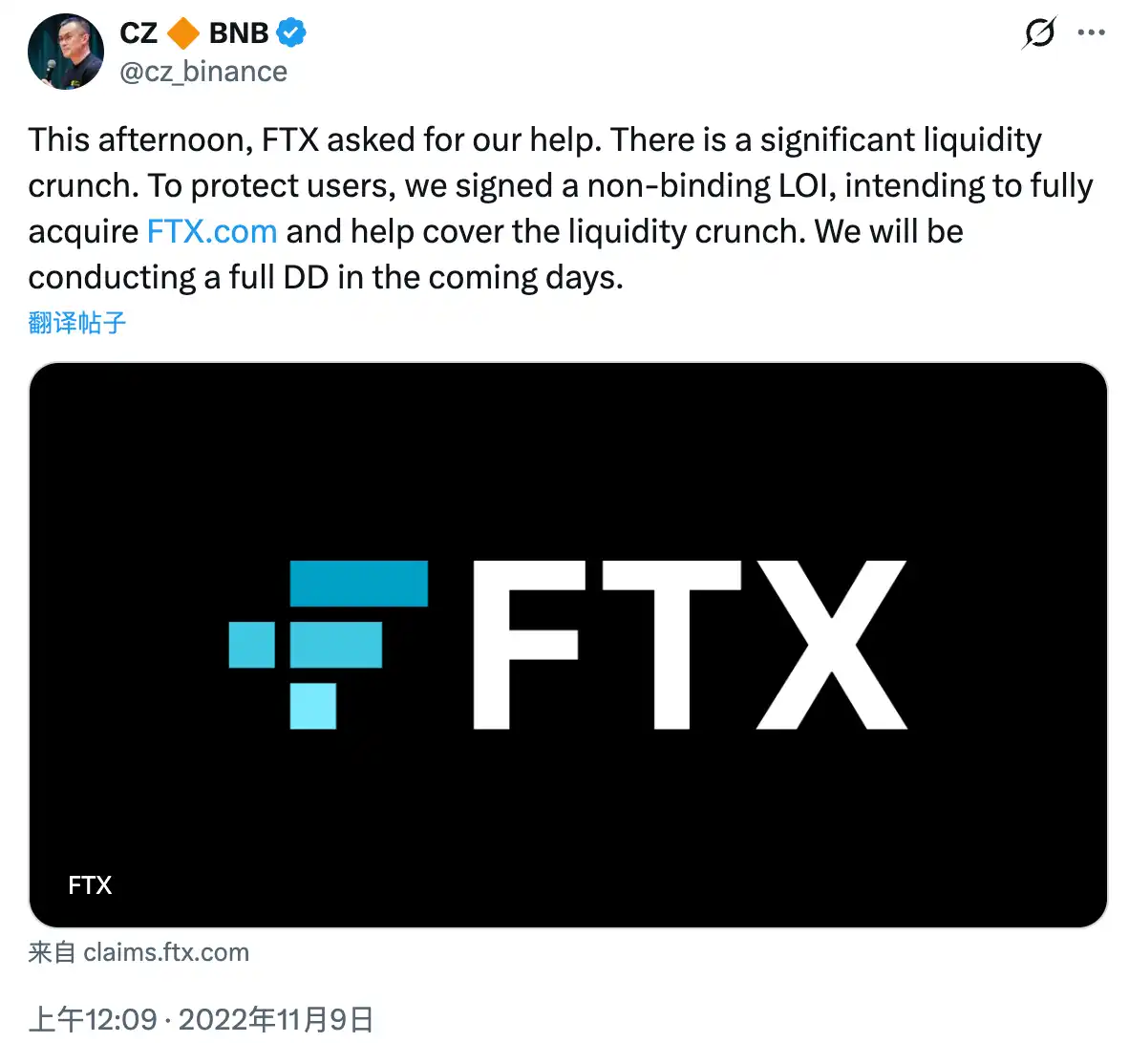
CZ: This afternoon, FTX asked us for help. The exchange is currently facing a severe liquidity crunch. To protect users, we signed a non-binding Letter of Intent, intending to fully acquire FTX to help alleviate the liquidity crisis. We will conduct full due diligence in the coming days.

However, the acquisition ultimately fell through. Just one day later, Binance officially announced the abandonment of the acquisition, citing "issues beyond our control", which became the final straw that broke FTX's back.

Did CZ ever seriously consider acquiring FTX? Was the hastily concluded acquisition farce a genuine attempt to help or merely a ploy to gauge the opponent's "health bar"? This may forever remain a mystery. From the outcome, CZ personally defeated his biggest competitor at the time, consolidating Binance's position as the industry's top dog.

But no one could have predicted that a seemingly insignificant "side bet" in FTX's asset portfolio at the time would rapidly appreciate in value over the next few years, its worth now even far exceeding the total value of the remaining assets involved in that unfinished acquisition.

Once a "Side Bet", Now an AI Focus

In April 2022 (this is the official announcement date; the deal was actually completed in 2021), FTX made its most important investment in the AI field — leading a $580 million funding round for AI startup Anthropic with a $500 million investment, initially acquiring a 13.56% equity stake, which was later diluted to 7.84% as Anthropic completed subsequent funding rounds.
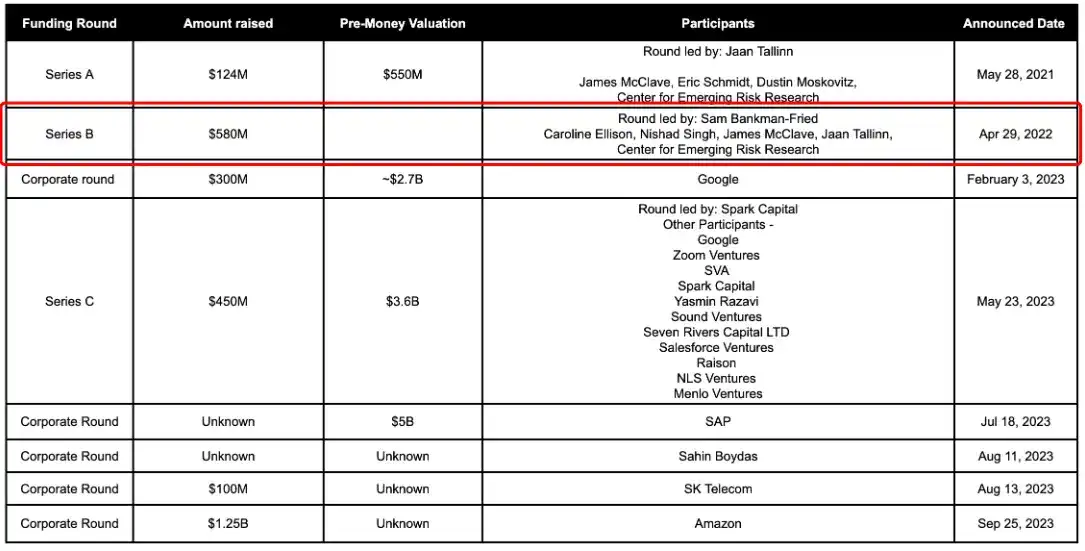
That was an era when AI's potential had not yet exploded. Just half a year later (late November 2022, the month FTX collapsed), OpenAI's ChatGPT burst onto the scene, irreversibly ushering the world into the "Age of Exploration" for AI. Anthropic, with its Claude series of products (especially the programming-oriented Claude Code), repeatedly amazed the world, gradually becoming one of the most dazzling star companies.

As Claude continuously iterated, Anthropic's valuation also kept rising. Capital frantically waved banknotes, desperate to secure a berth on Anthropic's ship sailing towards IPO. The latest market rumor is that Anthropic is in the final stages of a new massive funding round, expected to exceed $20 billion (originally planned to raise $10 billion, but investor demand far exceeded expectations, potentially doubling the final amount), with a valuation possibly as high as $350 billion. The deal could be completed as early as this week.

Calculated at the latest valuation of $350 billion, the value of the Anthropic equity once held by FTX would be approximately $27.44 billion, enough to cover the reserve shortfall that led to its bankruptcy several times over... But history has happened, and the outcome is settled.

It's hard not to marvel at SBF being a rare venture capital genius (besides Anthropic, he also invested in the now-hot Cursor in its seed round), but clearly he was not a qualified business operator, especially lacking in risk control. CZ's profile is the complete opposite; he is an absolute master at operating a business. Binance's dominance is inseparable from his多次正确的战略决策 (many correct strategic decisions). But CZ also often positions himself not as a traditional investor solely pursuing returns; he doesn't trade coins and prefers to be a builder of the industry.

A Messy Ending: This Should Have Been the Best Intersection of Crypto and AI

You might wonder, what happened to those FTX equity shares?

The ending is not complicated. After FTX's bankruptcy, all assets, including the Anthropic equity, were handled by the FTX bankruptcy estate management team. In February 2024, the court approved the team's request to sell these shares; in March and June of the same year, the FTX bankruptcy team sold 29.5 million shares for $884 million and 15 million shares for $450 million respectively, totaling over $1.3 billion sold.
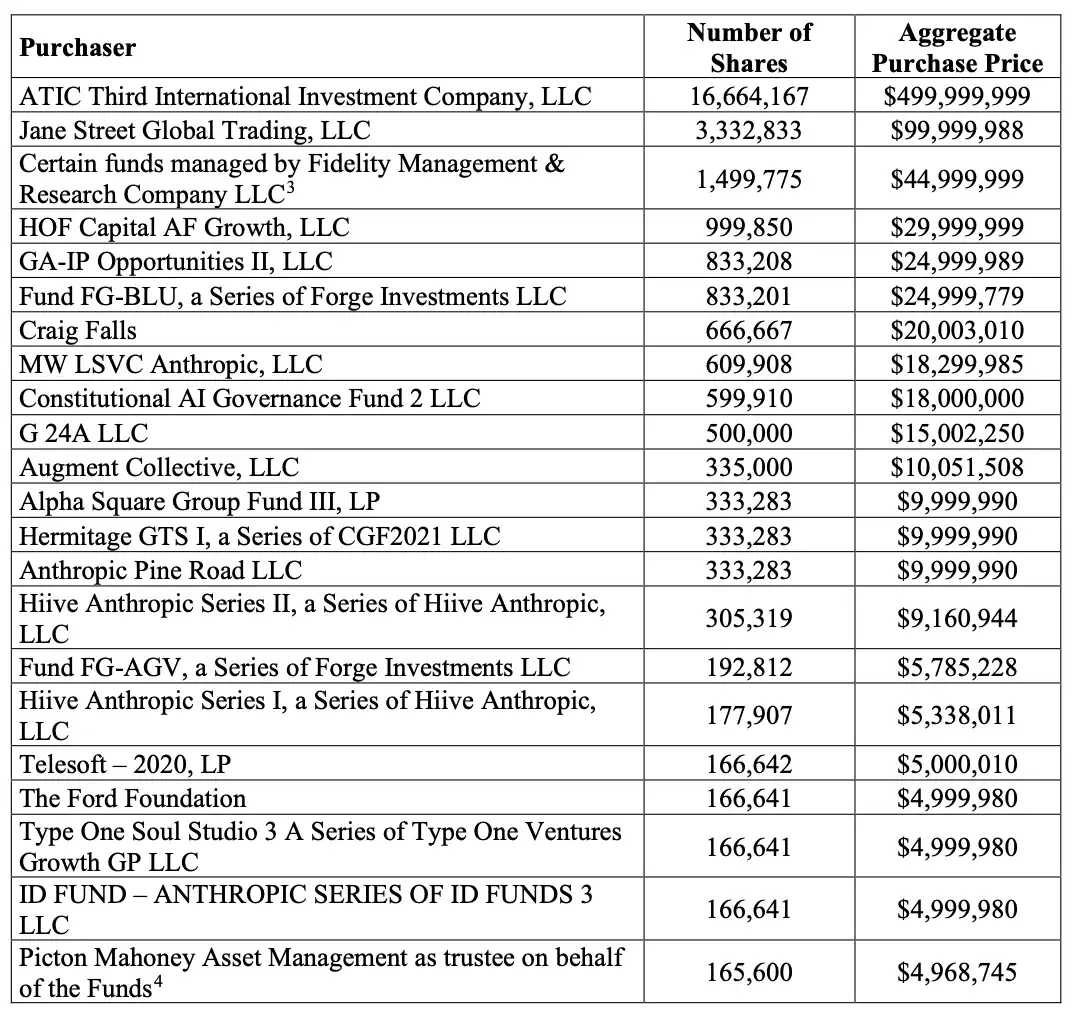
As for the buyers of these shares, they were primarily ATIC Third International Investment from Abu Dhabi, and traditional financial institutions from Wall Street like Jane Street and Fidelity. In other words, no crypto companies got a share of the pie.

Whether these shares were deliberately sold cheaply, or whether there was利益输送 (benefit transfer) under the guise of bankruptcy liquidation, is no longer important for the crypto industry.

This should have been the best intersection of Crypto and AI. In another worldline, whether these shares were in the hands of SBF or CZ, if leading companies in the crypto world had some say in the development of one of AI's most successful companies, there could have been more innovative attempts around Crypto + AI, potentially yielding unexpected fruits.

It's not just CZ who is slapping his thigh in regret.

Trending Cryptos

Related Questions

QWhat was the potential return on CZ's investment in BTC if he had not sold his apartment in Shanghai?

AIf CZ had not sold his BTC, the peak return on his investment would have been approximately $189 million.

QWhy did Binance ultimately decide not to acquire FTX in November 2021?

ABinance announced it was abandoning the acquisition because the issues at FTX were 'beyond their control or ability to help' after conducting initial due diligence.

QWhat was the significance of FTX's investment in Anthropic, and how much was it worth at its peak potential valuation?

AFTX invested $500 million in Anthropic, acquiring a 13.56% stake, which was later diluted to 7.84%. At a rumored $350 billion valuation, this stake would be worth approximately $27.44 billion.

QHow did the FTX bankruptcy estate handle its Anthropic shares, and who were the main buyers?

AThe FTX bankruptcy estate sold its Anthropic shares in two batches for a total of over $1.3 billion. The main buyers were ATIC Third International Investment from Abu Dhabi and traditional financial institutions like Jane Street and Fidelity.

QAccording to the article, what was the missed opportunity for the Crypto industry with the sale of FTX's Anthropic stake?

AThe missed opportunity was that no crypto companies acquired the Anthropic stake. If a crypto leader like SBF or CZ had retained influence over this leading AI company, it could have fostered more innovation at the intersection of Crypto and AI.

Related Reads

Report: Warsh Prepared to Raise Interest Rates in September if Inflation Data Remains Strong in Coming Weeks

Report: Fed Chair Walsh Prepared to Hike Rates in September If Upcoming Inflation Data Stays Strong According to a Financial Times report, Federal Reserve Chair Walsh is prepared to raise interest rates at the September policy meeting if inflation data in the coming weeks remains hot and market expectations for a hike increase. Following this news, short-term US Treasury yields rose. Walsh has adhered to a pared-back communication strategy despite recent market volatility and criticism that his limited guidance has weakened the Fed's inflation-fighting credibility. Sources close to his thinking acknowledge some communication missteps since he took office but insist these won't derail his overall reform agenda. His most significant policy shift has been drastically reducing forward guidance, a practice he has long criticized for boxing in policymakers. Futures markets now price in roughly a 55% chance of a 25-basis-point rate increase in September. Sources indicate that while Walsh has raised the possibility of using balance sheet reduction to tighten policy, interest rates remain the primary tool for now. The Fed's preferred inflation gauge was at 3.7% in June. Walsh is expected to deliver his first major speech at the upcoming Jackson Hole symposium, seen as a key opportunity to clarify his policy framework and address perceived shortcomings in his messaging.

marsbit12m ago

Report: Warsh Prepared to Raise Interest Rates in September if Inflation Data Remains Strong in Coming Weeks

marsbit12m ago

Chainalysis: Robbery of Crypto Investors Using a 'Soldering Iron' Nets $30 Million in Half a Year

According to a report from Chainalysis, criminals have stolen over $30 million from cryptocurrency investors through violent physical attacks, known as "wrench attacks," in the first half of 2026. This puts the year on track to surpass the record $58 million stolen via such methods in all of 2025. There were 46 documented violent incidents globally by the end of June, up from 40 in the same period of 2025. These attacks, which include kidnappings, home invasions, and hostage-taking, increasingly threaten the personal safety of crypto holders and their families. Only about 26% of these attacks resulted in a ransom being paid, a significant drop from a 49% success rate in 2025. Chainalysis notes the true scale of the problem is likely underreported. The criminals often identify targets in advance through data leaks, social media, or insider information before using low-skilled enforcers for the physical assault. France is a major hotspot, with 30 publicly known incidents by mid-2026, compared to 19 in all of 2025. French authorities have reported over 70 cases, suggesting the real number is even higher. A suspected leak of taxpayer data from the French tax service and a separate breach at crypto tax firm Waltio are considered key factors enabling criminals to find targets. Stolen funds are moved using various methods, from direct transfers to centralized exchanges to more sophisticated techniques involving blockchain bridges, decentralized exchanges, and money-mixing services. The report highlights a lack of a unified industry methodology for tracking these incidents, as evidenced by a different count (52 cases) from analytics firm CertiK for the same period.

cryptonews.ru13m ago

Chainalysis: Robbery of Crypto Investors Using a 'Soldering Iron' Nets $30 Million in Half a Year

cryptonews.ru13m ago

Shareholders' Accurate Reduction of 1.4 Billion Shares, Under Heavy Performance Pressure, Meish Technology Makes an Emergency Cross-Border Move into Indium Phosphide

Domestic distributed audio-visual and AI vision solutions provider Meish Technology (001229.SZ), despite its AI concept, has shown signs of fatigue shortly after listing, with consecutive declines in revenue and net profit. Amid this pressure, the company is making an urgent foray into the hot "indium phosphide" semiconductor concept. The company moved swiftly, establishing a wholly-owned subsidiary in July and holding an extraordinary shareholders' meeting in August to authorize management to advance the project. This rapid capital operation is seen as a move to tap into the AI computing power industry chain. However, behind this "cross-border self-rescue" lies deep pressure on fundamental performance, precise high-level减持 by a major shareholder who cashed out approximately 142 million yuan just before the stock price peaked, and the new business remaining at a very preliminary "blueprint" stage with no substantive impact on performance yet. Meish Tech's core business of "distributed audio-video control systems" faces intense competition. While maintaining high gross margins, its revenue growth and profit growth have seriously diverged. Although its AI business revenue surged in 2025, it failed to halt the overall profit decline. Since its 2022 IPO, the company's performance has declined, with 2026 first-quarter results even showing a loss. The half-year 2026 forecast predicts a profit plunge of over 70% year-on-year. In this context, the跨界 into the high-tech barrier, capital-intensive indium phosphide field appears more like a gamble driven by market valuation concerns than a strategy based on deep technical积累.

marsbit23m ago

Shareholders' Accurate Reduction of 1.4 Billion Shares, Under Heavy Performance Pressure, Meish Technology Makes an Emergency Cross-Border Move into Indium Phosphide

marsbit23m ago

Just 3.5 Months After Its Founding, It Started Making External Investments: The Embodied AI Sector Is Collectively 'Investing While Fundraising'

A counterintuitive trend is emerging in China's embodied AI sector: numerous startups that are still actively raising capital themselves are now making strategic investments in other companies. An analysis of 29 such enterprises reveals a pattern of "fundraising while investing," where companies, often still in early funding rounds, rapidly deploy capital into the ecosystem. These 29 investment entities, primarily based in the Pearl River Delta and Yangtze River Delta regions, have executed over 125 investment deals. Notably, 17 of them (59%) are humanoid robot manufacturers, making them the most active investors. The trend shows that newer companies are investing faster; firms founded after 2023 made their first external investment in an average of just 22.8 months, with one company, Poke Robotics, doing so within 3.8 months of its founding. Zhiyuan Robot (智元机器人) stands out as the most active corporate venture capital (CVC) player, completing 37 investments in 23 months. A more complex, networked investment structure is also forming, where companies like Lingchu Intelligent (灵初智能) and Lingxin Qiaoshou (灵心巧手), which received investments from larger players, have themselves become active investors, extending the strategic reach of capital down the supply chain. This collective shift from a few large players to widespread participation signals a strategic move to use capital as a lever to accelerate industry consolidation. Companies are seeking to quickly integrate critical supply chain elements—such as dexterous hands, joint motors, and AI data platforms—into their ecosystems to gain a competitive edge in a rapidly evolving, highly contested market window. The strategy aims to compress the decade-long process of traditional supply chain integration into just a few years, though it carries risks related to technology bets and ongoing capital burn. As the sector's IPO pipeline grows, this "fundraise and invest" model may soon become a standard industry practice.

marsbit26m ago

Just 3.5 Months After Its Founding, It Started Making External Investments: The Embodied AI Sector Is Collectively 'Investing While Fundraising'

marsbit26m ago

Trading

Spot

Hot Articles

Discussions

Welcome to the HTX Community. Here, you can stay informed about the latest platform developments and gain access to professional market insights. Users' opinions on the price of AI (AI) are presented below.

活动图片