Telegram's 'Crypto Accounting': Surging Revenue Behind Net Losses and the $450 Million Token Sale Controversy

链捕手Published on 2026-01-10Last updated on 2026-01-10

Abstract

Telegram's recent unaudited financials reveal a paradox: soaring revenues accompanied by net losses. In H1 2025, revenue surged 65% year-over-year to $870 million, driven by an 88% jump in premium subscriptions ($223 million) and a key partnership with the TON blockchain, which contributed nearly $300 million. Despite an operating profit of nearly $400 million, the company reported a net loss of $222 million. This was primarily due to a significant write-down of its TON token holdings, whose value fell over 73% during the crypto market downturn. A major point of controversy was Telegram's sale of over $450 million worth of TON tokens, representing more than 10% of the token's circulating supply. Community concerns about a cash grab were addressed by TONStrategy Chairman Manuel Stotz, who clarified that the sales were to long-term investors like his NASDAQ-listed firm TONX. The tokens are subject to a four-year vesting period to prevent immediate selling pressure. Founder Pavel Durov framed this as part of a strategy to decentralization, aiming to keep Telegram's ownership of TON below 10% to avoid centralization concerns. Telegram's path to a potential IPO is being watched closely. The company has raised significant capital through bonds, including a recent $1.7 billion convertible note with terms favorable to investors if an IPO occurs before 2030. However, an ongoing legal investigation in France involving Durov presents a potential obstacle. With nearly 1 billion monthly...

Author: Zen, PANews

Telegram recently found itself in the spotlight again due to financial information shared with investors: while its revenue curve is rising, its net profit is turning downward. The key variable here is not a slowdown in user growth, but rather the decline in TON's price, which has transmitted volatility from the asset side into the income statement.

The sale of over $450 million worth of TON tokens has led the outside world to re-examine its relationship and boundaries with the TON ecosystem.

Due to Low TON Prices, Telegram's Revenue Soars but Still Records Net Loss

According to an FT report, in the first half of 2025, Telegram achieved a significant leap in revenue. Unaudited financial reports show that the company's revenue reached $870 million in the first half of the year, a year-on-year increase of 65%, significantly exceeding the $525 million in the first half of 2024; it achieved nearly $400 million in operating profit.

In terms of revenue structure, Telegram's advertising revenue grew by 5% to $125 million; premium subscription revenue surged by 88% to $223 million, nearly doubling from the same period last year. Compared to these two items, the key factor in Telegram's revenue growth mainly comes from the exclusive agreement signed with the TON blockchain—TON became the exclusive blockchain infrastructure for Telegram's mini-program ecosystem and brought Telegram nearly $300 million in related revenue.
Therefore, overall, Telegram continued its strong growth in the first half of last year, driven by the mini-game boom that emerged in 2024—in 2024, Telegram achieved its first annual profit, with profits reaching $540 million, while annual revenue reached $1.4 billion, far exceeding the $343 million in 2023.

Of the $1.4 billion revenue in 2024, about half came from its so-called "partnerships and ecosystem," roughly $250 million from advertising, and $292 million from its premium subscription service. Clearly, Telegram's growth is partly due to a surge in the number of paying users, but even more so due to the收益 from its cryptocurrency-related collaborations.

However, the high volatility of cryptocurrencies has also brought risks to Telegram. Even though it achieved nearly $400 million in operating profit in the first half of 2025, Telegram still recorded a net loss of $222 million. Insiders stated that this was because the company had to revalue its holdings of Ton token assets. Due to the continued低迷 of altcoins in 2025, the price of Ton tokens持续下跌 throughout 2025, falling by over 73% at its lowest point.

Selling $450 Million: Cashing Out or Upholding Decentralization Ideals?

Accustomed to the long-term低迷 of altcoin prices and the floating losses of many DAT-listed companies, retail investors were not too surprised by Telegram's losses due to the depreciation of virtual assets. What surprised and displeased the community more was the FT report that Telegram had sold off a large amount, with its TON token sales exceeding $450 million. This figure exceeds 10% of the token's current circulating market capitalization.

Thus, the持续走低 of TON's price, combined with Telegram's disposal of its massive token holdings, has sparked质疑 and争议 from some TON community members and investors, who accuse it of "selling tokens to cash out" and betraying Ton investors.

According to public statements by Manuel Stotz, Chairman of the Board of TONStrategy (Nasdaq: TONX), a TON treasury company, all TON tokens sold by Telegram are subject to a four-year vesting period. This means these tokens cannot be circulated on the secondary market in the short term and will not cause immediate selling pressure.

Furthermore, Stotz stated that the main buyers Telegram connected with were long-term investment entities like the TONX company he leads. They purchased these tokens for long-term holding and staking. TONX, led by Stotz, as a US-listed专项 investment company for the TON ecosystem, its purchase of Telegram's筹码 is primarily for long-term strategic purposes, not speculative flipping.

Stotz also emphasized that Telegram's net holdings of Ton tokens did not significantly decrease after the transaction and may have even increased. This is because Telegram exchanged part of its existing holdings for vested token distributions and can持续 earn new TON income from businesses like advertising revenue sharing.综合计算, its holdings remain high.

Telegram's long-term business model of acquiring TON tokens had previously raised concerns among some community members—the company holding too high a proportion of tokens is not conducive to TON's decentralization. Telegram founder Pavel Durov took this concern very seriously and stated as early as 2024 that the team would keep Telegram's TON holdings at no more than 10%. If holdings exceed this standard, the excess will be sold to long-term investors to achieve wider token distribution, while also raising development funds for Telegram.
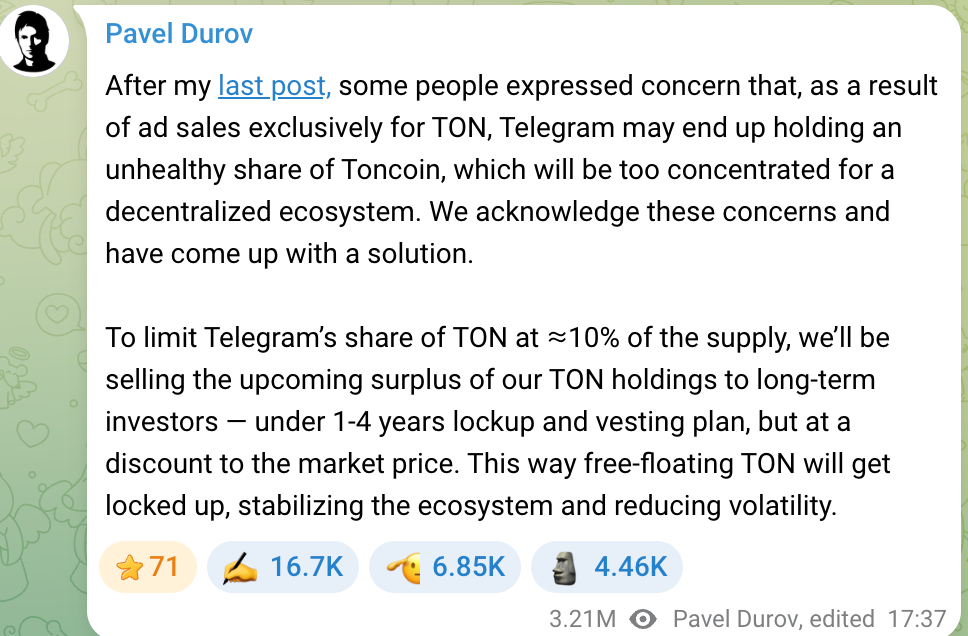
Durov emphasized that these sales would be conducted at a slight discount to the market price and subject to lock-up and vesting periods to avoid short-term selling pressure and ensure the stability of the TON ecosystem. This plan aims to prevent TON from being concentrated in Telegram's hands, which could raise concerns about price manipulation, and to uphold the project's decentralization宗旨. Therefore, Telegram's token selling行为 is more like a环节 of asset structure adjustment and liquidity management, rather than simple profit-taking by selling high.

It is worth noting that while the持续走低 of TON's price in 2025 certainly brought impairment pressure on Telegram's financial reports, in the long run, Telegram's deep integration with TON has also created a situation of shared prosperity and loss.

Telegram has gained new revenue sources and product highlights through its deep involvement in the TON ecosystem, but it must also bear the financial impact of crypto market volatility. This "double-edged sword" effect is also a factor that investors must consider when evaluating its value as Telegram contemplates an IPO.

Telegram's IPO Prospects

With improving financial performance and business diversification, Telegram's上市前景 has become a focus of market attention. The company has raised over $1 billion since 2021 through multiple rounds of bond issuance; in 2025, it issued another $1.7 billion in convertible bonds, attracting participation from internationally renowned institutions like BlackRock and Abu Dhabi's Mubadala.

These financing measures not only provide Telegram with capital but are seen as preparations for an IPO. However, Telegram's path to上市 is not smooth; its debt arrangements, regulatory environment, and founder factors will all influence the IPO process.

Telegram currently has two main bonds outstanding: one is a bond with a coupon of 7%, maturing in March 2026, and the other is a convertible bond with a coupon of 9%, maturing in 2030. In the second $1.7 billion bond, approximately $955 million was used to replace old bonds, and $745 million was new capital for the company.

The special feature of the convertible bond is that it has an IPO conversion clause: if the company goes public before 2030, investors can redeem/convert shares at approximately 80% of the IPO price, equivalent to a 20% discount. In other words, these investors are betting that Telegram can successfully IPO and achieve a considerable valuation premium.

Currently, through the 2025 debt restructuring, Telegram has提前 redeemed or repaid the vast majority of the bonds maturing in 2026. Durov publicly stated that the old debt from 2021 has been largely settled and does not pose a current risk. Addressing the impact of the frozen $500 million Russian bonds on Telegram, he responded that Telegram does not rely on Russian capital, and there were no Russian investors in the recently issued $1.7 billion bond.

Therefore, Telegram's main debt now is the convertible bond maturing in 2030, leaving a relatively宽裕的上市窗口. However, many investors still expect Telegram to seek an上市 around 2026-2027,实现债转股 and open up new financing channels. If this window is missed, the company may face long-term debt interest pressure in the future and could lose a good opportunity to transition to equity financing.

When investors measure Telegram's上市价值, they also focus on its profit prospects and revenue-sharing model. Telegram currently has about 1 billion monthly active users and an estimated 450 million daily active users. This庞大的用户基础 gives it commercial imagination space. Although its business has grown rapidly in recent years, Telegram still needs to prove that its business model can achieve sustainable profitability.

The good news is that Telegram currently has absolute control over its ecosystem. Durov recently emphasized that he remains the company's sole shareholder, and creditors are not involved in corporate governance.

Therefore, Telegram has the potential to sacrifice some short-term profits for long-term user stickiness and ecosystem prosperity without being constrained by short-sighted shareholders. This "delayed gratification" strategy aligns with Durov's consistent product philosophy and will also be the core of the growth story told to investors during the IPO path.

However, it must be emphasized that an IPO does not depend solely on financial and debt structure. FT pointed out that Telegram's potential上市计划 is currently still affected by judicial proceedings in France against Durov, and the related uncertainty makes it difficult to clarify the上市时间表. Telegram has also acknowledged in its communication with investors that this investigation may pose an obstacle.

Recommended Reading:

RootData 2025 Web3 Industry Annual Report

Xiao Hong: From Small-Town Youth to Manus CEO, A Bitcoin Believer's Long-Termism

Binance Power Shift: The Dilemma of a 300 Million User Empire

Has the Buyback Bonus Really Come to an End?

Related Questions

QWhy did Telegram report a net loss of $222 million in the first half of 2025 despite strong revenue growth?

ATelegram reported a net loss primarily because it had to revalue its holdings of Toncoin (TON) due to a significant price decline. The value of TON fell by over 73% at its lowest point in 2025, leading to substantial asset impairment losses on its financial statements.

QWhat was the primary source of Telegram's revenue growth in the first half of 2025?

AThe primary source of Telegram's revenue growth was its exclusive agreement with the TON blockchain, which brought in close to $300 million. This was supplemented by an 88% surge in premium subscription revenue ($223 million) and a 5% increase in advertising revenue ($125 million).

QWhat was the stated reason for Telegram selling over $450 million worth of TON tokens, and how did it address community concerns?

ATelegram stated the sales were part of a strategy to keep its TON holdings below 10% of the total supply to promote decentralization, as pledged by founder Pavel Durov. To address concerns about market pressure, the sold tokens were subject to a four-year vesting period and were sold at a discount to long-term investors (like TONX) for staking, not immediate resale.

QWhat are the key factors influencing Telegram's potential IPO, according to the article?

AKey factors include its debt structure (particularly a $1.7 billion convertible bond with an IPO conversion clause), its ability to demonstrate sustainable profitability, its massive user base (~1 billion MAUs), and ongoing legal proceedings in France against founder Pavel Durov, which create uncertainty.

QHow did Telegram's financial performance in 2024 compare to 2023?

AIn 2024, Telegram achieved its first annual profit of $540 million, with annual revenue skyrocketing to $1.4 billion. This was a massive increase from its 2023 revenue of $343 million, driven largely by its 'partnerships and ecosystem' (including TON), premium subscriptions, and advertising.

Related Reads

When Doing Cryptocurrency Payment, the First Thing is Licenses, What is the Second?

When launching a crypto payment business, obtaining the necessary licenses is the crucial first step. However, the second, and arguably more critical, step is designing a comprehensive operational framework that forms a coherent business loop. This loop must be clearly understood and executable by all stakeholders: banks, payment partners, exchanges, on-chain analytics providers, regulators, and your internal team. Many projects mistakenly believe a single license permits all operations. Licenses merely grant entry; they don't define how the specific business functions. The real challenge lies in detailing every aspect of the workflow. This involves clarifying the customer base, the flow of fiat and crypto assets, the settlement process, and establishing clear lines of responsibility for risks like AML compliance, sanctions screening, chargebacks, and regulatory inquiries. A robust framework must answer seven core questions: Who are the clients and merchants? Who collects fiat and crypto? Who handles conversion and custody? And who is ultimately accountable for compliance and risk management? Projects often fail not from a lack of licensing, but during due diligence when they cannot convincingly explain these operational details. Therefore, beyond securing licenses, the priority must be constructing a closed-loop system. This system ensures the business model is transparent, risks are managed, responsibilities are delineated, contracts are aligned, and the entire process is comprehensible to partners and regulators. The true competitive edge in crypto payments lies not in acquiring a license quickly, but in integrating licensing, banking, compliance, and operations into a sustainable and executable whole.

marsbit22m ago

When Doing Cryptocurrency Payment, the First Thing is Licenses, What is the Second?

marsbit22m ago

Arthur Hayes Analysis: AI Bubble Nears Burst, Crypto Market Faces Short-Term Pressure

Arthur Hayes argues that the current AI market is a bubble poised to burst, which will exert downward pressure on the crypto market in the near term. The core trigger is rising oil prices due to the US-Iran conflict and a blockade of the Strait of Hormuz. Higher energy costs directly increase the operational expenses of AI data centers, squeezing profit margins for companies like Google, Anthropic, and OpenAI. Hayes predicts that persistent inflation from high oil prices will force Trump, in a bid to win the November election, to turn public sentiment against the AI industry. He may propose regulations and taxes on data centers and AI companies to appeal to voters concerned about costs and job displacement. Such political rhetoric could shatter market confidence. Furthermore, the market is unlikely to healthily absorb the massive concurrent IPOs of SpaceX, Anthropic, and OpenAI, which together seek valuations in the trillions. The combination of soaring energy costs, overwhelming equity supply, and negative political pressure will puncture the AI bubble. Hayes notes that nearly all new USD liquidity since 2022 has flowed into AI, leaving crypto like Bitcoin behind. When the AI bubble bursts, liquidity will contract sharply, pulling down all risk assets, including cryptocurrencies. In response, Hayes's fund, Maelstrom, has sold all AI-related stocks and non-core cryptocurrencies. It maintains core positions in Bitcoin and Ethereum while increasing exposure to energy sector equities, betting on rising oil and gas prices. He expects Bitcoin to bottom after the AI-led market decline, before rallying again with future monetary easing.

Foresight News36m ago

Arthur Hayes Analysis: AI Bubble Nears Burst, Crypto Market Faces Short-Term Pressure

Foresight News36m ago

To C, To B, and the Next Big Thing Called To A

After To C and To B, the Next Wave is To A: Serving AI Agents In a recent quarterly earnings call, Meituan's Wang Xing introduced a new concept: To A (To Agent), signifying that future business services will increasingly target AI Agents as primary clients, not just consumers or merchants. This shift implies that internet giants must now consider how to make their services more appealing for AI Agents to recommend, fundamentally altering traditional distribution logic. This "To A era" is prompting an unusual trend of alliances among major tech companies. Unlike previous competitive battles, firms like Meituan, Tencent, JD.com, Huawei, OPPO, and OpenAI are rapidly forming partnerships. The reason is strategic: as AI Agents become the primary user interface, handling tasks from a single command (e.g., "Book a Japanese restaurant for tomorrow"), the risk for platforms is being bypassed entirely. Companies are positioning themselves within this new value chain. Three primary strategies are emerging: 1. **Super-Entry Points + Service Providers:** Platforms like Tencent's Yuanbao, WeChat, and ChatGPT aim to be the first-stop Agent, integrating various services (food delivery, shopping, travel) from partners like Meituan and JD.com. 2. **Apps as Callable Services:** Companies like Meituan, JD.com, and Uber are ensuring their core services remain accessible and callable by external Agents, shifting from front-end apps to back-end capabilities. 3. **System-Level Agent Entry Points:** Smartphone makers (Huawei, Honor, OPPO) are leveraging their OS-level AI assistants to control the initial user command, redistributing it to relevant service apps. While alliances offer mutual benefit—entry points gain service capabilities, and service providers gain traffic—inherent conflicts of interest exist. A dominant Agent platform could eventually attempt to connect directly with suppliers (restaurants, hotels), bypassing current aggregators like Meituan or Ctrip. Other unresolved challenges include the potential for Agent recommendations to become a new form of paid ranking and unclear accountability for faulty recommendations. The current rush to form alliances is a defensive move by service providers to secure their position before the landscape solidifies. In this To A-driven restructuring, the greatest risk is not losing the race but failing to hear the starting gun.

marsbit45m ago

To C, To B, and the Next Big Thing Called To A

marsbit45m ago

The More Lifelike the Robot, the More Terrifying? Unveiling the 'Uncanny Valley Effect' in the Era of Humanoid Robots

As humanoid robots become increasingly lifelike, they confront a significant psychological barrier known as the "Uncanny Valley Effect," a concept proposed by Japanese roboticist Masahiro Mori in 1970. This phenomenon describes a dip in human comfort and acceptance when robots appear almost, but not perfectly, human. Minor imperfections in facial expressions, eye movements, or skin texture trigger a subconscious sense of unease, as the brain detects something trying, yet failing, to mimic a person. Examples range from the controversial human-like robot Sophia to animated characters in films like *The Polar Express*. The effect poses a key design challenge for robotics companies. Some, like Boston Dynamics, avoid it entirely by creating highly capable but visibly mechanical robots. Others, like Hanson Robotics, push for greater human likeness despite the risk. For consumer robots, especially in homes, most manufacturers opt for stylized or clearly mechanical designs to ensure broader acceptance. While the Uncanny Valley remains a powerful force, its impact may diminish over time through technological advancements that achieve near-perfect realism or through generational familiarity as people grow accustomed to interacting with humanoid machines. Ultimately, navigating this psychological frontier requires as much understanding of human perception as of robotics technology itself.

marsbit45m ago

The More Lifelike the Robot, the More Terrifying? Unveiling the 'Uncanny Valley Effect' in the Era of Humanoid Robots

marsbit45m ago

Trading

Spot
Futures

Hot Articles

How to Buy TON

Welcome to HTX.com! We've made purchasing TONCOIN (TON) simple and convenient. Follow our step-by-step guide to embark on your crypto journey.Step 1: Create Your HTX AccountUse your email or phone number to sign up for a free account on HTX. Experience a hassle-free registration journey and unlock all features.Get My AccountStep 2: Go to Buy Crypto and Choose Your Payment MethodCredit/Debit Card: Use your Visa or Mastercard to buy TONCOIN (TON) instantly.Balance: Use funds from your HTX account balance to trade seamlessly.Third Parties: We've added popular payment methods such as Google Pay and Apple Pay to enhance convenience.P2P: Trade directly with other users on HTX.Over-the-Counter (OTC): We offer tailor-made services and competitive exchange rates for traders.Step 3: Store Your TONCOIN (TON)After purchasing your TONCOIN (TON), store it in your HTX account. Alternatively, you can send it elsewhere via blockchain transfer or use it to trade other cryptocurrencies.Step 4: Trade TONCOIN (TON)Easily trade TONCOIN (TON) on HTX's spot market. Simply access your account, select your trading pair, execute your trades, and monitor in real-time. We offer a user-friendly experience for both beginners and seasoned traders.

14.5k Total ViewsPublished 2024.03.29Updated 2026.06.02

How to Buy TON

Discussions

Welcome to the HTX Community. Here, you can stay informed about the latest platform developments and gain access to professional market insights. Users' opinions on the price of TON (TON) are presented below.

活动图片