# Dominance Related Articles

HTX News Center provides the latest articles and in-depth analysis on "Dominance", covering market trends, project updates, tech developments, and regulatory policies in the crypto industry.

Bitcoin Is Ready for "Parabolic Growth". Is Altseason Upon Us?

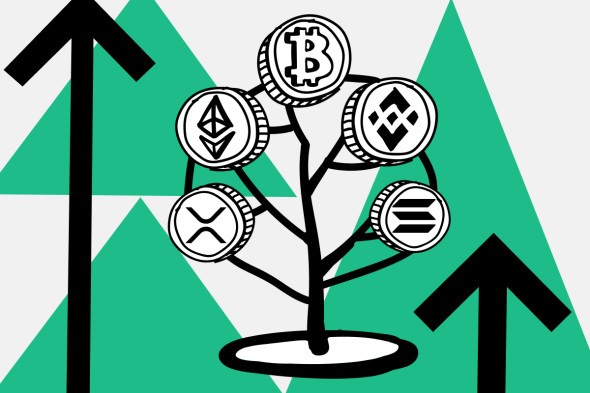
Amid a general market uptrend, experts are discussing the potential start of an 'altcoin season', where major cryptocurrencies could outpace Bitcoin's growth. This follows Bitcoin surpassing $81,000, predictions of a new bull market, and a capital shift from AI stocks toward Bitcoin and gold. Since August 17th, the crypto market has risen over 22%, primarily driven by Bitcoin (BTC) and Ethereum (ETH), which gained 25% and 30% respectively, reaching highs last seen in May. Analysts suggest the Bitcoin bear cycle has ended, anticipating a historically strong rally, with renewed institutional demand for cryptocurrency ETFs. BitMEX founder Arthur Hayes, in a recent interview, declared the start of a new bull market, predicting Bitcoin could quickly reach "hundreds of thousands" of dollars. Market observers interpret this as an expectation for 'parabolic growth.' Signs of a bull market revival include Bitcoin ETFs re-entering the top 10 most-traded ETFs, displacing some AI-focused funds. Analysts at CryptoQuant note capital is flowing from Bitcoin into riskier altcoins, with their bull market indicators showing the most optimistic signals since October 2025. However, the reality is more nuanced. The current surge is a rebound from yearly lows; Bitcoin's price is still down nearly 40% from its October peak. The Altcoin Season Index has dropped to 39 from 67 in early August, and Bitcoin's dominance remains around 60%, indicating investor focus is still on Bitcoin rather than altcoins. Experts predict the market is entering a phase where project fundamentals and real revenue, rather than speculation, will increasingly determine asset value.

cryptonews.ru13h ago

Bitcoin Is Ready for "Parabolic Growth". Is Altseason Upon Us?

cryptonews.ru13h ago

Fidelity Q3 Report: BTC, ETH, and SOL Continue to Build Bottoms; How Much Further Will This Crypto Bear Market Go?

Fidelity's Q3 Crypto Signal Report analyzes the current bear market, noting Bitcoin (BTC), Ethereum (ETH), and Solana (SOL) are in a prolonged bottoming phase. Key indicators like the weighted Net Unrealized Profit/Loss (NUPL) have turned negative (-0.01), signaling the market is slightly below its aggregate cost basis, with BTC acting as the primary stabilizing asset. BTC's dominance has risen to 68%, indicating a lack of capital rotation to other digital assets. Performance has been weak across the board, with BTC, ETH, and SOL down significantly year-to-date. Market sentiment is depressed, exacerbated by substantial outflows from spot ETPs and a challenging macro environment. The report compares the current ~203-day downtrend to historical ~300-day bottoming cycles, suggesting the process may be two-thirds complete, with late 2026 as a potential timeframe to monitor. For Bitcoin, NUPL at 0.09 indicates cautious sentiment, while momentum signals remain negative. The Yardstick metric points to potential undervaluation relative to network security (hashrate). Ethereum's NUPL is deep in the "capitulation" zone at -0.43, a historically positive signal for future returns, though its momentum and network fee revenue are negative. Solana shows the deepest NUPL at -0.72 but demonstrates relative resilience in on-chain activity and stablecoin transfer volume. The report concludes that while several metrics are near historical capitulation levels, a definitive market bottom has not yet been established. The path forward likely involves continued consolidation, with BTC's relative strength and fundamental on-chain usage for ETH and SOL providing key areas for investor observation.

marsbit08/01 11:52

Fidelity Q3 Report: BTC, ETH, and SOL Continue to Build Bottoms; How Much Further Will This Crypto Bear Market Go?

marsbit08/01 11:52

The Artificial Intelligence Economy Could Accelerate the Establishment of Dominance for Dollar-Pegged Stablecoins

Economists from the ASEAN+3 Macroeconomic Research Office (AMRO) suggest that the winner in the artificial intelligence (AI) race may not be the country developing the most powerful AI model, but the one whose currency underpins these models and their infrastructure. Their thesis outlines a potential cycle where AI-related costs—such as energy for data centers, infrastructure, and usage fees—are denominated in U.S. dollars. As AI grows into a massive industry, this could significantly increase global demand for U.S. dollar liquidity (first channel of dollar dominance). A second channel involves the currency used for payments between AI agents, expected to become widespread in logistics, inventory, and treasury management. Dollar-pegged stablecoins could provide the programmable settlements required for such agent commerce. These two channels may converge, creating a self-reinforcing "dollar loop" where AI computational payments are settled in stablecoins. Stablecoins could gain an early advantage over alternatives like CBDCs due to existing network effects, further entrenching dollar dominance. This would also boost demand for U.S. Treasury bonds used as collateral for stablecoin reserves. The report warns ASEAN+3 nations of over-reliance on this dollar loop and suggests developing regional data centers and tokenized money based on local currencies to participate in the AI economy without reinforcing dollar dependency.

cryptonews.ru07/31 09:24

The Artificial Intelligence Economy Could Accelerate the Establishment of Dominance for Dollar-Pegged Stablecoins

cryptonews.ru07/31 09:24

活动图片