Pump.fun Takes 98% of Launchpad Revenue as Daily Trading Volume Reaches $542 Million

cryptonews.ruPublished on 2026-08-11Last updated on 2026-08-11

Abstract

Pump.fun, a Solana-based memecoin launchpad, has achieved unprecedented market dominance, capturing 98% of the sector's daily revenue of $1.14 million on August 9. Its daily revenue of $1.12 million, alongside a trading volume of $542.17 million out of the sector's total $649.61 million, marks a significant recovery and the highest figures since March. The platform launched 37,966 tokens that day, with 127 reaching a market cap over $1 million. This dominance is attributed to aggressive product updates, including a social trading feature with zero-fee trading and cross-chain USDC swaps, and user acquisition tactics like offering large bonuses to competitors' users. Additionally, half of Pump.fun's revenue continues to fund a PUMP token buyback program. While impressive, this 98% share reflects both Pump.fun's growth and a substantial contraction in the overall launchpad market. The sector's total daily revenue is now a fraction of its 2024-2025 peak of $4-5.6 million, indicating market concentration rather than a broad-based retail recovery. Competitors like Flap and Raydium generated minimal revenue in comparison. New entrants like Robinhood Chain, while showing early promise with $28.39 million in volume, have not challenged Solana's overwhelming lead, which was responsible for nearly all platform-related volume on the network.

There has been a noticeable surge in memecoin activity over the past couple of weeks, and it becomes evident when we look at the metrics from launchpads. In fact, Blockworks data shows that over 587,000 tokens were created on launchpads last week, the highest number of tokens launched in a single week. Yet, one launchpad has been grabbing all the attention lately and showing the highest metrics.

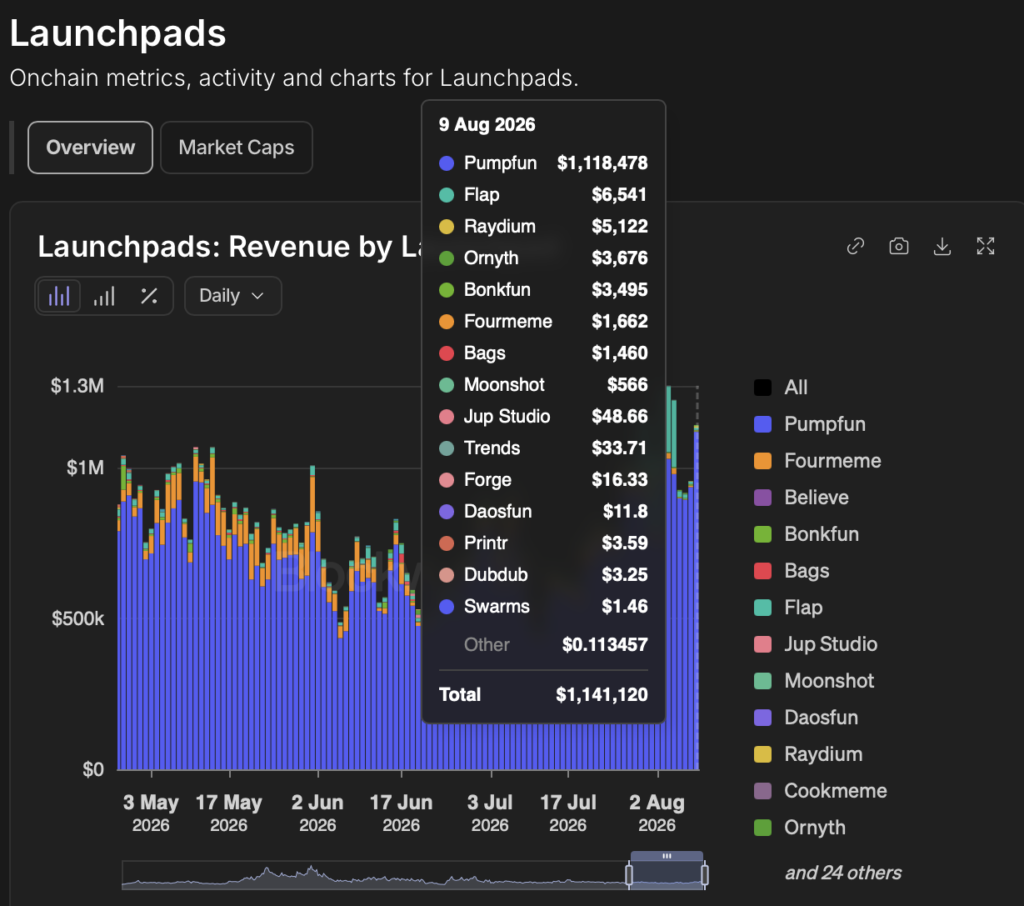
On August 9, Pump.fun earned $1,118,478. At the same time, all other launchpads combined earned $22,642. Thus, the Solana-based platform took 98% of the $1,141,120 earned by the entire category that day. This makes the market situation the most unbalanced since April 2025, when there were far fewer projects.
Source: Blockworks

Pump.fun's daily revenue of $1.1 million also marked an unprecedented figure since March, completing a recovery that had been brewing for several weeks. Trading volume followed a similar trend. Of the $649.61 million sold across all platforms yesterday, $542.17 million passed through Pump.fun.

In total, 37,966 tokens were launched on the Pump.fun platform that day, and 127 of them surpassed a market capitalization of $1 million, roughly one in every 300.

Robinhood Chain Emerges, Solana Still Sells All the Goods

Looking at the numbers, the competition appears quite stark. Flap earned $6,541 for the day, ranking second after Pump.fun. The Raydium launch brought in $5,122, while BONKfun, which was considered a serious competitor, especially in July of last year, earned $3,495.

The Robinhood Chain network has entered the game and is worth watching closely. Trading volume on platforms of this network amounted to $28.39 million, or about 4% of the total daily volume. This is commendable, given that the network launched just over a month ago. However, Solana still leads by a wide margin. This network accounted for $546.35 million of the total daily platform trading volume, compared to $74.87 million for BNB Chain, and nearly every Solana-related dollar can be traced back to one specific platform.

The launchpad sector has existed for over two years now, and during this time, new networks and new projects have emerged. In fact, current data shows that money has once again concentrated in one place.

Where This Volume Really Came From

None of this happened passively. The turnaround began in late July when memecoin pairs once again reached 29% of Solana's spot DEX trading volume, the highest level since August 2025, and Pump.fun became the primary platform absorbing this activity. This was followed by a series of product and incentive changes.

On August 7, Pump.fun released a social trading update that added trade callouts, commission-free trading, and cross-chain swaps with $USDC, moving the product closer to a trading terminal than a token factory.

Social Trading in the Pumpfun App just got leveled up!

– Callout tokens, alerting EVERY subscriber
– Commission-Free Trading
– Seamless Cross-Chain Trading with $USDC.

Grow your followers right now 👇 pic.twitter.com/lZGWozPCEY

— Pump.fun (@Pumpfun) August 7, 2026

User acquisition was also aggressive. FOMO is a competing Solana trading platform, and Pump.fun immediately offered its users a $20,000 sign-up bonus, plus $30,000 per month for switching platforms. Payment for order flow is not new in crypto, but the scale of these payouts relative to the sector's revenue is impressive. Pump.fun spent nearly the entire monthly revenue of its competitors just on poaching their users.

As for tokens, the buyback program continues to operate. Half of the platform's revenue still goes towards buying PUMP, with $3.73 million worth of tokens bought back in one week. BOOST, which returns liquidity gained from migration to new launches, is being promoted as the default launch mechanism, not as an option hidden in settings.

Each of these factors is incremental on its own. Together, over several weeks, they explain why the volume gap has widened, not narrowed.

98% of a Much Smaller Market

Context is needed to understand the dominance metric. With daily revenue of $1.14 million, the total revenue of the launchpad sector is just a fraction of what it was during the peak of the memecoin craze in 2024 and early 2025, when this segment regularly generated between $4 and $5.6 million per day.

Pump.fun's revenue today is not vastly different from what happened on average per day across the industry 18 months ago. Its 98% share reflects both a shrinking number of competitors and growth. The category has shrunk, and one platform has absorbed most of the remaining market.

This distinction is important for anyone interpreting these numbers as a signal of interest from retail investors. Concentration is not the same as recovery. Token launches are still happening on a large scale, nearly 38,000 per day, but the revenue they generate has sharply declined.

end-content
Trending Cryptos

Related Questions

QWhat staggering percentage of total launchpad revenue did Pump.fun capture on August 9, according to the article?

AAccording to the article, Pump.fun captured 98% of the total $1,141,120 in revenue earned by the entire launchpad category on August 9.

QWhat key product update did Pump.fun release on August 7th, and how did it change the platform's functionality?

AOn August 7th, Pump.fun released a social trading update that added trade alerts, fee-free trading, and cross-chain swaps with USDC. This update moved the platform closer to a full trading terminal rather than just a token creation factory.

QHow does the article qualify Pump.fun's current market dominance (98%) in the launchpad sector?

AThe article clarifies that this 98% dominance reflects both the growth of Pump.fun and a significant contraction of the overall launchpad market. The total sector revenue is much smaller than during the memecoin peak in 2024/2025, meaning Pump.fun is capturing a large share of a diminished market rather than signaling a broad retail recovery.

QWhat aggressive user acquisition tactic did Pump.fun employ against its competitor FOMO?

ATo acquire users from its competitor FOMO, Pump.fun offered a $20,000 sign-up bonus and a $30,000 monthly payment for switching platforms, effectively spending nearly an entire month's revenue of its competitors on poaching their users.

QWhich blockchain network handled the vast majority of the daily launchpad trading volume, and approximately how much was it?

AThe Solana blockchain handled the vast majority of the daily launchpad trading volume, accounting for $546.35 million of the total, with nearly every dollar of that volume being traceable to the Pump.fun platform.

Related Reads

New Claude models will embed invisible watermarks in generated text

Anthropic has announced that starting from August 2, 2026, new Claude models deployed in the European Union will incorporate machine-readable invisible watermarks into generated text. This measure will apply globally wherever Claude is offered, including via its API, applications, and through partners like AWS, Google Cloud, and Microsoft Foundry. The watermarking mechanism for text is distinct from file provenance. For text, invisible watermarks will be woven directly into the model's responses without altering meaning, quality, or readability, and are designed to persist through copying and pasting and partially through editing. This system is separate from the C2PA standard. For files (e.g., .png, .jpg), Claude already attaches C2PA-compliant metadata signatures to indicate AI origin. Models released before August 2, 2026 (including the current Claude Opus 5) are in a transitional period and do not embed text watermarks, though Anthropic is working to add support. Currently, there are no public tools to detect these text watermarks; Anthropic states it is developing such tools and will release technical details later. The timing aligns with the EU AI Act's Article 50, which from August 2, 2026, mandates labeling of AI-generated content, with potential fines for non-compliance. A key technical question remains regarding the watermark's resilience to paraphrasing or translation by other AI models, which in other industry experiments has significantly reduced detection accuracy.

cryptonews.ru26m ago

New Claude models will embed invisible watermarks in generated text

cryptonews.ru26m ago

Trading

Spot

Hot Articles

What is USDC(WORMHOLE)

USD Coin (Wormhole): A Comprehensive Overview Introduction In the rapidly evolving world of cryptocurrencies, USD Coin (Wormhole), referred to as $USDC(Wormhole), stands out as a pioneering solution within the DeFi (Decentralized Finance) landscape. Operating on several blockchain platforms, including Solana, USD Coin (Wormhole) is more than just a digital representation of the United States dollar. It embodies the innovative spirit of modern finance, enabling seamless cross-chain transactions and enhanced interoperability among diverse blockchain ecosystems through the advanced Wormhole protocol. What is USD Coin (Wormhole)? USD Coin (Wormhole) is a tokenized version of the US dollar designed to facilitate frictionless transactions across different blockchain networks. Its primary aim is to bolster liquidity and enhance the functionality of the DeFi ecosystem. By leveraging the Wormhole protocol, which establishes a robust cross-chain communication network, users can effortlessly transfer USDC tokens across various platforms. This cross-chain capability marks a significant advancement in cryptocurrency use, promoting a more interconnected and efficient ecosystem where assets can flow freely between different blockchains. The value proposition of USD Coin (Wormhole) lies not only in its stability, being pegged to the US dollar, but also in its ability to bridge gaps between disparate blockchain environments. This innovative approach fosters a greater level of participation among users and developers, paving the way for new and exciting applications within decentralized finance. Who is the creator of USD Coin (Wormhole)? The origins of USD Coin (Wormhole) are intricately tied to the Wormhole network, which was developed by Jump Crypto. While specific individual creators are not prominently documented, Jump Crypto is notable for its involvement in advancing blockchain technology and supporting its applications in finance. By creating the Wormhole network, Jump Crypto has played a vital role in promoting cross-chain asset transfers, enhancing the efficiency and diversity of cryptocurrency usage. Who are the investors of USD Coin (Wormhole)? The success of USD Coin (Wormhole) is supported by investments from several notable funds and organizations within the cryptocurrency realm. Key investors include: Coinbase Ventures: A prominent venture capital arm backed by one of the leading cryptocurrency exchanges in the industry, Coinbase Ventures provides essential capital and strategic support to promising blockchain projects. Arrington XRP Capital: Specializing in digital assets, Arrington XRP Capital recognizes the potential of innovative projects like USD Coin (Wormhole) and has invested accordingly to back its development. Jump Trading: As the parent organization of Jump Crypto, Jump Trading brings not only investment but a wealth of expertise in trading technology and market dynamics to bolster the Wormhole project. How Does USD Coin (Wormhole) Work? The operational framework of USD Coin (Wormhole) is intricately designed to facilitate effective cross-chain transactions, maximizing security and efficiency. Here’s a simplified overview of how it functions: Asset Locking: When a user wishes to transfer USDC from one blockchain to another, they first lock their tokens on the source blockchain. This process ensures that the assets are secure and are set to be either burned or moved later. Token Minting: After the tokens are locked, an equivalent amount of USDC is minted on the destination blockchain. This provides the user with access to their funds on a new platform, reflecting the flexibility that the Wormhole protocol enables. Cross-Chain Transfer: The Wormhole protocol efficiently facilitates the entire transfer process. It ensures that once the USDC is minted on the destination chain, the equivalent tokens are burned on the source chain. The result is a seamless transfer of value between two distinct blockchain environments. This cross-chain methodology ensures that transactions remain secure and transparent, significantly enhancing liquidity within the different DeFi ecosystems. Timeline of USD Coin (Wormhole) Understanding the evolution of USD Coin (Wormhole) provides vital context for its significance in the cryptocurrency arena. Here’s a timeline highlighting important milestones in the project’s history: 2021: The Wormhole project is launched, establishing a framework for cross-chain asset transfers and setting the stage for the development of USD Coin (Wormhole). 2022: The Wormhole network experiences a significant challenge with a security breach that results in a $325 million theft. However, the incident is later addressed and refunded by Jump Crypto, showcasing the project’s commitment to security and transparency. 2023: USD Coin (Wormhole) integrates with Circle’s Cross-Chain Transfer Protocol (CCTP), enhancing its capabilities for cross-chain transfers and further solidifying its place within the DeFi ecosystem. 2024: Ongoing development and expansion of the Wormhole network continue, aimed at increasing the utility and reach of USD Coin (Wormhole) as well as enhancing its operational framework. Key Features The success of USD Coin (Wormhole) can be attributed to several key features that differentiate it from other cryptocurrency offerings: Cross-Chain Interoperability At the core of USD Coin (Wormhole) is its ability to facilitate seamless transfers across multiple blockchain networks. This interoperability serves as a cornerstone for decentralized finance, allowing various platforms to interact with each other, thereby accelerating the evolution of financial services. Security Wormhole employs a well-designed Guardian Network comprised of node validators that ensure secure cross-chain transactions. This collective oversight minimizes the risk of fraud and provides users with confidence that their assets are protected during cross-chain transfers. Liquidity Enhancement By enabling USDC to circulate freely across different blockchains, USD Coin (Wormhole) enhances liquidity in the DeFi ecosystem. This increased liquidity can foster more efficient trading, contribute to better pricing strategies, and improve the overall market dynamics encompassing various digital assets. Conclusion USD Coin (Wormhole) is a pivotal innovation in the blockchain space, reinforcing the capabilities of decentralized finance (DeFi) and establishing a more connected financial ecosystem. With its robust framework for cross-chain transactions, security features, and strong backing from reputable investors, USD Coin (Wormhole) is positioned to play a key role in the future of cryptocurrency. As the digital finance landscape continues to evolve, USD Coin (Wormhole) not only embraces the future of interconnectivity among blockchain networks but also reaffirms the power of tokenization and blockchain technology in transforming how we perceive and utilize value in a digital world. By navigating the complexities of cross-chain functionality, it demonstrates a sophisticated approach to enabling financial inclusivity and innovation in the world of cryptocurrencies.

1.8k Total ViewsPublished 2024.04.01Updated 2024.12.03

What is USDC(WORMHOLE)

What is W$C

World$tateCoin ($W$C): A Comprehensive Exploration of the Emerging Cryptocurrency Project Introduction In the ever-evolving landscape of cryptocurrencies, World$tateCoin ($W$C) has emerged as a project that aims to harness the power of web3 technologies to create a distinctive digital ecosystem. As traditional models of online interaction undergo significant transformation, World$tateCoin seeks to establish itself in this budding third generation of the internet. This article will delve into the intricacies of World$tateCoin, providing an overview of the project, its objectives, and its potential impact on the web3 space. What is World$tateCoin ($W$C)? World$tateCoin ($W$C) is designed as a cryptocurrency that facilitates seamless transactions within a web3 environment. Aimed at creating a decentralized platform where users can interact with various web3 applications, $W$C intends to streamline user experience and enhance accessibility to digital services. While the project aspires to become an integral part of the web3 landscape, detailed insights into its specific objectives and use cases remain limited, raising questions regarding its potential role and utility in a rapidly advancing digital context. The essence of web3 revolves around decentralization and empowering users with greater control over their interactions online. World$tateCoin intends to align with these principles, although specific applications and functionalities of the currency are still under discussion within the community. Who is the Creator of World$tateCoin ($W$C)? In exploring the origins of World$tateCoin, information regarding its creator remains elusive. As of now, there is no publicly available data identifying the individuals or organizations behind the project. This obscurity may cast a shadow of uncertainty over the project’s credibility, but the commitment to innovation within the cryptocurrency framework could be a driving force for its adoption in the future. The lack of identifiable leadership may result in hurdles related to trust and transparency—elements that are crucial for establishing a strong community in the crypto space. Who are the Investors of World$tateCoin ($W$C)? Current research does not reveal any specific investors or backing organizations involved with World$tateCoin. It is not uncommon for emerging cryptocurrency projects to either attract discreet investments or operate in a minimalist financial structure during their initial phase. The ambiguity surrounding investment supports and funding methodologies could affect the project’s sustainability and growth prospects. When assessing new projects within the cryptocurrency domain, investors generally look for transparency regarding financial backing and support from established entities. The absence of this information might necessitate a cautious approach for potential users and stakeholders interested in the future of World$tateCoin. How Does World$tateCoin ($W$C) Work? The operational mechanics of World$tateCoin are grounded in the principles of decentralization, a hallmark of web3 technologies. By facilitating transactions directly between users without the intervention of intermediaries, $W$C is designed to enhance trust and efficiency. However, comprehensive documentation detailing the unique features and operational framework that distinguish World$tateCoin from other cryptocurrencies is markedly sparse. This lack of information complicates the understanding of how $W$C functions within the broader web3 ecosystem and what unique propositions it brings to users and developers alike. Nevertheless, the fundamental goal of allowing for decentralized transactions holds the promise of a more liberated financial landscape, should the project deliver on its aspirations of implementing robust mechanisms and user-friendly interfaces. Timeline of World$tateCoin ($W$C) Constructing a timeline that encapsulates the historical progression of World$tateCoin poses challenges due to an absence of significant documentation on key events and milestones. Nevertheless, an approximate sequence of hypothetical phases can be envisaged, constituting a path forward for the project: Initial Concept (Date Unknown): Conceptualization of the World$tateCoin framework in the broader context of web3 technologies. Development Phase (Date Unknown): Commencement of technical development and coding processes. Community Engagement (Date Unknown): Outreach to potential users and stakeholders to foster community interest in the project. Launch Target (Date Unknown): Announcing an expected launch date, contingent on the progress of development and testing phases. Due to the lack of substantiated dates and details surrounding these phases, stakeholders will need to remain vigilant and engaged with the project's communications for updates regarding its trajectory. Key Topics About World$tateCoin ($W$C) As the project unfolds, certain key subjects arise that embody the potential and aspirations of World$tateCoin: Decentralization: The core philosophy driving the project, aimed at fostering direct user interactions. Web3 Integration: The goal of mirroring web3 principles and enabling seamless user access to an array of digital services. Digital Currency: Positioned as a currency to facilitate internet-based transactions, World$tateCoin aims to inject additional liquidity into the web3 market. Challenge of Information Scarcity: The notable absence of detailed information regarding the project's foundations, creators, and operational methods, necessitating increased transparency from developers to build community trust. Conclusion World$tateCoin ($W$C) is positioned within an exciting yet uncertain terrain of cryptocurrency and web3 integration. While it aims to cultivate a decentralized environment, the limited availability of information regarding its creators, investors, and specific functionalities presents challenges for potential stakeholders and users. In the dynamic world of cryptocurrencies, transparency, engagement, and well-structured communication are vital for the success of projects such as World$tateCoin. As the landscape continues to evolve, stakeholders will be eager to see how the project can solidify its place within the web3 narrative and contribute to the ongoing transformation of the digital ecosystem.

1.5k Total ViewsPublished 2024.04.01Updated 2024.12.03

What is W$C

How to Buy W

Welcome to HTX.com! We've made purchasing Wormhole (W) simple and convenient. Follow our step-by-step guide to embark on your crypto journey.Step 1: Create Your HTX AccountUse your email or phone number to sign up for a free account on HTX. Experience a hassle-free registration journey and unlock all features.Get My AccountStep 2: Go to Buy Crypto and Choose Your Payment MethodCredit/Debit Card: Use your Visa or Mastercard to buy Wormhole (W) instantly.Balance: Use funds from your HTX account balance to trade seamlessly.Third Parties: We've added popular payment methods such as Google Pay and Apple Pay to enhance convenience.P2P: Trade directly with other users on HTX.Over-the-Counter (OTC): We offer tailor-made services and competitive exchange rates for traders.Step 3: Store Your Wormhole (W)After purchasing your Wormhole (W), store it in your HTX account. Alternatively, you can send it elsewhere via blockchain transfer or use it to trade other cryptocurrencies.Step 4: Trade Wormhole (W)Easily trade Wormhole (W) on HTX's spot market. Simply access your account, select your trading pair, execute your trades, and monitor in real-time. We offer a user-friendly experience for both beginners and seasoned traders.

6.6k Total ViewsPublished 2024.04.02Updated 2026.06.02

How to Buy W

Discussions

Welcome to the HTX Community. Here, you can stay informed about the latest platform developments and gain access to professional market insights. Users' opinions on the price of W (W) are presented below.

活动图片