# Capital Flows Related Articles

HTX News Center provides the latest articles and in-depth analysis on "Capital Flows", covering market trends, project updates, tech developments, and regulatory policies in the crypto industry.


Foreign Capital Sells Off $29 Billion in Short-Term US Treasuries, Why is the US Betting on Stablecoins to "Take Over"?

In June, foreign investors netted $133.5 billion into U.S. financial markets but simultaneously sold $29 billion in short-term U.S. Treasury bills. This divergence highlights a strong preference for U.S. equities over government debt. While overseas buyers purchased $181.4 billion in stocks, demand for Treasuries weakened significantly. This trend explains why the U.S. is looking to stablecoins as a potential new source of demand for its debt. Stablecoin issuers like Tether and Circle back their tokens primarily with highly liquid assets, including short-term Treasuries. As users buy stablecoins, issuers convert that dollar demand into Treasury purchases. Recent U.S. legislative efforts, such as the proposed rules under the *GENIUS Act*, formalize this by mandating stablecoin reserves be held in assets like cash and short-term Treasuries. Currently, stablecoins represent a substantial existing buyer base. For instance, Tether alone held nearly $115 billion in direct T-bill exposure in Q2. However, recent stablecoin supply growth has been minimal and does not account for the $29 billion sell-off by foreign investors in June. For stablecoins to act as a meaningful counterbalance to waning foreign demand, their circulating supply would need to expand significantly. The next TIC report will be crucial to monitor whether foreign selling continues and if stablecoin growth begins to fill the demand gap. Ultimately, the U.S. is strategically positioning the regulated stablecoin sector as a potential new pillar of demand for its government debt.

marsbitYesterday 10:15

Foreign Capital Sells Off $29 Billion in Short-Term US Treasuries, Why is the US Betting on Stablecoins to "Take Over"?

marsbitYesterday 10:15

Goldman Sachs Research Report Analysis: 135% Profit Growth in Q2, APAC Valuations Fall to a Decade Low

Goldman Sachs Asia Pacific Market Report Summary (Aug 21, 2026) Earnings soared 135% YoY in Q2 for the MXAPJ index, with 46% of companies beating expectations, led by the Information Technology sector (+390% YoY). Despite this robust profit growth, the index's forward P/E of 11x sits 2 standard deviations below its 10-year average, indicating deep valuation discount. Market sentiment remains cautious, as seen in hedge fund leverage for Asian long/short funds dropping to a one-year low. While China saw net buying in August, its allocation remains near five-year lows, and foreign investors withdrew $1.5bn from EM Asia ex-China markets. The valuation gap is attributed to market pessimism on future growth, not aligning with consensus EPS growth forecasts of 71% for 2026 and 24% for 2027. The upcoming MSCI index rebalancing is expected to trigger approximately $42bn in total two-way passive fund flows. Leveraged ETF flows in Korea and Taiwan show signs of cooling, suggesting a reduction in crowded long positions. Goldman Sachs' core trades include long positions in stocks with strong earnings revisions and AI infrastructure/semiconductors. Key downside risks are rising long-term US bond yields, heightened geopolitical tensions, and a slower-than-expected Chinese economic recovery. The firm maintains a 12-month target of 1080 for MXAPJ, implying 21% upside.

marsbitYesterday 06:01

Goldman Sachs Research Report Analysis: 135% Profit Growth in Q2, APAC Valuations Fall to a Decade Low

marsbitYesterday 06:01

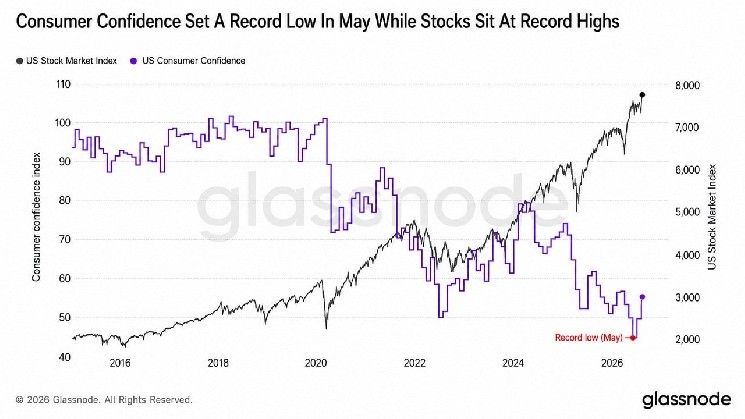
Glassnode: Consumer Confidence Falls as AI-Related Stocks Rise, Bitcoin Lags Behind

According to Glassnode, consumer confidence remains at one of its lowest levels in a decade, despite two consecutive months of improvement. This has not stopped households from moving money out of cash, as they expect further cost-of-living increases and a broader economic slowdown. The key question is where this capital is flowing. US stocks hit a new all-time high in early August, primarily driven by trading in AI-related stocks rather than a broad market rally. Bitcoin, historically seen as a hedge against declining trust in traditional finance, has not participated in this movement. Spot Bitcoin ETFs saw outflows of $389.7 million in one week, coinciding with rising equity markets—a divergence that aligns with Glassnode's data on capital flows. Bitcoin is currently trading at roughly half its October 2025 peak, stuck in a narrow range. Meanwhile, AI-related trading continues to attract fresh capital from retail traders, hedge funds, and even crypto-native institutional investors, who are redirecting funds into AI stocks and tokens. The macroeconomic backdrop has not been hostile to Bitcoin, with core inflation at a moderate 2.5% in July. However, Bitcoin's muted response to favorable inflation data is seen as a concerning signal, given its supposed role as a hedge against currency debasement. Spot Bitcoin exchange trading volume has fallen to its lowest since 2019, and recent ETF inflows are only a "fraction of any prior accumulation wave," suggesting institutional buying may have paused. This trend extends beyond trading: some Bitcoin miners are repurposing their power contracts and data center capacity for AI workloads. This appears to be a structural shift that could pressure Bitcoin's status as the default destination for capital leaving cash. The fundamental arguments for Bitcoin as a hedge against inflation or scarcity are not invalidated, but their expected impact has not materialized within the timeline anticipated by crypto optimists this summer.

cryptonews.ru08/17 09:55

Glassnode: Consumer Confidence Falls as AI-Related Stocks Rise, Bitcoin Lags Behind

cryptonews.ru08/17 09:55

The Optimal 'AI Bubble Trade': Simultaneously Going Long on 'Arrogance' and 'Bias'

The optimal investment strategy in the current AI bubble environment is a dual "leg" approach: going long on both "hubris" (AI tech leaders) and "humiliation" (neglected, underperforming cyclical assets). This aims to capture gains from both sides during the final surge of a nominal GDP-driven bubble, according to a Bank of America report by strategist Michael Hartnett. The bank's Bull & Bear Indicator remains in extreme bullish territory, signaling "sell", yet history shows such signals have limited immediate impact. Current fund flows show structural shifts: gold saw its largest weekly inflow since January, commodities are up 58.9% YTD, while tech stocks experienced their largest weekly outflow in seven weeks. The core thesis is that the final stage of a bubble benefits both the leading theme ("hubris" - AI) and oversold sectors ("humiliation" - like consumer stocks), similar to patterns seen in the 1999 tech bubble and 2007-2008 credit crisis. The report advises shorting "AI bonds," anticipating pressure from massive capital expenditures. Key risks include high concentration, surging bond yields, and cautious voter sentiment. The US debt burden is highlighted, with servicing costs reaching $1.4 trillion. The 10-year Treasury yield breaching 5% is seen as a red line for policymakers. For the "avoid the dollar" theme, BofA recommends gold and Hong Kong property stocks, the latter seen as deeply undervalued. The November US midterm elections, particularly the Texas governor race concerning AI data center expansion, are flagged as a critical political variable that could determine the AI bull market's trajectory. Private client data shows record-high equity allocations (66.4%) and record-low cash levels (9.4%), indicating bullish positioning. The report concludes that while overbought conditions can pause the bull market, ending it requires a combination of excessive positioning, overly optimistic earnings, and policy tightening—a scenario not yet in place.

marsbit08/17 09:15

The Optimal 'AI Bubble Trade': Simultaneously Going Long on 'Arrogance' and 'Bias'

marsbit08/17 09:15

NVIDIA Has Moved the Mountain

**Title: NVIDIA Moves the Mountain** This article analyzes a dramatic two-day reversal in the AI and semiconductor stock markets, driven by a key announcement from NVIDIA. On Monday, August 3rd, Asian markets fell sharply, led by a crash in South Korean leveraged ETFs and panic selling in semiconductors. This spilled over to China's A-share market, where major indices dropped and semiconductor stocks like GigaDevice were hammered despite buyback announcements. The outlook for optical modules (a key AI infrastructure component) appeared bleak, weighed down by rumors of delays in CPO (Co-Packaged Optics) technology adoption. The turnaround came from the U.S. market later that same day. NVIDIA announced its Vera Rubin platform and, crucially, its senior VP declared that CPO technology had entered mass production and would be widely deployed in AI factories in the second half of the year. This directly countered the "CPO delay" narrative. Positive capex data from U.S. cloud giants added to the bullish sentiment. On Tuesday, August 4th, A-shares surged, particularly the ChiNext and STAR boards. The market saw heavy volume with over 2.2 trillion yuan in turnover. Optical module and CPO concept stocks skyrocketed, with leaders like Zhongji Innolight soaring over 13%. The rally was concentrated in growth sectors like tech and communications, while traditional "old economy" stocks like Kweichow Moutai declined. The article also notes other key developments: * A strong earnings report and raised guidance from WuXi AppTec sparked a rally in the CXO (pharma outsourcing) sector. * Mixed signals from the Middle East regarding the Strait of Hormuz. * New Chinese policies supporting the semiconductor industry and Hong Kong-China market cooperation. * Significant inflows into equity ETFs in July, suggesting institutional buying. The piece concludes by highlighting upcoming catalysts: AMD and SpaceX earnings, the potential reopening of the Strait of Hormuz, and NVIDIA's upcoming financial report later in August, which will be the next major test for the AI investment theme.

marsbit08/04 13:51

NVIDIA Has Moved the Mountain

marsbit08/04 13:51

活动图片