AI has not taken anyone's job. At least not so far.
This conclusion comes from a lengthy article recently published by Peter McCrory, Head of Economic Research at Anthropic.
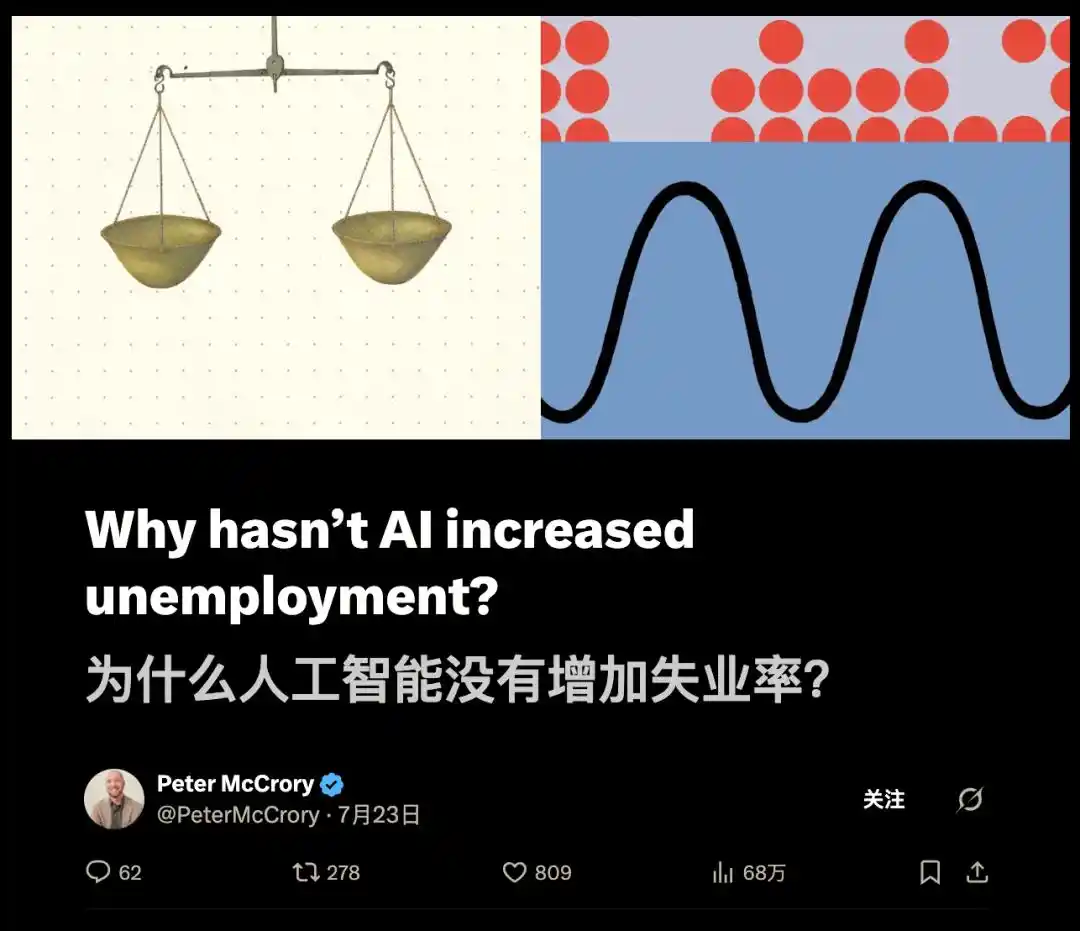
https://x.com/PeterMcCrory/article/2079979321607745905
Quality-adjusted AI output grew over 2000% in both 2024 and 2025, and about one-fifth of US businesses already use AI in their operations, yet the US unemployment rate in June remained at 4.2%, right at the full employment level.
McCrory's core judgment is: AI is currently still a "skill-biased, labor-augmenting" technology; it is amplifying human capabilities, not replacing humans.
He also gave this judgment an expiration date: 12 months.
Data Doesn't Lie: Even High AI-Exposure Jobs Are Fine
McCrory compiled a full chain of data to demonstrate how stable the US labor market is: unemployment rate at 4.2%, the job openings-to-unemployed ratio just above 1, employment-population ratio for ages 25-54 near multi-decade highs, and initial jobless claims running low for four consecutive years.
He believes that, overall, the US employment situation is stable and improving.
Aggregate data is just the starting point; cross-group comparisons reveal the real picture.
McCrory and his colleague Maxim Massenkoff previously conducted an analysis: they isolated jobs corresponding to tasks that Claude is heavily used to automate and examined whether their unemployment rates were deteriorating faster than other jobs.
The answer was no.
Updating with the latest Bureau of Labor Statistics data, the conclusion remains unchanged.
Job postings for software engineering positions have rebounded since May 2025, with growth rates even exceeding the average for other positions.
The only group worth noting is young workers.
McCrory acknowledges that it has indeed become harder for young people to find jobs in high AI-exposure positions, and a paper from Stanford's Digital Economy Lab provides similar evidence.
But he also points out an easily overlooked context: since 2022, the US has experienced the largest non-recessionary labor market cooling on record. The "low hiring, low layoffs" pattern naturally squeezes early-career individuals first.
Attributing this entirely to AI lacks sufficient evidence.
Why Jobs Haven't Been Taken: Every Job Has Parts AI Can't Handle
McCrory's explanation is built on the factual foundation of multiple Anthropic research reports from the past 18 months, with a logical chain as follows:
First-layer fact: Among all occupational classifications in the US Department of Labor's O*NET, there is not a single job where all associated tasks are systematically completed by Claude.
Every job has components that AI struggles with: interpersonal coordination, face-to-face interaction, and dealing with the physical world.
These components act like the short planks of a barrel, both limiting the extent to which AI can boost overall productivity and making people who can fill these gaps more valuable.
Second-layer fact: The stronger AI becomes, the higher the requirements for the people who operate it.
Anthropic's Economic Primitives report from January this year found that the more complex Claude's output, the higher the professional expertise of the user's input behind it.
When the model produces a complex economic model, it's often a professional user capable of giving precise instructions who is directing it.

https://www.anthropic.com/research/economic-index-primitives
The Learning Curves report in March showed that after six months of using Claude, users increasingly employed it as a thinking partner, with higher interaction success rates.
If AI were already strong enough to perform jobs independently, this learning effect shouldn't occur.

https://www.anthropic.com/research/economic-index-march-2026-report
Third-layer fact: Even in the era of Agents, human value remains solid.
Anthropic analyzed seven months of Claude Code usage data and found that task value continued to climb, but the return on human professional skills did not decline:
Users are responsible for planning and delegate implementation to Claude;
Users with stronger professional skills have higher task success rates and recover faster when Claude makes mistakes.
The premium for pure programming implementation might be shrinking, but the value of planning, judgment, and error correction is rising instead.
An interesting piece of supporting evidence comes from users' own perceptions.
In Anthropic's June Economic Index survey, over one-third of respondents expected AI to be able to do most of their job within 12 months, but the proportion expecting to become unemployed as a result was significantly lower.
Users with higher levels of AI automation were even more optimistic about their salaries and job security.

https://www.anthropic.com/research/economic-index-june-2026-report
Three Types of "Singularities" and One Line of Defense
McCrory's assessment of the present is optimistic, but he does not avoid discussing three possible future scenarios that could disrupt the current landscape.
They are referred to in academic literature and industry discussions as the Software Singularity, the Economic Singularity, and the Coasean Singularity.

https://x.com/MTSlive/status/2090610614154764509
The Software Singularity refers to the automation of innovation itself by AI.
>No matter how powerful past general-purpose technologies were, an internal combustion engine couldn't invent new modes of transportation.
But AI is directly endowed with general cognitive abilities, theoretically capable of accelerating its own iteration in return.
McCrory's article explicitly discusses this scenario: if recursive self-improvement (RSI) becomes a reality, the improvement of AI capabilities will break free from the pace of human control.
The Economic Singularity is the economic consequence of the Software Singularity.
McCrory cites a 2017 model by Aghion, Jones, and Jones, pointing out that if the innovation process itself is automated, standard economic models predict "infinite growth in finite time."
This conclusion sounds like science fiction, but it is the result of rigorous mathematical deduction.
The Coasean Singularity targets another dimension.
An NBER paper from 2025 (co-authored by Shahidi, Rusak, Manning, et al.) proposed that when Agents reduce transaction costs like search, negotiation, contracting, and supervision to near zero, Ronald Coase's classic 1937 question is reactivated—once the cost of market coordination disappears, the very reason for a firm's existence is called into question.
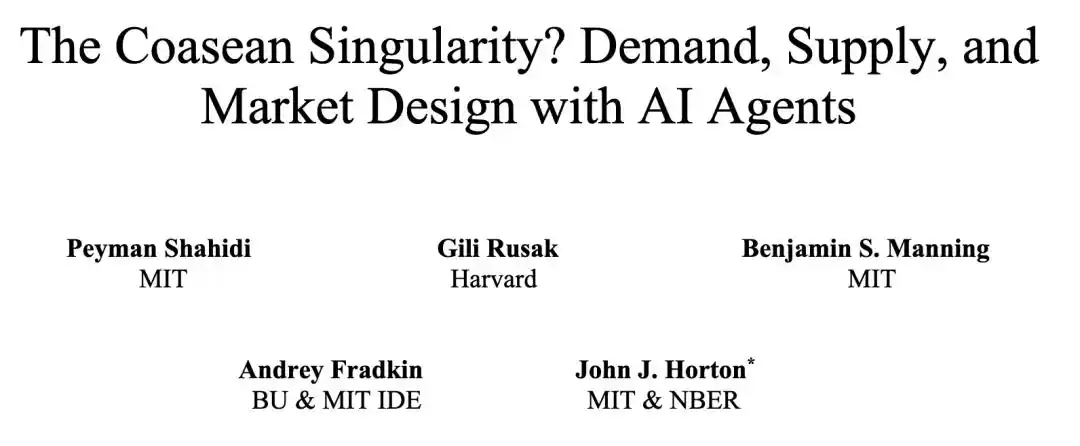
https://www.nber.org/system/files/chapters/c15309/c15309.pdf
The Agent scenario discussed by McCrory naturally dialogues with this framework: if Agents not only change production methods but also organizational forms, the impact on the labor market will be far more complex than simply "who lost their job."
Faced with the three singularities, McCrory offers the same line of defense: the "weak link."
This concept comes from the paper by Aghion, Jones, and Jones—the ceiling of economic growth is not determined by the best-performing links, but by those indispensable links that are difficult to improve.
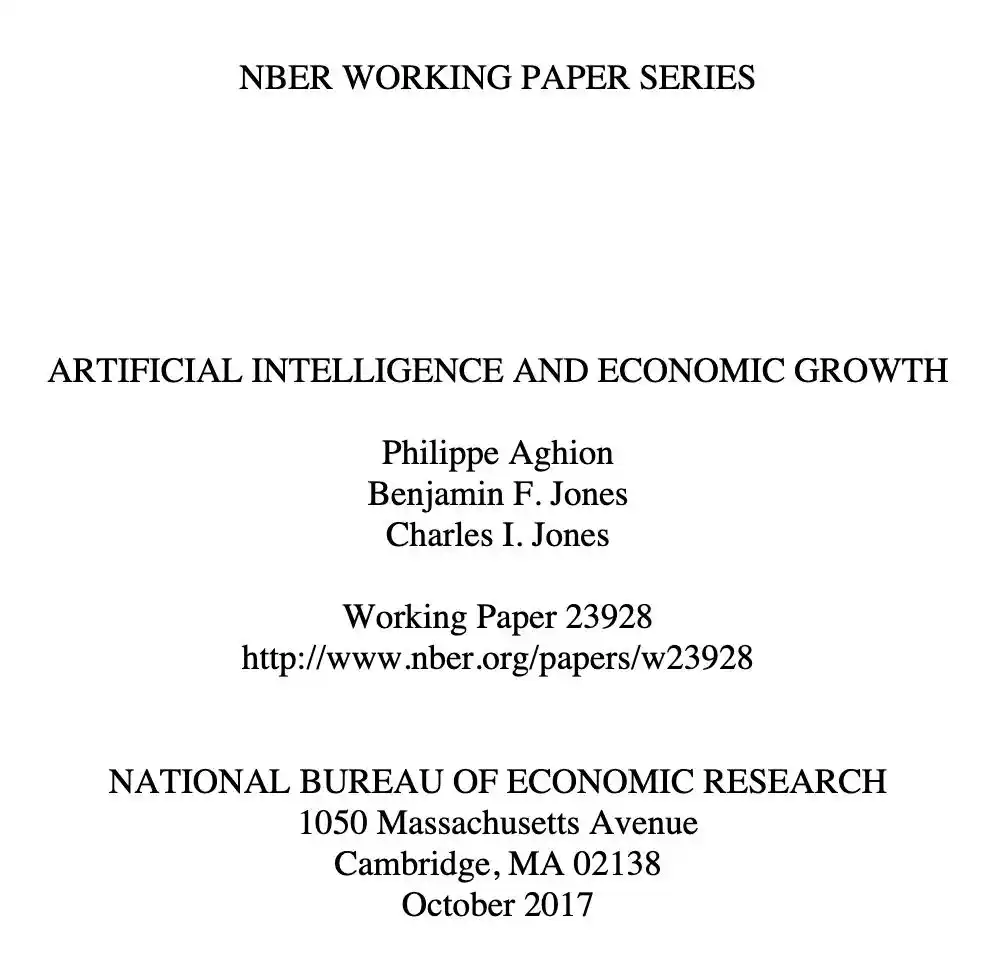
https://www.nber.org/system/files/working_papers/w23928/w23928.pdf
As long as there exist critical tasks that consistently cannot be automated, whether due to technical bottlenecks or social constraints, the labor income share will not collapse, and corporate forms will not completely dissolve.
The current state of coding Agents is already validating this logic.
Data cited by McCrory shows that after introducing coding Agents, lines of code increased by 10 to 20 times, but the number of software releases only increased by 30%, with no growth in the actual usage of applications.
Coding is just one part of software production; links like testing, architectural design, and product judgment are still in human hands—they are the current "weak links."
McCrory gives a clear prediction: One year from now, the US unemployment rate will not have risen significantly due to AI.
This judgment is valid for 12 months, and the signals for verification are clear—observe whether the unemployment rate for high AI-exposure positions begins to diverge from other positions, and whether the return on human professional skills in Agent scenarios begins to decline.
The day both indicators turn simultaneously is the day the analytical framework he built himself will also need to be revised.
References:
https://x.com/PeterMcCrory/article/2079979321607745905
https://x.com/MTSlive/status/2091252532689658001
This article is from the WeChat public account "新智元" (New Zhiyuan), author: ASI启示录 (ASI Apocalypse), editor: 马可 (Ma Ke)