Foreign Capital Sells Off $29 Billion in Short-Term US Treasuries, Why is the US Betting on Stablecoins to "Take Over"?

marsbitPublished on 2026-08-24Last updated on 2026-08-24

Abstract

In June, foreign investors netted $133.5 billion into U.S. financial markets but simultaneously sold $29 billion in short-term U.S. Treasury bills. This divergence highlights a strong preference for U.S. equities over government debt. While overseas buyers purchased $181.4 billion in stocks, demand for Treasuries weakened significantly. This trend explains why the U.S. is looking to stablecoins as a potential new source of demand for its debt. Stablecoin issuers like Tether and Circle back their tokens primarily with highly liquid assets, including short-term Treasuries. As users buy stablecoins, issuers convert that dollar demand into Treasury purchases. Recent U.S. legislative efforts, such as the proposed rules under the *GENIUS Act*, formalize this by mandating stablecoin reserves be held in assets like cash and short-term Treasuries. Currently, stablecoins represent a substantial existing buyer base. For instance, Tether alone held nearly $115 billion in direct T-bill exposure in Q2. However, recent stablecoin supply growth has been minimal and does not account for the $29 billion sell-off by foreign investors in June. For stablecoins to act as a meaningful counterbalance to waning foreign demand, their circulating supply would need to expand significantly. The next TIC report will be crucial to monitor whether foreign selling continues and if stablecoin growth begins to fill the demand gap. Ultimately, the U.S. is strategically positioning the regulated stablecoin sec...

Written by: Andjela Radmilac

Compiled by: Saoirse, Foresight News

In June, foreign investors collectively poured a net $133.5 billion into US financial markets, but simultaneously sold off $29 billion in short-term Treasury bills.

The two sets of data reflect two distinctly different capital flows within the same month: most of the inflow went into the US stock market, but demand for US government debt weakened significantly. Foreign buyers purchased $181.4 billion worth of US stocks but only bought $6.8 billion in long-term Treasury bonds; on the short-term bond side, they reduced their holdings of short-term Treasury bills, often used as cash reservoirs.

This divergence in capital flows also explains why stablecoins have been incorporated into the US government's debt management strategy. Stablecoin issuers like Tether and Circle allocate the majority of their reserve assets backing the token's value into short-term Treasury bills and similar assets. If overseas buyers continue to reduce their Treasury holdings, the rapidly growing stablecoin sector could become another significant source of demand, potentially comparable in scale to foreign capital. June's data shows the industry already has sufficient size, but recent token issuance has been minimal and cannot explain this $29 billion sell-off.

Foreign Investors Favor Stocks Over Cash-Like Debt

The US Treasury International Capital (TIC) report is a monthly document tracking capital flows between the US and the rest of the world. It records both securities transactions and short-term bank flows, so the headline total often masks underlying, vastly different investment decisions.

Summary of June overseas investor activity:
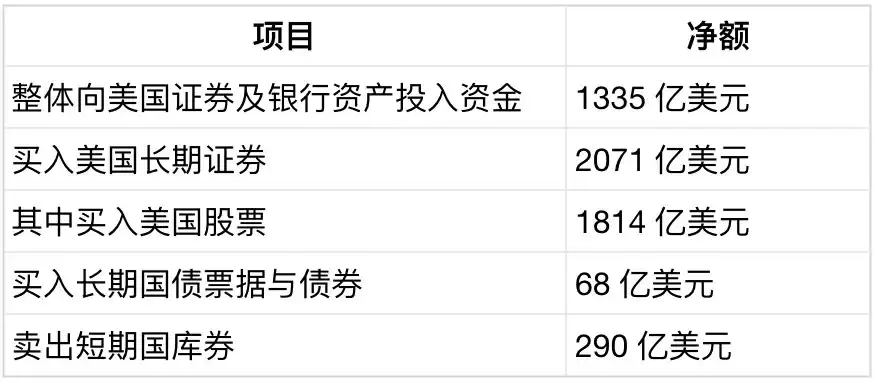
The $181.4 billion figure for stock investment is higher than the total inflow of $133.5 billion because the total is a net result after offsetting numerous inflows and outflows. The sell-off of Treasury bills and the outflow of $34.4 billion under bank balance sheet items offset some of the stock purchases; meanwhile, US residents also exported capital overseas by purchasing foreign securities.

Although the statistical logic is complex, the core message is clear: foreign investors continue to allocate to US assets, especially US corporate equity; but their appetite for government debt is weak, and they are withdrawing funds from short-term debt instruments.

Treasury bills are US government debt securities maturing in one year or less. Due to their quick principal repayment and high market liquidity, they are often seen as a close substitute for cash, favored by central banks, corporations, money market funds, and stablecoin issuers for allocation.

US short-term Treasury holdings by overseas institutions dropped from about $1.43 trillion in May to $1.40 trillion in June. The June reduction amounted to roughly 2% of the May holdings. This marks the second consecutive month of reduction: foreign investors sold $43.5 billion in May and $29 billion in June, totaling approximately $72.5 billion over two months.

Existing data cannot directly determine the reason behind the sell-off. It could be routine cash management or a shift in asset allocation to other categories. The aggregate data shows a differentiated approach by foreign capital towards the US market: buying stocks, reducing Treasury bill holdings, but still maintaining a net inflow of funds overall. Caution is also needed when interpreting the Treasury's country-by-country data table, as securities are recorded through custodian institutions, which can obscure the actual owner's country.

How Stablecoins Convert Dollar Demand into Treasury Bill Demand

A simple transaction illustrates the link between stablecoins and Treasury bills: a user pays $1 to an issuer and receives 1 dollar-pegged stablecoin. The issuer is obligated to redeem the token for $1, so it invests the reserve funds in assets that can be quickly liquidated. Short-term Treasury bills fit this need perfectly; few other assets can be converted to cash as efficiently.

Once the issuer purchases Treasury bills, the user's demand for digital dollars is indirectly transformed into demand for US government debt. Users don't need a securities account or access to the TreasuryDirect platform; the investment of reserve assets is handled entirely by the stablecoin company in the background.

The "Clarity for Payment Stablecoins Act" (often referenced as the "GENIUS Act" or similar proposals) formalizes this operational model, requiring regulated payment stablecoins to hold highly liquid reserves. Proposed rules released by the US Treasury on August 17th further refine the federal regulatory framework, listing cash, short-term US Treasuries, and related repurchase agreements as priority-approved reserve assets.

CryptoSlate previously analyzed that such legislation would provide a federal regulatory path for dollar tokens while delegating the design of reserve asset composition and access details to regulators.

Tether's scale exemplifies the size of major issuers. Its Q2 attestation report shows direct holdings of short-term Treasury bills worth $114.96 billion, plus an additional $25.62 billion in overnight and term reverse repurchase agreement positions. The $29 billion sold by foreign investors in June is roughly equivalent to one-quarter of Tether's direct Treasury bill holdings.

This comparison is for scale reference only; the TIC report data cannot prove that the bonds sold by foreign institutions were directly purchased by Tether or other issuers.

Circle, the issuer of USDC, also employs a similar reserve model. According to its reserve disclosure, the vast majority of USDC reserves are held in the Circle Reserve Fund, managed by BlackRock. This is a government money market fund that can allocate to cash, short-term Treasury bills, and overnight US Treasury repurchase products.

Although Tether and Circle have different reserve structures, both convert market demand for digital dollars into demand for US cash-like assets.

Stablecoins as the Potential Buyer the US Government Hopes For

It's easy to understand why the US government places high hopes on stablecoins. Overseas users can hold and transfer dollar stablecoins without personally buying Treasuries; meanwhile, stablecoin issuers invest reserve funds into Treasury bills or the repo market. Dollars can circulate into the hands of overseas users, and the resulting demand from reserves flows back into the US financial system.

However, this mechanism only generates new Treasury demand when the circulating supply of stablecoins expands, or when issuers reallocate reserves by replacing other assets. At the end of Q2, Tether's USDT circulation was $184.6 billion, an increase of only about $446 million from the end of Q1. DeFiLlama data shows that as of August 21, the total stablecoin market size was approximately $302.1 billion, down slightly by 0.14% over thirty days.

This data refutes a simple deduction: new token issuance did not absorb the $29 billion Treasury bill selling pressure; issuers merely made internal adjustments to existing reserves. Public data also provides no evidence that overseas holders directly sold bonds to stablecoin firms.

This mechanism also carries a reverse risk: when a large number of users redeem stablecoins, issuers must pay out cash, potentially leading to sales of Treasury bills or allowing bonds to mature. Stablecoins can become important buyers of US debt, but they themselves experience cycles of buying and selling.

The next TIC report, covering July data, will be released on September 16th. Two key metrics to watch: overseas holdings of short-term Treasury bills, and total stablecoin circulation. If overseas institutions reduce holdings for a third consecutive month while stablecoin supply remains stable, the demand gap for Treasuries will persist. If stablecoin circulation rises and issuers' disclosed Treasury holdings expand correspondingly, it would indicate this new class of buyers is increasing its participation. Due to the custody-based recording model, it's difficult to precisely match the two datasets.

In summary, foreign investors continued to allocate to US assets in June, but capital flooded into the stock market while reducing holdings of short-term government cash-like bonds. Stablecoin issuers, with holdings of hundreds of billions in US Treasuries, are already an undeniable force on the demand side for US debt. Tether's minimal Q2 growth was completely insufficient to explain June's large-scale sell-off.

In the arena of short-term US Treasuries where foreign demand is weakening, the US is building a regulatory framework for a new class of potentially massive buyers. The connection forged between the digital dollar and US government financing is precisely the core reason this $29 billion Treasury bill sell-off warrants attention.


Related Questions

QWhat does the June TIC report reveal about foreign investors' capital allocation in the U.S. financial markets?

AThe June TIC report reveals a distinct divergence in foreign capital allocation. Foreign investors had a net inflow of $133.5 billion overall. However, they heavily favored U.S. equities, purchasing $181.4 billion in stocks, while showing weak demand for government debt. They bought only $6.8 billion in long-term Treasury securities and were net sellers of short-term Treasury bills, offloading $29 billion worth.

QHow do stablecoin issuers like Tether and Circle generate demand for U.S. Treasury bills?

AStablecoin issuers generate demand for U.S. Treasury bills through their reserve management. When a user buys a dollar-pegged stablecoin, the issuer receives cash and has an obligation to redeem the token for $1. To back this promise with highly liquid assets, issuers allocate the reserve funds to short-term U.S. Treasury bills and similar instruments. Thus, the demand for digital dollars is indirectly converted into demand for U.S. government debt, as companies like Tether and Circle purchase these bills to hold as reserves.

QWhy does the article argue that increased stablecoin issuance did not explain the $29 billion sell-off in Treasury bills in June?

AThe article argues that increased stablecoin issuance did not explain the sell-off because data shows stablecoin supply was largely flat during that period. Specifically, Tether's USDT circulation increased by only about $446 million in Q2, and the total market capitalization of all stablecoins saw a minor decrease of 0.14% in the 30 days leading up to August 21st. Therefore, the scale of new token minting was far too small to account for or directly absorb the $29 billion in selling pressure from foreign investors.

QWhat potential role does the U.S. government see for stablecoins in its debt strategy, according to the article?

AAccording to the article, the U.S. government sees stablecoins as a potential new source of demand for its debt, particularly short-term Treasury bills. Legislation like the GENIUS Act and proposed Treasury rules aim to create a federal regulatory framework that mandates stablecoin reserves to be held in highly liquid assets like cash and short-term Treasuries. This mechanism could channel global demand for digital dollars back into the U.S. financial system as reserve purchases, potentially offsetting weaker demand from traditional foreign buyers.

QWhat are the two key data points to watch in the next TIC report (for July) to understand the dynamics between foreign investors and stablecoins?

AThe two key data points to watch in the next TIC report are: 1) The level of foreign holdings of short-term Treasury bills, to see if the selling trend continues for a third consecutive month. 2) The total circulating supply of stablecoins in the market. Comparing these will help assess whether a demand gap for Treasuries persists (if foreign selling continues and stablecoin supply is flat) or if a new class of buyers is stepping in (if stablecoin supply rises, suggesting issuers are likely increasing their Treasury holdings).

Related Reads

Grayscale Reassesses Zcash: In the Era of AI Surveillance, What is Financial Privacy Worth?

Grayscale Research reevaluates Zcash (ZEC) in the context of AI-powered financial surveillance. The report posits that stablecoins, transparent blockchains, and AI analytics tools are increasing the traceability of digital finance, potentially reigniting mainstream demand for financial privacy as a core monetary attribute. While AI could drive a third wave of privacy concern, Zcash's investment thesis hinges on whether this theoretical demand translates into sustained adoption. Zcash, operational for nearly a decade, uses zero-knowledge proofs to offer users a choice between transparent and shielded transactions, placing control of information disclosure back in users' hands. Recent infrastructure improvements—like wallet enhancements, mining pool expansions, and protocol upgrades—have reduced usability barriers. On-chain data shows shielded transactions comprise ~90% of transaction count, with ~25% of circulating ZEC in shielded pools, indicating existing use. However, significant risks remain. These include regulatory hurdles for exchanges and custodians dealing with shielded assets, past protocol vulnerabilities (theoretical, now patched), long-term quantum computing threats, and execution risks for future scalability upgrades. Grayscale's analysis suggests ZEC's current low market share (~0.6% of the "digital currency" crypto sector) offers valuation upside *if* the market reprices privacy. A scenario analysis notes that capturing 5% of this sector could imply a ~9x valuation increase, though this is a simplified sensitivity test, not a price target. Ultimately, Zcash's opportunity lies in the unresolved question: in an AI-monitored era, what price will the market assign to financial privacy? Validating the thesis requires monitoring growth in real shielded usage, wallet usability, upgrade timelines, and regulatory accessibility, not just price appreciation.

marsbit35m ago

Grayscale Reassesses Zcash: In the Era of AI Surveillance, What is Financial Privacy Worth?

marsbit35m ago

AI Democratizes Hacking, Bitcoin Red Team White Hats Race in Speed-Based Attack-Defense Contest

AI is democratizing powerful hacking tools, putting them in the hands of those with little cybersecurity expertise. Cryptocurrency developers are now in a race to find system vulnerabilities before attackers do. The Bitcoin Red Team, a group of 20-25 volunteers including anonymous developers like Calle, has formed to urgently address these AI-augmented security threats within the Bitcoin ecosystem. Calle emphasizes that while the Bitcoin core protocol itself is secure, the real risk lies in the wallets, applications, services, and other third-party software built on top of it—the software most users interact with. Incidents like the Coldcard wallet hack and the emergence of powerful Chinese AI models have accelerated their proactive security auditing efforts. The team both accepts audit requests from Bitcoin projects and proactively scans major open-source projects. They report found vulnerabilities to developers and refine their classification standards. Notably, Calle states the team frequently uses Chinese AI models over US counterparts, as the latter's strict safety guardrails often block cybersecurity research tasks, hindering their utility for finding or fixing vulnerabilities. Calle warns that AI is erasing the information asymmetry that previously protected some vulnerabilities. It lowers the technical barrier, allowing non-experts to exploit simple flaws. He describes the current state of Bitcoin software as "on fire" and believes the direct financial incentive of cryptocurrency makes it a first target in this industry-wide shift, with other sectors to follow. The era of security through obscurity is over.

marsbit56m ago

AI Democratizes Hacking, Bitcoin Red Team White Hats Race in Speed-Based Attack-Defense Contest

marsbit56m ago

Trading

Spot
活动图片