# Automotive Related Articles

HTX News Center provides the latest articles and in-depth analysis on "Automotive", covering market trends, project updates, tech developments, and regulatory policies in the crypto industry.

Analog Chips Are Picking Up

The analog chip market is showing signs of recovery, as evidenced by strong Q2 2026 earnings and guidance from major players like TI, STMicroelectronics, NXP, and onsemi. Revenue growth, improved order backlogs, and declining inventory levels across the supply chain indicate the start of a new upward cycle. Industrial markets led the recovery, followed by data centers and a notable pickup in automotive demand in Q2. The rebound is broad-based but uneven, with specific product areas like automotive analog, power management, and AI server power chains seeing tighter supply and pricing power, while consumer-focused and general-purpose segments remain competitive. A critical turning point is the normalization of inventory. After a prolonged multi-level destocking phase from OEMs to end customers, channel inventories have returned to healthy levels (e.g., NXP at 11 weeks). This has triggered restocking, particularly in automotive, and is now being supplemented by genuine end-demand from new system designs. AI is emerging as a key growth driver, creating new demand in two areas: 1) high-power data center infrastructure (power conversion, thermal management, signal integrity for GPUs, and optical modules) and 2) "Physical AI" in automotive, robotics, and industrial equipment (sensors, motor drivers, power management). This provides a growth vector less dependent on traditional consumer cycles. While some price increase notices have been issued, the revenue impact in Q3 is expected to be minimal, with volume driving growth. The recovery's sustainability will depend on the strength of underlying end-demand now taking over from inventory replenishment.

marsbit11h ago

Analog Chips Are Picking Up

marsbit11h ago

Global Market Share Survey: Japanese Firms Lead in Semiconductor Materials

Global Market Share Survey: Japanese Firms Lead in Semiconductor Materials According to the 2025 "Major Goods and Services Market Share Survey" by Nikkei, Japanese companies maintain strong positions in semiconductor-related materials. In silicon wafers, Shin-Etsu Chemical ranks first with a 26.3% share, followed by SUMCO at 17.8%. Together, they hold 44.1% of the market, widening their lead over competitors from Taiwan, Germany, and South Korea. In photoresists, Tokyo Ohka Kogyo, JSR, and Shin-Etsu Chemical occupy the top three spots, with a combined share of 60.5%. Despite their strength in materials, Japanese firms have a weaker presence in core semiconductor segments like DRAM and NAND flash memory, where South Korean and U.S. companies dominate. For instance, SK Hynix and Samsung lead in DRAM, while China’s CXMT doubled its share to 6% in 2025. The semiconductor market is projected to grow rapidly, with WSTS forecasting a 90% increase to $1.5112 trillion by 2026. Major players like Samsung, SK Hynix, and Micron are making massive investments to expand capacity. To maintain their edge in materials, Japanese companies must similarly commit to large-scale, risk-taking investments. In contrast, Japan’s automotive sector shows stagnation. Toyota remains the global leader but with only a slight share increase to 12.3%, while Japanese brands are absent from the top five in the EV market. In shipbuilding, Imabari Shipbuilding rose to third place globally with a 7.2% share, benefiting from large container ship deliveries. However, Chinese and South Korean firms dominate the sector, holding the top two positions. Japan aims to revitalize its shipbuilding industry through government and corporate efforts, targeting a near doubling of output by 2035. Addressing labor shortages and adopting advanced technologies like physical AI will be critical for competitiveness.

marsbit07/31 04:21

Global Market Share Survey: Japanese Firms Lead in Semiconductor Materials

marsbit07/31 04:21

September 1st, A Major Chip Price Hike

On July 29, 2026 (US time), Qualcomm reported its Q3 FY2026 (Q2 CY) results. Revenue reached $9.95 billion, up 4% and beating estimates, but net profit fell 25% YoY to $2 billion. The "revenue up, profit down" trend is attributed to rising costs across semiconductor manufacturing, testing, packaging, and materials. In response, CEO Cristiano Amon announced price increases for all chip products, effective September 1, to pass on costs and restore historical profit margins. The stock fell over 5% in after-hours trading due to weaker-than-expected Q4 profit guidance. Qualcomm's core chip business (QCT) revenue was $8.5 billion, down 5% YoY. Handset revenue dropped 20% to $5.09 billion, reflecting a weak global smartphone market with declining shipments. In contrast, Automotive revenue surged 61% to $1.59 billion, marking 23 consecutive quarters of double-digit growth, and IoT revenue grew 9% to $1.83 billion. The licensing division (QTL) revenue was $1.28 billion, down 3%. Facing smartphone headwinds and a reduced component share in future iPhones, Qualcomm is aggressively diversifying. It is betting heavily on the data center AI market, maintaining a target of $5 billion in data center revenue for FY2027. The company completed the acquisition of AI software firm Modular to build an open software platform for generative AI. For Q4 FY2026, Qualcomm forecasts revenue between $9.7B and $10.5B, roughly in line with expectations. However, non-GAAP EPS guidance of $2.05-$2.25 fell short of the $2.36 analyst consensus. Management expects the chip price increases to gradually improve margins after September 1, but near-term profitability pressure from costs and the weak handset market persists.

marsbit07/30 08:11

September 1st, A Major Chip Price Hike

marsbit07/30 08:11

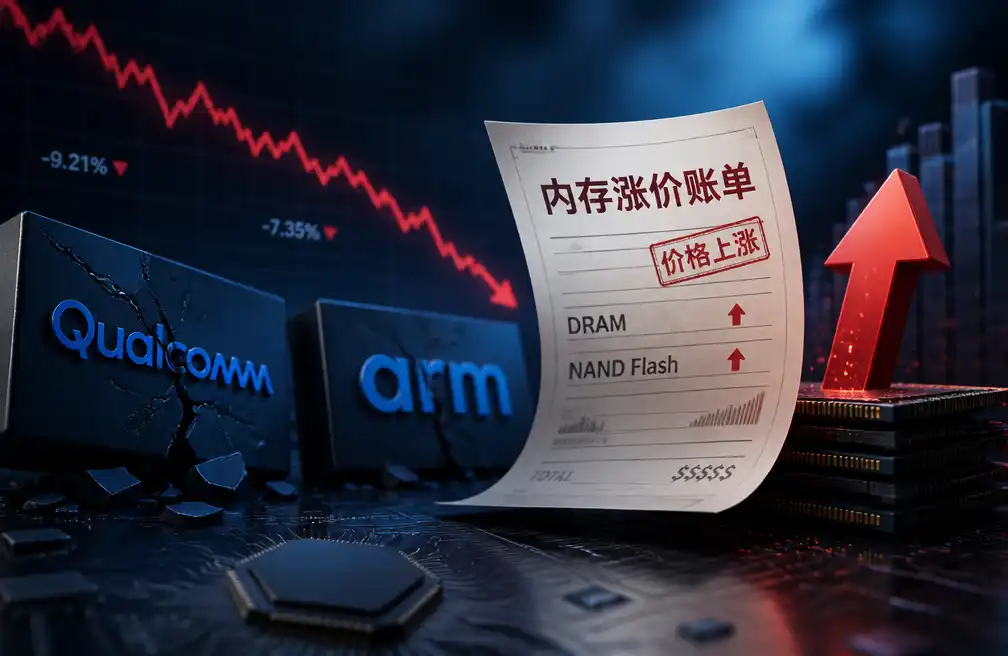
Qualcomm and Arm Fall Together: The Bill for Memory Price Hikes Finally Arrives at Mobile Chip Companies

After posting Q2 FY2026 results, Qualcomm and Arm both saw their shares decline, reflecting the impact of memory price increases on the smartphone chip sector. Qualcomm's revenue of $9.95B slightly beat expectations, but EPS of $2.21 fell short. More concerning was its guidance for next quarter, with EPS projections below analyst estimates. The company directly attributed a >$1.50 per share annual EPS headwind to rising memory costs and supply constraints in Android phones, prompting planned price hikes. While automotive revenue grew 61% and is approaching one-third of phone revenue, the mobile segment declined 20%. Qualcomm also confirmed a significant reduction in its modem share for the upcoming iPhone and outlined a plan for data center revenue to replace all Apple-related income by FY2027. Arm's results surpassed expectations with revenue of $1.29B and EPS of $0.45, and its guidance was also strong. However, its stock fell. Key concerns included royalty revenue failing to set a new record and a downward revision to full-year royalty growth guidance from ~20% to the high-teens, citing weak smartphone demand and high memory prices. Despite robust growth in its data center business, Arm's premium valuation (over 100x forward P/E) means even beating expectations isn't enough to push the stock higher, as any sign of uncertainty is magnified. Ongoing global antitrust investigations add another risk factor. The situation highlights a broader shift. Memory price surges, which boosted Samsung's profits, are now pressuring chip designers. Meanwhile, the semiconductor sector saw significant corrections in July, with the hardest-hit stocks often being those with the biggest AI-driven gains year-to-date. Qualcomm, lacking such a premium, was an exception.

marsbit07/30 02:41

Qualcomm and Arm Fall Together: The Bill for Memory Price Hikes Finally Arrives at Mobile Chip Companies

marsbit07/30 02:41

Qingyan Jingzhun Raises Hundreds of Millions in Funding, with Investment from National Equipment Manufacturing Giants

Qingyan Precision, a provider of physical AI infrastructure, has secured billions of RMB in Series B financing. The investment round, led by prominent automotive industry funds and notably featuring the state-owned China National Machinery Industry Corp. (Sinomach) fund, underscores a strategic shift in the capital market towards companies with proven industrial application capabilities. The company positions itself as the "engineering foundation for physical AI," specializing in enabling embodied intelligence (like humanoid robots) to operate in complex, real-world industrial environments. Its core offering is the "TsingLoop" multi-modal data engineering pipeline, which captures and standardizes data from physical workspaces (like visual, force, and process parameters) to create reusable data assets. This system supports a "Robot-in-the-Loop" testing framework that validates robotic performance in digital twin simulations and real-world conditions before deployment. Qingyan Precision leverages over eight years of experience and a network of 2000+ industrial sensor nodes across sectors like automotive and mining. This provides a crucial "training ground" for embodied AI models. The founding team combines academic pedigree from Tsinghua University and Stanford with deep industry experience from leading robotics firms. The company's vision is to build "one foundation, one brain, and hundreds of vertical applications," using its data platform and industrial world model to deploy scalable physical intelligence across various industrial tasks.

marsbit07/13 04:30

Qingyan Jingzhun Raises Hundreds of Millions in Funding, with Investment from National Equipment Manufacturing Giants

marsbit07/13 04:30

$10 Billion, Qualcomm to Acquire Chip Legend Jim Keller's Company

Global mobile chip giant Qualcomm is in advanced talks to acquire AI chip startup Tenstorrent in a deal valued between $8-10 billion, according to media reports. This potential acquisition would be one of the largest in the AI chip sector in recent years. Tenstorrent, led by legendary chip architect Jim Keller, has gained prominence for its RISC-V architecture and AI accelerator designs. The move highlights Qualcomm's strategic push to diversify beyond its core smartphone chip business. As the smartphone market matures, Qualcomm is aggressively targeting growth in automotive, data center, and cloud AI. Acquiring Tenstorrent would allow Qualcomm to rapidly enter the high-end AI computing market, bypassing lengthy in-house development cycles. Tenstorrent's cost-effective system architecture, which avoids expensive HBM memory and relies on standard Ethernet for clustering, offers a potential alternative to Nvidia's costly solutions. Furthermore, Tenstorrent's high-performance RISC-V CPU technology and its focus on the automotive and edge computing segments align with Qualcomm's strategic goals, including its "Snapdragon Digital Chassis" platform. Despite the strategic rationale, the high valuation has sparked some investor caution. The successful integration of Tenstorrent's open-source culture and independent team into Qualcomm's organization, along with the commercialization of its technology, remains a key challenge.

marsbit06/18 11:16

$10 Billion, Qualcomm to Acquire Chip Legend Jim Keller's Company

marsbit06/18 11:16

9:01 Kr | 7 Third-Party Platforms Involved in Train Ticket Sales Summoned for Talks; 4.5 Seconds for 5 Million, Zhang Xue's Live Auction of Championship Replica Racing Car Sells 'At Light Speed'; Amazon Denies Rumors of Laying Off 14,000 Employees in May

Chinese authorities have summoned seven third-party train ticket booking platforms, including Ctrip and Meituan, for disruptive practices against the official 12306 system. In a live stream auction, Zhangxue Motorcycle sold a championship replica race car for 5 million yuan in 45 seconds, with proceeds to be donated. Amazon denied rumors of planning to lay off 14,000 employees in May. Key developments include a national AI education action plan, Hong Kong's strict e-cigarette ban effective April 30, and a $352 million fine for accounting firm Zhongxingcai Guanghua. Samsung is reportedly restructuring its China operations, while Tesla denied producing a new compact SUV. OpenAI faces executive departures in its data center strategy, and Huawei previewed upcoming AI glasses. Financial results showed TSMC's Q1 revenue grew 35% YoY, while Porsche's China sales dropped 21%. Anthropic secured AI computing power from CoreWeave, and MiniMax launched a new music generation model. Several Chinese tech companies, including Shengshu Tech and Opensource China, completed significant funding rounds. Nio unveiled its ES9 premium SUV with starting price of 528,000 yuan, and XPeng partnered with Fuyao on AI dimming glass technology.

marsbit04/11 01:08

9:01 Kr | 7 Third-Party Platforms Involved in Train Ticket Sales Summoned for Talks; 4.5 Seconds for 5 Million, Zhang Xue's Live Auction of Championship Replica Racing Car Sells 'At Light Speed'; Amazon Denies Rumors of Laying Off 14,000 Employees in May

marsbit04/11 01:08

活动图片